Quick Info
At a glance
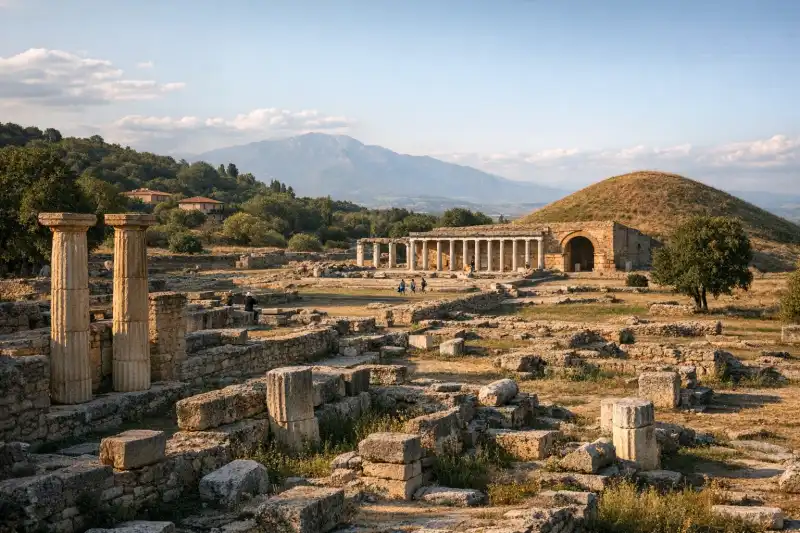
Vergina (Aigai) in Greece is one of those rare archaeological places where history feels startlingly close. Tucked into the plains of northern Greece below the Pierian Mountains, the site does not overwhelm at first with massive standing ruins. Instead, it reveals its power gradually: through the burial mounds, the excavated palace, the theater, and above all the remarkable museum built around the royal tombs. Here, in what was once Aigai, the first capital of the Macedonian kingdom, the political and dynastic story that shaped the age of Philip II and Alexander the Great takes on physical form.
For many visitors, the name Vergina is inseparable from one of archaeology’s most celebrated discoveries: the unlooted royal tombs found in the 20th century beneath the Great Tumulus. Gold wreaths, weapons, ivory portraits, painted facades, and refined metalwork transformed scholarly understanding of ancient Macedonia. Yet Aigai is more than a single sensational burial. It was a living royal center, a ceremonial heart of the Macedonian state, and a place where kings were buried, dynastic rituals were performed, and power was staged before the wider Greek world.
Today, a visit combines quiet rural scenery with an encounter of enormous historical weight. The modern village of Vergina sits close to the ancient remains, and the museum experience is unusually moving, preserving the tombs in low light beneath the reconstructed mound. Whether you arrive from Thessaloniki, Veria, or elsewhere in Central Macedonia, Vergina offers a vivid, essential chapter in the story of ancient Greece.
History
Early Aigai and the rise of the Macedonian kingdom
Aigai emerged as an important settlement in lower Macedonia during the early first millennium BCE and became the dynastic seat of the Argead kings. Ancient literary tradition connected the city with the foundation myths of the Macedonian royal house, giving it a status that was political, ancestral, and sacred at once. Even after later capitals gained prominence, Aigai remained deeply symbolic because it housed royal palaces, sanctuaries, and burial grounds. In effect, it was the place where Macedonian kings anchored their legitimacy.
During the Archaic and Classical periods, Macedonia was still developing into the major power it would later become. The kingdom stood at the edge of the Greek world in the eyes of many southern Greeks, but it was increasingly integrated through trade, warfare, diplomacy, and cultural exchange. Aigai reflected this dynamic. Archaeology shows a courtly center with monumental ambitions and access to fine craftsmanship. Elite burials reveal wealth and connections, while the built environment points to an evolving monarchy capable of commanding labor and projecting prestige.
Philip II and the transformation of Macedonia
The 4th century BCE was the defining age of Aigai. Philip II, who ruled from 359 to 336 BCE, transformed Macedonia from a vulnerable kingdom into the dominant military force in Greece. He reorganized the army, expanded territory, subdued rivals, and defeated the combined forces of Athens and Thebes at the Battle of Chaeronea in 338 BCE. Under his rule, Macedonia moved from regional power to hegemon.
Aigai played a major ceremonial role in this rise. Although Pella became the main administrative capital, Aigai remained the royal heartland, where the dynasty maintained its ancestral tombs and public rituals. Philip undertook ambitious building works there, including an enormous palace complex that ranks among the most important monuments of classical Greece. The palace was not merely a residence; it was a setting for banquets, receptions, governance, and the performance of kingship.
Aigai was also the scene of one of antiquity’s most consequential assassinations. In 336 BCE, Philip II was murdered in the theater at Aigai during celebrations connected with the marriage of his daughter Cleopatra. His death brought Alexander III, later known as Alexander the Great, to the throne. The event linked Aigai forever to the turning point between Philip’s consolidation of power and Alexander’s vast conquests.
Alexander, the Hellenistic age, and changing fortunes
After Alexander launched his campaigns into Asia, Aigai retained its royal and ceremonial significance even as the Macedonian world expanded dramatically. Kings continued to honor the city’s ancestral role, and royal burials there reinforced continuity with the Argead past. The tombs from this broader period preserve evidence of elite culture at an astonishing level, from painted decoration to sumptuous grave goods.
In the Hellenistic age, however, political and economic priorities shifted. Other cities became more prominent in administration and trade, and the balance of power across the eastern Mediterranean changed repeatedly. Aigai still mattered, but increasingly as a dynastic and symbolic site rather than the beating center of policy. Yet symbols were never trivial in the ancient world, especially in monarchies built on lineage and legitimacy.
The city suffered destruction in the 2nd century BCE after the Roman defeat of the Macedonian kingdom. Although occupation and use of the area continued in altered forms, the old royal capital declined. Over time, many of its structures fell into ruin, and the burials disappeared beneath the earth.
Rediscovery and modern archaeology
Modern recognition of Vergina’s true importance culminated in the excavations led by Manolis Andronikos in 1977. Beneath the Great Tumulus, archaeologists uncovered richly furnished royal tombs that had escaped looting. The find electrified the scholarly world. One of the principal tombs, based on a combination of evidence including date, status, and contents, has often been identified as that of Philip II, though aspects of the debate have continued.
What is beyond dispute is the exceptional quality of the discovery. The tombs preserved gold larnakes, armor, textiles, painted walls, ceremonial objects, and human remains that opened a new window onto Macedonian royalty. Since then, continued excavation and conservation have expanded the known site to include the palace, theater, necropolis, and urban remains. In 1996, the archaeological site of Aigai was inscribed on the UNESCO World Heritage List, recognizing its outstanding significance in the history of Europe and the ancient Mediterranean.
Key Features
The emotional center of Vergina is the Museum of the Royal Tombs, one of the most distinctive archaeological museums in Greece. Rather than removing the funerary context entirely, the museum shelters the tombs beneath the recreated Great Tumulus, preserving a sense of descent into a royal burial landscape. Inside, the lighting is subdued and carefully controlled. The effect is deliberate: visitors move through a darkened interior where the illuminated facades of the tombs emerge with almost theatrical force. This setting helps convey that these are not generic artifacts in cases but the remains of a dynastic world.
The most famous structure inside is Tomb II, usually associated with Philip II. Its painted facade, monumental form, and lavish grave goods have made it central to both public imagination and scholarly discussion. The finds linked with this burial include a gold larnax decorated with the Macedonian star, armor, weaponry, and a splendid golden wreath. Nearby, other tombs and burials broaden the picture, showing that the mound protected not a single grave but an elite funerary complex. Together they reveal a court culture of ceremony, martial identity, artistry, and wealth.
Equally compelling are the painted decorations, among the finest survivals of ancient Greek painting. Wall paintings from the tombs offer precious evidence for a medium that is otherwise poorly preserved. Their themes and style illuminate elite values and the sophistication of Macedonian art in the late Classical period. For many visitors, these paintings are among the site’s greatest treasures because they bridge the gap between abstract history and lived visual culture.
Beyond the tumulus, the palace of Aigai is essential for understanding the scale of the city’s former grandeur. This was no provincial residence. Set prominently in the landscape, the palace covered a large area and included courtyards, banquet spaces, and ceremonial zones that speak to both practical governance and royal display. Even in ruin, and even after periods of restoration and presentation work, the complex communicates ambition. Scholars have emphasized its importance for the study of architecture, kingship, and public ritual in the Macedonian world. Walking through its remains, you begin to appreciate Aigai not just as a necropolis but as an active center of rule.
Close by lies the theater, inseparable from the story of Philip II’s assassination. Although less visually dramatic than the tomb museum, it carries immense historical resonance. To stand near the place where one of antiquity’s pivotal political murders occurred is to feel how tightly this landscape is bound to world history. Here the fate of Macedonia changed in a moment, and with it the future of Greece, Persia, Egypt, and much of the known world through Alexander’s campaigns.
The wider archaeological zone includes parts of the ancient city and extensive burial grounds. These elements are important because they place the famous royal finds within a broader social and urban setting. Aigai was not composed solely of kings; it had craftspeople, attendants, officials, and communities tied to the court. The surrounding land, still agricultural and open, helps preserve that sense of a settlement integrated into the plains of Macedonia.
What makes Vergina especially rewarding is the balance between spectacle and interpretation. Some ancient sites impress through massive surviving architecture, while others excel through museum collections detached from place. Aigai does both in a connected way. The tombs remain where they were built. The palace still overlooks the region it once dominated. The theater still marks the site of a historical turning point. The result is a destination that rewards careful attention and lingers in memory long after more overtly monumental places fade.
Getting There
Vergina (Aigai) is easiest to reach from Thessaloniki or Veria in northern Greece. From Thessaloniki, the drive typically takes about 1 to 1.5 hours, depending on traffic and your exact starting point. A rental car is the most practical choice because it lets you combine the royal tombs, palace, and nearby museums at your own pace. Daily rental rates in Thessaloniki often start around €35 to €60 for a basic car, with fuel costs adding roughly €15 to €25 for the round trip depending on season and vehicle.
If you prefer not to drive, organized day tours from Thessaloniki are widely available and usually cost about €45 to €90 per person, often depending on group size, guiding, and whether other Macedonian sites are included. This is the most convenient option for travelers who want transport and historical context without navigating rural connections.
Public transport is possible but less straightforward. Intercity buses from Thessaloniki to Veria generally cost around €8 to €12 one way. From Veria, you may need a local bus, taxi, or prearranged transfer to reach Vergina itself. A taxi from Veria to Vergina often costs roughly €15 to €25 each way. If you are already staying in Veria, this becomes a much easier and cheaper excursion.
Parking near the archaeological area is usually manageable for self-drivers. Because the museum is the main draw, many visitors begin there and then continue to the palace remains. Check current opening hours before setting out, as museum and archaeological schedules in Greece can vary by season and public holiday.
When to Visit
Spring and autumn are the best times to visit Vergina. From April to early June and from September to October, temperatures are usually mild, the surrounding countryside is green or golden, and the site is comfortable for walking. These months also offer a good balance between pleasant weather and manageable visitor numbers. For many travelers, this is the ideal season to pair Vergina with Thessaloniki, Veria, or other destinations in northern Greece.
Summer, especially July and August, brings heat that can make exposed archaeological areas tiring in the middle of the day. The museum inside the tumulus is more sheltered and easier to enjoy even in hot weather, but the palace and outdoor remains are best seen early in the morning or later in the afternoon. If you visit in summer, bring water, a hat, and sun protection, and allow time for a slower pace between sections of the site.
Winter has advantages too. Crowds are thinner, the atmosphere can feel more contemplative, and museum visits are often especially rewarding when the weather is cool. However, daylight hours are shorter, and overcast or rainy conditions may make the open areas less appealing. Winter is a good choice for travelers focused primarily on the royal tomb museum rather than long outdoor exploration.
If your interests are photography and atmosphere, aim for shoulder season days with clear skies and softer light. If your priority is historical concentration rather than scenery, any season can work well because the museum experience is the highlight and remains compelling year-round. The key is simply to match your timing to your tolerance for heat and your broader route through northern Greece.
| Quick Facts | Details |
|---|---|
| Ancient name | Aigai |
| Modern location | Vergina, near Veria, Central Macedonia, Greece |
| Best known for | Royal Macedonian tombs and palace remains |
| Historical significance | First capital of the Macedonian kingdom |
| Famous figure connected to site | Philip II of Macedon |
| UNESCO status | UNESCO World Heritage Site |
| Typical visit length | 2–4 hours |
| Nearest major city | Thessaloniki |
| Best season | Spring and autumn |
| Main highlights | Royal Tombs Museum, palace, theater, necropolis |
Vergina stands apart among ancient destinations because it offers not only artifacts of extraordinary beauty but also a direct encounter with the setting of Macedonian royal power. The site ties together dynasty, ritual, art, and political transformation in a way few places can match. For anyone interested in the world of Philip II, the rise of Macedonia, or the background to Alexander the Great’s era, Aigai is not a detour. It is one of the key places where that history can still be felt in the ground beneath your feet.
Guided tours: worth it?
You can visit Vergina (Aigai) independently, but a guide can help connect the most important objects to the wider ancient landscape instead of turning the visit into a long label-reading session.
Best for
- Trips where tickets, circuits, or timed entry can shape the day
- Museum-plus-site days where the collection needs context
- Short visits where a planned route saves time
When to go self-guided
Go independently if you prefer setting your own pace, reading as you go, and checking official hours or ticket rules directly before you arrive.
What I’d avoid
Skip paid tours that bundle unrelated stops you do not actually want. The best option should either save meaningful planning time or add historical context you would miss on your own.
Vergina Aigai day tours
Useful when: you want to compare guided formats before deciding
Vergina royal tombs tours
Useful when: you want to compare guided formats before deciding
Thessaloniki to Vergina tours
Useful when: you want to compare guided formats before deciding
Some tour links are affiliate links, which may earn Ancient Travel a small commission at no extra cost to you. I try to surface options that make practical sense for the site—not just anything bookable.
Frequently Asked Questions
What is Vergina (Aigai) famous for?
Vergina, ancient Aigai, is famous as the first capital of the Macedonian kingdom and for the richly furnished royal tombs discovered there, including a tomb widely identified as that of Philip II, father of Alexander the Great.
Is Vergina worth visiting from Thessaloniki?
Yes. Vergina is one of the most important archaeological sites in Greece and makes an excellent day trip from Thessaloniki thanks to its royal tomb museum, palace remains, and strong connection to Macedonian history.
How long do you need at Vergina?
Most visitors need between two and four hours to see the Museum of the Royal Tombs, the palace area, and the surrounding archaeological remains without rushing.
Can you visit the tomb of Philip II?
Visitors cannot enter the burial chamber itself, but the tumulus museum is built around the royal tombs, allowing you to see the tomb facades, grave goods, and interpretive displays in a protected setting.
What is the best way to get to Vergina?
The easiest option is usually a rental car or organized tour from Thessaloniki. Buses can be used in combination with nearby towns, but public transport is less convenient than driving.
When is the best time to visit Vergina (Aigai)?
Spring and autumn are the most comfortable seasons, with mild temperatures and fewer crowds. Summer is workable if you start early and focus on the shaded museum during the hottest hours.
Nearby Ancient Sites
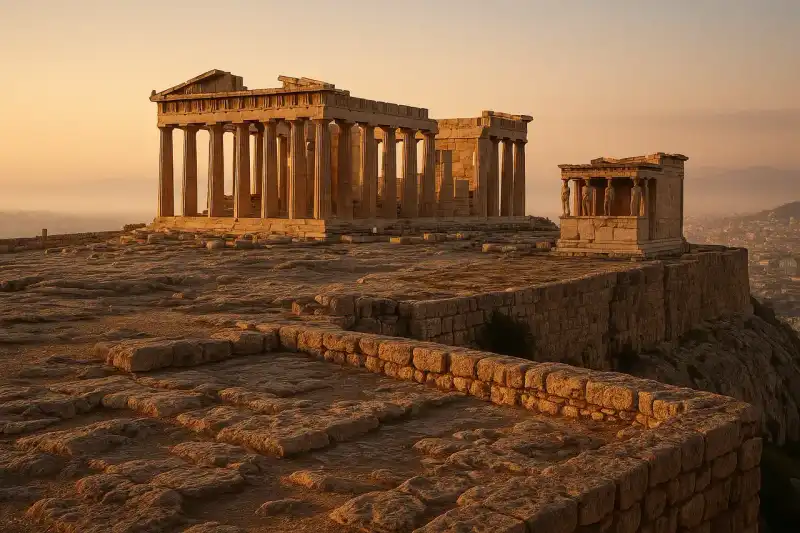
Acropolis Travel Guide 2026: Parthenon, Tickets, and Best Time
Ancient GreecePlan an efficient Acropolis visit with practical ticket timing, key monuments, and museum pairing ti...
The Complete Acropolis Athens Travel Guide: Temples
Ancient GreecePlan the perfect visit to the Acropolis of Athens with our 2026 guide. Discover the Parthenon, best ...
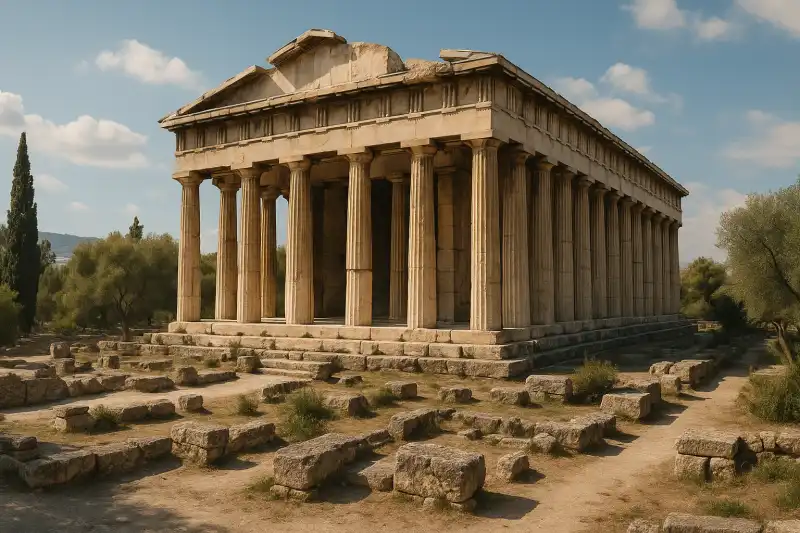
Ancient Agora of Athens Travel Guide 2026: Route, Tickets, and Context
Classical GreekPlan a better Ancient Agora visit with practical timing, monument priorities, and clear historical c...