Quick Info
Curated Experiences
Ayutthaya Historical Park Small-Group Day Tour from Bangkok
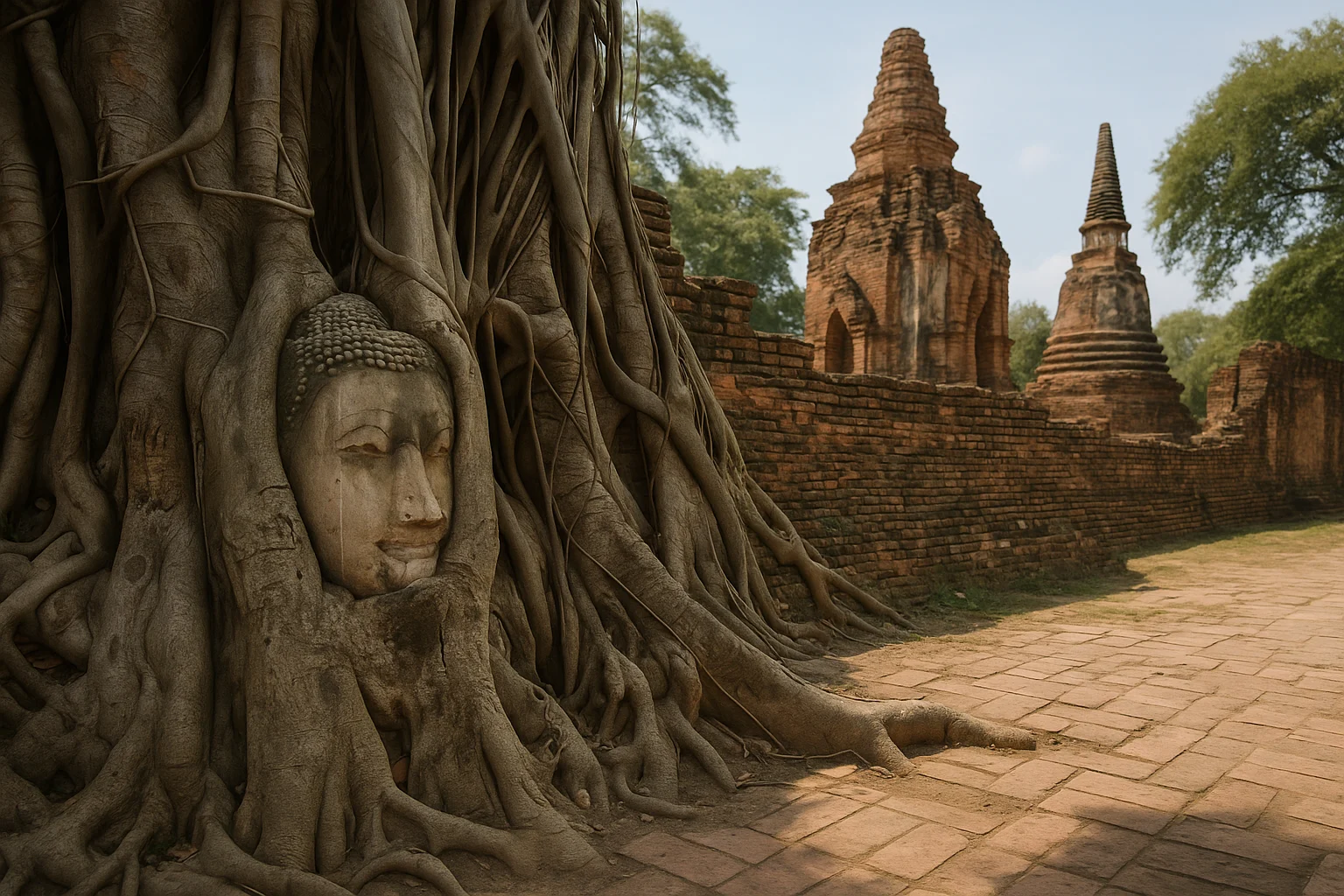
A sandstone Buddha head sits cradled in the roots of a bodhi tree, its face composed and faintly smiling as the tree slowly absorbs it. The roots have grown around the stone over decades, not gripping it so much as receiving it, and the combined image — serene carved features emerging from living wood, human craft and natural force intertwined — has become the single most recognized photograph in all of Thai archaeological tourism. Visitors come to Wat Mahathat for that image. They should stay for the rest.
Behind the Buddha head stretches one of the most emotionally direct ruin sites in Southeast Asia. Rows of headless Buddha statues line crumbling galleries. The collapsed base of what was once one of the tallest prangs in the kingdom rises from weeds and broken brick. Boundary walls that once enclosed the most important religious institution in a nation of temples now barely reach waist height. This was the spiritual nucleus of the Ayutthaya Kingdom — the monastery where the supreme patriarch resided, where royal ceremonies bound religious authority to political power — and the Burmese armies that destroyed Ayutthaya in 1767 understood exactly what they were targeting when they came here first.
The tree-root Buddha head is the draw. But the headless rows, the collapsed prang, and the scope of deliberate destruction are what give Wat Mahathat its cumulative gravity and make it the essential first stop on any Ayutthaya itinerary.
Historical Context
Wat Mahathat was established around 1374 CE during the reign of Borommaracha I, though some sources suggest the initial foundations date to an even earlier period. The complex grew substantially under subsequent kings, particularly Borommaracha II in the early 15th century, who expanded the monastery and raised the central prang to its full height. At its peak the Khmer-style tower likely rose over 40 meters, a dominant feature of the flat island skyline visible from the river approaches that brought traders and diplomats to the capital.
The temple’s layout reflects the blend of Khmer and Sukhothai architectural traditions that defined Ayutthaya’s built environment. The central prang drew from the Khmer tradition of tower sanctuaries, while the surrounding viharas and ordination halls followed patterns established at Sukhothai to the north. Ayutthaya’s kings claimed inheritance from both traditions and used architecture to make that dual lineage visible. The position of Wat Mahathat was itself a statement: fixed between the Grand Palace and the main waterways, it occupied the precise geographical center of political and religious power.
As the seat of the Sangharaja, the supreme patriarch of Thai Buddhism, Wat Mahathat was the kingdom’s most important religious institution for nearly four centuries. The monastery trained monks who served across the realm, conducted the ceremonies that legitimized royal succession, and maintained the doctrinal infrastructure of Theravada Buddhism for a kingdom that at its height controlled much of mainland Southeast Asia and maintained diplomatic relations with Persia, China, Japan, and the courts of Europe.
The Burmese siege of 1767 ended Ayutthaya as a functioning capital. Wat Mahathat was systematically looted. Buddha images were decapitated — partly to search for gold concealed inside, partly as an act of deliberate symbolic erasure aimed at the spiritual foundations of the kingdom itself. The central prang collapsed, likely undermined by fire and the removal of structural elements. The site was abandoned as the surviving court relocated south to what would become Bangkok.
The tree-root Buddha head was almost certainly displaced during the destruction — knocked from its body and left on the ground where a bodhi tree gradually grew around it over the following decades. It was not placed there by design, which is precisely what gives it resonance: nature slowly reclaiming what violence tried to destroy.
What to See
The Tree-Root Buddha Head
The image draws most visitors, and it rewards more than the quick photograph that most people take. Etiquette requires you to crouch or kneel so your head remains below the level of the Buddha’s face — guards enforce this, and it is both a sign of respect and a practical constraint for photography. Early morning light filtering through the surrounding canopy produces the best conditions for seeing the detail of how the roots have shaped themselves around the stone. The interplay between carved features and living wood is more striking in person than any photograph captures. Spend a few minutes watching before reaching for a camera. Do not touch the tree or the stone.
The Collapsed Central Prang
The base of the main tower still conveys the scale of what stood here. Walk the full perimeter to read the layers of brick, laterite, and stucco construction. Several partial stairways remain, giving a sense of the vertical ambition of the original structure. The Khmer-influenced profile is visible in the proportions even in ruin — the same architectural DNA that produced the towers of Angkor, adapted for Thai purposes. Interpretive signage is minimal throughout the site, so a guide or pre-visit reading adds context that the ruins alone do not narrate.
Rows of Headless Buddhas
The ordination hall and surrounding galleries hold dozens of seated and standing Buddha statues, nearly all missing their heads. The effect is sobering rather than decorative. These rows are the most direct physical evidence of the 1767 destruction, and they give Wat Mahathat a different emotional register than most Thai temple visits. The sheer repetition — row after row of identical poses, each one damaged in the same deliberate way — makes the scale of the destruction impossible to aestheticize. Some heads were removed to search for hidden gold; others were taken as trophies or sold to collectors. The headless bodies that remain are a collective portrait of what targeted cultural violence looks like.
The Outer Grounds and Boundary Walls
Most visitors concentrate on the central area and miss the quieter outer sections, where partial chedis and crumbling boundary walls offer a sense of the complex’s original footprint. These edges are less photogenic but more atmospheric, especially in early morning when the light is low and foot traffic has not yet arrived. The transition from manicured central ruins to overgrown perimeter — where trees push through brick and grass covers what were once meditation walkways — provides the most complete sense of the reclamation that time has performed here.
Reading the Layout
Stand at the center of the compound and orient yourself. The Grand Palace sat to the west. The river approaches ran along the east and south. Wat Mahathat occupied the intersection, the precise point where political power met religious authority. Understanding this spatial logic transforms the site from a collection of ruined buildings into a statement about how cities are organized around their highest values. Ayutthaya organized itself around this monastery, and the Burmese understood that destroying it would unmake the city’s symbolic center.
Timing and Seasons
November through February delivers the most comfortable conditions, with temperatures of 77 to 90°F (25 to 32°C) and low humidity. This is Thailand’s cool season and the peak tourist window. March through May brings extreme heat with midday temperatures regularly exceeding 100°F (38°C) — the central ruin area has minimal shade, and sustained exposure is genuinely risky. The wet season from June through October brings afternoon downpours that can make uneven brick surfaces slippery, but mornings are often clear and crowds thin considerably.
Arrive when the site opens at 8:00 AM. The first hour offers soft light, manageable temperatures, and thin crowds around the Buddha head. By 10:00 AM, day-tour buses from Bangkok begin arriving in waves, and the central areas become congested through early afternoon. Late afternoon after 4:00 PM offers a second window with warm golden light on the brick, particularly effective for photographing the headless Buddha rows and the prang base.
Tickets, Logistics and Getting There
Entrance fee is 50 baht (approximately $1.40 USD) for foreign visitors. The Ayutthaya Historical Park combination ticket at 220 baht covers six major sites and saves money if you plan to visit three or more. Hours are 8:00 AM to 6:00 PM daily. Carry small bills; change may be limited.
From Bangkok, take a minivan from Victory Monument (approximately 90 minutes, 60 to 80 baht) or the train from Hua Lamphong Station to Ayutthaya (about two hours, 20 to 345 baht depending on class). From the Ayutthaya train station, cross the river by ferry (5 baht) and walk or take a tuk-tuk to the historical park. Private car hire from Bangkok for a full day of temple-hopping runs 1,500 to 2,500 baht ($42 to $70 USD).
Within the historical park, Wat Mahathat sits on the east-central portion of the island. Bicycle rental from shops near the guesthouse district (50 to 80 baht per day) is the most efficient way to connect sites. Tuk-tuks charge approximately 200 to 300 baht per hour for guided circuits.
Practical Tips
- Water and sun protection are essential. Shade is scarce in the central ruin area, and the heat amplified by exposed brick and laterite surfaces can catch visitors off guard.
- Sturdy closed-toe shoes handle the uneven brick surfaces better than sandals. The terrain is flat but irregular, with exposed roots and broken edges.
- A small flashlight is useful for peering into partially enclosed gallery spaces where headless Buddhas sit in deep shadow.
- Standard Thai temple dress code applies: shoulders and knees covered. Even at a ruin site, the custom is respected and occasionally enforced.
- When photographing the tree-root Buddha head, crouch or kneel so your head is below the Buddha’s. Guards will ask you to adjust if you forget. This is not a suggestion but a requirement.
- A guide adds substantial value here. On-site signage is minimal, and the historical context that transforms these ruins from photogenic rubble into a comprehensible narrative of power, faith, and destruction is not self-evident from the remains alone.
- Avoid the midday hours between 11:00 AM and 2:00 PM. The combination of crowds and heat makes this the worst window for both comfort and photography.
Suggested Itinerary
8:00 AM — Arrive at Wat Mahathat at opening. Head directly to the tree-root Buddha head while crowds are thin and morning light filters through the canopy.
8:20 AM — Walk the rows of headless Buddhas in the galleries and ordination hall. Absorb the scale of the destruction without rushing.
8:40 AM — Circle the collapsed central prang. Read the construction layers and partial stairways. Note the Khmer-influenced proportions.
9:00 AM — Explore the outer grounds and boundary walls. The quieter perimeter sections offer the most atmospheric experience.
9:20 AM — Return to the central compound for a final look. Orient yourself to the spatial relationship between Wat Mahathat and the Grand Palace site to the west.
9:30 AM — Exit and walk or cycle north to Wat Phra Si Sanphet (10 minutes). The contrast between the tangled monastic ruins here and the austere royal geometry there is one of the most instructive pairings in Thai archaeology.
10:15 AM — Continue to Wat Ratchaburana (5 minutes north), whose intact prang contains partially preserved murals. Then cycle to Wat Chaiwatthanaram across the river for its Angkor-inspired layout. Return to the guesthouse district for lunch. Total morning: 4 major sites in approximately 4.5 hours.
Nearby Sites
Ayutthaya Historical Park — Wat Mahathat is the emotional center of the park, but the surrounding ruins fill a full day. Start here and build outward.
Wat Phra Si Sanphet — A 10-minute walk west. The three royal chedis provide the geometric counterpart to Wat Mahathat’s organic ruin. The pairing — royal ceremony versus monastic life, clean alignment versus root-tangled decay — is one of Ayutthaya’s defining experiences.
Wat Phra That Doi Suthep — In Chiang Mai, this hilltop temple shows what maintained continuity looks like. Where Wat Mahathat was destroyed and abandoned, Doi Suthep has been continuously venerated for six centuries. The contrast is illuminating.
Angkor Wat — The Khmer architectural influences visible at Wat Mahathat connect directly to the Angkor complex across the border in Cambodia. Visitors tracing the evolution of Southeast Asian temple architecture from Khmer origins through Thai adaptation find Wat Mahathat an essential link.
Where Ambition and Destruction Sit Together
Wat Mahathat is not the largest or best-preserved ruin in Ayutthaya. It does not have the clean geometry of Wat Phra Si Sanphet or the dramatic riverside setting of Wat Chaiwatthanaram. What it has is concentration. In a single compound, the full arc of the Ayutthaya Kingdom — its religious ambition, its Khmer-influenced architecture, its centrality to the spiritual life of a major civilization, and the systematic violence that ended it all in 1767 — sits visible in the same glance. The tree-root Buddha head is the draw, and it delivers. But the headless rows, the collapsed tower, and the quiet outer grounds where nature has been slowly reabsorbing the ruins for 250 years give the site its cumulative weight. This is where Ayutthaya’s story is told most directly, and it is worth arriving first, staying longest, and carrying what you see here into every other temple you visit for the rest of the day.
Discover More Ancient Wonders
- Wat Phra Si Sanphet — Ayutthaya’s royal temple of three aligned chedis, the geometric counterpart to Wat Mahathat
- Ayutthaya Historical Park — The full spread of the ancient capital’s temple ruins
- Wat Phra That Doi Suthep — Chiang Mai’s golden hilltop temple, where continuity endured
- Plan your Thailand temple route with our beginner’s guide to visiting ancient sites
- Capture the Buddha head with our guide to photographing ruins
Quick Facts
| Attribute | Details |
|---|---|
| Location | Ayutthaya Historical Park, Central Thailand |
| Country | Thailand |
| Region | Central Thailand |
| Civilization | Kingdom of Ayutthaya |
| Historical Period | 14th to 18th century CE |
| Established | c. 1374 CE |
| UNESCO Status | Part of the Historic City of Ayutthaya World Heritage Site (1991) |
| Entrance Fee | 50 baht (~$1.40 USD); combo ticket 220 baht for six sites |
| Hours | 8:00 AM–6:00 PM daily |
| Best Season | November–February (cool season) |
| Best Time of Day | 8:00–10:00 AM or after 4:00 PM |
| Suggested Stay | 45 minutes to 1.5 hours |
| Distance from Bangkok | ~80 km; 90 min by minivan, 2 hours by train |
| Coordinates | 14.3565, 100.5684 |
Frequently Asked Questions
How long should I spend at Wat Mahathat?
Most visitors spend 45 minutes to 1.5 hours depending on how thoroughly they explore the outer ruins beyond the central prang area.
Can I photograph the tree-root Buddha head?
Yes, photography is allowed. Crouch or kneel so your head is not above the Buddha's, and avoid touching the tree or the stone.
Is Wat Mahathat worth visiting separately from the rest of Ayutthaya?
It works best as the first stop on a broader Ayutthaya route. The ruins are significant enough to anchor a visit, but combining with two or three nearby temples makes the most of the trip.
Nearby Ancient Sites
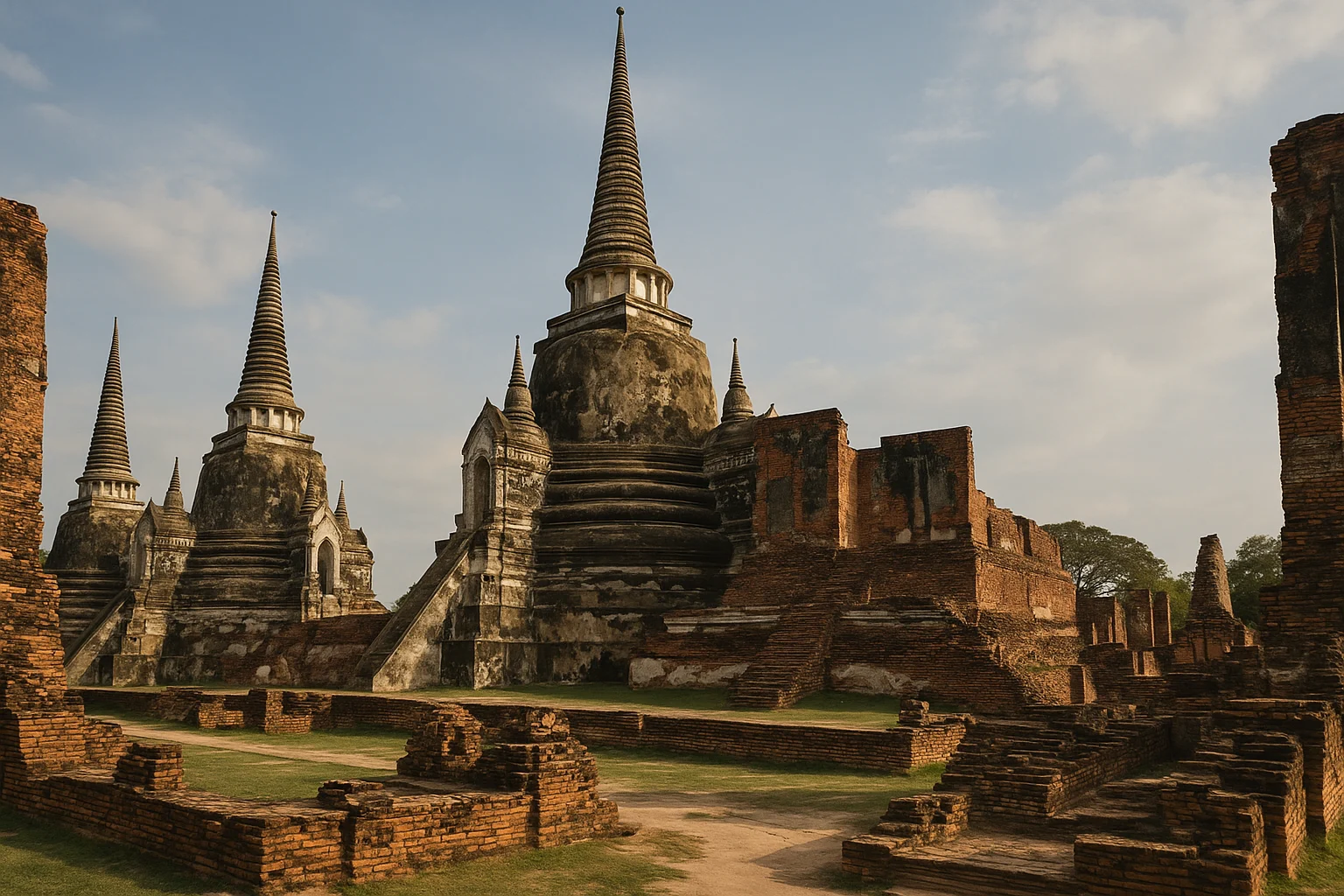
Ayutthaya Travel Guide 2026: Temple Ruins, Day Trip Planning, and What to Prioritize
Ayutthaya KingdomPlan a focused Ayutthaya visit with practical temple routing, timing, and transport guidance from Ba...
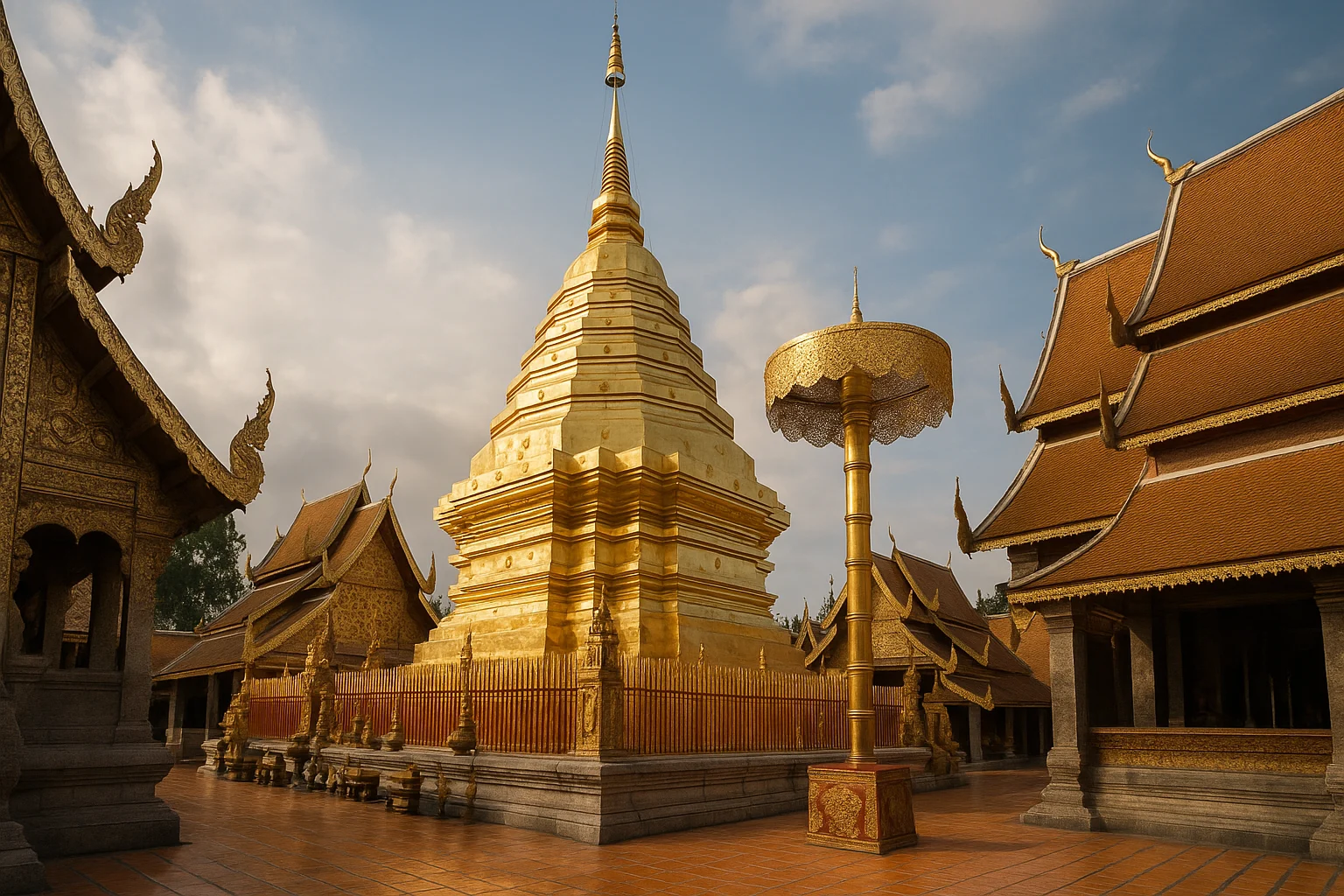
Wat Phra That Doi Suthep Travel Guide 2026: Temple Etiquette, Timing, and Chiang Mai Logistics
Lanna KingdomPlan a smooth Wat Phra That Doi Suthep visit with practical timing, temple etiquette, and route tips...
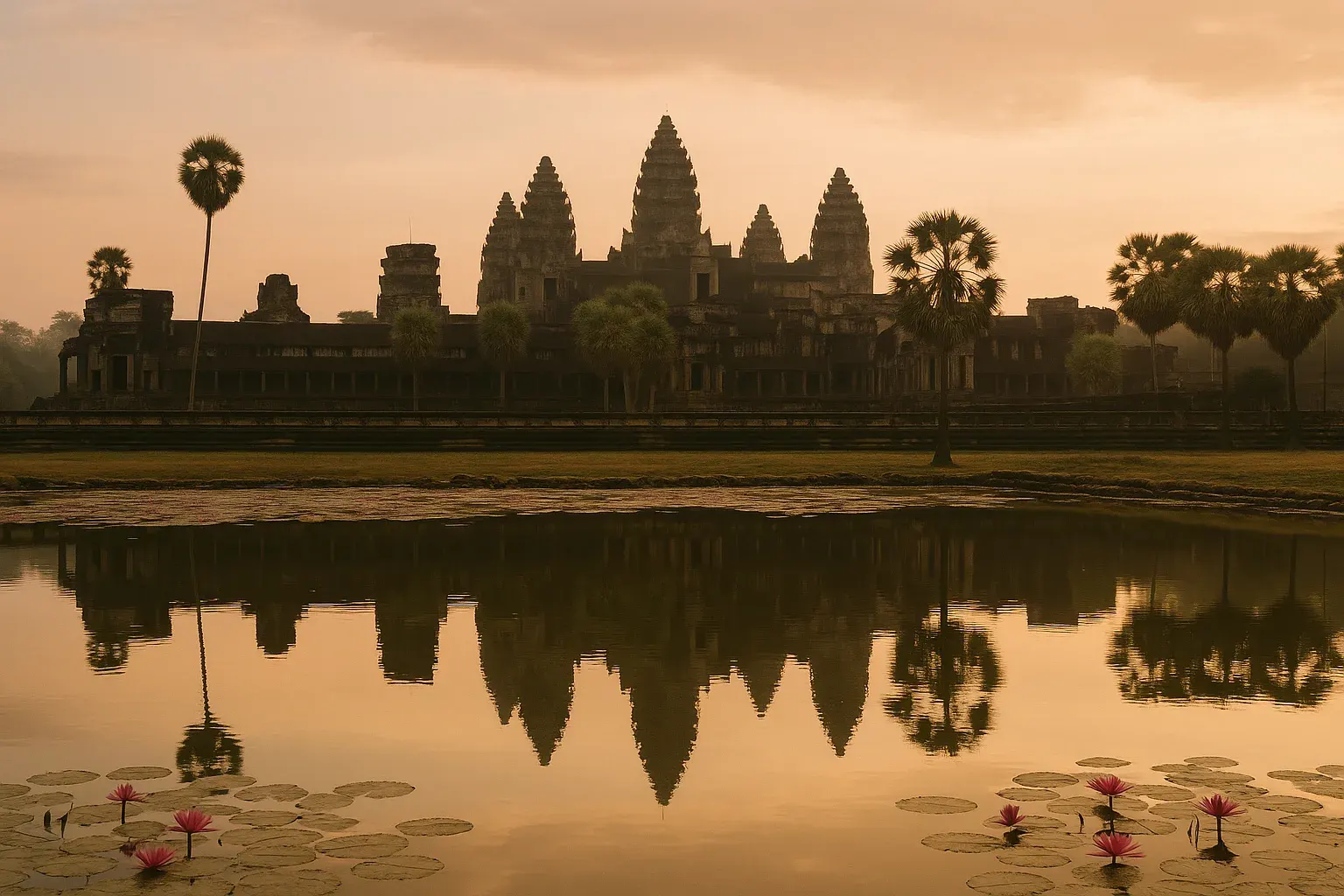
Angkor Wat Travel Guide 2026: Everything You Need to Know
KhmerAngkor Wat, the world's largest religious monument, spans over 400 acres in the heart of Cambodia. T...