Quick Info
Curated Experiences
Xochicalco Pyramid Day Trip from Cuernavaca
Full-Day Tour to Xochicalco from Mexico City
Xochicalco and Cuernavaca Archaeological Tour
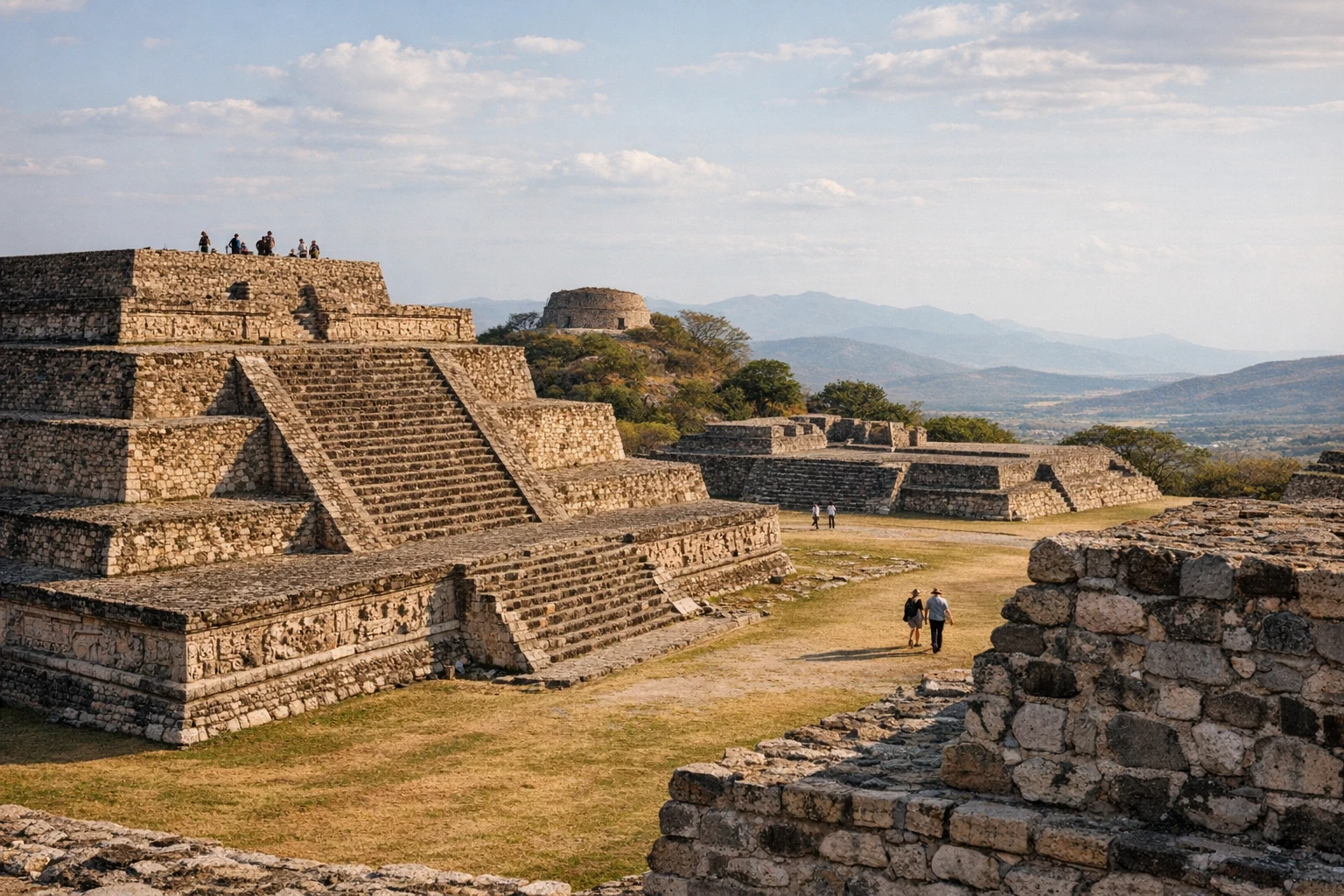
Perched dramatically above the rolling hills of Morelos, just south of modern-day Mexico City, Xochicalco stands as a silent guardian to centuries of Mesoamerican civilization. For those seeking a profound connection to the ancient heart of Mexico, Xochicalco is not merely a destination—it is a vivid journey across time. In the golden sunlight, the stepped pyramids and ceremonial plazas emerge from the scrubby highlands, their weathered stone facades telling stories of war, trade, science, and faith. UNESCO recognized this site in 1999 as a World Heritage treasure, and it continues to inspire awe for its remarkable blend of artistry, architectural sophistication, and strategic brilliance. A centerpiece of the Epiclassic era, Xochicalco flourished between the decline of Teotihuacan and the rise of the Aztecs, serving as both a fortified refuge and a vibrant hub of cultural exchange.
For international visitors, Xochicalco represents a quintessential moment in Mexico’s past, embodying the resilience, ingenuity, and syncretism that defined ancient Mesoamerican societies. The name Xochicalco, meaning “Place of the House of Flowers” in Nahuatl, is a poetic allusion to the city’s dual role as a center for both scientific discovery and ritual celebration. Here, astronomer-priests observed the movements of the sun and stars from ingeniously crafted observatories, while artisans decorated temples with tales of gods, rulers, and cosmological visions. Today, the winding causeways, monumental ballcourts, and mythic reliefs create a vivid atmosphere, inviting travelers to lose themselves in a landscape where ancient cosmology and modern imagination blend seamlessly. Whether you are a devoted history enthusiast, an adventurous hiker, or someone simply eager for an encounter with the mysteries of Mexico, Xochicalco promises a rich and unforgettable experience.
History
Origins and the Epiclassic Transformation
Xochicalco emerged during a pivotal era in Mesoamerica’s timeline—the Epiclassic period, around 700 AD. This was a moment of profound political change and regional upheaval, as the mighty city of Teotihuacan, once the center of a far-reaching empire, collapsed into decline and disarray. In the resulting power vacuum, a mosaic of city-states rose to prominence across central Mexico, with Xochicalco strategically situated atop a defensible hill. Its founders were adept at integrating military engineering with urban planning: terraces were cut into the slopes, creating wide, flat platforms for temples, palaces, granaries, and ballcourts, all protected by formidable walls and ramparts. This not only shielded the city from invasion but also enabled residents to control key trade routes connecting the Valley of Mexico with western and southern lands.
Cultural Fusion and Flourishing
Around the 8th and 9th centuries AD, Xochicalco blossomed into one of the preeminent centers of the region. Archaeological evidence shows a unique blend of influences, as people from fallen Teotihuacan, the Gulf Coast (notably the Olmeca-Xicallanca), the Mixtec, Maya, and even Zapotec cultures intermingled within the city. The architecture and arts of Xochicalco reflect this cosmopolitan heritage: the Pyramid of the Feathered Serpent is adorned with iconography reminiscent of Teotihuacan and Maya traditions alike, including calendrical glyphs and serpent imagery. Urban elites fostered a society that prized trade, education, science, and competition—most notably seen in the city’s elaborate ballcourts, where ritual games reinforced political alliances and social hierarchies.
Xochicalco’s astronomer-priests became renowned for their scientific achievements. The site boasts a sophisticated observatory, ingeniously engineered as a cave with a shaft that channels sunlight dramatically during the zenith passage of the sun. This device allowed priests to predict agricultural cycles, seasonal changes, and festivals with astounding precision, highlighting Xochicalco’s status as an intellectual as well as religious capital.
Conflict, Decline, and Abandonment
By the late 9th century, however, Xochicalco’s fortunes began to wane. Like many fortified cities of the time, it was repeatedly embroiled in conflict with rival city-states, struggling to preserve its independence and wealth. Archaeological layers of ash and destruction indicate that the city ultimately fell to a combination of warfare and internal upheaval sometime around AD 900. With the rise of new powers such as Tula and eventually the Toltecs and Aztecs, Xochicalco was abandoned, its ceremonial spaces left to the encroaching forest and wildflowers.
Though it never regained its former glory, Xochicalco remained a place of pilgrimage and legend throughout later centuries, its monuments venerated by successive generations. Excavations in the 20th and 21st centuries have gradually revealed the remarkable sophistication of this hilltop city, offering fresh perspectives on the resilience and ingenuity of ancient Mexican societies.
Key Features
At the heart of Xochicalco’s mystique are its monumental structures, impressively preserved and thoughtfully restored to evoke the splendor of its heyday. The site unfolds as a multi-level acropolis spread out along the crest of a steep hill, giving visitors both panoramic views and a strong sense of its defensibility.
The centerpiece is the Pyramid of the Feathered Serpent, an astonishing example of Mesoamerican architecture and iconography. This stepped pyramid is unique for its intricate stone reliefs—draped around every side with writhing plumed serpents, calendrical symbols, and depictions of elite personages adorned in elaborate regalia. It is both a statement of artistic achievement and a manifestation of the theological and cosmological ideas that dominated the period. The motifs blend Central Mexican and Maya influences, reflecting the city’s status as a crossroads of civilizations.
Close by, the Great Plaza stretches out as an expansive open space flanked by imposing platforms and ceremonial stairways. In its prime, this plaza was the bustling heart of public life, a stage for processions, markets, festivals, and ritual performances. Its proportion and planning demonstrate a sophisticated grasp of urban design and the importance of spectacle in ancient political culture.
To the south, two impressive ballcourts are set among terraced platforms. The largest follows the classic “I” shape favored across Mesoamerica, complete with stone rings affixed high on the side walls. Far from being mere sporting arenas, these ballcourts were arenas for the cosmic drama of life, death, and renewal—themes played out in tightly choreographed games with deep spiritual meaning. Relief carvings along the courts’ sides further reinforce their political and religious roles.
Perhaps the most awe-inspiring feature is the Xochicalco Observatory, located within a manmade cave deep beneath the surface. A narrow shaft in the ceiling allows a shaft of sunlight to illuminate the chamber’s interior for a brief period around the summer solstice, marking an important moment in both the agricultural and ritual calendars. The engineering precision required to create this feature is testament to the astronomer-priests’ skill and the city’s obsession with celestial cycles.
Scattered throughout Xochicalco are dozens of smaller temples, residential platforms, carved stelae, and even ancient sweat baths (temazcales), all interconnected by stairways and causeways designed to guide ceremonial movement. A well-interpreted site museum near the entrance contains a wealth of artifacts recovered in decades of excavation: polychrome ceramics, war regalia, obsidian tools, and fragments of ancient murals offer visitors an intimate window onto Xochicalco’s vanished world.
The combination of lofty physical setting, monumental artwork, and masterful engineering make Xochicalco a masterpiece of Epiclassic Mexico and an enduring emblem of the region’s creativity and complexity.
Getting There
Xochicalco is surprisingly accessible for both domestic and international travelers. Its location, roughly 38 kilometers southwest of Cuernavaca and about 120 kilometers south of Mexico City, places it within easy reach of major transport hubs.
For those starting from Mexico City, the swiftest option is to take a direct long-distance bus from Terminal de Autobuses del Sur (Tasquena) to Cuernavaca, with frequent departures and a comfortable ride of just over an hour. Buses are operated by several companies, including Pullman de Morelos; a one-way ticket typically costs 150–200 Mexican pesos (about $8–10 USD). Upon arrival in Cuernavaca, travelers can either rent a car or hire an authorized local taxi for the last leg. The drive to the site takes around 45 minutes, and a taxi fare will usually fall between 350 and 500 pesos ($20–28 USD), depending on negotiation and traffic.
Alternatively, guided day tours depart from both Cuernavaca and Mexico City. These tours often include roundtrip transport, knowledgeable guides, entrance fees, and sometimes a visit to other local attractions like the colonial city center of Cuernavaca. Expect to pay upwards of 1,200–1,700 pesos ($60–90 USD) per person for a well-organized day trip—well worth the price for convenience as well as interpretive depth.
For self-drivers, the journey from Mexico City follows the highway (Mexico–Acapulco, Highway 95) to Alpuyeca, and from there a well-marked road turns west toward Xochicalco. Ample parking is available at the visitor’s center.
Once on site, a modest shuttle truck—operated by the site administration—ferries visitors from the entrance gate and museum up to the main ceremonial hilltop for a small fee (around 20 pesos per person). Adventurous hikers may opt for the steep walk, rewarded with sweeping views of the valleys below.
When to Visit
The optimal time to discover Xochicalco’s wonders is during the dry season, which runs from November through April. During these months, skies are typically clear and blue, with daytime temperatures ranging from 20°C to 28°C (68°F to 82°F). The pleasant climate and minimal rainfall make climbing the site’s terraced slopes or exploring exposed plazas much more comfortable. Visitors during the Mexican spring (February to April) will also see the surrounding hills ablaze with wildflowers, living up to the city’s poetic name.
The rainy season extends from May through October. While the site is open year-round, frequent afternoon showers and higher humidity can make the gravel paths and stone steps slippery and less pleasant to navigate. Summer months (especially June and July) may bring dense, lush greenery to the slopes and a relative calm, as tourist numbers drop. If you visit during this period, plan to arrive early in the day to beat the rain and carry a light rain jacket or umbrella.
Xochicalco is rarely as crowded as better-known sites like Teotihuacan or Chichen Itza, so even in peak holiday periods, you are unlikely to find large crowds. For those keen to experience the famed solar phenomenon in the observatory cave, the days surrounding the summer solstice (May 14–28 and July 18–Aug 1, when the sun reaches its zenith at these latitudes) are particularly popular—check ahead with site staff for timing and access restrictions.
No matter the season, sturdy walking shoes, sun protection (hat, sunscreen, water), and a camera (or sketchbook) will enhance your visit. The on-site museum, open year-round, offers air-conditioned respite and a chance to dive deeper into the site’s history between explorations of the ancient ruins.
Quick Facts
| Feature | Detail |
|---|---|
| Location | Morelos, Mexico (38 km SW of Cuernavaca) |
| Civilization | Epiclassic Mesoamerica |
| Period | ca. 700–900 AD |
| Established | Circa 700 AD |
| UNESCO World Heritage Status | Inscribed 1999 |
| Notable Structures | Pyramid of the Feathered Serpent, observatory, ballcourts |
| Visitor Hours | 9:00 am – 5:00 pm daily |
| Entry Fee | ~90 MXN for adults; discounts available |
| Museum On-Site | Yes |
| Guided Tours Available | Yes (book in advance for English-language tours) |
| Parking | Available |
| Accessibility | Partial (main ruins involve steep/uneven paths) |
| Nearby City | Cuernavaca (approx. 45-minute drive) |
| Best Time to Visit | November–April (dry season) |
Frequently Asked Questions
What are the opening hours for Xochicalco?
Xochicalco is open daily from 9:00 am to 5:00 pm, with the last entry at 4:30 pm. Hours may vary on holidays, so check ahead before visiting.
Is the site wheelchair accessible?
Parts of Xochicalco are accessible, particularly the museum and some lower paths, but the main pyramids require climbing uneven stone steps.
Can I visit Xochicalco on my own, or do I need a guide?
You can visit on your own, but booking a guided tour is recommended for deeper historical context and understanding of the site’s unique features.
How much does it cost to enter Xochicalco?
Entry is around 90 MXN for adults. There are often discounts for students, teachers, and free entry for children under 13 or Mexican citizens on Sundays.
How long should I allow to explore Xochicalco?
A thorough visit typically takes 2–3 hours, including time for the museum and walking the main ceremonial plaza and observatory.
Nearby Ancient Sites
Teotihuacan Mexico Travel Guide 2026: Pyramids, Mysteries & Day Trips
TeotihuacanoTeotihuacan, the 'birthplace of the gods,' remains Mesoamerica's most influential ancient city. This...
Great Pyramid of Cholula Travel Guide 2026: Tlachihualtepetl Essentials
Preclassic and Postclassic MesoamericanPlan a smart visit to the Great Pyramid of Cholula with key context, timing advice, and practical fi...
Monte Albán Mexico Travel Guide 2026: Zapotec Capital Above Oaxaca
ZapotecExplore Monte Albán, the ancient Zapotec capital perched above Oaxaca. Discover the Grand Plaza, bal...