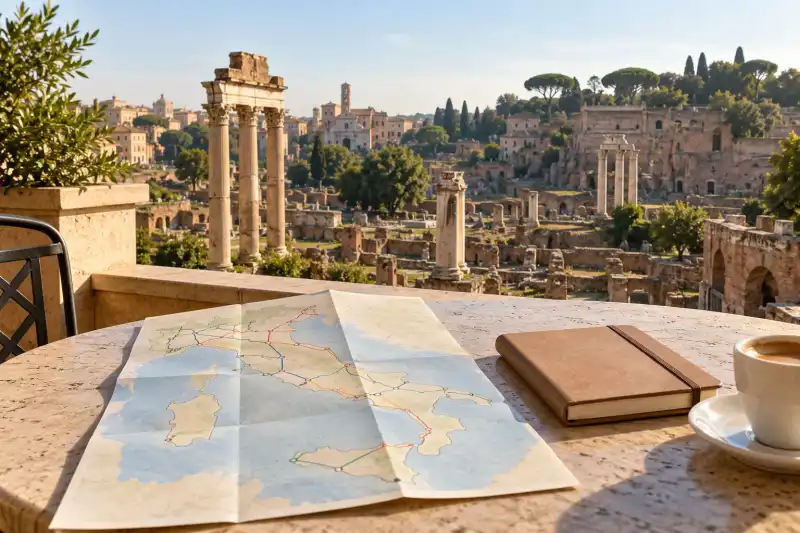
Italy rewards a plan with boundaries. The country has enough Roman, Etruscan, Greek, medieval and museum material to fill a lifetime, which is lovely until a ten-day itinerary becomes five regional overnights and a fever dream involving two rolling suitcases at Termini.
A useful itinerary begins with a question: what historical thread are you following? A Roman urban route might link Rome, Pompeii and the Bay of Naples. A southern route might connect Campania, Sicily and Magna Graecia. An Etruscan plan belongs in central Italy. Once the thread is clear, choose a small number of bases and let travel days remain travel days.
Start with fixed admissions, not wishful geography
Some visits require a selected date, timed entry or a current reservation procedure. Check the official operator before treating a site as movable. The Roman Forum and Pompeii may be names everyone recognizes, but the current entry conditions belong to their official pages, not to the itinerary you saved last winter.
Put the least flexible commitment on the calendar first. Then find the arrival city and overnight base that support it. This reverses the common mistake of buying a cheap flight, booking a scenic hotel and later discovering the archaeological day begins several transfers away.
Plan in regional clusters
| Cluster | Good planning question | Common trap |
|---|---|---|
| Rome and Lazio | Which ancient urban sites deserve full days rather than late-afternoon leftovers? | Treating every forum, museum and villa as one walkable loop |
| Campania | Is Pompeii the centerpiece, or one part of a wider Bay of Naples history plan? | Arriving from Rome, visiting the site and moving hotels on the same tight day |
| Sicily | Are you committing to eastern or western Sicily, or allowing enough nights for both? | Assuming rail corridors remove every rural last-mile problem |
| Central Italy | Is the goal Etruscan archaeology, medieval towns or a Rome extension? | Changing base every night for places that could be day trips |
The Ancient Italy 10-day itinerary offers a longer route shape. Use this guide when you are deciding whether that kind of route fits your actual flights, mobility and appetite for hotel changes.
Give transfers a job
A transfer day can be a rest day, an arrival buffer or a single well-chosen stop. It cannot reliably be all of those plus a three-hour museum, a rental-car return and a non-refundable dinner reservation. When a route crosses from one regional system to another, book the night that protects the next morning instead of optimizing for a theoretical shortest line.
Italy’s official tourism site notes that scheduled coaches and buses connect cities and villages beyond the main rail network. That is a useful reminder that trains are not the whole map. It is not a schedule. Check the current operator for your actual date, station, terminal, strike notice and luggage conditions.
Decide where a car helps
A car is useful when rural sites or scattered town clusters are the point of the trip. It is less useful when the plan is centered on Rome, Naples, Florence or other rail-connected cities. If you use one, decide the pickup and return cities before booking lodging, learn the local restricted-traffic-zone rules, and do not assume that a historic center offers easy parking. A rental car is a tool, not a personality trait.
Keep the final two nights boring
Near an international departure, stay within a route you understand. That does not mean every final night must be at an airport hotel. It means a distant rural site, a rental-car return and an early flight should not all collide without a buffer.
Use Italia.it’s practical travel guidance and current carrier pages for transport decisions. This guide does not state live fares, rail frequencies, reservation availability or site hours. It gives you a sequence that leaves room for the Italy you will actually encounter.