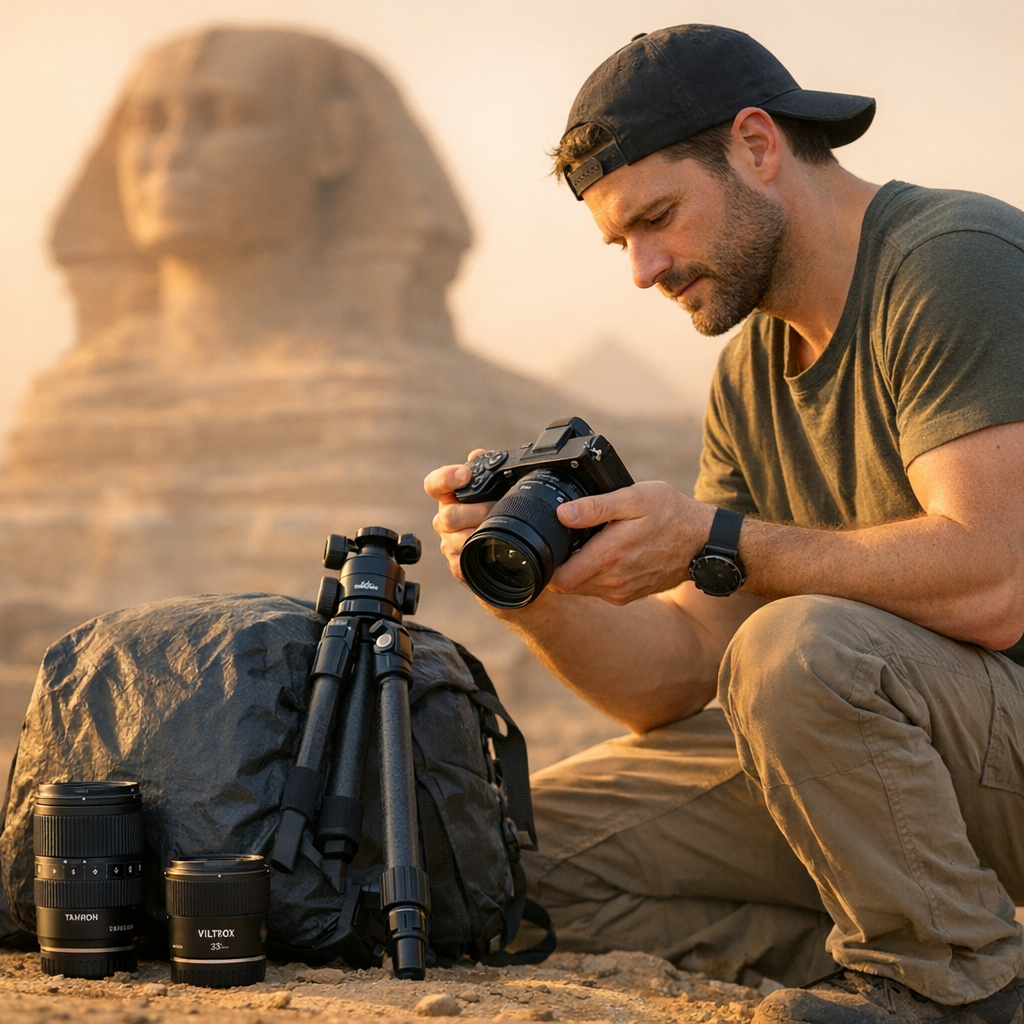
Every photographer’s gear list is a set of opinions disguised as recommendations, and this one is no exception. I’ve spent years refining what goes in my bag for travel to ancient and archaeological sites, and the kit I’ve landed on reflects a specific philosophy: stay light, stay flexible, and never miss a shot because you were fiddling with equipment.
Ancient sites throw everything at you. Dark temple interiors followed by blinding midday sun on white marble. Crowds you can’t control. Tripod restrictions you didn’t know about until you walked through the gate. Shooting conditions that change faster than you can swap a lens. The gear below is what I trust to handle all of it, and more importantly, to stay out of my way while I work.
Sony a6700
This is the body I shoot everything on. It’s APS-C, it’s compact, and the image quality punches way above what you’d expect from a crop sensor. The autofocus is scary good, especially in complex scenes where older systems would hunt all over the place. High ISO performance is solid enough that I can shoot handheld inside dim temple interiors without everything turning to mush. It’s light enough to carry all day without your neck hating you by sunset, and that matters more than people think when you’re on your feet for eight or ten hours at a stretch.
Tamron 18-300mm F/3.5-6.3 Di III-A VC VXD
Yeah, I know. A superzoom. Every lens snob on the internet just closed the tab. But here’s the thing: for travel photography at archaeological sites, not changing lenses is a superpower. No dust on the sensor, no fumbling with glass while the light changes, and I can go from a wide interior establishing shot to a tight 300mm compression of a distant monument without missing a beat. The vibration compensation lets me get sharp handheld shots at shutter speeds that have no business working. Is it optically perfect at every focal length? No. Does it let me actually get the shot instead of wishing I had the right lens mounted? Every single time.
Viltrox 35mm F1.7 Autofocus Prime
This is the lens I grab when I have time to slow down and work a scene. At f/1.7 it pulls in a ton of light, which is a lifesaver in dark interiors, and it gives me enough background separation to isolate details against busy surroundings. On the a6700’s crop sensor, 35mm gives you roughly a 52mm equivalent, which is right in that sweet spot for environmental work where you want a subject in context rather than blown out of it. Autofocus is fast, quiet, and the whole lens weighs almost nothing. I carry it when the schedule gives me room to breathe.
K&F Concept 67mm CPL + Variable ND Filter
This one filter replaces a whole stack of glass. The circular polarizer cuts glare off stone and water and deepens sky contrast, which makes a huge difference when you’re shooting marble or sandstone in direct sun. The variable ND side lets me dial in light reduction on the fly, so I can drag the shutter in broad daylight for long exposures: blurring crowds out of a scene, getting that silky water look near rivers, whatever the situation calls for. One filter, two jobs, and I’m not digging through a filter case trying to find the right density while the moment passes.
Sirui Traveler 7C Tripod
I’d say I use this at maybe 40% of the sites I visit. A lot of places restrict tripods, so it stays in the bag more than I’d like. But when I can set it up, it earns its spot. Carbon fiber, collapses small, weighs next to nothing, and extends to a usable height. I lean on it for long exposures, blue hour shots when even the a6700 starts to show noise, and self portraits on the timer. It’s not a rock solid studio tripod. It’s a travel tripod that does what a travel tripod needs to do without making you resent carrying it.
Ulanzi CU01 Camera Cooler
This thing looks silly, but it solves a real problem. The a6700 will thermal throttle and shut down video recording after about 30 minutes of continuous shooting, which kills you in the middle of a longer documentary take. The CU01 snaps onto the back of the camera where the articulating screen normally sits, and uses a small active fan to pull heat off the body. With it attached, I can run much longer takes without hitting the thermal wall. If you’re only shooting stills, you don’t need this. But if you’re building any kind of video content alongside your photography, it’s a cheap fix for an annoying limitation.
The Philosophy Behind the Bag
None of this gear is exotic or expensive by photography standards. That’s deliberate. I’d rather carry a kit I’m not precious about into a dusty ruin than baby a five figure setup while missing the shot. Everything here is chosen to solve a specific problem that ancient site photography actually throws at you, not to impress anyone on a forum.
If you’re building your own travel kit for this kind of work, my advice is simple: figure out what slows you down, and fix that first. The best camera bag is the one you stop thinking about ten minutes into the shoot.