Quick route summary
This 3-day route uses La Paz as a single base and gives the Tiwanaku area the breathing room it deserves. The main ancient focus is Puma Punku, part of the wider Tiwanaku ceremonial landscape on the high Andean plateau west of La Paz.
The route starts gently because altitude matters here. La Paz already sits high, and the Tiwanaku area is not a place to visit while pretending your body has not noticed. Day 2 is the main site day. Day 3 gives you a choice: return for a slower second look if logistics and energy allow, or stay in La Paz for museum context and a less punishing finish.
The pace is compact, but sensible. This is not a route about packing in five ruins before lunch. The stones at Puma Punku are quiet now, but the political ambition behind them was not subtle.
Who this itinerary is for
This itinerary is for travelers who are already passing through La Paz and want to understand one of the most important pre-Inca ceremonial centers in the Andes without treating it as a quick photo stop. It suits people who like archaeology, highland landscapes, and sites where the surviving pieces ask for patience.
It is not ideal if you want a low-altitude, low-effort trip. The roads are manageable, but the elevation can make a normal sightseeing day feel strangely heavy. It is also not the best plan if you need every ancient site to be visually complete. Puma Punku rewards close looking more than instant drama.
Route at a glance
- Day 1: Overnight in La Paz. Arrive, adjust to altitude, and keep plans light while preparing for the Tiwanaku day trip.
- Day 2: Overnight in La Paz. Travel west to the Tiwanaku archaeological area and spend focused time at Puma Punku, with a guided tour or driver making the day easier.
- Day 3: Overnight in La Paz. Either return for a slower second look at the Tiwanaku landscape or stay in La Paz for museums, notes, and recovery.
Practical logistics before you go
La Paz is the practical base. Most travelers visit Tiwanaku and Puma Punku as a day trip from the city, using a guided tour, private driver, or public bus. A tour is often the easiest option because it bundles transport and interpretation, and interpretation matters at a site where many of the most interesting remains are architectural fragments.
Altitude is the real planning variable. Do not land in La Paz late at night and schedule the ruins for first thing the next morning if you can avoid it. Give yourself a light first day, drink water, eat simply, and do not build the route around heroic walking.
The Tiwanaku area sits on the altiplano near Lake Titicaca’s broader cultural zone. Weather can change quickly, shade can be limited, and the sun can feel stronger than the air temperature suggests. Bring layers, sunscreen, water, and patience. The site is easier to appreciate when you are not rushing or mildly dizzy.
A guided day tour makes sense on Day 2, especially if you want help connecting the scattered remains, museum material, and platform architecture. This is a reasonable place to use a La Paz day tour to Tiwanaku and Puma Punku rather than solving transport and context separately.
Day 1: La Paz arrival and altitude buffer
Use the first day for La Paz, not for proving anything. If you have just arrived from a lower elevation, keep the schedule loose and resist the temptation to rush straight out to Puma Punku. The ruins will make more sense if you are not fighting a headache.
This is a good day to get oriented to Bolivia’s highland geography. Tiwanaku power grew on the altiplano, a world of cold nights, bright sun, raised fields, camelid caravans, and ceremonial centers tied into regional exchange. By the first millennium CE, Tiwanaku influence reached far beyond the immediate site, with connections across parts of the south-central Andes.
Practical tasks matter today. Confirm transport for Day 2, check pickup times if you are using a tour, and bring cash for small expenses. If you are going independently, ask locally about current bus routes and return timing rather than relying on stale advice. Roads and schedules are not the place to improvise at the end of a long high-altitude day.
Keep the evening quiet. The best version of this itinerary starts with restraint.
Day 2: Tiwanaku ceremonial core and Puma Punku
Start early from La Paz and treat this as the main archaeological day. The drive west gives you a better feel for the altiplano than a map can. Distances are not huge, but the open plateau changes the mood of the trip. Tiwanaku was not a mountain citadel or a jungle city. It was a highland ceremonial and political center built into a broad, exposed landscape.
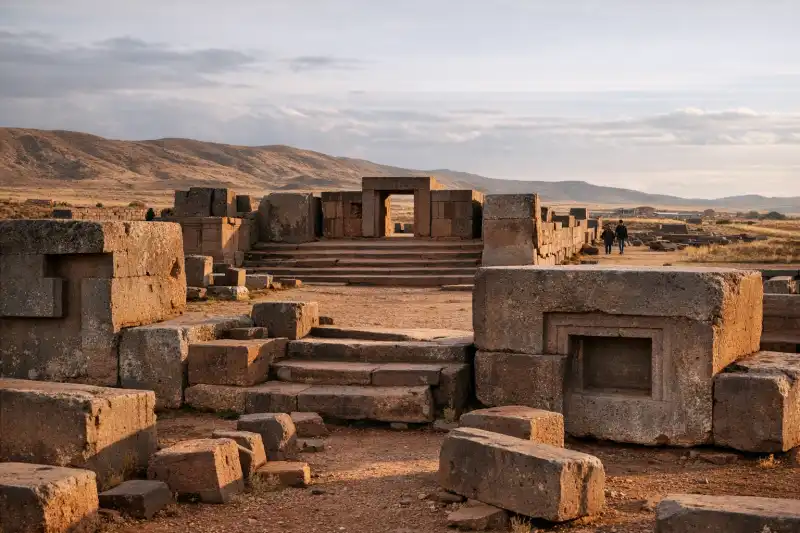
Give Puma Punku more time than the scattered stones may seem to demand at first glance. The site is known for its finely cut blocks, including H-shaped stones and carefully worked andesite pieces that show precise planning. The fascination is not that the stones are mysterious in a lazy way. It is that they preserve evidence of serious craft, labor organization, and architectural ambition in a place where much of the original structure has been disturbed.
Historically, Puma Punku belonged to the Tiwanaku world, which flourished long before the Inca. The ceremonial center developed over centuries and reached its height roughly in the first millennium CE. Its builders used monumental platforms, sunken courts, carved stone, and carefully managed ritual space to project authority. You are not looking at an isolated ruin. You are looking at part of a highland system that helped shape later Andean political imagination.
Do not overpack the day. If your tour includes museums and the main Tiwanaku ceremonial core, let that be enough. A guide can help explain what has been reconstructed, what remains in place, and what scholars still debate. Without that context, the site can flatten into a pile of impressive stones and missed meaning.
Return to La Paz with the evening open. The combination of road time, sun, altitude, and archaeological concentration can be more tiring than expected.
Day 3: Second look at the Tiwanaku landscape or La Paz museums
Day 3 depends on your energy and how much time you had on site the day before. If Day 2 felt rushed, consider arranging a slower return to the Tiwanaku area and Puma Punku. This only makes sense if you have reliable transport and a real reason to go back, such as photography, note-taking, or a deeper interest in the architecture.
A second look can be valuable because Puma Punku is not an instant-read site. The cut stones, platform remains, and scattered blocks make more sense after you have heard the basic chronology. Look for the way the site asks you to think in pieces: stone type, carving technique, alignment, missing superstructure, and later disturbance. The absence is part of the experience.
If you do not return to the ruins, stay in La Paz and use the day for museum context, rest, and a slower finish. That is not a compromise. For many travelers, it is the better choice. High-altitude archaeology is easier to absorb when you leave time to process it.
End the route in La Paz rather than trying to bolt on a long transfer. If you are continuing toward Lake Titicaca, Copacabana, or Peru, give yourself a buffer. The altiplano rewards travelers who respect distances, daylight, and their own energy.
The historical thread: highland power before the Inca
Tiwanaku and Puma Punku matter because they push the Andean story earlier than many travelers expect. The Inca are better known, but they did not invent Andean statecraft from nothing. Long before Cusco became an imperial capital, Tiwanaku showed how highland communities could organize labor, ritual, architecture, farming, and exchange across a difficult environment.
Puma Punku is especially useful because it makes ambition visible through fragments. The site does not hand you a complete temple. Instead, it gives you worked stone, platform traces, and enough precision to feel the scale of the original project. The political message was probably not subtle: people came here to see order imposed on stone, space, and ceremony.
That is the thread of the route. Not mystery for mystery’s sake, but a high-altitude society using architecture to make authority feel durable.
Transportation notes
Use La Paz as your base for all three nights. Moving hotels for this itinerary would waste more energy than it saves.
For Day 2, the simplest options are a guided tour or private driver from La Paz. Independent bus travel can work, but it requires more patience and better local timing. If you choose that route, confirm return options before you go. Do not assume late-day flexibility.
Self-driving is not necessary for most visitors. Between altitude, unfamiliar roads, parking uncertainty, and the value of having someone explain the site, a tour or driver is usually the better tool.
Do not compress this route into an arrival day plus one rushed excursion unless your schedule forces it. The ruins are close enough for a day trip, but the altitude makes tight planning feel harsher than it looks on paper.
Optional add-ons and swaps
If you have less time, cut Day 3 and keep Day 2 as a single focused Tiwanaku and Puma Punku day trip from La Paz. That is the most common version and works well if you have already adjusted to altitude.
If you have more time, add Lake Titicaca after La Paz rather than adding another ruin to the same day. It fits the wider highland geography better and keeps the trip from becoming a checklist. Remove the second-look version of Day 3 if you need to create that buffer.
If altitude is hitting hard, swap the Day 2 ruins visit to Day 3 and use the extra day in La Paz to acclimatize. That is the least glamorous advice in the itinerary, but it may save the trip.
Shorter and longer itinerary options
For a shorter route, make this a 2-day plan: arrive and acclimatize in La Paz on Day 1, then visit Tiwanaku and Puma Punku on Day 2.
For a longer Bolivia route, pair this with Lake Titicaca or additional time in La Paz rather than stacking too many distant ancient sites into one sprint. The better long version would keep Puma Punku as the archaeological anchor and use the extra days for landscape, museums, and highland context.
There are no related Ancient Travel route-family pages published for this Bolivia itinerary yet.
Related ancient sites
FAQ
The most common planning questions for this route are answered below.