Quick route summary
This 5-day route links Aksum and Lalibela, two places that explain different chapters of Ethiopia’s ancient and medieval past. Start in Aksum, the old royal city of stelae, tombs, inscriptions, and early Christian tradition. Then continue to Lalibela, where churches were cut down into volcanic rock rather than built upward from it.
The route starts in Aksum and ends in Lalibela, with two simple bases: Aksum for the first half, Lalibela for the second. The pace is focused rather than packed. Do not try to turn this into a northern Ethiopia grand tour in five days unless you are happy losing whole days to roads and flight delays.
Who this itinerary is for
This itinerary is for travelers who want Ethiopia’s ancient history without pretending the logistics are effortless. It suits people who are comfortable with domestic flights, local guides, early starts, church etiquette, altitude, and uneven walking.
It is not ideal if you want a single relaxed base, resort-style comfort, or a route where every transfer is predictable. Northern Ethiopia rewards patience. The history is extraordinary, but the travel rhythm is not always smooth.
Route at a glance
- Day 1: Overnight in Aksum. Arrive, settle in, and take a gentle first look at the old royal city.
- Day 2: Overnight in Aksum. Visit the stelae field, tomb areas, and church precincts with a guide or local taxi.
- Day 3: Overnight in Lalibela. Fly or transfer from Aksum to Lalibela, keeping the day deliberately light.
- Day 4: Overnight in Lalibela. Explore the northern church group on foot, with time for tunnels, courtyards, and services.
- Day 5: Overnight in Lalibela. Continue through the southern churches and leave the afternoon flexible for a slower finish.
Practical logistics before you go
The best bases are simple: sleep in Aksum for the Aksumite sites, then sleep in Lalibela for the rock-hewn churches. Do not base in one and day-trip to the other. The map may make northern Ethiopia look compact, but roads, terrain, weather, and flight schedules make that a bad bet.
Domestic flights are the cleanest way to connect Aksum and Lalibela when they are operating on a usable schedule. If flights do not line up, ask locally about the safest and most realistic overland option before committing. Long drives in this region should be treated as transfer days, not scenic filler between major sites.
Guides make sense in both destinations. In Aksum, a guide helps connect stelae, tombs, inscriptions, and later church traditions into one story. In Lalibela, a guide is useful for route order, ticket handling, shoe removal, church etiquette, and knowing when services might affect access.
Build in slack. Highland light can be strong, paths can be uneven, and altitude can make a short walking day feel longer. This is not the place to stack five major stops before lunch and call it efficient.
Day 1: Arrive in Aksum and settle into the old royal city
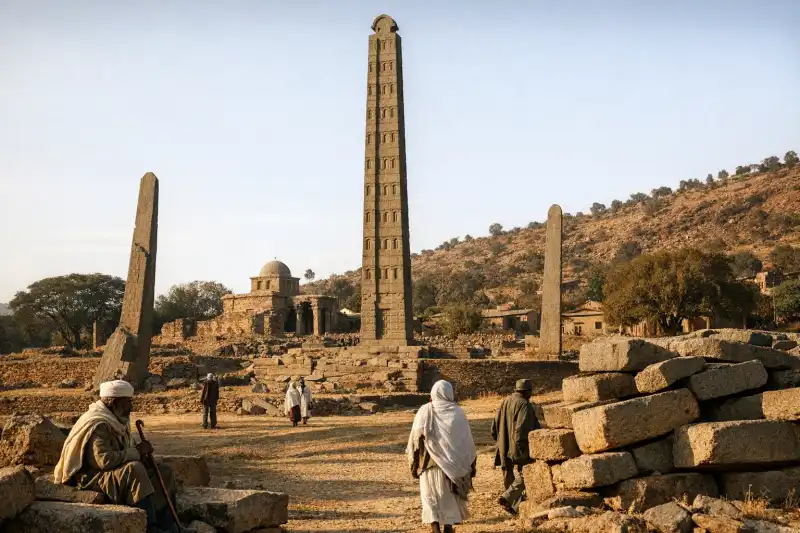
Arrive in Aksum and resist the urge to make the first afternoon too ambitious. The town sits in the highlands of Tigray, and even if the flight is short, the travel day can still take more out of you than expected. Check into your hotel, confirm a guide for tomorrow, and use the remaining light for a gentle orientation walk or a short taxi loop.
Aksum was not a footnote on the edge of the ancient world. The Aksumite kingdom traded across the Red Sea and connected inland Africa with Arabia, the Mediterranean, and the Indian Ocean. Its rulers issued coins, carved inscriptions, raised enormous stelae, and adopted Christianity in the 4th century CE, making Ethiopia one of the earliest Christian kingdoms.
Keep the day practical. Confirm opening times, ask about any local restrictions, and decide how you want to handle the church precincts. Some sacred areas may have access rules that vary by visitor, gender, service schedule, or local custom. A calm first day will make Day 2 much better.
Day 2: Aksum stelae, tombs, and royal memory
Give Aksum a full day. Start with the stelae field, where carved granite monuments mark elite burial landscapes. The tallest standing examples are impressive, but the fallen Great Stele is the one that makes the engineering feel almost reckless. It was carved from a single piece of stone and likely collapsed in antiquity, which says plenty about both ambition and risk.
Continue to the tomb areas and related archaeological zones. Aksum’s underground spaces matter because the city’s power was not only expressed above ground. Royal burial, stone architecture, inscriptions, and controlled memory all worked together. The stones are quiet now, but the political message was not subtle.
Aksum is also where ancient state power and Ethiopian Christian tradition overlap in ways that can be hard to separate neatly. The city is tied to the Church of St. Mary of Zion and to long-standing local traditions about the Ark of the Covenant. Treat those traditions respectfully, even when the archaeological record and sacred memory are doing different kinds of work.
Use a guide or taxi rather than trying to stitch the sites together casually on foot. Distances are not enormous, but the heat, altitude, and scattered layout make a planned circuit easier. End the day early enough to pack, check tomorrow’s transport, and avoid starting the Lalibela leg already tired.
Day 3: Fly or transfer from Aksum to Lalibela
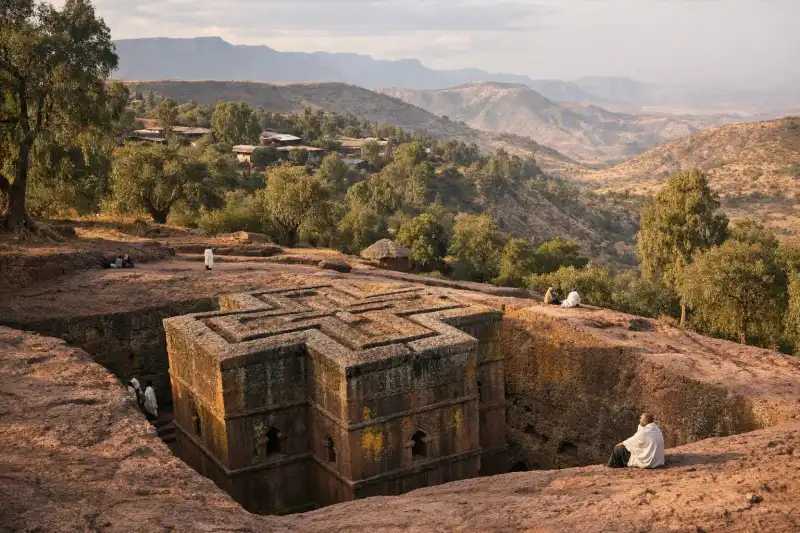
Today is a movement day from Aksum to Lalibela. If a domestic flight works, take it. If not, get current local advice before choosing an overland transfer. This is one of those travel days where the honest plan is simple: move safely, arrive, eat, and do not pretend you are also going to absorb a major monument complex.
If you arrive early enough, take a short first look at Lalibela from the outside. The town feels completely different from Aksum. Aksum’s monuments announce themselves as royal markers in open space. Lalibela’s churches often reveal themselves downward, through trenches, courtyards, thresholds, and carved passages.
The churches are generally associated with the Zagwe dynasty, especially King Lalibela, around the 12th and 13th centuries. The traditional story links the site to a “New Jerusalem,” shaped after Muslim control of Jerusalem made pilgrimage harder for many Christians in the region. Whether you approach that as sacred geography, political imagination, or both, it gives the next two days their shape.
Use the afternoon to arrange a guide, check ticket rules, and ask about service times. Lalibela is not a dead monument park. It is a living religious landscape, and that changes how you should move through it.
Day 4: Lalibela’s northern church group
Start early in Lalibela and focus on the northern church group. This is the day when the mechanics of the place begin to make sense. The churches were carved from the living rock, with workers cutting down around the mass and then shaping interiors, pillars, windows, drainage channels, and passages. It is architecture by subtraction, which still feels strange no matter how many photos you have seen.
Move slowly. The famous church views are only part of the experience. The better rhythm is to notice how courtyards, trenches, tunnels, and thresholds control movement. One minute you are in bright highland sun, the next you are stepping into a cool, dim space where painted cloth, chanting, incense, or a priest with a hand cross may matter more than the carved stone itself.
This is a guide day. Not because you cannot physically find the churches, but because the order, symbolism, etiquette, and access rules are easy to flatten if you treat the site like a checklist. Wear shoes that come off easily, bring socks you do not mind walking in, and dress conservatively.
Do not pack the afternoon with a second major excursion unless your energy is unusually good. Lalibela asks for attention in small spaces. Too much speed turns it into a blur of doorways and dust.
Day 5: Lalibela’s southern churches and a slower finish
Use the final day for Lalibela’s southern churches and any parts of the complex you did not give enough time yesterday. This is also a good day to revisit one church in better light or with fewer people. Lalibela rewards repetition more than rushing. The second look is often when the carved drainage channels, rooflines, and spatial tricks become clear.
If your guide suggests a short taxi transfer or a different order based on services, listen. The site is active, and practical timing matters. Some churches may feel quiet at one hour and crowded at another. That is not a problem to solve so much as part of visiting a sacred place that still belongs to its worshippers.
Historically, Lalibela sits in a different register from Aksum. Aksum speaks in royal stelae, trade, coinage, inscriptions, and early Christian statecraft. Lalibela speaks through pilgrimage, liturgy, carved space, and a medieval vision of holiness mapped into stone. Seeing both in one route keeps Ethiopia from being reduced to a single ancient story.
Keep your afternoon flexible. If you fly out the next day, confirm the transfer. If you have more time, decide whether to add a church outside town or simply sit with what you have already seen. A slower finish is not wasted time here.
The historical thread: royal stone, sacred stone, and Ethiopia’s long memory
Aksum and Lalibela belong together because both use stone to make authority visible, but they do it in completely different ways. Aksum raises stone upward. Lalibela cuts stone downward. One city preserves the memory of kings, tombs, inscriptions, and Red Sea trade. The other turns a highland town into a carved sacred landscape.
The route also shows how Ethiopia’s past resists tidy categories. Aksum is ancient, African, Red Sea, royal, and Christian. Lalibela is medieval, monastic, political, liturgical, and still active. The connection between them is not a straight line from one capital to another. It is a long argument about power, faith, memory, and how a landscape can be made holy.
Transportation notes
Plan this route around flights first, then adjust. Domestic air connections can save huge amounts of time, but schedules may change, and a route that looks neat on paper can become awkward quickly. Recheck flight options close to travel and avoid booking a same-day international departure after a domestic hop from Lalibela.
Overland travel should be handled with current local advice. Road conditions, security, fuel, weather, and regional access can matter more than distance. If a driver says a transfer is too long or unwise, take that seriously.
Do not self-drive this itinerary. Use flights, hotel-arranged transfers, licensed drivers, taxis, and guides. The historical payoff is real, but the logistics are not a place to improvise for the sake of independence.
Two bases are enough. Adding another overnight stop inside five days will usually make the route worse, not richer.
Optional add-ons and swaps
If you have more energy in Aksum, add extra time there rather than treating Day 1 as disposable. Use it for a deeper guided circuit, more time around the stelae field, or a slower look at the church precincts. To do this within five days, trim Lalibela’s final afternoon rather than cutting the full Lalibela church day.
If your main interest is living religious tradition, give Lalibela the extra time instead. Add a third night there and use it for a slower church circuit, service timing, or a nearby excursion arranged locally. To make room, reduce Aksum to one full day and one arrival or departure evening.
If flights collapse or the transfer becomes too hard, do not force both places. Choose Aksum for ancient royal archaeology and early Christian state history. Choose Lalibela for rock-hewn churches, pilgrimage, and living sacred architecture. Either one deserves more than a rushed token visit.
Shorter and longer itinerary options
For a shorter trip, make this a 3-day Lalibela-focused itinerary: arrive, spend one full day with the northern and southern church groups, then use the final morning for a second look before departure. It will not cover ancient Ethiopia broadly, but it is cleaner than racing.
A 4-day version can work if flights are perfect: one night in Aksum, one full Aksum day, transfer to Lalibela, one full Lalibela day, depart. It is tight and not my favorite version.
For a longer 7-day route, add another night in each base. Aksum gets more archaeological breathing room, and Lalibela gets the slower pacing it deserves. The extra time is especially useful if you want to plan around church services rather than just buildings.
Related ancient sites
FAQ
The most common planning questions for this route are answered below.