Quick route summary
This 3-day route uses AlUla as a single base and gives Hegra (Madain Saleh) the time it deserves. The trip starts gently, spends the second day on Hegra’s Nabataean tombs, then keeps the final day flexible for AlUla context, rest, and departure logistics.
The pace is deliberately restrained. Hegra is not a place to squeeze between airport transfers. The tombs are spread across a desert landscape, access is controlled, and the best part of the visit is seeing how the carved facades, open ground, and old caravan geography fit together.
Who this itinerary is for
This itinerary is for travelers who want a compact ancient-history trip built around Hegra rather than a rushed checklist of AlUla photo stops. It suits people who are comfortable with guided access, desert heat planning, and a little logistical rigidity.
It is not ideal if you want to improvise each day after breakfast. Hegra requires more structure than many ancient sites. If your trip style depends on wandering freely, treat this route as a framework and leave wider gaps around the official visit times.
Route at a glance
- Day 1: Overnight in AlUla. Arrive, settle in, get your bearings, and keep the day light so the Hegra visit does not begin with travel fatigue.
- Day 2: Overnight in AlUla. Visit Hegra through the official access system or a licensed guided experience, with time for the major Nabataean tomb areas.
- Day 3: Overnight in AlUla or depart late. Use the day for Hegra context, AlUla oasis time, a slower desert finish, or a buffer if schedules shift.
Practical logistics before you go
Base yourself in AlUla for all three nights if you can. Changing hotels adds nothing here. The useful decision is not where to move each night, but how to line up flights, transfers, site access, and heat.
Hegra access is controlled, so check current ticketing and tour arrangements before you build the rest of the trip. A guided visit is not just convenient. It is usually the practical way to see the site, because the tomb groups are spread out and visitor movement is managed.
A rental car can help around AlUla, but do not assume it replaces official Hegra access. If you do not want to drive, arrange hotel transfers, private transport, or tours in advance. Distances can feel short on a map and still become awkward when heat, daylight, and pickup points enter the equation.
Plan around the sun. Northwest Arabia can be harsh in the middle of the day, and ancient stone does not provide much kindness at noon. Early or late site times are worth taking seriously. Carry water, use sun protection, and avoid stacking too much after Hegra.
Day 1: AlUla arrival and a first look at the oasis
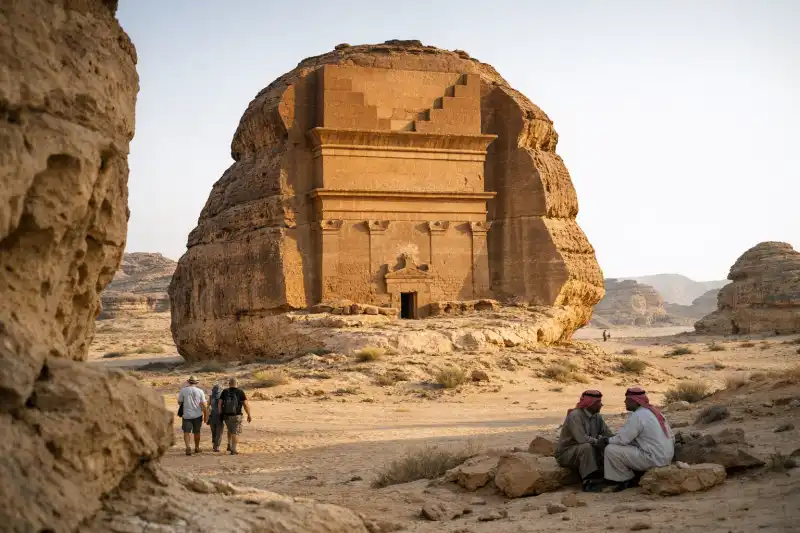
Arrive in AlUla and resist the urge to spend the day chasing every desert viewpoint. This route works better if Day 1 is about orientation: where your hotel sits, how transfers work, when your Hegra visit begins, and how much daylight you realistically have.
The ancient story here is tied to movement. AlUla sat near routes that connected southern Arabia, the Hijaz, the Levant, and the wider Mediterranean world. Incense, aromatics, textiles, metals, and people moved through this region long before modern roads made the desert look easy.
Use the first evening to read up on Hegra (Madain Saleh) and understand why it is not just “Saudi Arabia’s Petra.” Both were Nabataean, but Hegra was a southern city in the kingdom, and its tomb inscriptions help preserve the names, family ties, and legal language of the people who paid for these monuments.
Keep dinner close to your base if you have an early start. The practical win today is simple: sleep in AlUla, confirm your Hegra access, and do not begin the main site day already tired.
Day 2: Hegra tombs and Nabataean desert architecture
Make this the full Hegra day. Visit Hegra (Madain Saleh) through the official visitor system or a licensed guided experience, and give the site more attention than the timetable may suggest. The tomb facades are the famous part, but the setting matters just as much.
Hegra was the first Saudi site inscribed on the UNESCO World Heritage List, and its carved tombs date mainly to the 1st century BCE and 1st century CE. Many belonged to Nabataean elites who wanted their status fixed into sandstone. Some tomb inscriptions warn against unauthorized reuse, which is a wonderfully direct reminder that these were family properties as well as monuments.
Do not treat the facades as interchangeable. Look for the mix of stepped crenellations, classical-looking details, carved eagles, urns, and doorway forms. Nabataean builders were good at borrowing visual languages and making them serve local tastes. The result is not Greek, Roman, or Arabian in any simple way. It is a desert trading culture speaking in stone.
The logistics are part of the day. Hegra’s tomb groups are spread across a protected landscape, so you will likely move between stops as part of a managed visit rather than wandering independently. That is not a flaw. It helps protect the site and saves you from losing time in a landscape where the distances are easy to misread.
If you want a simpler planning path, a guided AlUla and Hegra experience can make sense, especially if it handles pickup, timing, and site interpretation in one package. Check that the tour actually includes Hegra access before booking.
After the visit, do less than you think you can. Hegra is visually quiet but mentally dense. A slow dinner in AlUla is a better finish than forcing another major outing into the evening.
Day 3: Hegra context and a slower AlUla finish
Use the final day as a buffer and context day. If your Hegra timing shifted because of access, weather, or transport, this is where the itinerary protects you. If everything went smoothly, keep the day slower and let the landscape do some of the work.
Return mentally to Hegra (Madain Saleh) and its place in Nabataean history. Petra was the kingdom’s great northern center, but Hegra shows how far Nabataean influence stretched into northwest Arabia. The tombs make most sense when you imagine caravans, water management, family wealth, and desert-route politics all overlapping.
This is also a good day to think about what Hegra does not show easily. The tombs survive because sandstone can hold a facade for centuries. The living city, trade infrastructure, and daily work of the oasis are harder to see. Ancient travel writing sometimes overfocuses on the dead because tombs preserve better than kitchens, markets, and ordinary houses. Hegra rewards remembering that imbalance.
For logistics, keep transport flexible. If you fly out today, do not schedule a tight final site visit unless your transfer is secure. If you stay another night, use the afternoon for a relaxed AlUla walk, an overlook, or a quiet meal rather than another big ancient-site push.
The historical thread: Nabataean Arabia beyond Petra
Hegra belongs to the Nabataean world, but it changes the usual map in your head. Many travelers know the Nabataeans through Petra, where carved facades, water systems, and dramatic rock-cut approaches create a dense urban impression. Hegra feels more open, more exposed, and more directly tied to long desert movement.
That difference is the point. The Nabataeans were not just builders of spectacular tombs. They were brokers of routes, water, goods, and local power. At Hegra, elite families used carved tombs to make their status permanent beside the roads and oases that helped create their wealth.
The stones are quiet now, but the social ambition was not subtle. Names, warnings, facades, and placement all say the same thing: these families expected to be remembered, and they had the money to carve that expectation into the desert.
Transportation notes
Use AlUla as your base. Do not split the stay unless you have a special reason. The main time sinks are airport transfers, hotel distance, Hegra access windows, and heat, not hotel variety.
You can drive around parts of AlUla if you are comfortable with local conditions, but Hegra itself should be planned through official or licensed access. Self-driving does not mean free-form entry to protected archaeological zones.
Book transfers ahead if you are not renting a car. Ask your hotel about pickup points and timing before arrival, especially if you land late or leave early. A missed transfer can eat more of this trip than the map makes reasonable.
Do not compress Hegra into a same-day arrival and departure plan unless you have no other choice. It may work on paper, but one flight delay or access mismatch can break the whole route.
Optional add-ons and swaps
With only three days, the best add-on is not another distant ancient site. It is more breathing room in AlUla. Add a fourth night if you want to pair Hegra with more oasis walks, viewpoints, or museum-style interpretation without turning the trip into a blur.
If you need to cut the route to two days, keep Day 2 and remove most of Day 1’s gentle orientation. Arrive, sleep, visit Hegra, and depart the next day. It works, but it leaves very little room for schedule changes.
If heat or fatigue becomes a problem, protect the Hegra visit and cut everything else first. The route is built around the tombs. A tired wander through extra scenery is less valuable than a clear-headed morning at the main site.
Shorter and longer itinerary options
For a shorter version, make this a 2-day AlUla trip: arrive on Day 1, visit Hegra on Day 2, and leave late if flights allow. It is efficient, but not forgiving.
For a longer version, add one or two extra nights in AlUla rather than changing bases immediately. That gives you more flexibility around Hegra access, desert conditions, and the wider oasis landscape.
There are no published related Ancient Travel itinerary pages for this route family yet. When a broader Saudi Arabia or northwest Arabia route exists, it should link here as the compact Hegra-first version.
Related ancient sites
FAQ
The most common planning questions for this route are answered below.