Quick route summary
This 5-day route starts in Nîmes, moves to Arles, and finishes with a deliberate detour north to Alesia. The first four days are compact and train-friendly, built around the Nîmes Roman Arena and the Arles Amphitheatre. The last day is the awkward one, but it gives the route its sharper historical ending: Roman spectacle in southern Gaul, then Caesar’s military victory over Vercingetorix in Burgundy.
Use Nîmes and Arles as slow bases rather than trying to turn both into one rushed day trip. The pace is moderate until Day 5, when the transfer to Alesia adds real friction. That friction is worth accepting only if you care about the Gallic Wars as much as Roman city life.
Who this itinerary is for
This itinerary is for travelers who want a focused Roman France route and are happy to trade a little geographic neatness for historical range. It works well for people traveling by train through southern France who can add one final car, taxi, or carefully planned local transfer for Alesia.
It is not ideal if you want a simple Provence-only loop. Alesia is in Bourgogne-Franche-Comté, not Provence, and pretending otherwise would make the route feel smoother than it is. If you want fewer logistics, spend all five days between Nîmes, Arles, and nearby Roman sites instead.
Route at a glance
- Day 1: Overnight in Nîmes. Arrive by train, settle into the center, and visit the Nîmes Roman Arena on foot.
- Day 2: Overnight in Nîmes. Keep the day local and give Roman Nîmes more time than a quick arena stop.
- Day 3: Overnight in Arles. Take the short train to Arles and start with the amphitheater and Roman city core.
- Day 4: Overnight in Arles. Use a second day to slow down, revisit the Roman street pattern, and avoid making Arles a checklist.
- Day 5: Overnight in Dijon or nearby. Transfer north toward Alesia and visit the hilltop Gallic and Roman site with a car, taxi, or planned local connection.
Practical logistics before you go
Nîmes and Arles are easy by train and best explored on foot once you are in the center. Do not rent a car for the first four days unless you are adding countryside stops. Parking inside old southern French cities is more annoying than useful.
The hard part is Alesia. It sits far north of Provence, near Alise-Sainte-Reine in Burgundy. Plan the final transfer carefully: train north toward Dijon or Montbard, then use a rental car, taxi, or local transport depending on what is running when you travel. Do not leave this for the morning of the visit.
A guided tour can help if you want to combine Nîmes and Arles without thinking about train timing, but it is not required. The sites are central and walkable. A Nîmes and Arles Roman sites tour makes most sense if you are short on time or want someone to connect the arenas, theaters, and imperial urban planning in plain language.
Build in heat and stone fatigue. Amphitheaters are thrilling, but they are also exposed, repetitive underfoot, and harder on the body than they look on a map.
Day 1: Nîmes Roman Arena and the Roman city grid
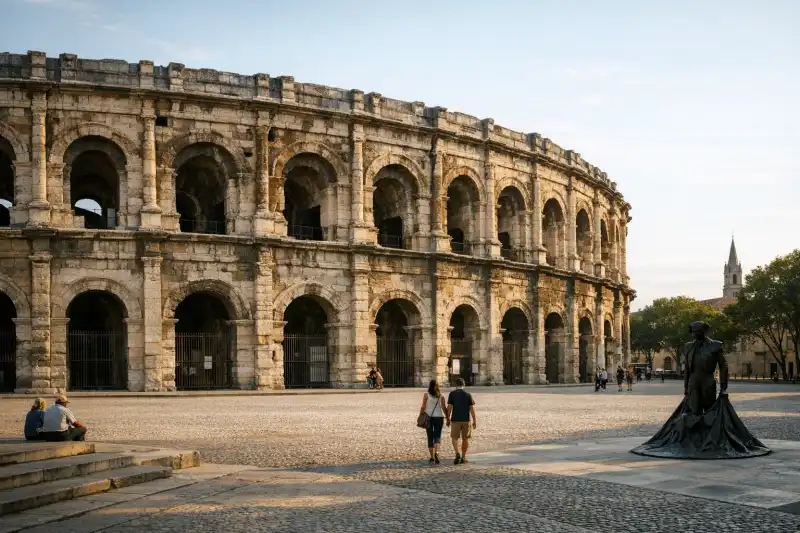
Start at the Nîmes Roman Arena, ideally after dropping your bags nearby. The arena was built around the late 1st century CE, when Nemausus was a prosperous Roman colony in southern Gaul. It is one of the clearest places in France to understand how public spectacle sat inside everyday urban life.
Do not treat the arena as just a shell. Walk the exterior first and notice the two levels of arches, then go inside and think about crowd movement. Roman amphitheaters were not only about gladiators and animal hunts. They were crowd-management machines, designed to move thousands of people through entrances, stairways, and seating zones with impressive discipline.
Keep the rest of the day simple. Nîmes is compact, and the Roman remains make more sense when you walk between them rather than hopping in and out of taxis. Stay central, eat nearby, and resist the urge to add Arles today. The train ride is short, but the first day lands better if Nîmes gets room to breathe.
Day 2: A slower second day in Roman Nîmes
Use the second day to deepen Nîmes instead of rushing east. Return to the Nîmes Roman Arena if you only saw it briefly on arrival. The building survived partly because it kept being used. In the Middle Ages, houses and even a small neighborhood grew inside the arena. That afterlife is part of the story, not an inconvenience to the Roman one.
This is a good day for walking the shape of the Roman city. Nemausus grew rich under Roman rule, and the monuments were not scattered randomly. They belonged to a civic environment where water supply, worship, entertainment, and status all had architectural form. The stones are quiet now, but the urban ambition was not subtle.
Keep your logistics light. Stay a second night in Nîmes, do laundry if needed, and avoid booking a late transfer. Tomorrow’s move to Arles is easy, but these compact Roman cities reward alertness. If you overpack the day, the monuments start blurring into one another.
Day 3: Arles Amphitheatre and the Rhône city
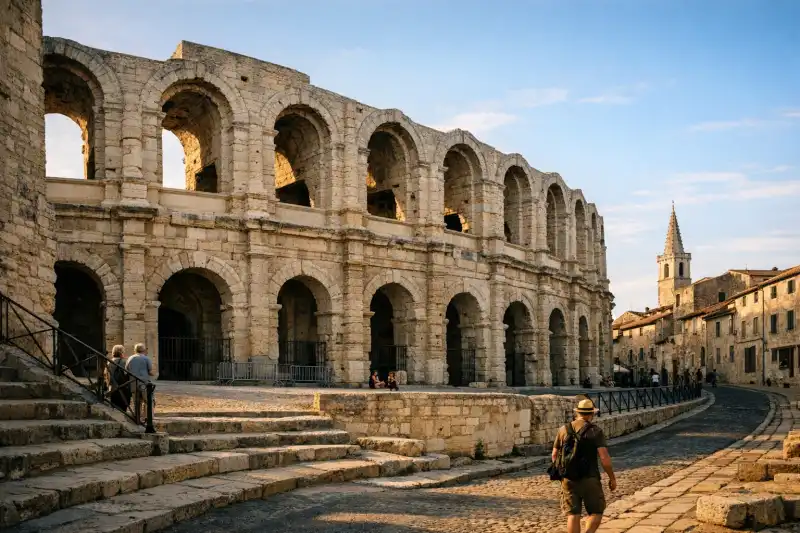
Take the train from Nîmes to Arles in the morning. The ride is short enough that you can arrive, check bags, and still give the Arles Amphitheatre a proper visit. Ancient Arelate mattered because of its position near the Rhône, a river route that tied the Mediterranean to inland Gaul.
The amphitheater dates to the Roman imperial period and feels different from Nîmes because Arles wraps around it more tightly. Again, look at the circulation. The exterior arcades are handsome, but the more interesting question is how a Roman crowd entered, found its place, watched controlled violence, and left through a building designed for mass behavior.
Stay overnight in Arles. Many travelers day-trip here and leave too quickly. That works if you only want the main photo, but the Roman city is better in the evening, when the tour groups thin and you can feel how ancient structures sit inside the modern town.
Day 4: Arles at Roman street level
Spend a second day in Arles without apologizing for the slower pace. The Arles Amphitheatre is the anchor, but the point today is to see it as part of a Roman colony rather than a standalone attraction. Arles rose under Roman patronage after siding with Julius Caesar against Massalia, and that political choice helped reshape the city’s future.
This is a good day for people who like their ruins urban. You are not chasing lonely stones in a field. You are reading layers inside a town that kept rebuilding itself. Roman entertainment architecture, medieval reuse, modern streets, and tourism all share the same tight space.
Keep the afternoon flexible. If the weather is hot, break the day in two and rest indoors. If you are moving north tomorrow, check train times before dinner and decide whether you are sleeping in Dijon, Montbard, or another practical base. Alesia is the historical payoff, but it punishes vague planning.
Day 5: Alesia and the end of Gallic resistance
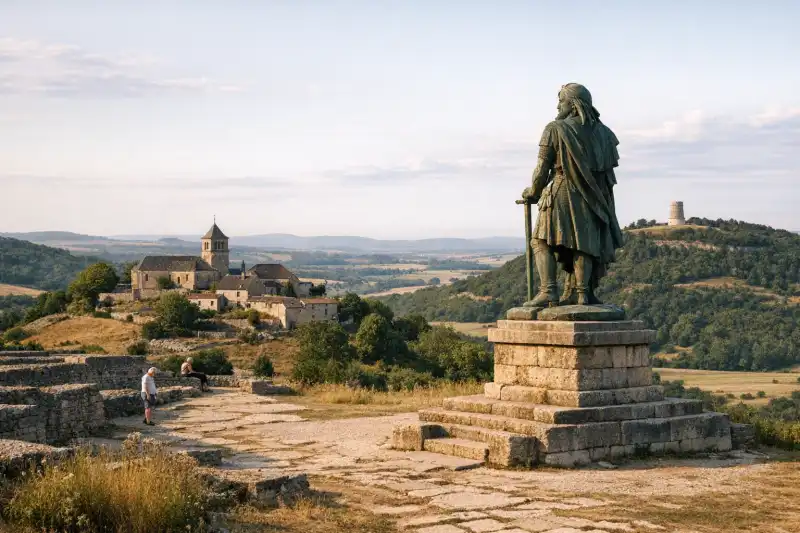
Today leaves Provence behind. Be honest about that. Alesia belongs to a different landscape and a different kind of Roman story. Instead of amphitheaters, civic pride, and urban spectacle, you are dealing with siege warfare, political collapse, and the Roman conquest of Gaul.
Alesia is associated with Julius Caesar’s victory over Vercingetorix in 52 BCE. The story is famous because Caesar wrote about it himself in the Commentarii de Bello Gallico, which makes the site both archaeological and literary. You are walking through a landscape that Rome also turned into propaganda.
Give the site more time than the map suggests. The drama of Alesia is not a single wall or monument. It is the terrain: hilltop position, encirclement, supply pressure, and the brutal logic of siege works. The Roman army reportedly built lines facing both inward toward the besieged Gauls and outward against relieving forces. That double-facing anxiety is the detail that makes Alesia stick.
Logistically, this is the day to be careful. Train access gets you partway, but the final approach may need a rental car, taxi, or local bus depending on season and schedule. Do not plan a tight same-day international departure after Alesia. End in Dijon or another sensible rail base and let the route finish without panic.
The historical thread: Roman spectacle, Gallic cities, and Caesar’s hard edge
Nîmes and Arles show Roman power as urban confidence. Their amphitheaters made hierarchy visible: who sat where, who performed, who watched, and how a colonial city displayed its place inside the empire. These were not just entertainment venues. They were civic architecture with a crowd inside.
Alesia changes the mood. It points to the violence that made Roman Gaul possible in the first place. Caesar’s victory over Vercingetorix did not instantly turn Gaul into a peaceful Roman province, but it became the symbolic breaking point in the conquest. Ending here gives the itinerary a useful tension: the polished Roman cities of southern France rest on a much harder military history.
Transportation notes
Use trains for Nîmes to Arles. They are frequent enough for a relaxed transfer, and both historic centers are walkable if you choose hotels carefully.
Do not self-drive inside Nîmes or Arles just for the Roman sites. A car becomes useful only if you are adding rural stops or if you want full control for Alesia. For the final day, plan the route north in advance and decide where you will sleep before booking the Alesia visit.
The biggest compression warning is simple: do not try to make Alesia a casual add-on from Arles. It is a long northbound move into Burgundy. If that sounds like too much, cut Alesia and keep the trip southern. That is a cleaner vacation, even if it loses the Caesar and Vercingetorix finale.
Optional add-ons and swaps
If you want a tighter Roman Provence itinerary, remove Alesia and add another southern Roman day around Nîmes or Arles. This keeps the route geographically honest and reduces transfer stress. The tradeoff is that you lose the Gallic Wars ending.
If you want a deeper pre-Roman France contrast and have a much longer trip, the Carnac Stones are a fascinating add-on, but they are in Brittany and do not belong in this 5-day route. Add Carnac only by removing Alesia and building a separate western France leg.
If you have less energy, cut Day 2 in Nîmes or Day 4 in Arles and make this a 3-day southern France route. Keep one full day each for Nîmes and Arles, then decide whether Alesia is worth the transfer.
Shorter and longer itinerary options
For a shorter version, spend three days between Nîmes and Arles only: one full day in Nîmes, one full day in Arles, and one buffer day for slower walking, museums, or nearby Roman landscapes.
For a longer version, keep this 5-day route and add two or three days in Burgundy after Alesia. That turns the final stop from a rushed historical detour into a proper northern France extension.
There are no published related route-family pages for this exact itinerary yet. When a shorter Roman southern France route or a longer Roman Gaul route is available, those should be linked here.
Related ancient sites
FAQ
The most common planning questions for this route are answered below.