Quick Info
At a glance
Amphipolis in Greece occupies one of those landscapes where geography feels inseparable from history. Set near a bend of the Strymon River in northern Greece, the ancient city once controlled routes between the Macedonian interior, Thrace, and the northern Aegean. Today, the setting still explains its past: fertile plains spread outward, low hills shape the horizon, and the remains of walls, foundations, graves, and monuments hint at centuries of ambition, warfare, trade, and royal attention. For travelers who know Athens, Delphi, or Olympia, Amphipolis offers something different: a major ancient site that still feels quiet, expansive, and deeply connected to the wider story of Macedon.
What makes Amphipolis especially compelling is the range of eras visible here. It began as a contested colonial foundation, became a strategically vital Athenian possession, passed through periods of conflict and independence, then rose again under Philip II and Alexander the Great as a city of real significance to the Macedonian kingdom. In Roman times, it remained important thanks to the Via Egnatia, one of the great roads of the ancient world. Even beyond antiquity, the area continued to matter through the Byzantine period. A visit to Amphipolis is therefore not about one isolated ruin but about reading an entire historical corridor. The archaeology museum, the circuit of the ancient walls, the famous Lion of Amphipolis, and the nearby Kasta Tomb all help visitors piece together a city that once stood at the crossroads of empire.
History
Before the city: Thracian roots and contested ground
Long before Amphipolis became a Greek and later Macedonian city, the region was inhabited by Thracian populations, especially the Edonians. The site’s importance was obvious. It sat near timber resources, precious metals from the wider region, and a river crossing that linked inland territories to the coast. These advantages made the area attractive to expanding Greek powers during the 5th century BCE, particularly Athens, which depended on imported grain, naval timber, and strategic outposts.
Athens attempted to establish control over the region before Amphipolis itself was securely founded. Earlier efforts met resistance, and the area remained unstable. The challenge was not simply military. Any colony here had to hold river routes, organize agricultural land, and defend itself from neighboring peoples and rival Greek interests. That difficulty is part of what makes Amphipolis historically significant: its success was neither inevitable nor easy.
Athenian foundation and the Classical city
The city of Amphipolis was founded by the Athenians in 437/436 BCE under Hagnon, son of Nicias. Its name is often explained as referring to the way the Strymon flows around the settlement on several sides. From the start, Amphipolis was designed as more than a remote colony. It was intended to anchor Athenian power in the north and secure resources critical to the city’s wider imperial network.
During the Peloponnesian War, Amphipolis became one of the conflict’s most important northern theaters. In 424 BCE, the Spartan general Brasidas captured the city, dealing a major blow to Athenian interests. The event became famous not only for its political consequences but also because it drew in the historian Thucydides, who as an Athenian commander in the region was blamed for failing to save the city. His later account gives Amphipolis a lasting place in the written history of the war.
A subsequent battle in 422 BCE led to the deaths of both Brasidas and the Athenian leader Cleon. Although Athens tried repeatedly to recover the city, Amphipolis increasingly developed its own local identity. It remained a key urban center whose allegiance and autonomy mattered to all the major powers around it.
Macedonian control and the age of Alexander
In 357 BCE, Philip II of Macedon took Amphipolis and integrated it into the expanding Macedonian kingdom. This was a turning point. Under Macedonian rule, the city’s strategic value only grew. Amphipolis helped secure access to the east, protected communications, and connected the royal center with coastal and frontier zones. Its resources and position made it an important support base for Philip’s state-building efforts.
The city reached another level of prominence in the age of Alexander the Great. Amphipolis served as a naval and administrative center, and several notable figures in Alexander’s circle had ties to the city or region. Its harbor access through nearby ports and its connections inland meant that it functioned within the broader machinery of Macedonian expansion. Troops, officials, supplies, and information all moved through this corridor.
The surrounding area also became associated with elite burials and monuments, a sign of its prestige. While many details remain debated, the archaeological discoveries around Amphipolis, especially the Kasta Tomb area, reinforce the impression of a landscape bound up with Macedonian power and memory.
Roman and Byzantine continuity
After the Roman conquest of Macedonia in the 2nd century BCE, Amphipolis continued to prosper. The Romans valued the city for many of the same reasons as earlier rulers had. Most importantly, it lay on the route of the Via Egnatia, the great road connecting the Adriatic with the eastern provinces. This turned Amphipolis into a waypoint in a much larger imperial system of administration, trade, military movement, and communication.
The city became the capital of one of the districts into which the Romans initially divided Macedonia. Even as political structures changed, Amphipolis retained a civic and regional role. Public buildings, domestic remains, inscriptions, and funerary monuments attest to an urban life that adapted rather than disappeared.
In the Byzantine period, settlement in the area persisted, though the urban form changed over time. Fortifications were reused and rebuilt, churches appeared, and the ancient city gradually transformed into a layered archaeological landscape. The result for modern visitors is not a single frozen moment but a place shaped across many centuries of continuity, conflict, and reinvention.
Key Features
Amphipolis does not overwhelm visitors with one colossal surviving temple or stadium. Its appeal is subtler and, for many travelers, richer. The site rewards those willing to imagine the ancient city in relation to its terrain. As you move through the archaeological area, the surviving line of the walls is one of the most meaningful features. These fortifications once enclosed an important urban center and still help define the scale of the settlement. Looking across the earthworks and masonry traces, you begin to understand that Amphipolis was not a minor outpost but a true city with defenses worthy of its strategic role.
The archaeological museum is essential to any visit. Many objects found in the area are displayed there with enough context to make sense of the wider landscape outside. Grave stelae, architectural fragments, inscriptions, ceramics, and sculpture reveal the social complexity of the city across different periods. The museum helps bridge what can otherwise feel like an incomplete site. Instead of isolated stones in a field, Amphipolis becomes legible as a place of households, sanctuaries, administration, and long-distance connections.
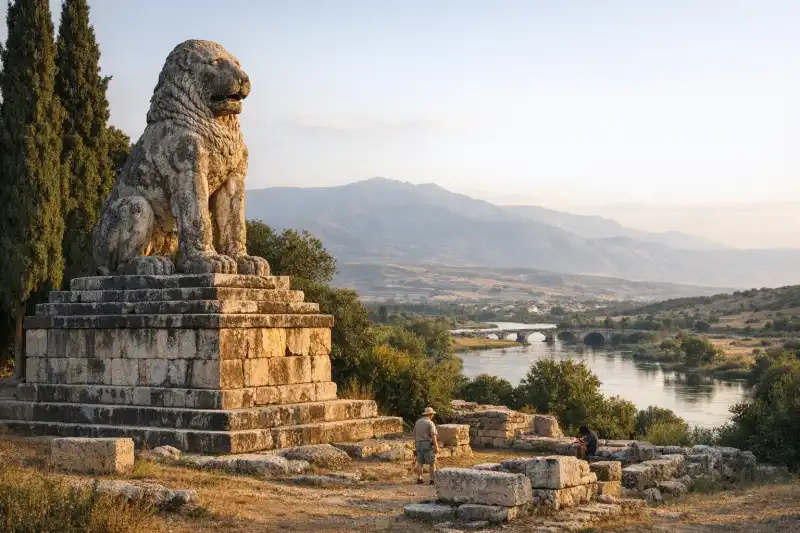
The Lion of Amphipolis is the site’s most iconic monument. Although the lion now stands reconstructed near the Strymon, away from the main archaeological core, it remains one of northern Greece’s most memorable ancient sculptures. Monumental yet elegant, the lion has become a symbol of the city and of the larger Macedonian funerary tradition. Scholars have long debated its original function and exact association, but for visitors its power is immediate. It suggests honor, status, and commemoration on a grand scale. The sculpture’s commanding posture also suits the landscape, as if still guarding the river corridor that made Amphipolis so valuable.
Another major point of interest is the Kasta Tomb, located in the wider Amphipolis area. Access conditions may change, and not all parts are necessarily open in the way travelers expect, but the discovery transformed public awareness of the site. The monumental tumulus, sphinxes, caryatid figures, pebble mosaics, and sophisticated architectural design point to a burial project of exceptional ambition from the late Classical or early Hellenistic era. Even where full entry is limited, the tomb’s significance deepens the experience of Amphipolis by reminding visitors that this was a place closely linked to elite Macedonian memory and display.
The natural setting is also one of the city’s key features. Amphipolis was shaped by the river, by nearby access to the sea, and by the fertile land around it. This environmental context is not decorative; it is historical evidence. The prosperity of the city, the contests over it, and its role in regional politics all become easier to understand when you stand in the landscape itself. The views are not dramatic in the same way as a hilltop acropolis, but they are revealing. Roads, river, fields, and hills combine into a geography of power.
Finally, Amphipolis stands out because it remains comparatively uncrowded. That changes the quality of the visit. You can spend time tracing walls, moving slowly through the museum, and reflecting on the relationship between local archaeology and the grand narratives of Athens, Sparta, Macedon, and Rome. For travelers who appreciate atmosphere as much as monuments, this quieter pace is one of the site’s greatest strengths.
Getting There
Amphipolis is most easily reached by car. From Thessaloniki, the drive is roughly 100 to 110 kilometers and usually takes about 1 hour 20 minutes to 1 hour 40 minutes via the A2/Egnatia Odos. Tolls and fuel make this the most convenient option for independent travelers, and a typical one-day car rental from Thessaloniki often starts around €35 to €60 in low season, rising in summer. Driving also makes it easier to combine the archaeological site, museum, Lion of Amphipolis, and the wider Kasta Tomb area.
Public transport is possible but less direct. Regional buses from Thessaloniki toward Serres or Kavala may serve nearby stops, though schedules can be limited and may require checking current KTEL timetables in advance. Fares are generally modest, often around €10 to €18 one way depending on route and connection. From a bus stop in the wider area, you may still need a taxi to reach the archaeological site comfortably. Short taxi rides locally can cost about €10 to €20, while longer transfers from nearby towns will cost more.
Organized day trips are another practical choice, especially for travelers who prefer not to navigate rural transport. Private or small-group tours from Thessaloniki can be more expensive, often starting around €80 and ranging upward depending on inclusions, but they remove the uncertainty around timings and access. If you are already staying in Kavala, Drama, or Serres, Amphipolis makes a reasonable half-day or full-day excursion with much shorter road journeys.
When to Visit
The best times to visit Amphipolis are spring and autumn, when northern Greece is mild, green, and comfortable for walking outdoors. From April to early June, the surrounding countryside is especially attractive, and temperatures are usually pleasant enough to explore both the open archaeological areas and nearby monuments without much heat stress. September and October are similarly rewarding, with warm light, fewer crowds, and a more relaxed atmosphere on the roads.
Summer is entirely possible, but the site can feel exposed in the middle of the day. July and August often bring strong sun and temperatures above 30°C, so early morning visits are the most comfortable. Bring water, a hat, and sun protection, especially if you plan to move between the museum, outdoor ruins, and the lion monument. The upside of summer is long daylight and easy combination with a northern Greece road trip that also includes beaches or mountain villages.
Winter has its own appeal for travelers who prefer solitude and clear historical focus over ideal weather. Northern Greece can be cool, damp, and occasionally windy, but Amphipolis remains visitable and often very quiet. The softer light can be excellent for photography, and museum visits are especially pleasant then. The main caution is to check opening hours, which may be reduced in the off-season.
Whenever you go, it is wise to confirm current access conditions in advance, especially for museum schedules and any viewing arrangements related to the Kasta Tomb area. Amphipolis is rewarding year-round, but timing your visit well can make the site easier to appreciate in full.
| Quick Facts | Details |
|---|---|
| Location | Central Macedonia, northern Greece |
| Ancient significance | Major Athenian colony later incorporated into Macedon |
| Founded | 437/436 BCE |
| Strategic feature | Controlled routes along the Strymon River and toward Thrace |
| Famous monument | Lion of Amphipolis |
| Nearby discovery | Kasta Tomb |
| Best base for a day trip | Thessaloniki or Kavala |
| Best seasons | Spring and autumn |
| Time needed | 2 to 4 hours for site, museum, and nearby monuments |
| Best for | Ancient history enthusiasts, archaeology travelers, Macedonian history fans |
Guided tours: worth it?
Self-guided works here, but a guide can add real value if you want the ruins explained as a living place rather than just a sequence of monuments.
Best for
- First-time visitors who want context, not just photos
- Short visits where a planned route saves time
When to go self-guided
Go independently if you prefer setting your own pace, reading as you go, and checking official hours or ticket rules directly before you arrive.
What I’d avoid
Skip paid tours that bundle unrelated stops you do not actually want. The best option should either save meaningful planning time or add historical context you would miss on your own.
Amphipolis and Kasta Tomb Area Tours
Useful when: you want to compare guided formats before deciding
Day Trips from Thessaloniki to Amphipolis
Useful when: transport or pickup logistics matter
Ancient Macedonia Archaeology Tours
Useful when: you want to compare guided formats before deciding
Some tour links are affiliate links, which may earn Ancient Travel a small commission at no extra cost to you. I try to surface options that make practical sense for the site—not just anything bookable.
Frequently Asked Questions
Where is Amphipolis located?
Amphipolis is in northern Greece, in the Serres regional unit of Central Macedonia, near the Strymon River and not far from the Aegean coast.
What is Amphipolis famous for?
Amphipolis is known for its importance in ancient Macedonian history, its strategic position on the Strymon, the famous Lion of Amphipolis, and the nearby Kasta Tomb.
Can you visit the archaeological site of Amphipolis?
Yes, visitors can explore the archaeological area and the local museum, though access to specific zones may vary depending on conservation work and seasonal opening hours.
How far is Amphipolis from Thessaloniki?
Amphipolis is roughly 100 to 110 kilometers east of Thessaloniki, and the drive usually takes about 1.5 hours depending on traffic.
Is Amphipolis worth visiting for history lovers?
Yes, Amphipolis is especially rewarding for travelers interested in Classical Greece, Macedonian expansion, Roman roads, and lesser-visited archaeological landscapes.
Do you need a car to visit Amphipolis?
A car is the easiest option, but buses serving the wider area and organized day trips from Thessaloniki can also make a visit possible.
Nearby Ancient Sites
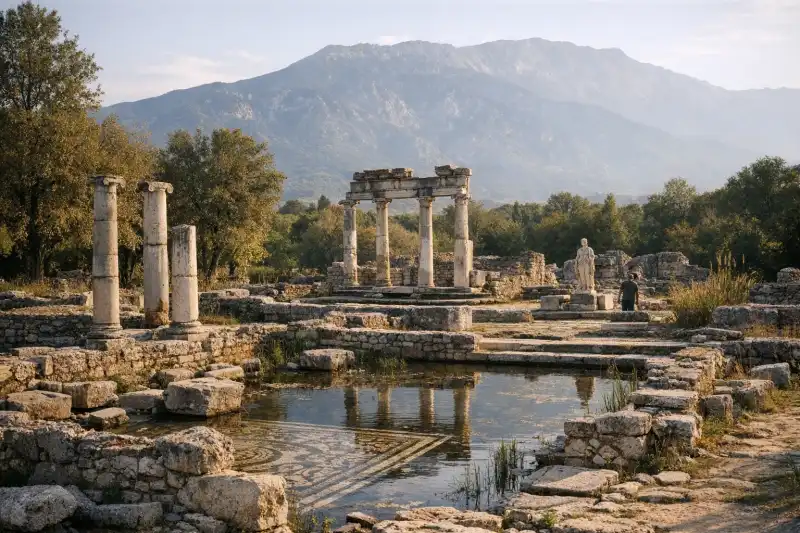
Ancient Dion
Macedonian, Hellenistic Greek, and RomanExplore Ancient Dion in Greece, a sacred Macedonian city at Mount Olympus with temples, theaters, ba...
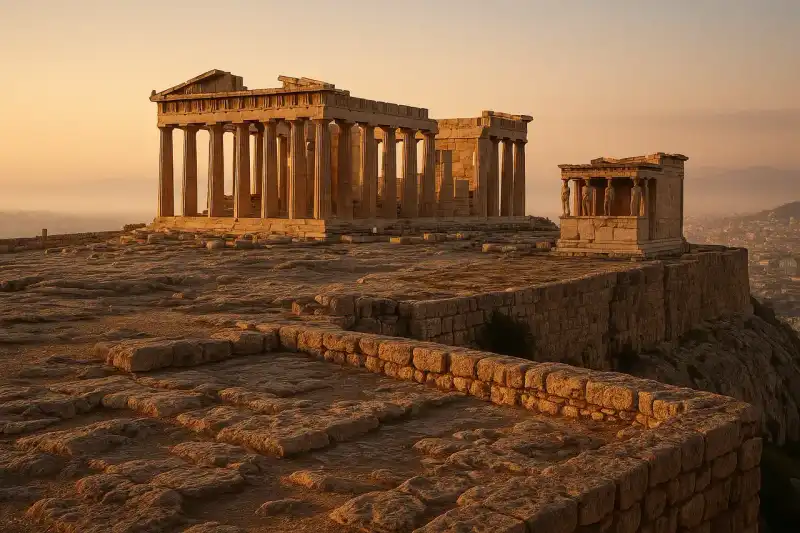
Acropolis Travel Guide 2026: Parthenon, Tickets, and Best Time
Ancient GreecePlan an efficient Acropolis visit with practical ticket timing, key monuments, and museum pairing ti...
The Complete Acropolis Athens Travel Guide: Temples
Ancient GreecePlan the perfect visit to the Acropolis of Athens with our 2026 guide. Discover the Parthenon, best ...