Quick Info
At a glance
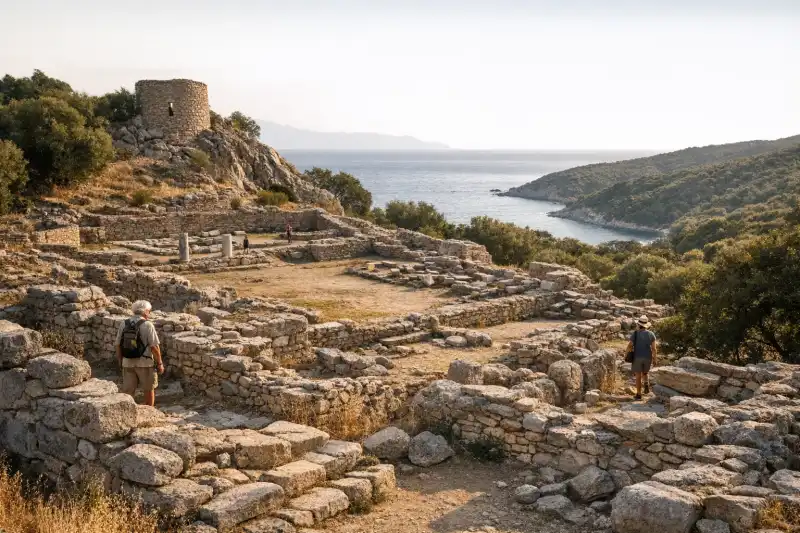
Ancient Stagira in Greece occupies one of the most dramatic settings of any classical site in northern Macedonia: a rocky, sea-washed peninsula edged by coves, pine-covered slopes, and broad views across the Strymonic Gulf. Even before you begin reading the masonry or tracing the lines of old streets, the landscape explains why a community took root here. The site feels both protected and open, with natural harbors, defensible ground, and easy visual command of the coast. For modern visitors, that combination creates an experience that is quieter and more atmospheric than many of Greece’s better-known ruins.
Stagira matters historically for many reasons, but above all because it is associated with Aristotle, who was born here in 384 BCE. That single fact gives the city an enduring place in world cultural history. Yet the archaeological remains tell a broader story than biography alone. Ancient Stagira was a functioning Greek city with walls, houses, sanctuaries, water systems, and public spaces that developed over centuries, suffered destruction, and revived under new political realities. Today, wandering through the site near modern Olympiada, you encounter not a monumental marble showpiece but a lived-in urban landscape. Its stone foundations, towers, and streets reveal a community shaped by trade, war, regional alliances, and the shifting fortunes of ancient Macedonia. The result is a destination that rewards travelers who enjoy context, scenery, and the sense of discovering a place still closely tied to its natural setting.
History
Early foundation and Archaic growth
Ancient Stagira was founded in the 7th century BCE, generally understood to have been established by colonists from Andros, with possible participation from settlers from Chalcis as well. Its position on the northeastern edge of the Chalkidiki peninsula made practical sense. The city had access to maritime routes running along the northern Aegean and stood within a region rich in timber, metals, and agricultural resources. Like many Greek colonies of the Archaic period, Stagira was not an isolated outpost but part of an expanding web of communities connected by trade, kinship, and political ambition.
During its early centuries, the city grew into a recognizable polis. Archaeological evidence points to organized habitation, fortification, and civic planning. Its harbors would have helped support exchange with the islands and mainland Greece, while the surrounding hinterland sustained local life. Stagira’s early development reflects the broader story of Greek colonization, when settlements sought both economic opportunity and strategic security. Though it was never among the largest Greek cities, it held a significant local role and occupied a valuable coastal node in the ancient world.
Classical Stagira and the age of Aristotle
The city’s most famous son, Aristotle, was born here in 384 BCE. His father, Nicomachus, served as a physician linked to the Macedonian royal court, suggesting that Stagira already stood in meaningful contact with larger political networks in the north. Aristotle’s later career in Athens, Assos, Lesbos, and eventually at the court of Philip II and the education of Alexander the Great ensured that Stagira’s name would be carried far beyond regional history.
But the 5th and 4th centuries BCE were not peaceful for the city itself. During the Peloponnesian War, the northern Aegean became a zone of contest involving Athens, Sparta, local powers, and shifting alliances. Stagira appears in ancient historical accounts connected to these tensions. In 349 BCE, Philip II of Macedon destroyed the city during his campaigns in the region, part of his effort to consolidate Macedonian influence and neutralize resistance among the Chalcidian and neighboring cities. The destruction marked a profound turning point.
Refoundation under Macedonian power
Ancient sources record that Philip later restored Stagira, reportedly in honor of Aristotle. Whether this refoundation was entirely a personal gesture or also a calculated political act, it shows the city’s continuing symbolic and strategic importance. A re-established Stagira would have existed within a world increasingly dominated by Macedon. That meant new opportunities as well as reduced independence.
The rebuilt city adapted to Hellenistic realities. Defensive works were renewed, and habitation continued across the site. The Hellenistic period often left a layered urban fabric in cities like this one: old street lines and practical domestic spaces existed alongside modifications driven by new military and administrative needs. Stagira’s remains suggest a community that endured not through grand imperial splendor but through local resilience and the ability to function within changing regional systems.
Roman, Byzantine, and later afterlife
Under Roman rule, many Greek cities retained local importance even when they no longer played major political roles. Stagira seems to have continued in some form, though not at the level of larger regional centers. Over time, the settlement pattern shifted, and late antique as well as Byzantine occupation added new layers to the site. Such continuity is common in well-situated places: a good harbor, a defensible hill, and reliable access to resources kept drawing people back, even if the character of the community changed.
Archaeological work has identified traces from multiple periods, including fortifications and structures that speak to these later centuries. Rather than a single frozen moment, Ancient Stagira presents a long arc of habitation. Its decline was gradual, and its stones were eventually absorbed into the broader historical landscape of Macedonia.
Modern excavations have brought the city back into view. Researchers have uncovered domestic quarters, sections of walls, towers, roads, and water infrastructure that make the ancient settlement legible again. For visitors today, the history of Stagira is compelling precisely because it combines local detail with larger themes: colonization, war, Macedonian expansion, intellectual heritage, and the long persistence of human settlement on a favorable stretch of coast.
Key Features
Ancient Stagira is best appreciated as a landscape city. Unlike sites dominated by a single surviving temple or theater, it reveals itself through topography and urban texture. The first defining feature is the setting itself: two hills connected by a saddle, projecting toward the sea, with natural bays on either side. This terrain shaped everything. Standing among the ruins, you can see how the city exploited defensible ridges while maintaining close contact with the water. The sea is never just a backdrop here; it is part of the archaeology, explaining trade, communication, and strategic value.
The fortifications are among the most striking remains. Sections of walls and towers survive along the contours of the site, showing how carefully the inhabitants used the peninsula’s natural lines of defense. Even where only low stone courses remain, the scale is enough to evoke a serious urban settlement rather than a minor village. Walking beside these fortifications gives a clear sense of how the city guarded access points and monitored movement along the coast.
Equally rewarding are the domestic and civic remains spread through the site. Foundations of houses, traces of streets, and neighborhood layouts provide a sense of ordinary life. This is one of the pleasures of Ancient Stagira: it feels human in scale. Instead of moving from one monumental structure to another, you move through the framework of a real town. The remains of public and communal spaces, though more fragmentary, suggest a functioning polis with shared infrastructure and organized planning.
Water management is another important feature. Archaeologists have identified cisterns and hydraulic installations that reveal how the inhabitants dealt with storage and supply in a terrain where seasonal conditions mattered. These details may seem modest at first glance, but they are often what make ancient cities feel most intelligible. A wall tells you how a place defended itself; a water system tells you how it survived day to day.
Visitors often look for direct traces linked to Aristotle, and while the site’s fame derives from his birth here, Ancient Stagira is not a shrine built around a single philosopher’s house. That is part of its honesty and appeal. The connection to Aristotle is cultural and historical rather than theatrically staged. You are visiting the urban world that produced him, not a heavily reconstructed memorial. Nearby Aristotle Park, outside the archaeological zone, offers a more explicitly educational tribute, but the site itself remains rooted in archaeology.
The views are among the strongest reasons to visit. From different points in the ruins, you can look over the sea, the wooded slopes, and the inlets that once served the city. These views make it easier to imagine ships approaching, watchmen scanning the coast, and residents inhabiting a place where maritime awareness was a daily fact. Light also transforms the site. In the morning, the stone surfaces can appear crisp and pale; later in the day, the warmer tones of the landscape bring out the softer contours of foundations and paths.
Another notable feature is the relative tranquility of the experience. Ancient Stagira usually receives far fewer visitors than flagship archaeological destinations in southern Greece. That means you can hear the wind, the insects, and the surf, and spend time reading the site rather than navigating crowds. For travelers interested in archaeology as environment rather than spectacle, this quieter rhythm is a major advantage.
Finally, the relationship between ruins and vegetation gives Stagira much of its character. Pines, shrubs, and coastal plants frame the archaeological remains without completely overpowering them. The result is a site that feels integrated into the land rather than detached from it. Ancient Stagira is not simply something to photograph; it is somewhere to walk slowly, observe carefully, and understand as both city and coastline at once.
Getting There
Ancient Stagira is near the modern village of Olympiada in eastern Chalkidiki, and the usual gateway is Thessaloniki. By car, the drive from Thessaloniki generally takes around 1 hour 45 minutes to 2 hours 15 minutes, depending on traffic and your exact starting point. Rental cars offer the easiest and most flexible option, especially if you want to combine the ruins with beaches or other stops in Chalkidiki. In high season, a small rental car commonly starts around €35-€60 per day before fuel, while petrol costs vary but should be factored in for the round trip.
Public transport is possible but less direct. Buses from Thessaloniki’s intercity KTEL station may connect toward the Olympiada area, sometimes requiring a change in larger regional hubs such as Stavros or Ierissos depending on the schedule. One-way fares are often in the roughly €10-€18 range in total, but routes and timing can be limited, so checking current schedules in advance is essential. If you rely on buses, plan for a longer day and less flexibility.
Taxis from nearby towns can help with the final leg if you are staying elsewhere in Chalkidiki, though costs rise quickly over longer distances. A local transfer from the broader area might cost €15-€40, while a full taxi from Thessaloniki would usually be far more expensive than self-driving. Organized day tours from Thessaloniki are often the simplest no-planning option; prices commonly begin around €60-€120 per person depending on whether the itinerary includes beaches, Aristotle Park, or other regional attractions.
Once you arrive, expect some walking on uneven ground. Wear shoes with grip, bring water, and allow extra time if you prefer a slow, scenic visit.
When to Visit
The best times to visit Ancient Stagira are spring and early autumn, when temperatures are mild and the surrounding landscape is at its most inviting. From April to early June, wildflowers and greener hillsides soften the stone ruins and make the site especially photogenic. Daytime conditions are usually comfortable for walking, with enough warmth to enjoy the coast without the intense heat that can build later in summer.
September and October are equally attractive. The sea remains bright and appealing, summer crowds in Chalkidiki begin to thin, and the light can be particularly beautiful in the late afternoon. These months are ideal if you want to combine archaeology with a broader coastal trip. The site’s exposed position means that even moderate temperatures can feel warmer in direct sun, so a hat and sunscreen remain useful.
July and August are perfectly possible but require more planning. Midday heat can be tiring, and the rocky ground reflects sunlight strongly. If visiting in peak summer, arrive early in the morning or later in the afternoon, carry plenty of water, and avoid expecting much shade inside the archaeological zone. The benefit of summer is easier pairing with swimming or a beach stop in Olympiada.
Winter offers a quieter, more contemplative atmosphere. You may have the site nearly to yourself, and the coastal weather can be crisp and clear. However, conditions can be windy or damp, and opening arrangements may feel less predictable than in high season. For most travelers, late spring and early autumn provide the best balance of comfort, scenery, and flexibility. If photography matters to you, aim for softer morning or late-day light, when the sea and stone surfaces are at their most expressive.
| Quick Facts | Details |
|---|---|
| Location | Near Olympiada, Chalkidiki, Central Macedonia, Greece |
| Famous For | Birthplace of Aristotle |
| Founded | 7th century BCE |
| Main Periods | Archaic, Classical, Hellenistic, Roman, Byzantine |
| Best Base | Olympiada or Thessaloniki |
| Ideal Visit Length | 1.5 to 3 hours |
| Best Seasons | Spring and early autumn |
| Terrain | Uneven archaeological paths, coastal slopes, rocky ground |
| Nearest Major City | Thessaloniki |
| Why Visit | Scenic ruins, Macedonian history, Aristotle connection, coastal views |
Guided tours: worth it?
Most travelers can visit Ancient Stagira independently. Compare a tour only if you want a tighter history-focused visit, easier logistics, or a guide who can answer questions on the spot.
Best for
- Short visits where a planned route saves time
When to go self-guided
Go independently if you prefer setting your own pace, reading as you go, and checking official hours or ticket rules directly before you arrive.
What I’d avoid
Skip paid tours that bundle unrelated stops you do not actually want. The best option should either save meaningful planning time or add historical context you would miss on your own.
Ancient Stagira and Aristotle Park Tours
Useful when: you want to compare guided formats before deciding
Chalkidiki Historical Day Trips
Useful when: transport or pickup logistics matter
Thessaloniki to Ancient Stagira Tours
Useful when: you want to compare guided formats before deciding
Some tour links are affiliate links, which may earn Ancient Travel a small commission at no extra cost to you. I try to surface options that make practical sense for the site—not just anything bookable.
Frequently Asked Questions
Where is Ancient Stagira located?
Ancient Stagira is in northeastern Chalkidiki in Central Macedonia, Greece, near the modern village of Olympiada on the coast.
Why is Ancient Stagira famous?
The site is best known as the birthplace of Aristotle, one of the most influential philosophers of the ancient world.
How much time do you need to visit Ancient Stagira?
Most visitors spend 1.5 to 3 hours exploring the archaeological area, depending on how much time they devote to the fortifications, houses, and coastal views.
Can you visit Ancient Stagira on a day trip from Thessaloniki?
Yes. Ancient Stagira is reachable as a long but manageable day trip from Thessaloniki by car or organized tour.
Is Ancient Stagira suitable for casual visitors and families?
Yes, though paths can be uneven and rocky in places, so sturdy footwear and care on slopes are recommended.
What should you combine with a visit to Ancient Stagira?
Many travelers combine the ruins with Aristotle Park, the beaches near Olympiada, or a broader tour of eastern Chalkidiki.
Nearby Ancient Sites
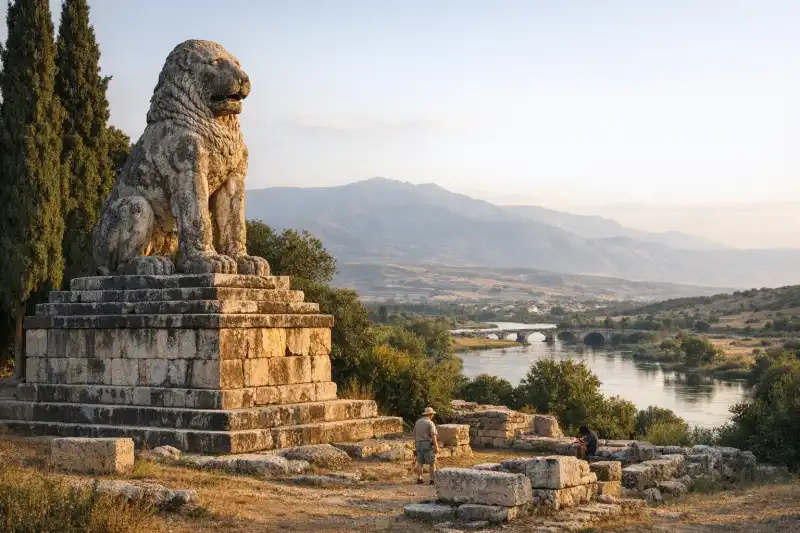
Amphipolis
Ancient Greek, Macedonian, Roman, ByzantineExplore Amphipolis in Greece, an important ancient Macedonian city famed for its walls, lion monumen...
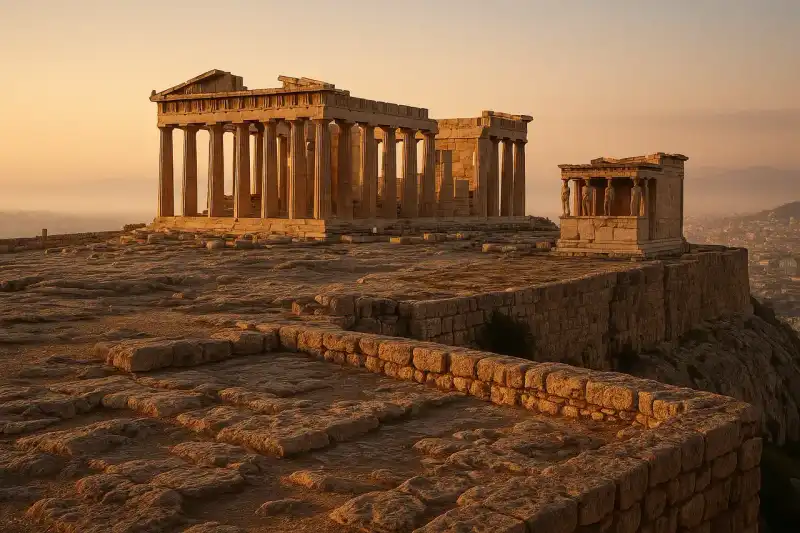
Acropolis Travel Guide 2026: Parthenon, Tickets, and Best Time
Ancient GreecePlan an efficient Acropolis visit with practical ticket timing, key monuments, and museum pairing ti...
The Complete Acropolis Athens Travel Guide: Temples
Ancient GreecePlan the perfect visit to the Acropolis of Athens with our 2026 guide. Discover the Parthenon, best ...