Quick Info
Curated Experiences
Cook, Craft, and Explore Aphrodisias from Izmir
Pamukkale and Aphrodisias Small-Group Day Tour
Private Aphrodisias Tour from Kusadasi
At Aphrodisias in Turkey, the silence is the first surprise. You stand in one of the best-preserved Roman stadiums in the world, ringed by marble seating that once held thirty thousand voices, and hear wind in the grasses instead of tour-bus engines. The scale is imperial, the carving is delicate, and the atmosphere feels almost private. That combination is rare. Most famous ancient cities give you either monumentality or intimacy; Aphrodisias gives you both in a single circuit.
What makes the site unforgettable is not one postcard ruin but a whole urban system still legible: temple, theater, bath complexes, civic squares, workshops, and a sculpture school whose marble output shaped artistic taste across the eastern Roman world. At Ancient Travels, we recommend Aphrodisias as one of the strongest counterweights to crowded marquee sites. You get exceptional archaeology with room to breathe. This guide covers the city’s layered history, the key monuments worth your time, transport from regional hubs, practical ticket and hour planning, seasonal strategy, and how to combine the site with western Turkey’s other major classics.
History: A Marble City Built Around a Goddess
Carian sanctuary origins (before c. 3rd century BCE)
Long before the Roman city rose here, the plateau held a local cult center linked to a regional fertility deity who would later be identified with Aphrodite. The area belonged to inland Caria, a landscape of farming communities, hill routes, and mixed Anatolian traditions. Archaeological evidence suggests a sacred focus developed first, with settlement activity clustering around ritual life rather than formal urban planning. That origin matters because Aphrodisias never behaved exactly like a purely military or administrative foundation; from the start, identity, worship, and prestige were fused. The sanctuary drew resources, artisans, and patronage that eventually made large-scale city building possible.
Hellenistic urban shaping (c. 3rd century-1st century BCE)
In the Hellenistic period, local elites and regional dynasties began formalizing the settlement around the sanctuary. Streets, civic spaces, and monumental ambitions appeared in stages rather than through one master blueprint. The city adopted Greek civic forms while retaining strong local character, and the cult of Aphrodite became both spiritual center and political branding. By the 1st century BCE, Aphrodisias was positioned to benefit from Rome’s reorganization of Anatolia. Its religious prestige gave it leverage, and its marble resources gave it economic power. Even before imperial patronage peaked, the city was already evolving from sacred town into a high-status urban center.
Roman flourishing and sculptural fame (1st century BCE-3rd century CE)
Aphrodisias reached its golden age under Roman imperial rule. The city received privileges in the early imperial period and expanded with confidence: grand colonnades, bath complexes, the theater, the Sebasteion, and the immense stadium all belong to this long era of investment. At the same time, local workshops made Aphrodisias synonymous with elite marble carving. Sculptors trained here produced portraiture, mythological groups, and reliefs exported across the empire. Inscriptions attest to a civic identity built on both piety and artistic excellence. You can still feel that pride in the stonework, where technical mastery and civic propaganda were intentionally inseparable.
Christian transformation and Byzantine continuity (4th-12th centuries CE)
As Christianity spread through Anatolia, Aphrodisias transformed without simply disappearing. The Temple of Aphrodite was reworked into a basilica, pagan imagery was selectively removed or reinterpreted, and ecclesiastical institutions replaced older cult structures. The city was eventually renamed Stauropolis, signaling its Christian status. Earthquakes, changing trade routes, and broader regional instability gradually reduced urban scale, but settlement persisted for centuries. Like many Anatolian cities, Aphrodisias did not experience one dramatic end; it thinned, adapted, and contracted. The ruins visible today preserve this layered transition from classical cult city to Byzantine provincial center.
Modern rediscovery and archaeology (18th century-present)
Travelers and antiquarians noted the ruins in the early modern period, but systematic excavation accelerated in the 20th century, especially through long-running international archaeological projects. Epigraphic work at Aphrodisias became globally important because the site produced a huge corpus of inscriptions that illuminate civic administration, social life, and imperial politics. Conservation of marble sculpture and architectural fragments has been unusually strong, supported by an excellent on-site museum. In 2017, UNESCO inscribed Aphrodisias as a World Heritage Site, recognizing both the urban remains and nearby marble quarries. Today it stands as one of the clearest laboratories for studying art, religion, and identity in the Roman East.
The Key Monuments: What to See at Aphrodisias
The stadium
The Stadium of Aphrodisias is the site’s most astonishing structure and one of the best-preserved ancient stadiums anywhere. Built in the Roman period and measuring roughly 270 meters long, it could hold around 30,000 spectators, with elongated seating wrapping a racetrack-like arena. Unlike many fragmentary arenas, this one still reads as an engineered mass gathering machine: entry points, sightlines, and seating geometry remain legible from multiple angles. Later adaptations suggest use for spectacles beyond athletics, including staged combats. Walk to one end and look back across the full curve of seats for the defining photograph. Early morning light creates crisp contrast across the marble tiers and emphasizes just how complete the structure remains.
The Temple of Aphrodite and basilica conversion
At the ritual heart of the city, the Temple of Aphrodite began as a pagan sanctuary and was later transformed into a Christian basilica, making it one of the clearest architectural narratives on site. You are not seeing a static ruin; you are seeing ideological change in stone. Column lines, reused blocks, and altered spatial orientation reveal how sacred architecture was adapted rather than erased. In its Roman form, the temple anchored civic identity and pilgrimage prestige. In its Christian phase, the building served a different spiritual language while still claiming the same central ground. Visit from two vantage points: first at close range for masonry details, then from a slight distance to read the plan shifts.
The Tetrapylon
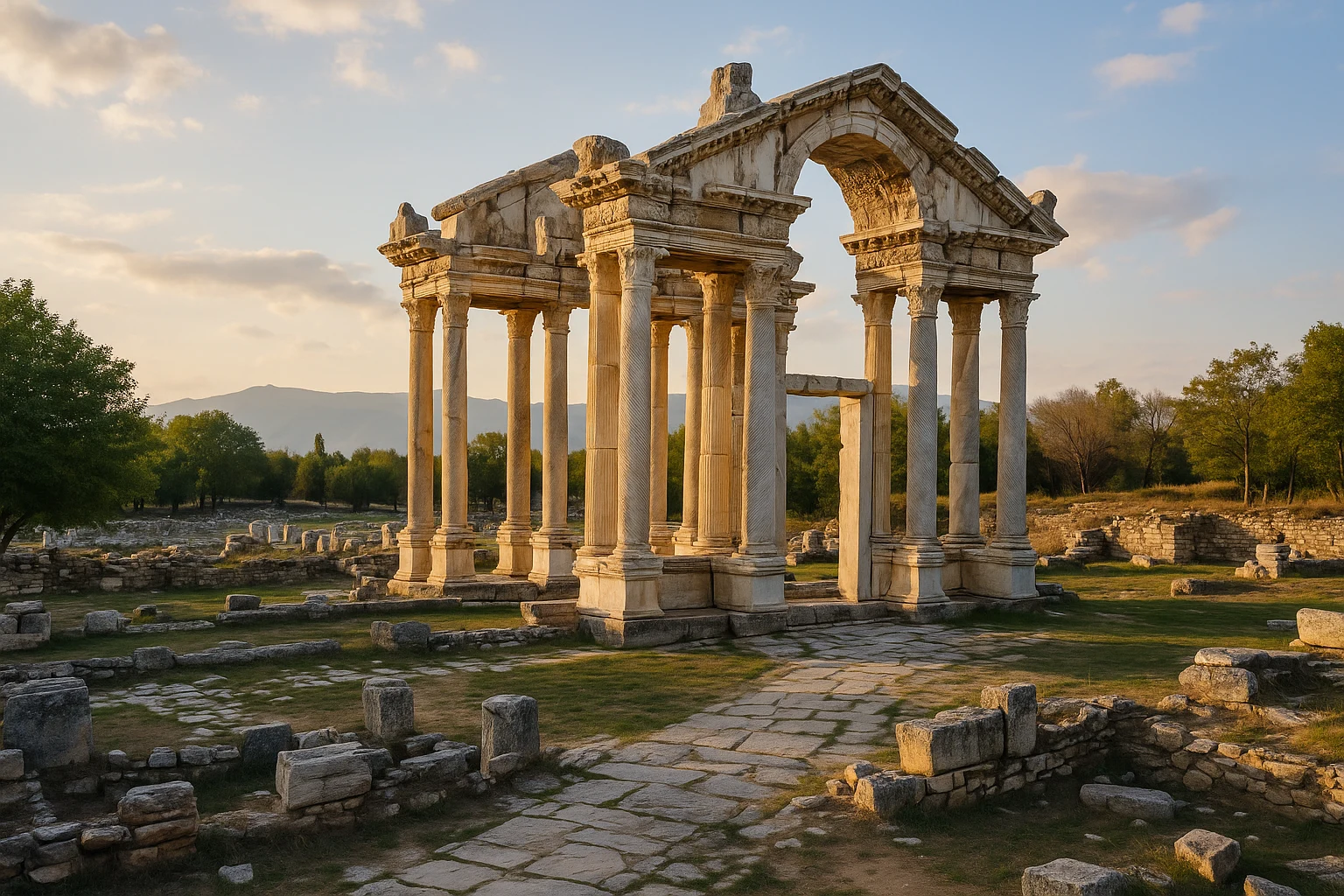
The Tetrapylon is Aphrodisias’s ceremonial gateway and most elegant marble composition. Re-erected with extensive anastylosis, it presents clustered columns, ornate capitals, and richly decorated entablature that once framed the processional approach to the sanctuary district. The structure is less about defensive or practical function and more about choreography: it controls how you enter space, where your eye lands, and how monumental identity is staged. Because so many carved surfaces survive, the Tetrapylon is also a close-up lesson in workshop quality at Aphrodisias. For photography, mid-morning can flatten details; late afternoon side light often brings out relief depth better and separates column layers beautifully.
The Sebasteion relief complex
The Sebasteion was a monumental processional avenue and temple complex dedicated to the imperial cult, famous for relief panels depicting emperors, deities, conquered peoples, and mythic scenes. Much of the architecture survives as foundations and fragment groups, while many reliefs are conserved in the museum. Together they show how local cities translated Roman imperial ideology into visual narrative. This is where Aphrodisias becomes intellectually thrilling: you can trace the language of power from street-level architecture to carved propaganda cycles. Spend time reading captions in the museum after walking the site remains; the two experiences are designed, in effect, to complete each other.
The theater, bouleuterion, and civic core
Aphrodisias’s theater climbs a natural slope and still communicates strong acoustical and ceremonial logic. Nearby, the bouleuterion (council house) reflects civic administration and elite decision-making, while adjacent agoras and baths map everyday social life. This cluster helps you understand the city as more than isolated monuments: performance, politics, commerce, and leisure operated in tight proximity. Marble revetment fragments, inscriptions, and seating forms provide evidence of sponsorship culture and public benefaction. If you have limited time, prioritize stadium, Tetrapylon, temple zone, and museum; if you have a full half-day, the civic core rewards slower pacing and makes the urban plan feel coherent rather than scattered.
The Aphrodisias Museum
The Aphrodisias Museum is not optional; it is where the site’s sculptural genius becomes undeniable. Galleries display portrait heads, mythological reliefs, sarcophagi, and Sebasteion panels with a density and quality that rival larger national collections. Many pieces preserve chisel finesse and facial modeling at an extraordinary level, confirming the city’s status as a major sculptural school. The museum also contextualizes fragmentary architecture you just walked past, turning broken blocks into readable historical data. Plan at least 45-60 minutes. If you skip it, you see impressive ruins; if you include it, you understand why Aphrodisias mattered across the Roman world.
Getting There: Transportation and Access
Aphrodisias is rural and easiest by road, so most travelers either self-drive or join a guided day tour from larger hubs.
From Pamukkale or Denizli
This is the most practical pairing for many travelers in western Turkey. The drive usually takes 1.5-2 hours depending on route and seasonal traffic.
- Taxi/private transfer: Typically 2,800-4,500 TRY ($87-140 USD) round trip depending on waiting time and negotiation.
- Public transport: Denizli buses toward Nazilli or Karacasu plus local dolmus/taxi connection; usually 2.5-3.5 hours total with schedule risk.
- Rental car: Around 1,200-2,000 TRY ($37-62 USD) per day plus fuel; easiest for flexible timing and sunset departure.
From Izmir or Kusadasi
From Izmir, the route is longer but still realistic as a full-day excursion if you leave early. Kusadasi is a common tour departure point for cruise and resort travelers.
- Guided day tour: Commonly 4,200-7,500 TRY ($131-234 USD) per person depending on inclusions and group size.
- Intercity bus + local connection: Budget-friendly but slow, often 4-5+ hours one way including transfers.
- Rental car: About 1,400-2,300 TRY ($44-72 USD) per day plus tolls/fuel; best for combining multiple archaeological stops.
Admission and Hours
Entry is ticketed in Turkish lira, and prices can update seasonally; a common recent range is around 500-650 TRY (about $16-21 USD), so check official channels shortly before visiting. Museum Pass Turkey is frequently accepted and can save money if you are visiting several major sites in one trip. Typical opening windows are longer in summer and shorter in winter, with last entry before closing. Card payment is often available but not guaranteed during outages, so carry backup cash. For comfort and best light, arrive near opening and tour the stadium or Tetrapylon before midday heat intensifies.
When to Visit: Seasonal Considerations
Spring (March-May)
Spring is the most balanced season, especially April and May. Daytime temperatures commonly range from 15-27°C (59-81°F), with greener surroundings and comfortable walking for long circuits. Crowd levels are moderate: you’ll see groups, but rarely the bottlenecks common at bigger Turkish sites. Bring a light layer for morning starts and plan museum time around midday.
Summer (June-August)
Summer can be intense, often 30-38°C (86-100°F) by afternoon with limited shade across exposed areas. Crowds remain lower than Ephesus, but heat is the main challenge, not people. Start as close to opening as possible, carry at least 1.5 liters of water per person, and use hat plus sunscreen aggressively. For most travelers, summer is manageable only with strict morning-first planning.
Autumn (September-November)
Early autumn is excellent and often the ideal compromise. Temperatures usually settle around 18-30°C (64-86°F) in September-October, with warmer afternoons and pleasant evenings. Crowd pressure eases after peak holiday weeks, and softer light improves monument photography. If you want long walking sessions without summer strain, autumn is often the sweet spot.
Winter (December-February)
Winter is quiet, atmospheric, and best for travelers who prioritize solitude over guaranteed sunshine. Typical daytime ranges hover around 8-16°C (46-61°F), with periodic rain and cooler winds over open areas. Visitor numbers are low, which makes contemplative exploration easy, but wet stone can be slippery. Waterproof layers and grippy shoes are essential, and you should verify seasonal opening hours in advance.
Combining Aphrodisias with Pamukkale and the Maeander Valley
Aphrodisias pairs naturally with Pamukkale-Hierapolis for a full archaeological day that balances natural spectacle with serious urban ruins. The most efficient sequence starts by departing Pamukkale around 8:00 AM, reaching Aphrodisias in the cooler part of the morning. Begin at the stadium and move inward toward the Tetrapylon and temple zone by 9:00 AM, before sun exposure builds across the central avenues. By 10:30 AM, continue into the Sebasteion area and civic core, then give the museum a focused visit around 11:30 AM, when midday heat is strongest outside.
Around 1:00 PM, break for lunch in the Karacasu area or on your return corridor, choosing a simple local lokanta for grilled meats, soups, and seasonal mezze rather than waiting until late afternoon. If you are returning to Pamukkale, aim to be back near 3:30 PM for travertine light and a short Hierapolis sunset circuit. Total combined experience runs roughly 10-11 hours with transfers.
If you are based in Izmir or Kusadasi and only have one long day, treat Aphrodisias as the anchor and skip overstuffing with additional ruins. The site rewards attention. Rushing it into a checklist stop misses the very reason to come: this is one of Turkey’s rare places where urban form, sculptural excellence, and spiritual history remain readable in one coherent landscape.
Why Aphrodisias Matters
Aphrodisias matters because it shows how beauty can be civic policy. This was not a marginal town with a lucky ruin; it was a city that invested in art as infrastructure, in carving as identity, in sacred space as political language. You see that ambition in the Tetrapylon’s choreography, in the stadium’s improbable survival, and in portrait heads whose expressions still feel psychologically alive after two millennia.
It also matters because it refuses the false choice between grand history and human scale. You can stand inside imperial architecture and still notice a mason’s tool marks, an inscription naming local benefactors, a reused block signaling religious transition. The city tells the long story of adaptation: pagan to Christian, local to imperial, monument to museum, ruin to world heritage.
When you leave, the memory that lingers is not only marble. It is proportion: enough silence to think, enough evidence to learn, and enough beauty to understand why people kept returning to this plateau long after empires changed their names.
Quick Facts
| Attribute | Details |
|---|---|
| Location | Geyre, Aydin Province, Turkey |
| Ancient Name | Aphrodisias (later Stauropolis) |
| UNESCO Status | World Heritage Site (2017) |
| Established | c. 3rd century BCE sanctuary |
| Distance from nearest hub | ~30 km from Nazilli; ~1 hour by road |
| Entry Fee | Usually around 500-650 TRY ($16-21 USD); Museum Pass often valid |
| Hours | Seasonal schedule; generally longer summer, shorter winter |
| Best Time | April-May and September-October, early morning |
| Suggested Stay | 3-5 hours including museum |
| Signature Highlight | Exceptionally preserved Roman stadium and marble sculpture tradition |
Explore More Turkey
- Ephesus: Turkey’s most famous Roman city, with the Library of Celsus and Terrace Houses.
- Miletus: A major Ionian and Roman center with a monumental theater and layered urban history.
- Didyma: Home to the vast Temple of Apollo, one of the grandest sanctuaries in Anatolia.
- Hierapolis: A thermal Greco-Roman city above Pamukkale’s white travertines.
Plan your complete journey with our Turkey Ancient Sites Guide. For route strategy, read our Turkey itinerary planning guide.
Frequently Asked Questions
How much time should I plan for Aphrodisias?
Give yourself at least three hours for the main ruins and museum, and four to five hours if you like photography or epigraphy. The stadium and Sebasteion reliefs deserve unhurried time. If you are arriving from Pamukkale or Izmir as a day trip, start as early as possible to avoid rushing the final sections.
What is the best time of year to visit Aphrodisias?
Spring (April-May) and autumn (late September-October) are ideal, with mild temperatures and better walking conditions across the open site. Summer is very hot by midday, so you should enter early and carry plenty of water. Winter is peaceful and photogenic, but occasional rain can make paths slick.
How much does Aphrodisias cost, and does the Museum Pass cover it?
Expect a single-site ticket in Turkish lira at the gate, with occasional seasonal updates. The national Museum Pass Turkey is often valid, but rules can change, so verify on the Ministry of Culture portal before travel day. Bringing a physical card and some cash is smart in case connectivity is unreliable.
How do I get to Aphrodisias from Izmir or Pamukkale?
From Izmir, most travelers drive or join a full-day guided tour; the journey is roughly three hours each way depending on traffic. From Pamukkale/Denizli, travel time is usually 1.5-2 hours by car. Public transport is possible via buses toward Nazilli/Karabacak and local connections, but schedules are limited and less convenient for same-day returns.
What are the absolute highlights at Aphrodisias?
Do not miss the vast Roman stadium, the Temple of Aphrodite transformed into a basilica, the Sebasteion relief program, and the on-site museum. The Tetrapylon is the iconic photo spot, but the sculptural details in the museum are what make Aphrodisias world-class.
Is Aphrodisias suitable for families and older travelers?
Yes, especially because it is calmer than many famous Turkish sites and has broad walking corridors between monuments. Surfaces are uneven in places, and there is limited shade, so pace yourself and rest frequently in summer. Comfortable shoes, hats, and short hydration breaks make a major difference for all age groups.
Nearby Ancient Sites
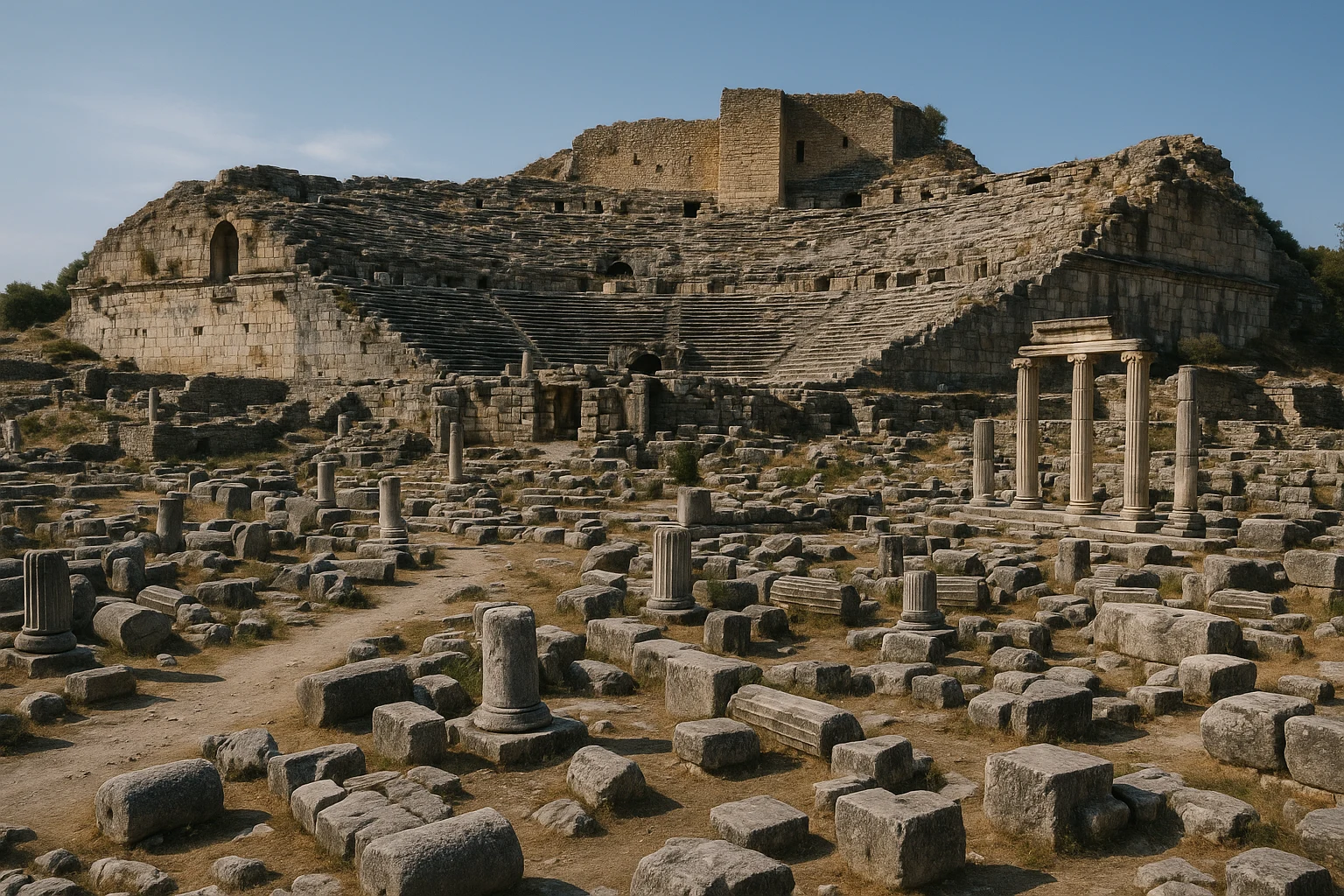
Miletus Turkey Guide 2026: Great Theater & Faustina Baths
Carian-Ionian-Persian-Hellenistic-Roman-ByzantineUse this Miletus, Turkey guide to explore its great theater, Roman baths, history, tickets, and tran...
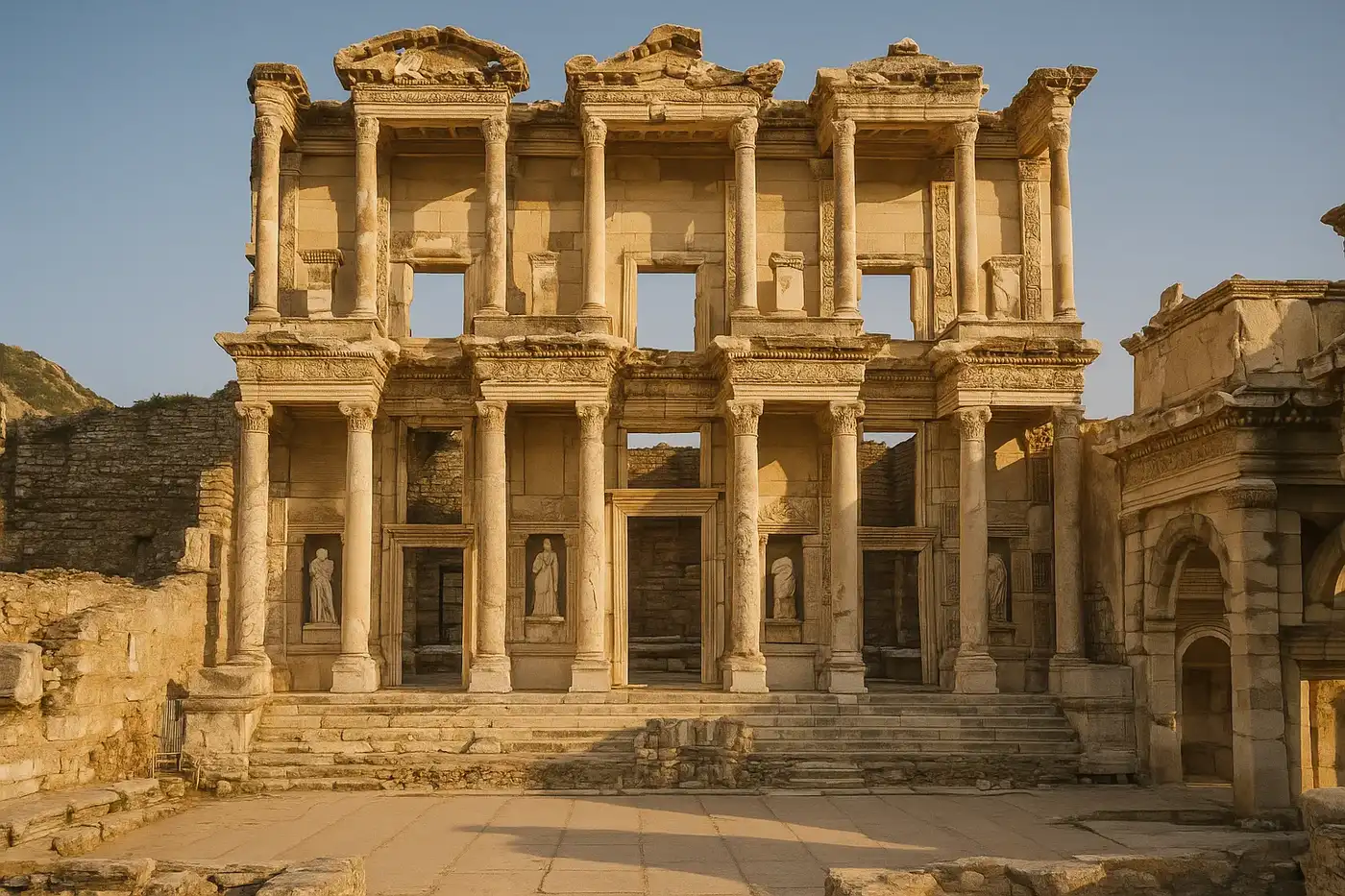
Ephesus Turkey Travel Guide: Library of Celsus & Terrace Houses
Greco-RomanDiscover Ephesus, the best-preserved ancient city in the Mediterranean. Our complete guide covers th...
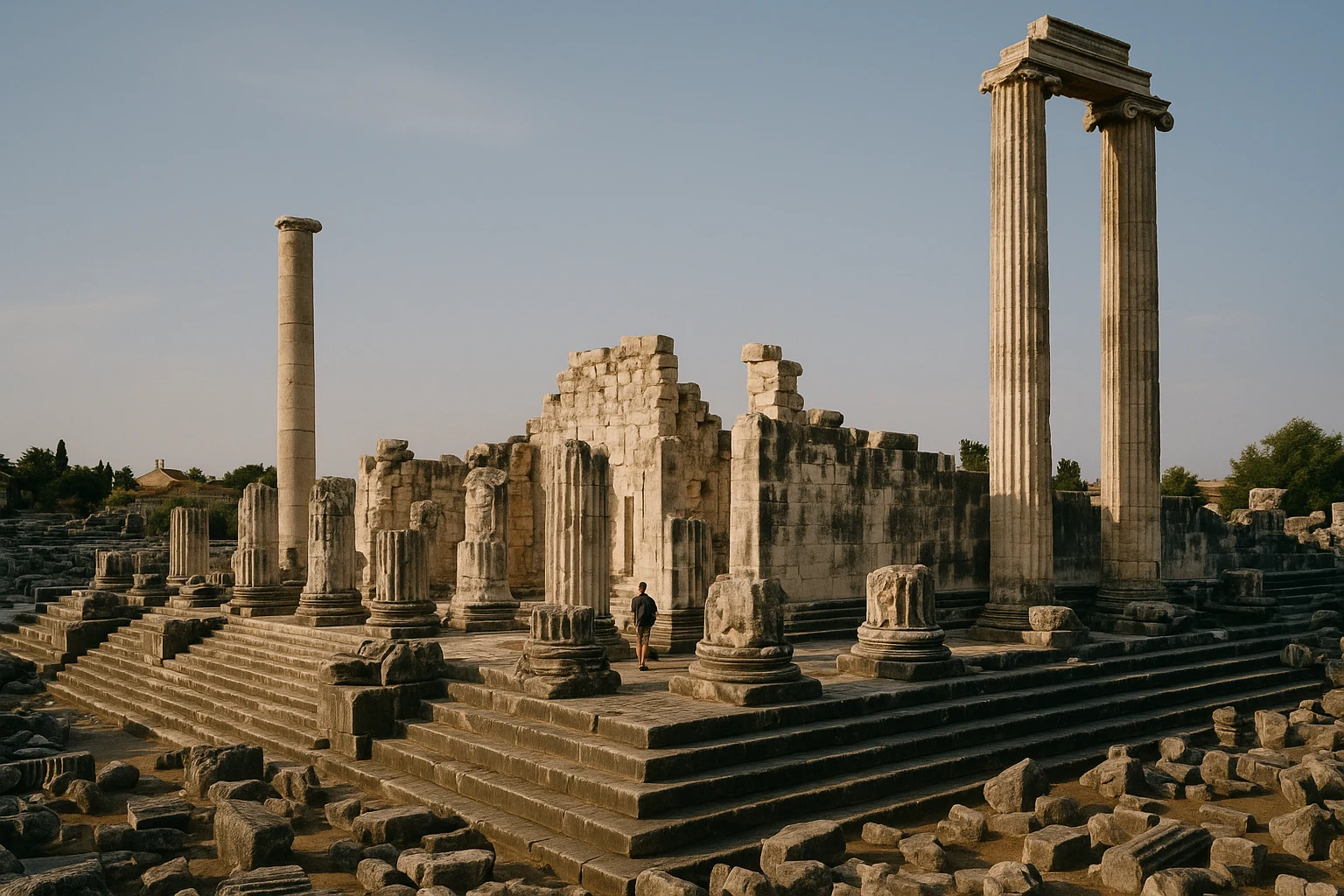
Didyma Turkey Guide 2026: Temple of Apollo & Sacred Way
Ionian-Hellenistic-Roman-ByzantinePlan your Didyma, Turkey visit with history, transport, tickets, and what to see at the vast Temple ...