Quick Info
At a glance
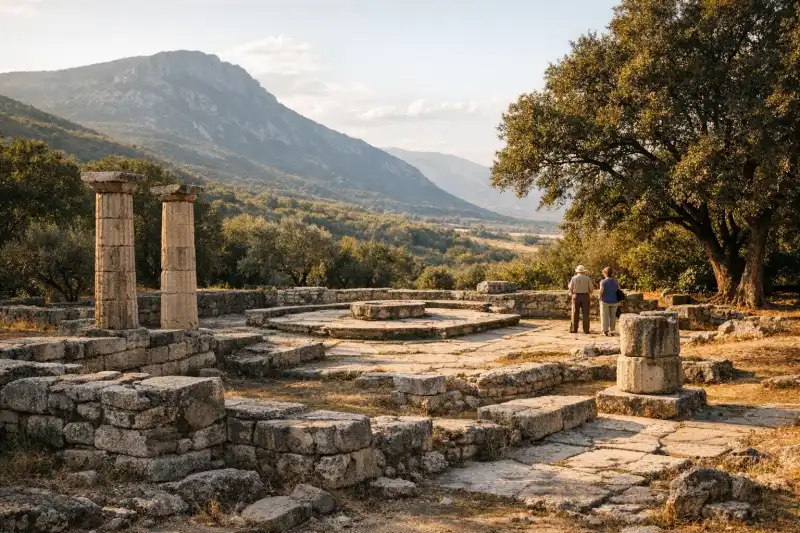
Aristotle’s School in Greece lies in a green, quiet corner of Central Macedonia where philosophy feels inseparable from landscape. Unlike the monumental hilltop temples and city citadels that dominate many itineraries through the ancient Greek world, this site is intimate, shaded, and contemplative. It sits near modern Naousa, in the area identified with ancient Mieza, and tradition holds that this was the place where Aristotle taught the young Alexander, later known as Alexander the Great, together with other sons of the Macedonian elite. Whether every lesson unfolded exactly here is less important than what the setting still communicates: education in the ancient world was not confined to enclosed classrooms, but could take place among groves, caves, water, and stone.
A visit today is less about standing before a single overwhelming ruin and more about entering an atmosphere. Rock-cut niches, the remains of stoas, and the natural contours of the site suggest a sanctuary-like place adapted for thought, conversation, and instruction. The surrounding vegetation softens the archaeological remains, and the springs and shade make it easy to imagine why this landscape would have suited a philosopher who paid close attention to nature, observation, and classification. For travelers interested in ancient Greece beyond the usual classics of Athens and Delphi, Aristotle’s School offers a different kind of encounter: one rooted in ideas, pedagogy, and the formative years of one of history’s most influential rulers.
History
The landscape of ancient Mieza
Before the site became associated with Aristotle, the wider region of Mieza was already part of the cultural and political fabric of ancient Macedonia. Located in a fertile area with water sources, rocky outcrops, and cultivated land, Mieza was well suited to settlement and rural sanctuary activity. Ancient Macedon in the 5th and 4th centuries BCE was transforming from a regional kingdom into an increasingly organized and ambitious state. Landscapes like this one, close to power but removed from urban distraction, played an important role in aristocratic life. They were places for retreat, worship, and elite education.
The natural setting mattered. Ancient education, especially among the upper classes, often drew on walking, discussion, and reflection in gardens or sacred precincts. Mieza’s terrain, with its caves and sheltered spaces, would have made it both practical and symbolically appropriate for teaching. Archaeological evidence from the area points to cult activity and architectural development that framed the landscape as more than simply agricultural countryside.
Aristotle and the education of Alexander
The fame of the site rests on an episode from the mid-4th century BCE. Around 343/342 BCE, King Philip II of Macedon invited Aristotle to educate his son Alexander and other young nobles. Aristotle, born in Stagira and already well known in the Greek intellectual world, had studied in Plato’s Academy and developed a broad range of interests spanning philosophy, politics, rhetoric, zoology, ethics, and natural science. Philip’s choice was politically astute: employing a philosopher of such stature elevated the prestige of the Macedonian court and gave the prince an education with clear pan-Hellenic significance.
Ancient literary sources, particularly Plutarch, connect Aristotle’s teaching of Alexander with Mieza. The king is said to have assigned a precinct there for the philosopher and his pupils. The exact curriculum can only be reconstructed indirectly, but it likely included Homer, ethics, politics, medicine, rhetoric, and aspects of natural inquiry. Whatever the precise details, the tradition reflects a powerful historical truth: Alexander’s generation of Macedonian leadership was shaped by systematic education, and Aristotle stood at the center of that effort.
This connection gave the site enduring symbolic prestige. Even if archaeology cannot replay the lessons word for word, the association between place, philosopher, and future conqueror became one of the most resonant educational stories in antiquity. The image of Aristotle instructing Alexander in a shaded Macedonian sanctuary remains one of the strongest cultural memories of the classical world.
Hellenistic and Roman afterlives
After Alexander’s conquests and the spread of Hellenistic culture across the eastern Mediterranean and beyond, Aristotle’s own intellectual legacy grew rapidly. His works circulated, though not always in a complete or organized form, and his reputation evolved over time. The site at Mieza likely continued to be known regionally, especially through local memory and literary references. The surrounding area remained significant within Macedonian history, though political change, warfare, and reorganization under Roman rule altered the broader landscape.
Roman interest in Greek philosophy helped preserve the fame of both Aristotle and Alexander. Educated Romans admired Greek teachers, and stories connecting famous thinkers to famous pupils became part of elite cultural identity. Even when the original educational function of the site had long passed, the tradition attached to Mieza kept it visible in historical imagination. In that sense, the school entered a second life: less as a functioning institution and more as a commemorative place.
Rediscovery and modern archaeology
Modern identification of Aristotle’s School emerged through archaeological study of ancient Mieza and its monuments. Scholars pieced together literary testimony, local topography, and excavated remains to identify the probable location of the school. Excavations revealed architectural fragments and structures integrated into the natural rock, including stoas and cave-like formations that support the idea of a landscaped educational or sacred complex.
As with many ancient sites, interpretation remains careful rather than absolute. Archaeology often works by convergence of evidence rather than by a single dramatic inscription that settles every debate. Yet the site has gained broad recognition as the traditional School of Aristotle, and it is now visited by travelers interested in philosophy, Alexander, and the wider history of Macedonia. Its significance today lies in both evidence and memory: a physically grounded place where ancient intellectual history can still be encountered in the open air.
Key Features
What makes Aristotle’s School memorable is not grandeur in the usual monumental sense, but the way the remains and natural setting combine. The most striking feature is the environment itself. Trees, shade, irregular stone surfaces, and the subtle sound of water create a calm that feels different from exposed temples or dense urban ruins. It is easy to understand why ancient authors and modern visitors alike are drawn to the idea of learning here. The place seems designed for walking and conversation, with nature functioning not as a backdrop but as part of the experience.
The rock-cut elements are among the site’s most evocative details. Caves and carved recesses suggest a landscape adapted rather than completely remade. This gives the site a gentle, almost organic quality. Ancient architecture here did not try to overpower the terrain; instead, it worked with it. That harmony is one reason the site feels unusually human in scale. You can imagine small groups gathering in the shade, pausing between discussions, or using sheltered corners for reflection. For travelers interested in how Greek intellectual life was actually lived beyond formal texts, that intimacy is invaluable.
The remains of stoas, or colonnaded spaces, are also important. Though fragmentary, they point to built areas suitable for assembly and instruction. In the Greek world, stoas were flexible architectural forms used for movement, shelter, and public interaction. At Aristotle’s School, such structures would have given shape to a teaching environment that was partly formal and partly peripatetic. The image of philosophical education as something conducted while walking is especially apt here. Even if later imagination has amplified that picture, the physical layout encourages it.
Another key feature is the relationship between the site and the story of Alexander the Great. Many archaeological places are impressive because of what survives in stone; this one is equally powerful because of what may have happened there. The possibility that one of history’s most consequential rulers received part of his education in this quiet setting changes the visitor’s perspective. Empire, conquest, and political transformation begin to feel rooted in an almost modest landscape. It reminds you that the shaping of world history can occur far from battlefields and palaces, in places of reading, debate, and mentorship.
The surrounding region adds depth to the visit. Central Macedonia is rich in sites tied to the Macedonian kingdom, including royal centers and tombs elsewhere in the region. Aristotle’s School fits into that larger map as the intellectual counterpart to the political and dynastic monuments. If Vergina evokes kingship and burial, Mieza evokes formation and thought. Together they tell a fuller story of ancient Macedonian power: not only force and ceremony, but education, cultural ambition, and participation in the Greek philosophical tradition.
Visitors also notice how approachable the site is. There is no need for specialized archaeological knowledge to appreciate it. The pathways are manageable, the remains legible in broad outline, and the atmosphere immediately distinct. Yet for those with deeper interests in philosophy or classical history, the site rewards slower attention. You can reflect on Aristotle’s method of observing the natural world, his influence on ethics and politics, or the irony that the tutor of Alexander helped educate a figure who would transform the Mediterranean and Near East through war. Few ancient sites invite that blend of landscape appreciation and intellectual reflection so naturally.
Perhaps the most special feature of all is the mood of the place. Many travelers come expecting ruins and leave remembering stillness. Aristotle’s School is one of those destinations where imagination is not a distraction from the archaeology but part of the archaeological encounter itself. The stones alone do not tell the whole story; the trees, the light, the terrain, and the historical association complete it.
Getting There
Aristotle’s School is easiest to reach from Naousa, a town in Central Macedonia known for its vineyards, orchards, and proximity to ancient Mieza. If you are driving, the trip from Naousa usually takes around 10 to 15 minutes, while the journey from Thessaloniki is roughly 1.5 hours depending on traffic. Car rental is the most practical option for independent travelers exploring northern Greece, with daily rental prices often starting around €35 to €60 in season, excluding fuel.
Public transport to the immediate site is limited. The simplest rail or intercity bus approach is usually to travel first to Naousa or nearby Veria from Thessaloniki. KTEL intercity bus fares from Thessaloniki to Naousa or Veria are commonly in the range of about €10 to €16 one way, depending on route and operator updates. From Naousa, a taxi to Aristotle’s School is usually the easiest final leg, often costing around €10 to €18 each way depending on time of day and local rates.
If you prefer a guided excursion, some travelers join broader northern Greece or ancient Macedonia tours that combine archaeological destinations in the region. These can be cost-effective if you want transport included, though availability for this exact site varies. Expect organized day tours in the region to start roughly from €60 and rise substantially for private experiences.
Once you arrive, wear comfortable shoes. The site is outdoors, and while it is not a strenuous trek, the terrain can be uneven. Bringing water is wise, especially in summer.
When to Visit
Spring and early autumn are the best times to visit Aristotle’s School. From April to June, the landscape is green, the temperatures are generally pleasant, and the site’s natural beauty is at its strongest. This is the season when the combination of archaeology, shade, and fresh vegetation feels most balanced. September and October are similarly rewarding, with warm but usually more manageable conditions than midsummer and softer light for photography.
Summer remains a good option if your itinerary is fixed, but midday heat in northern Greece can still be intense. The advantage of Aristotle’s School is that it offers more shade than many exposed archaeological sites, yet it is still best to visit in the morning or later in the afternoon. If you come in July or August, bring sunscreen, water, and a hat even though parts of the site are sheltered.
Winter visits can be peaceful and atmospheric, especially for travelers who enjoy quiet historic places without crowds. The surrounding countryside can look beautiful under cooler skies, but weather may be damp or chilly, and the site feels less lush than in spring. Opening schedules can also be more limited, so it is sensible to confirm practical details in advance.
In terms of crowd levels, Aristotle’s School is generally calmer than Greece’s headline ancient attractions. That makes timing more about weather and comfort than beating large tour groups. If possible, pair your visit with nearby regional sites over two or three days rather than treating it as a rushed stop. The school is best appreciated slowly, when the setting has time to work on your imagination.
| Quick Facts | Details |
|---|---|
| Location | Near Naousa, Central Macedonia, Greece |
| Ancient name of area | Mieza |
| Best known for | Traditional site where Aristotle taught Alexander the Great |
| Historical period | 4th century BCE, Classical Macedonia |
| Type of site | Archaeological and landscape site with rock-cut and architectural remains |
| Nearest town | Naousa |
| Best season | Spring and early autumn |
| Typical visit length | 45 minutes to 1.5 hours |
| Ideal visitors | History lovers, philosophy enthusiasts, travelers exploring ancient Macedonia |
| Access notes | Easiest by car or taxi; limited direct public transport |
Guided tours: worth it?
Most travelers can visit Aristotle's School independently. Compare a tour only if you want a tighter history-focused visit, easier logistics, or a guide who can answer questions on the spot.
Best for
- Short visits where a planned route saves time
When to go self-guided
Go independently if you prefer setting your own pace, reading as you go, and checking official hours or ticket rules directly before you arrive.
What I’d avoid
Skip paid tours that bundle unrelated stops you do not actually want. The best option should either save meaningful planning time or add historical context you would miss on your own.
Aristotle's School and Naousa day tours
Useful when: you want to compare guided formats before deciding
Ancient Macedonia historical tours
Useful when: you want to compare guided formats before deciding
Vergina and northern Greece archaeological tours
Useful when: you want to compare guided formats before deciding
Some tour links are affiliate links, which may earn Ancient Travel a small commission at no extra cost to you. I try to surface options that make practical sense for the site—not just anything bookable.
Frequently Asked Questions
Where is Aristotle's School located?
Aristotle's School is located near Naousa in Central Macedonia, Greece, in the scenic area traditionally identified with ancient Mieza.
Is Aristotle's School the place where Alexander the Great studied?
According to ancient tradition, this is the site where Aristotle taught the young Alexander, along with other Macedonian nobles, in the 4th century BCE.
How much time should I allow for a visit?
Most visitors spend about 45 minutes to 1.5 hours exploring the archaeological remains, rock-cut spaces, pathways, and surrounding landscape.
Do I need a car to visit Aristotle's School?
A car is the easiest option because public transport connections are limited, though taxis from Naousa are also practical for a short visit.
Is Aristotle's School suitable for families?
Yes, families often enjoy the peaceful outdoor setting, but paths can be uneven, so comfortable shoes and supervision for children are recommended.
Can I combine Aristotle's School with other sites in the region?
Yes, many travelers pair it with Vergina, Naousa, Edessa, or other places connected with ancient Macedonia and northern Greece.
Nearby Ancient Sites
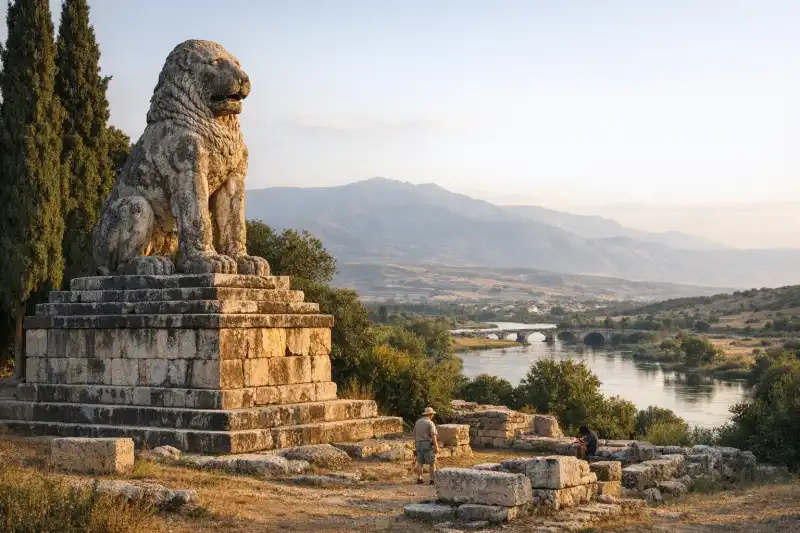
Amphipolis
Ancient Greek, Macedonian, Roman, ByzantineExplore Amphipolis in Greece, an important ancient Macedonian city famed for its walls, lion monumen...
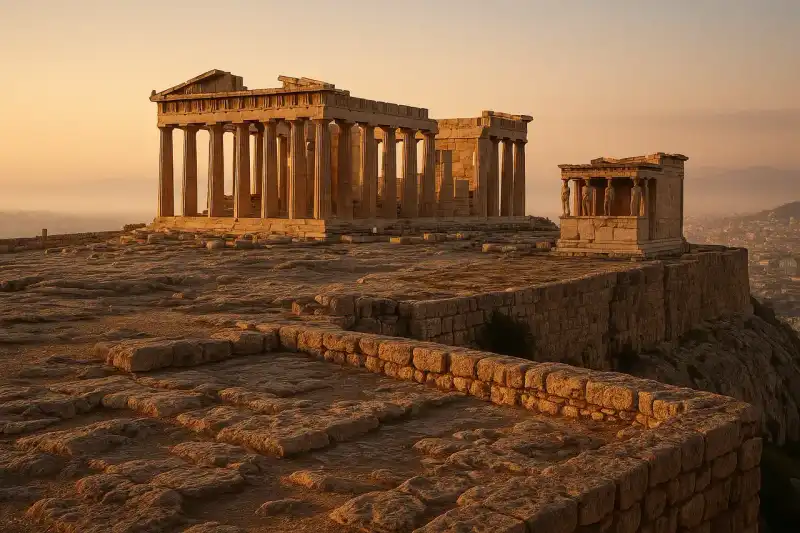
Acropolis Travel Guide 2026: Parthenon, Tickets, and Best Time
Ancient GreecePlan an efficient Acropolis visit with practical ticket timing, key monuments, and museum pairing ti...
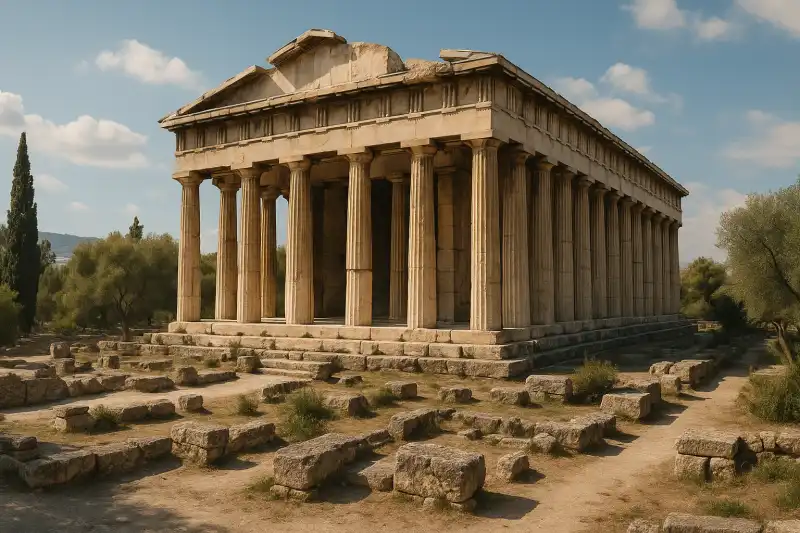
Ancient Agora of Athens Travel Guide 2026: Route, Tickets, and Context
Classical GreekPlan a better Ancient Agora visit with practical timing, monument priorities, and clear historical c...