Quick Info
At a glance
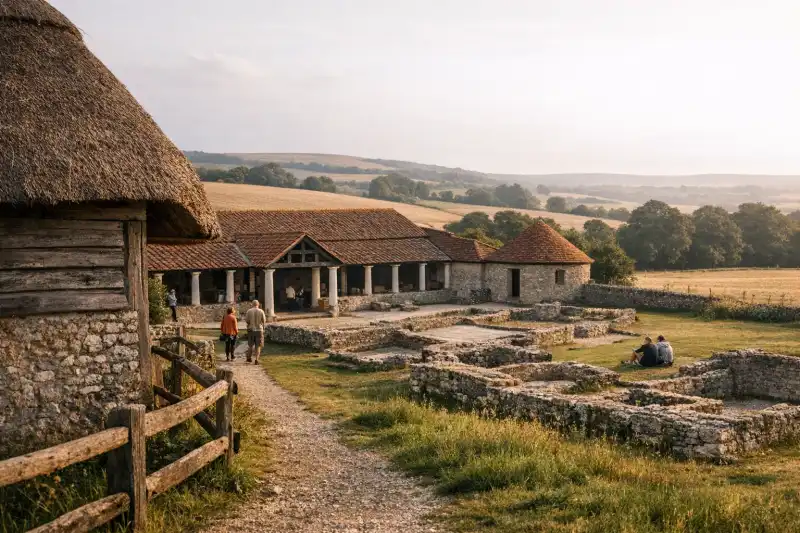
Bignor Roman Villa in the United Kingdom sits quietly in the folds of the South Downs, surrounded by fields, hedgerows, and the soft green light of the Sussex countryside. That gentle landscape can make the site feel almost accidental, as if the remains of one of Roman Britain’s most impressive country houses had simply surfaced from beneath the farmland and decided to stay visible. Yet the calm setting is part of its appeal. Unlike urban Roman ruins, where walls and roads compete with modern noise, Bignor still feels close to the rhythms that once shaped it: agriculture, estate management, and the wealth drawn from a productive rural hinterland.
For many visitors, the first surprise is the quality of what survives. Britain has many Roman sites, but few preserve mosaic floors as arresting as those at Bignor. Here, geometric designs, mythological scenes, and richly patterned pavements remain where they were laid, giving a rare sense of intimacy with domestic life in Roman Britain. The villa was not a fortress or a monumental public building. It was a home, a statement of status, and a working estate center. That combination makes it especially compelling. You are not just looking at ruins; you are entering a place where comfort, taste, and local ambition were expressed in stone, plaster, heating systems, and floor decoration. Bignor offers an encounter with Roman Britain at its most refined, while still feeling rooted in the landscape that sustained it.
History
Early Roman presence in Sussex
The story of Bignor Roman Villa begins within the broader context of the Roman conquest and consolidation of Britain in the 1st century CE. After the invasion of 43 CE, southern Britain became one of the most Romanized parts of the province. Sussex, lying within reach of important roads, ports, and settlements, was gradually integrated into imperial administration and economy. Villas began to appear across the landscape as the Roman way of organizing landownership and agricultural production took hold.
At first, these rural establishments were often modest. They served as estate centers connected to farming, storage, and local exchange. Bignor likely started in this practical mode. The earliest phase on the site seems to have consisted of a relatively simple structure, part of the wave of rural development that accompanied prosperity in Roman Britain. Its location was well chosen: sheltered, fertile, and near routes that linked the countryside with larger settlements such as Chichester, known to the Romans as Noviomagus Reginorum.
Expansion into a grand villa
By the 3rd century CE, Bignor had grown into something much more ambitious. This was the era in which many British villas reached their architectural and decorative peak, and Bignor became one of the clearest examples of that transformation. The estate was expanded into a large courtyard villa with multiple ranges of rooms, reception areas, private apartments, bath facilities, and service spaces. It was not merely functional; it was designed to display wealth, education, and cultural aspiration.
The extraordinary mosaics belong largely to this period of expansion. Their presence suggests owners with both means and access to skilled craftsmen. Some mosaic patterns were based on widespread Roman decorative traditions, while others reveal a degree of local adaptation. The iconography, including mythological motifs, placed Bignor within the shared visual language of the Roman world. Even in provincial Britain, elite households could express their status through art that referenced classical stories and Mediterranean tastes.
The villa’s amenities also reflected sophistication. Heated rooms, likely served by hypocaust systems, indicate a concern with comfort as well as prestige. Bath suites and carefully arranged domestic spaces show that life here could be conducted according to Roman ideals of civilized living. At the same time, Bignor remained the heart of a working agricultural estate. Its elegance depended on the productivity of the land around it.
Life in the late Roman period
The 4th century CE brought continued use and, in many cases across Britain, renewed investment in elite rural residences. Bignor appears to have remained occupied during this phase, though like many villas, it may have evolved in piecemeal ways as needs changed. Some rooms were refurbished, others perhaps repurposed, and the estate continued to operate within a provincial economy that was increasingly complex and occasionally unstable.
Life in late Roman Britain was never entirely detached from the wider empire. Political uncertainty, military pressure, and changing administrative arrangements could all affect even apparently peaceful country houses. Yet villas like Bignor show that prosperity endured for significant stretches of time. The owners and occupants may have balanced local identity with Romanized cultural habits, using architecture and decoration to affirm their place in both worlds.
Eventually, as Roman authority in Britain weakened during the early 5th century CE, the villa system declined. Some villas were abandoned relatively quickly; others saw reduced occupation or reuse. At Bignor, the grand domestic life suggested by the mosaics came to an end, and the buildings fell into ruin. Roofs collapsed, walls decayed, and the site was gradually reclaimed by soil and vegetation.
Rediscovery and preservation
Bignor’s modern story began in 1811, when the site was rediscovered by farmer George Tupper after a plough struck part of the villa remains. What followed was one of the great episodes of antiquarian discovery in Britain. Excavations revealed mosaics of exceptional quality, and protective coverings were soon erected to preserve them. Remarkably, the villa has remained in private stewardship by descendants of the Tupper family, creating a continuity unusual among major ancient sites.
Because the mosaics were recognized early as both fragile and significant, Bignor developed into a place where preservation became part of the visitor experience. Rather than reconstructing the villa into an overly polished attraction, the site has retained much of its character as an excavated ruin under shelter. This allows visitors to understand both the ancient building and the history of archaeological discovery in the 19th century. In that sense, Bignor tells two intertwined stories: one about Roman Britain, and another about how Britain learned to value and protect its buried past.
Key Features
What sets Bignor Roman Villa apart above all is the survival of its mosaic floors. These are not isolated fragments in a museum case but pavements preserved close to where Roman occupants once walked, dined, and received guests. Their colors, geometry, and imagery give the site an immediacy that standing walls alone rarely achieve. The famous Medusa mosaic is among the most striking. Its central head, surrounded by patterned decoration, combines artistry with symbolic power. In Roman visual culture, Medusa could serve an apotropaic function, warding off harm, while also displaying the owner’s taste for classical imagery.
Another highlight is the Ganymede mosaic, one of the best-known figurative pavements in Britain. Mythological scenes like this were more than decoration. They connected provincial households to the stories and visual habits of the broader Roman world. To encounter such a floor in rural Sussex is to understand how far Roman cultural forms extended, and how enthusiastically they could be embraced by local elites.
The villa’s layout is also revealing. Though not all parts survive equally well, enough remains to show a large and carefully organized residence. Rooms were arranged around courtyards in a plan that combined practicality with display. Some spaces were clearly more public, intended for entertaining or formal reception, while others served domestic or service functions. Walking through the preserved areas, you can sense the choreography of villa life: movement from open courtyard to enclosed room, from work-oriented areas to spaces of comfort and performance.
The bath complex is one of the most evocative elements. Roman bathing was not simply a matter of hygiene. It was social, cultural, and symbolic, part of a lifestyle associated with Roman identity. Even on a rural estate, bathing facilities signaled refinement and access to technologies such as underfloor heating and controlled water use. At Bignor, the remains of heated rooms and associated structures help visitors imagine the villa not as a ruin but as a place that once had warmth, steam, conversation, and daily routine.
A quieter but equally important feature is the evidence for infrastructure. Foundations, room divisions, and heating systems reveal how much planning went into an elite Romano-British household. Hypocaust pilae, channels for warm air, and construction details speak to the technical sophistication behind the villa’s comfort. These remains may seem less dramatic than mosaics at first glance, but they are crucial for understanding how the house functioned.
The protective buildings that now shelter the mosaics form part of the site’s distinctive atmosphere. Some visitors initially expect open-air ruins and instead find a sequence of coverings and enclosed spaces. Yet these structures are essential to preservation and have become part of Bignor’s character. They create intimate viewing conditions, drawing attention downward to the floors and encouraging slower observation. This is a site best appreciated not by rushing from one monument to another, but by pausing over details: the twist of a border pattern, the symmetry of a design, the wear in a threshold.
The surrounding landscape should not be overlooked. Bignor is still embedded in agricultural countryside, and that context matters. Villas depended on estates, labor, and rural productivity. Looking beyond the ruins to the fields helps restore the scale of what the villa once represented. It was not an isolated luxury retreat but the headquarters of an economic unit, tied to roads, markets, and local communities. The contrast between refined interior decoration and practical rural setting is precisely what makes Roman villas so revealing.
Finally, the site’s museum and interpretive materials help bridge the gap between ruin and imagination. Finds from the excavations, explanations of room functions, and accounts of the villa’s discovery provide texture to the visit. Bignor does not overwhelm with spectacle. Instead, it rewards attentiveness. It is a place where artistry, archaeology, and landscape work together to show how Roman culture was adapted, lived, and displayed in the British countryside.
Getting There
Bignor Roman Villa is easiest to reach by car, and for most travelers this is the most practical option. The site lies in rural West Sussex, near Bignor village, roughly 8 miles from Arundel and within reach of Pulborough, Chichester, and Worthing. Driving from London usually takes around 1.5 to 2 hours depending on traffic. Parking is typically available on site, which makes self-driving the simplest way to visit, especially if you want to combine Bignor with other South Downs destinations.
If you are relying on public transport, the nearest useful rail connections are usually Arundel, Pulborough, or Amberley, all served from London Victoria. Advance single train fares can start around £10 to £25, while walk-up tickets may cost more. From the station, you will usually need a taxi for the final rural leg. A taxi from Arundel or Pulborough may cost roughly £15 to £25 each way depending on distance and time of day. Because services in the countryside can be limited, it is wise to book ahead.
Bus options exist in the wider region but are not always convenient directly to the villa, so they generally work best when combined with a short taxi ride or a planned walk or cycle through the South Downs. Organized day tours specifically to Bignor are less common than tours to larger Sussex attractions, but private guides based around Arundel, Chichester, or the South Downs can sometimes include it on request.
Before setting out, check seasonal opening times on the official site, as country attractions may not operate daily year-round.
When to Visit
The best time to visit Bignor Roman Villa is from late spring through early autumn, when the West Sussex countryside is at its most inviting and travel conditions are easiest. From May to September, the surrounding landscape is green and open, and the longer daylight hours make it easy to combine the villa with nearby villages, walking routes, or other historic stops. Summer brings the warmest weather, usually in the range of 18 to 25°C, though occasional heatwaves or rain showers are always possible in southern England.
Spring is especially rewarding for visitors who enjoy a quieter atmosphere. The fields and hedgerows are fresh, roads are generally less busy than in peak summer, and the villa feels particularly well matched to the season’s calm light. Early autumn is another excellent choice, offering mild temperatures and fewer crowds while preserving much of the visual appeal of the South Downs.
Winter visits can still be enjoyable for dedicated history travelers, but you should plan more carefully. Rural roads may be damp or muddy, daylight hours are shorter, and opening days may be reduced. Because much of the experience involves protected but lightly enclosed archaeological remains, cold weather can affect comfort more than at larger indoor museums.
If possible, aim for a dry weekday outside school holidays. You will have more space to study the mosaics slowly, and the site’s intimate scale is best appreciated without too much foot traffic. Bignor is not a place that demands dramatic weather; it rewards patience, good light, and enough time to look closely.
| Quick Facts | Details |
|---|---|
| Location | West Sussex, United Kingdom |
| Nearest town | Arundel |
| Historical period | Romano-British, mainly 3rd-4th century CE |
| Best known for | Exceptional in-situ Roman mosaics |
| Civilization | Roman Britain |
| Approximate visit length | 1.5-2.5 hours |
| Best transport option | Car or train plus taxi |
| Setting | Rural South Downs countryside |
| Family friendly | Yes, especially for history-minded families |
| Top highlight | The Medusa and Ganymede mosaic floors |
Bignor Roman Villa is one of those rare archaeological sites where scale and delicacy work together. It does not rely on towering walls or dramatic reconstructions. Instead, it offers something more intimate and, in many ways, more revealing: the decorated floors of a wealthy provincial home, preserved in the landscape that once sustained it. In the United Kingdom, there are many places to encounter Roman history, but few make the domestic world of Roman Britain feel so tangible. At Bignor, refinement is not abstract. It is built into every tessera, every heated room, and every surviving trace of an estate that once stood at the meeting point of countryside, commerce, and culture.
Guided tours: worth it?
Most travelers can visit Bignor Roman Villa independently. Compare a tour only if you want a tighter history-focused visit, easier logistics, or a guide who can answer questions on the spot.
Best for
- Short visits where a planned route saves time
When to go self-guided
Go independently if you prefer setting your own pace, reading as you go, and checking official hours or ticket rules directly before you arrive.
What I’d avoid
Skip paid tours that bundle unrelated stops you do not actually want. The best option should either save meaningful planning time or add historical context you would miss on your own.
Bignor Roman Villa and West Sussex Day Tours
Useful when: you want to compare guided formats before deciding
Arundel and South Downs Tours
Useful when: you want to compare guided formats before deciding
Chichester Roman History Tours
Useful when: you want to compare guided formats before deciding
Some tour links are affiliate links, which may earn Ancient Travel a small commission at no extra cost to you. I try to surface options that make practical sense for the site—not just anything bookable.
Frequently Asked Questions
What is Bignor Roman Villa famous for?
Bignor Roman Villa is best known for its exceptionally well-preserved Roman mosaics, including the famous Ganymede and Medusa floors, among the finest in Britain.
Where is Bignor Roman Villa located?
Bignor Roman Villa is located in West Sussex, United Kingdom, near the village of Bignor and within reach of Arundel, Pulborough, and Chichester.
How much time do you need to visit Bignor Roman Villa?
Most visitors spend 1.5 to 2.5 hours at Bignor Roman Villa, allowing enough time to see the mosaic rooms, museum displays, and the surrounding rural setting.
Is Bignor Roman Villa suitable for families?
Yes, Bignor Roman Villa is suitable for families, especially those interested in Roman Britain, archaeology, and mosaic art, though some surfaces may be uneven.
Can you see original mosaics at Bignor Roman Villa?
Yes, the site preserves original in-situ Roman mosaics under protective shelters, which is one of the main reasons it is considered so important.
Do you need a car to visit Bignor Roman Villa?
A car is the easiest way to reach Bignor Roman Villa, though it is also possible to combine train travel to nearby towns with a taxi for the final stretch.
Nearby Ancient Sites
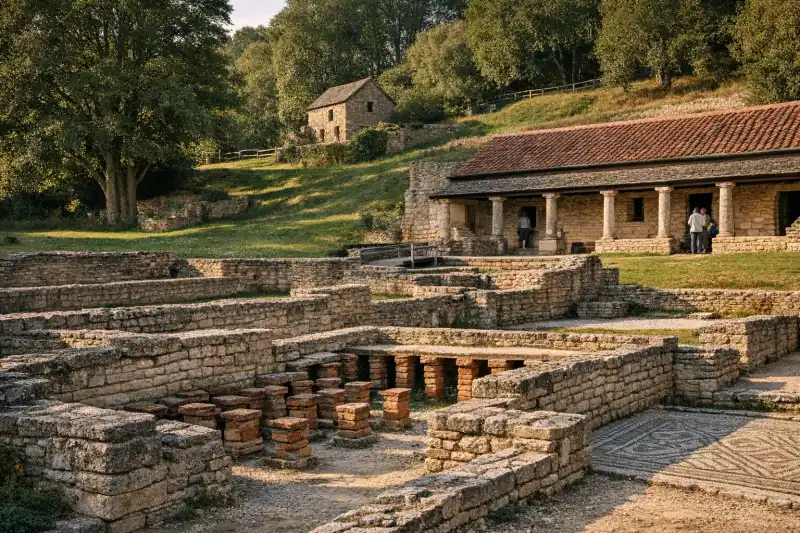
Chedworth Roman Villa
RomanExplore Chedworth Roman Villa, a remarkably preserved Roman countryside estate in the United Kingdom...
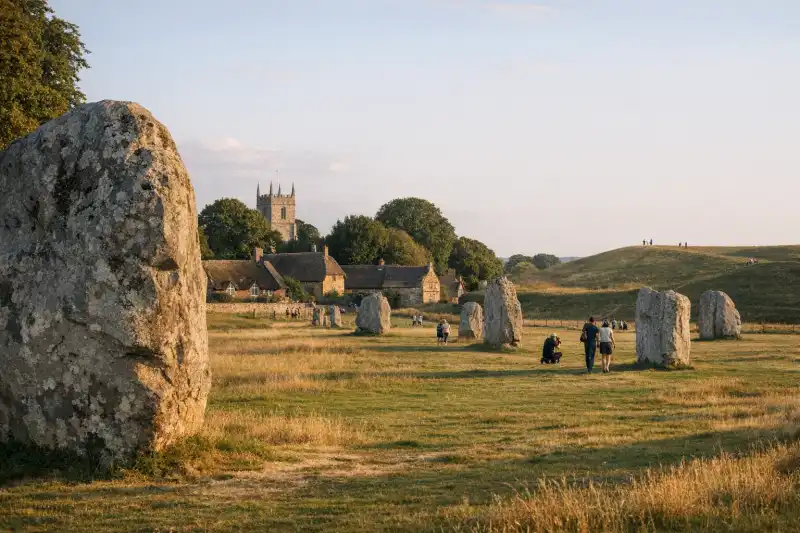
Avebury
Neolithic BritainExplore Avebury in the United Kingdom, a vast prehistoric stone circle and ritual landscape in the h...
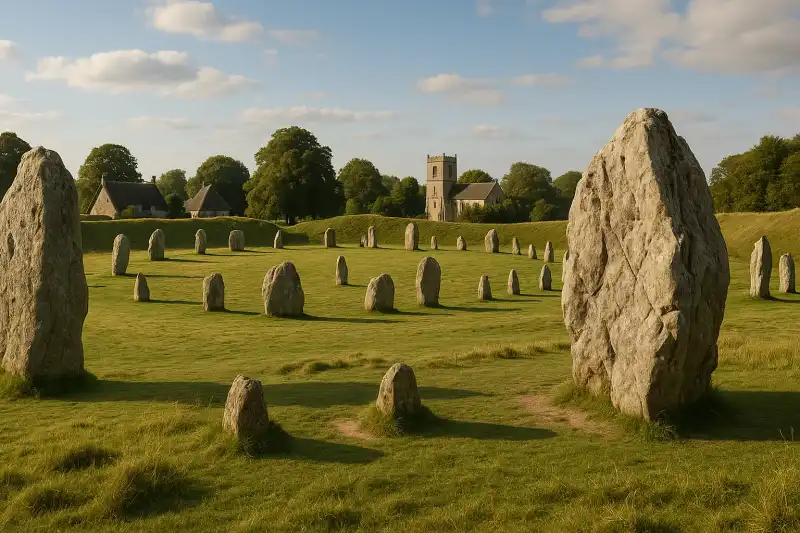
Avebury Stone Circle Travel Guide 2026: Best Walk Routes, History, and Visit Planning
Neolithic BritainPlan a stronger visit to Avebury Stone Circle with practical walking routes, landscape context, and ...