Quick Info
At a glance
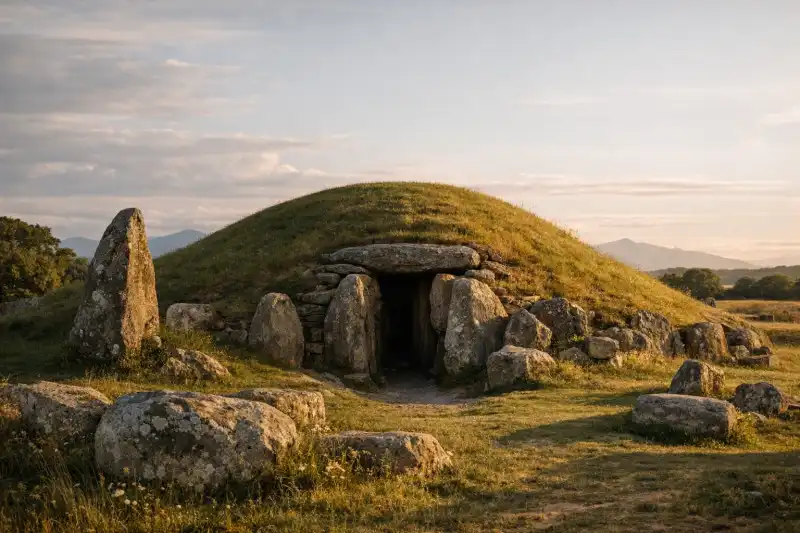
Bryn Celli Ddu in the United Kingdom sits low in the Anglesey landscape, easy to miss at first glance, yet impossible to forget once you step into its quiet orbit. Fields ripple outward in shades of green, hedgerows soften the edges of the horizon, and the monument itself rises with the calm authority of something that has watched thousands of years pass. Unlike the theatrical scale of some famous stone circles, this Welsh site works through atmosphere. It invites you to slow down, listen to the wind moving across the island, and imagine a world in which ritual, death, memory, and the movement of the sun were woven tightly together.
Today, Bryn Celli Ddu appears as a reconstructed passage tomb within a grassy enclosure, but its modest footprint conceals a layered story. This was not a single-purpose structure built once and left unchanged. Archaeology has shown that the site evolved over time, first as a ceremonial enclosure and later as a chambered tomb. That sequence makes it especially compelling for travelers interested in how prehistoric communities shaped sacred places across generations.
Visiting also means experiencing Anglesey itself, an island with a deep concentration of prehistoric monuments and a strong sense of continuity between land and history. Bryn Celli Ddu feels rooted in that setting. Even in daylight, with birdsong and open skies around you, there is a palpable sense of enclosure and intention. It is a site that rewards patience more than spectacle, and that quiet intensity is exactly what makes it one of the most memorable ancient places in Wales.
History
Early ceremonial origins
The story of Bryn Celli Ddu begins in the Neolithic period, when communities across Britain were building monuments that expressed new ways of organizing ritual life, territory, and collective memory. Long before the passage tomb visible today took shape, the site appears to have been used as a ceremonial enclosure. Archaeological excavations revealed evidence of a henge-like monument here, defined by a circular bank and ditch. Such enclosures were not defensive structures. Instead, they seem to have marked out spaces for gathering, ceremony, and symbolic activity.
At Bryn Celli Ddu, this earlier phase included standing stones and signs of ritual deposition. One of the most intriguing discoveries was a carved stone decorated with serpentine patterns, now associated with the site’s prehistoric symbolism and likely once standing within the enclosure. Cremated human remains were also found, suggesting that the place was linked not only to ceremony but to funerary rites. This combination of enclosed sacred space, upright stones, and cremation deposits places Bryn Celli Ddu firmly within a wider Neolithic tradition in which monuments acted as theaters for communal acts of remembrance and transformation.
The name itself, usually translated from Welsh as “the mound in the dark grove” or “the hill of the dark woodland,” adds another layer of atmosphere, though it is much later than the monument. Even so, the modern name captures something that fits the site remarkably well: a sense of mystery, concealment, and sacred separation from the everyday world.
Construction of the passage tomb
At some point after the earlier enclosure was in use, the monument underwent a major transformation. The henge elements were altered or covered, and a passage tomb was constructed at the center. This was not merely a practical rebuilding. It represented a shift in how the place functioned. Passage tombs across Atlantic Europe often served as burial sites, ceremonial chambers, and cosmological markers all at once. Bryn Celli Ddu fits this broader tradition while maintaining features distinctive to Anglesey and Wales.
The tomb consists of a stone-lined passage leading into an inner chamber, all originally covered by a substantial earthen mound. The chamber would have created a powerful contrast between open landscape and enclosed darkness. Entering such a space was likely an experience charged with meaning. The dead, the ancestors, and the hidden powers of the earth may all have been understood as present there.
Excavation in the 20th century revealed that the monument had been disturbed over centuries, but enough survived to show that Bryn Celli Ddu was part of a sophisticated architectural and symbolic tradition. Human remains were relatively limited compared with some other tombs, leading scholars to debate whether the site functioned primarily as a communal burial place, a shrine used for selected interments, or a monument whose importance exceeded funerary use alone. The answer may well be all of these at different times.
Astronomical significance and later interpretation
One of the most discussed aspects of Bryn Celli Ddu is its possible alignment with the summer solstice sunrise. Observations have suggested that on or around midsummer, early sunlight can penetrate the passage and illuminate the chamber interior. Whether this was the monument’s central purpose or one important feature among many, the idea reinforces the close link between prehistoric architecture and the cycles of the natural world.
Such alignments are often tempting to romanticize, but at Bryn Celli Ddu they are best understood in a broader context. Neolithic communities watched the skies closely, not only for agricultural reasons but also as part of ritual life. A tomb aligned to a significant solar event would connect the ancestors to recurring cosmic order. Dawn light entering a dark chamber could symbolize renewal, continuity, or the union of earth and sky.
In later centuries, as the monument fell out of its original use, it remained part of the lived landscape. Local memory preserved it as an ancient and uncanny place. Antiquarians eventually took notice, and modern archaeology transformed understanding of the site, especially through excavations in the 1920s. Reconstruction followed, meaning what visitors see today is partly ancient fabric and partly careful re-creation based on archaeological evidence. That does not diminish the experience. If anything, it helps modern travelers read the monument’s form while still sensing the great antiquity beneath their feet.
Key Features
What makes Bryn Celli Ddu so striking is not a single dramatic element, but the way several features work together to create a layered experience. As you approach, the monument appears as a grass-covered mound within a gentle circular setting. The landscape is open, agricultural, and unassuming, which makes the concentration of meaning at the site feel all the more powerful. There is no towering skyline of stones. Instead, the architecture draws you inward.
The passage itself is the first key feature. Narrow and stone-lined, it creates a deliberate transition from daylight into shadow. Ancient monuments often manipulate movement, and Bryn Celli Ddu does this elegantly. You do not simply look at it; you enter it. The act of crossing from outside to inside is central to understanding its original impact. Even during a casual visit, the temperature, sound, and light seem to shift as you move inward, giving a glimpse of how carefully prehistoric builders understood sensory experience.
Inside, the chamber is compact but memorable. The stone uprights, capstones, and enclosed form are enough to evoke both burial and ritual. This is not an expansive interior meant for large gatherings. It feels selective, restricted, and intimate, as if entry itself carried meaning. In a world without artificial light, the darkness of such a chamber would have been profound. Any illumination, whether from a torch, ceremonial fire, or solstice dawn, would have transformed the space dramatically.
The mound surrounding the tomb is another important feature. Although reconstructed, it conveys the monument’s intended presence in the landscape. Passage tombs were not merely collections of stones; they were earth-and-stone compositions, shaped to stand out while also seeming to rise organically from the ground. At Bryn Celli Ddu, the mound gives volume and focus to the tomb, making it feel like a carefully made hill with a hidden core.
Equally significant are the traces of the earlier henge monument. While less visually obvious to a first-time visitor, the enclosing earthworks and archaeological history are essential to the site’s character. This was a place with more than one life. The burial chamber did not erase the past entirely; it was built upon it. That continuity gives Bryn Celli Ddu unusual depth. You are standing in a monument that remembers another monument beneath it.
The famous carved stone associated with the site, decorated with winding patterns, adds an artistic and symbolic dimension. The original is no longer standing in place as it once may have been, but knowledge of its discovery helps frame Bryn Celli Ddu as more than an architectural relic. It was also a site where visual symbolism mattered. Curving designs in prehistoric art often resist exact interpretation, yet they clearly carried significance. Their presence here suggests ritual language expressed in stone as well as in earthworks and alignment.
Then there is the possible solar alignment. Even if you do not visit at midsummer, the orientation of the passage encourages you to think about light as part of the design. Ancient monuments across Britain often engage with celestial events, and Bryn Celli Ddu belongs to that tradition in a way that feels subtle rather than grandiose. The thought that dawn light may have reached into the chamber on a key day of the year changes how you perceive the whole structure. It becomes not just a tomb but a calendar, a ceremonial device, and a statement about time.
Finally, the setting on Anglesey is itself a feature. The island contains an exceptional density of prehistoric sites, and Bryn Celli Ddu gains meaning from that wider landscape. It is part of a network of monuments built by communities who clearly invested heavily in marking place, ancestry, and ritual pathways. A visit here can therefore be both focused and expansive: focused on the chamber in front of you, expansive in the sense that it opens out onto the whole prehistoric geography of northwestern Wales.
Getting There
Bryn Celli Ddu is located on Anglesey, near Llanddaniel Fab, and is easiest to reach by car. From Bangor, the drive is usually around 25 to 35 minutes depending on traffic, crossing onto the island via the A55 and then following local roads south toward the site. From Holyhead, allow roughly 35 to 45 minutes. Parking is limited, and the final approach is along a minor lane, so drive slowly and be prepared for a short walk.
For travelers using public transport, the nearest larger rail hub is Bangor on the mainland, which has regular trains from Chester, Crewe, and beyond. Advance rail fares vary widely, but Bangor from Chester can often start around £12 to £25 one way if booked early, with higher walk-up fares possible. From Bangor, local buses toward parts of Anglesey may help, but services are not always convenient for the monument itself. A taxi from Bangor to Bryn Celli Ddu typically costs about £25 to £40 each way depending on time and operator.
If you are staying on Anglesey, taxis from Llangefni or Menai Bridge can be more manageable, often in the £15 to £25 range. Cycling is also possible in fair weather, especially for confident riders comfortable on rural roads. Many visitors combine Bryn Celli Ddu with a broader Anglesey road trip, which is the most practical option if you want to see multiple prehistoric sites in one day. Wear sturdy shoes, as the ground near the monument can be uneven or muddy after rain.
When to Visit
Late spring through early autumn is the most comfortable time to visit Bryn Celli Ddu. From May to September, longer daylight hours make the rural setting especially enjoyable, and the fields around the monument are often at their most vivid. Summer usually offers the easiest conditions for walking and photography, though even then Welsh weather can change quickly. Bring a waterproof layer regardless of forecast.
For atmosphere, early morning and late afternoon are often better than the middle of the day. The monument feels more contemplative when fewer people are around, and angled light brings out the shape of the mound and passage entrance more clearly. If your interest is strongly tied to archaeoastronomy, midsummer naturally draws attention because of the site’s association with the solstice sunrise. However, this can also mean more visitors and less solitude.
Autumn can be a rewarding compromise. The countryside remains beautiful, crowds are lighter, and the site’s mood deepens under lower skies and changing light. Winter visits are possible, but expect wet ground, shorter days, and wind exposure. In poor weather, the monument can feel bleak, though some travelers may find that dramatic rather than discouraging.
Whenever you go, aim for a day with enough time to linger. Bryn Celli Ddu is not a site that demands hours, but it benefits from unhurried attention. If you can combine good weather, quiet surroundings, and time to absorb the landscape, your experience will be much richer. This is a monument of subtleties, and the best visits happen when you allow those subtleties to emerge gradually.
| Quick Facts | Details |
|---|---|
| Location | Near Llanddaniel Fab, Anglesey, Wales, United Kingdom |
| Monument Type | Neolithic passage tomb built within an earlier henge enclosure |
| Date | c. 3000-2000 BCE |
| Cultural Context | Neolithic Britain |
| Best Known For | Burial chamber, ceremonial origins, and possible summer solstice alignment |
| Typical Visit Length | 30-60 minutes |
| Entry Fee | Usually free |
| Best Season | Late spring to early autumn |
| Nearest Town | Llangefni |
| Access | Best reached by car; limited rural access by public transport |
Bryn Celli Ddu does not overwhelm through size or elaborate ruins. Its power lies in concentration: a chamber, a mound, an enclosure, and a landscape that still seems able to hold memory. For travelers interested in ancient Britain, it offers something precious and increasingly rare—the chance to encounter a prehistoric monument that still feels intimate. Rather than presenting its meaning all at once, it reveals itself in layers: first as a peaceful field monument, then as a place of burial, then as a ceremonial site older than the tomb itself, and finally as a carefully aligned work of architecture tied to the rhythms of the sky.
That depth makes Bryn Celli Ddu far more than a brief stop on an Anglesey itinerary. It is one of the clearest reminders in Wales that prehistoric communities built not only for utility or display, but for experience. They shaped movement, darkness, light, and memory into lasting form. Even after reconstruction, excavation, and centuries of change, the site retains that human intention. Standing at the passage entrance, looking from open daylight into stone shadow, you can still sense the threshold the builders created.
If you are exploring the ancient landscapes of the United Kingdom, Bryn Celli Ddu deserves a place high on your list. It may be quieter than better-known monuments, but that quiet is part of its brilliance. Here, the past does not shout. It waits, and if you give it time, it speaks with unusual clarity.
Guided tours: worth it?
Most travelers can visit Bryn Celli Ddu independently. Compare a tour only if you want a tighter history-focused visit, easier logistics, or a guide who can answer questions on the spot.
Best for
- Short visits where a planned route saves time
When to go self-guided
Go independently if you prefer setting your own pace, reading as you go, and checking official hours or ticket rules directly before you arrive.
What I’d avoid
Skip paid tours that bundle unrelated stops you do not actually want. The best option should either save meaningful planning time or add historical context you would miss on your own.
Anglesey Ancient Sites Tours
Useful when: you want to compare guided formats before deciding
North Wales Day Trips
Useful when: transport or pickup logistics matter
Snowdonia and Anglesey Tours
Useful when: you want to compare guided formats before deciding
Some tour links are affiliate links, which may earn Ancient Travel a small commission at no extra cost to you. I try to surface options that make practical sense for the site—not just anything bookable.
Frequently Asked Questions
What is Bryn Celli Ddu?
Bryn Celli Ddu is a prehistoric monument on Anglesey in Wales, consisting of a Neolithic passage tomb built within an earlier henge enclosure.
Is Bryn Celli Ddu free to visit?
Yes, the site is generally open without an admission charge, though visitors should always check current Cadw guidance before traveling.
How long do you need at Bryn Celli Ddu?
Most visitors spend 30 to 60 minutes exploring the chamber, surrounding earthworks, and nearby interpretation.
Can you go inside Bryn Celli Ddu?
Visitors can usually enter the passage tomb chamber, but access may occasionally be limited by conservation needs or weather-related safety concerns.
Why is Bryn Celli Ddu important?
It is one of the most significant prehistoric monuments in Wales because it preserves evidence of ritual activity, burial practices, and possible solstice alignment.
What is the best time of year to visit Bryn Celli Ddu?
Late spring to early autumn offers the best weather and longest daylight, while early morning or evening provides a quieter, more atmospheric experience.
Nearby Ancient Sites
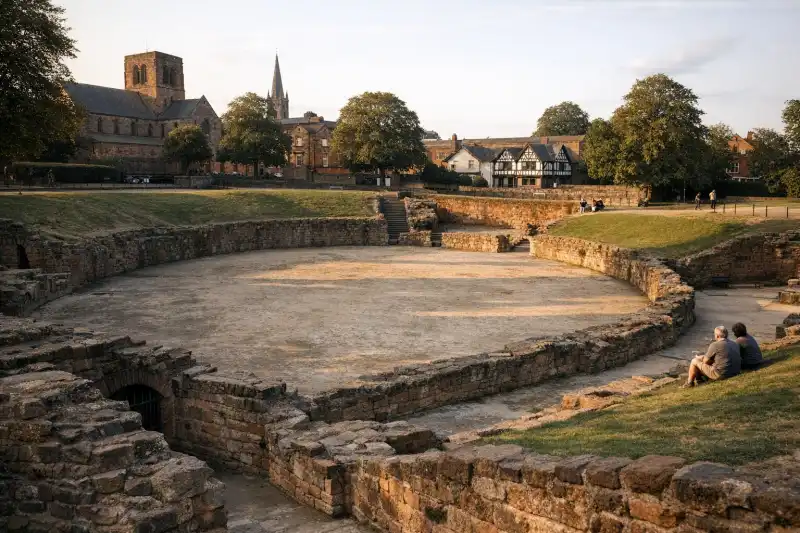
Chester Roman Amphitheater
Explore Chester Roman Amphitheater in the United Kingdom, the largest known Roman amphitheater in Br...
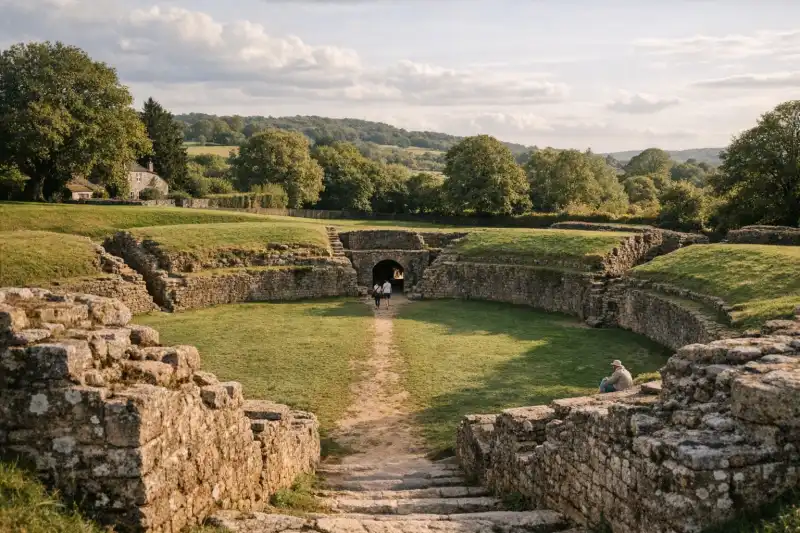
Caerleon Roman Fortress
RomanExplore Caerleon Roman Fortress in the United Kingdom, one of Roman Britain's best-preserved legiona...
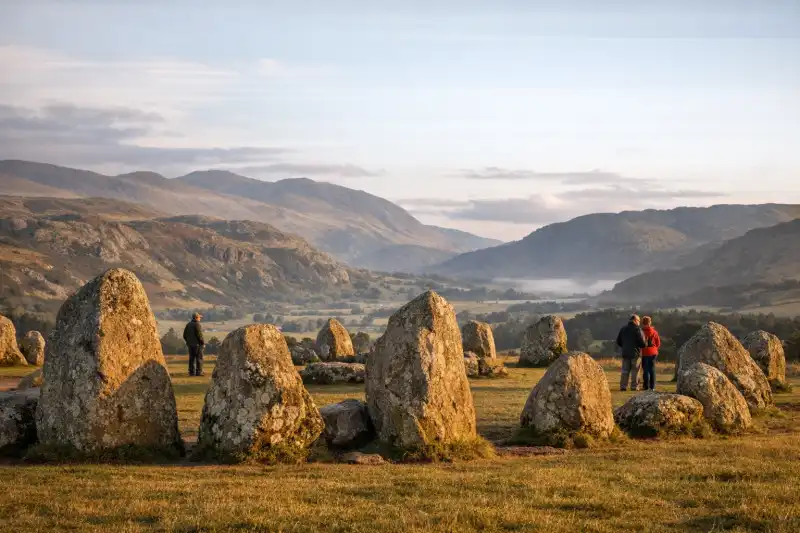
Castlerigg Stone Circle
Neolithic BritainAncient stone circle near Keswick in the United Kingdom, famed for dramatic mountain views and one o...