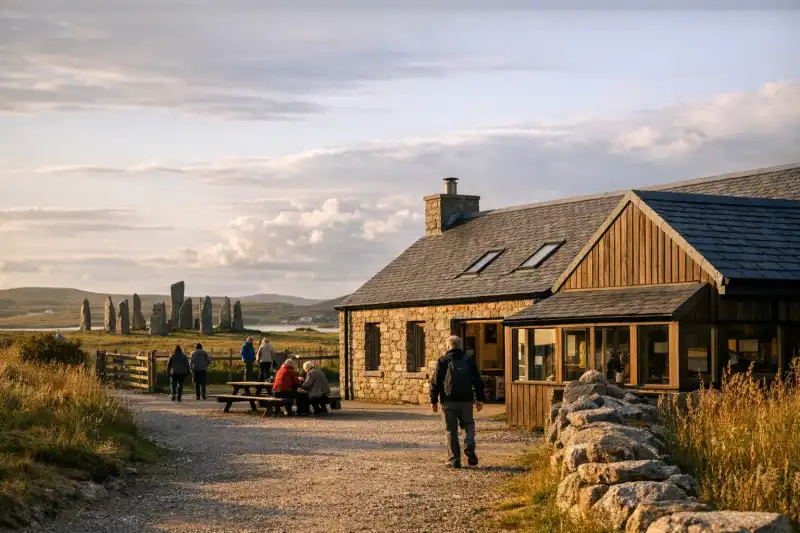
Quick Info
At a glance
Calanais Visitor Centre in the United Kingdom stands in one of the most evocative prehistoric landscapes in northwestern Europe. On the west side of the Isle of Lewis, amid peat moor, loch-studded ground, and a sky that seems to change color by the minute, the centre acts as the modern threshold to an ancient ceremonial world. Visitors often arrive expecting a stone circle and leave with something far more memorable: a sense of deep time, elemental weather, and a landscape where human ritual once aligned with horizon, moon, and season.
The famous stones of Calanais rise from a ridge with a surprising authority. They are not hidden in woodland or enclosed by urban sprawl. Instead, they command open country, with low hills and distant water expanding the setting in every direction. That openness is part of their power. The visitor centre helps make sense of what can otherwise feel mysterious, introducing the archaeology, history, and cultural significance of one of Scotland’s most important Neolithic monuments. It also provides a practical base for understanding the wider Calanais complex, which includes not just the central stone setting but additional nearby circles, avenues, and burial remains scattered across the surrounding landscape. For travelers exploring the Outer Hebrides, Calanais is both a major destination and an unforgettable encounter with the ancient past.
History
Neolithic Origins
The stones at Calanais were erected during the Late Neolithic, likely around 3000 BCE, placing them in the same broad era as some of Britain’s most famous prehistoric monuments. This was a time when farming communities had already taken root across many parts of the British Isles, and ceremonial construction had become one of the defining expressions of social and spiritual life. At Calanais, builders selected a natural rise in the landscape and raised a striking arrangement of monoliths around a central ring, with stone alignments extending outward.
The exact purpose of the monument remains debated, and that uncertainty is part of its fascination. Archaeologists have proposed ceremonial, astronomical, territorial, and funerary roles, and the site may have served several functions over a long span of use. Excavation has revealed that a chambered tomb was inserted into the center of the circle after the original stones were established, suggesting that the monument evolved rather than remaining fixed in meaning. Like many prehistoric sacred places, Calanais was probably revisited, reinterpreted, and adapted by successive generations.
Its setting was carefully chosen. The ridge gives broad views and striking horizon lines, and scholars have long examined possible alignments with lunar cycles, especially the dramatic southern moonset associated with the major lunar standstill. While not every theory commands universal agreement, there is no doubt that the monument’s builders understood the landscape intimately and placed the stones with intention.
Bronze Age Change and Long Silence
By the Bronze Age, patterns of ritual and settlement were shifting across Britain. Calanais appears to have lost some of its earlier centrality, though the monument was never entirely erased from memory. In many prehistoric places, ceremonial use faded gradually rather than ending abruptly, and Calanais may have continued to hold local significance long after its principal phase of construction ended.
Over centuries, peat accumulated in the surrounding ground and in some places around the stones themselves. This natural process changed how the monument appeared in the landscape. What had once been a more visibly engineered ceremonial setting slowly became part of a wilder moorland environment. That transformation can mislead modern visitors into thinking the stones have always looked exactly as they do now, but the prehistoric experience of the site would have been different: the monument was fresher, more deliberately monumental, and probably more connected to an actively managed landscape.
Even so, the stones endured. Their survival through millennia of wind, rain, and social change is remarkable. Unlike sites dismantled for building material or swallowed by later development, Calanais remained standing in a relatively remote setting, preserved partly by geography and partly by continuity of local awareness.
Folklore, Antiquarian Interest, and Excavation
As written records began to touch the Hebridean past more often, Calanais entered folklore as well as scholarship. Local traditions preserved tales about the stones, including stories that they were once giants turned to stone. Such legends are common at megalithic sites, and while they do not explain original Neolithic meaning, they show that the monument remained culturally alive long after its builders were forgotten.
From the seventeenth century onward, antiquarians and later archaeologists began documenting the site more systematically. Plans were drawn, comparisons were made with other stone circles, and Calanais took its place in the wider study of megalithic Britain. Excavation in the twentieth century clarified aspects of the monument’s chronology, including evidence for the later insertion of a burial chamber into the center. These investigations helped move understanding beyond romantic speculation toward archaeological interpretation.
The Modern Visitor Centre and Conservation Era
The creation of the Calanais Visitor Centre marked a newer stage in the site’s history: the era of interpretation, conservation, and managed public access. Rather than leaving travelers to encounter the stones without context, the centre was designed to explain what is known, what remains uncertain, and why the wider landscape matters. Exhibits, orientation materials, and staff knowledge help bridge the gap between scientific research and visitor experience.
In modern times, Calanais has become one of the signature archaeological destinations of the Outer Hebrides. This popularity brings benefits and challenges. More visitors means greater appreciation, stronger local tourism, and broader public awareness of Hebridean heritage. It also creates pressure on paths, facilities, and the monument itself. Conservation work and visitor management are therefore essential. The centre plays a key role in balancing access with protection, ensuring that this extraordinary Neolithic landscape can still be experienced without being loved to ruin.
Key Features
The most obvious feature associated with Calanais Visitor Centre is the great stone setting itself, often called the Calanais or Callanish stones. Unlike a simple circular arrangement, the monument has a more complex plan. A central stone circle is joined by a long avenue and several alignments radiating outward, creating a cross-like form when viewed from above. This geometry is one reason the site feels so distinct. It is both circle and processional monument, compact and expansive at the same time.
The stones are formed from local Lewisian gneiss, a hard and ancient rock that adds to the impression of permanence. Their surfaces are rough, weathered, and full of subtle texture. Some rise more than four meters high, and because they are irregular rather than neatly shaped, they feel alive in changing light. Morning mist can make them seem spectral; late evening sunlight gives them a bronze-gray glow; rain darkens them into something almost metallic. The visitor centre helps explain these physical qualities, but the landscape itself completes the lesson.
Another key feature is the site’s relationship to the wider Calanais ritual landscape. The famous main circle is only one element in a broader cluster of prehistoric monuments in the area. Nearby smaller circles and alignments reveal that this ridge was not an isolated sacred spot but part of an interconnected ceremonial zone. For travelers with time, this wider setting is as rewarding as the central monument. The centre encourages visitors to think beyond a single photo stop and to appreciate how ritual activity may once have spread across the surrounding moor.
Inside the visitor centre, interpretation is one of the strongest attractions. A good prehistoric site can be emotionally powerful even without explanation, but understanding the archaeology deepens the experience. Exhibitions introduce the chronology of the monument, the excavation evidence, and the questions scholars still debate. Visitors can learn about lunar alignment theories, burial practices, megalith construction, and the environmental history of the site. Because so much of prehistoric meaning remains uncertain, the best interpretation avoids pretending to have every answer. Calanais is compelling partly because mystery still survives, and the centre generally presents that uncertainty as a strength rather than a weakness.
The setting is another major feature in its own right. The Isle of Lewis offers a landscape of peatland, lochs, rock outcrops, and Atlantic weather systems that move fast across the sky. At Calanais, that environment is not background scenery but part of the monument’s atmosphere. The changing weather makes every visit slightly different. Wind can be fierce, silence can be sudden, and the horizon often appears immense. This environmental drama helps explain why ancient communities may have selected the site for ritual use. The stones seem to anchor human intention in a place already charged with natural presence.
Accessibility and visitor services also matter. For many travelers, especially those new to the Outer Hebrides, the visitor centre provides the practical confidence needed to explore. It offers a clear arrival point, orientation, and usually amenities such as information, retail, and refreshments depending on current operations. That may seem ordinary, but in a rural island context it makes a real difference. Instead of approaching a remote prehistoric site with uncertainty, visitors can begin with a sense of structure and understanding.
Finally, one of the subtler features of Calanais is the way the monument changes when seen from different distances. From afar, the stones appear as a compact cluster on a ridge. Up close, the scale of individual monoliths becomes more impressive. Walking around them reveals changing alignments and shifting relationships between stone, tomb, and avenue. The visitor centre prepares you for this layered experience, but the site itself delivers it through movement. Calanais is not a monument best understood from a single fixed viewpoint. It invites circling, pausing, and looking again.
Getting There
Most visitors reach Calanais Visitor Centre from Stornoway, the main town on the Isle of Lewis. The drive takes roughly 35 to 40 minutes and is the simplest option if you have a rental car. Roads on Lewis are generally straightforward, though some routes elsewhere in the Outer Hebrides can be narrow, so allow extra time and drive carefully in poor weather. Car hire from Stornoway is often the most flexible choice, with daily rental rates commonly starting around £45 to £80 depending on season and vehicle type.
Public transport is possible but less convenient. Local bus services connect Stornoway with western parts of Lewis, though schedules may be limited and can vary by day and season. Single fares are usually modest, often in the range of £5 to £10, but the main issue is frequency rather than cost. Check current timetables before committing to a same-day return. From the nearest stop, you may need to walk a short distance to the visitor centre and stones.
Taxis from Stornoway are useful for travelers without a car who want more flexibility than the bus offers. Expect a one-way fare of roughly £35 to £55 depending on time of day and operator. For couples or small groups, this can be reasonable, especially if combined with other nearby stops on Lewis.
To reach Lewis itself, most travelers either fly to Stornoway from mainland Scotland or take the ferry from Ullapool. Ferry foot-passenger fares are often around £10 to £20 one way, while taking a car costs more. Flights vary widely, but booking ahead usually secures better prices. However you arrive, try to plan transport early, because island capacity in summer can be tight.
When to Visit
Late spring through early autumn is the easiest period for most travelers to visit Calanais Visitor Centre. From May to September, days are long, the landscape is greener, and roads and ferry schedules generally feel more visitor-friendly. Summer brings the best chance of combining Calanais with a broader Lewis and Harris itinerary, and the long northern daylight can make evening visits especially memorable. Even then, expect wind, rain showers, and rapidly shifting skies. The Hebrides rarely deliver fully predictable conditions.
June, July, and August are the busiest months. These offer the warmest temperatures, often around 12°C to 18°C, but also bring more competition for accommodation, rental cars, and ferry space. If you want a balance between access and relative quiet, May and September are often excellent choices. Light is still good, visitor numbers are lower, and the atmosphere can feel calmer.
Autumn and winter have a different appeal. Storm light, dramatic clouds, and a more solitary mood can make the stones feel exceptionally powerful. The downside is practical: shorter daylight hours, more severe weather, and a greater chance of transport disruption. Some services may be reduced, and conditions underfoot can be wet and challenging. Winter visits are best for travelers comfortable with flexible planning and strong weather.
If your interest includes photography, early morning and late afternoon usually offer the best light. If your interest is atmosphere, overcast skies can be just as rewarding as sunshine. Calanais is one of those rare places where moody weather often enhances rather than diminishes the experience. The key is not to chase perfect conditions, but to arrive prepared for whatever the island gives you.
| Quick Facts | Details |
|---|---|
| Location | Near Calanais village, Isle of Lewis, Outer Hebrides, Scotland |
| Country | United Kingdom |
| Monument Type | Neolithic standing stone complex with central circle, avenue, and alignments |
| Best Known For | The Calanais standing stones and their dramatic moorland setting |
| Visitor Base | Calanais Visitor Centre |
| Approximate Date of Stones | Around 3000 BCE |
| Nearby Hub | Stornoway |
| Typical Visit Duration | 1 to 2 hours |
| Best Season | May to September for easiest logistics |
| What to Bring | Waterproofs, sturdy shoes, windproof layers, camera |
Guided tours: worth it?
Most travelers can visit Calanais Visitor Centre independently. Compare a tour only if you want a tighter history-focused visit, easier logistics, or a guide who can answer questions on the spot.
Best for
- Short visits where a planned route saves time
When to go self-guided
Go independently if you prefer setting your own pace, reading as you go, and checking official hours or ticket rules directly before you arrive.
What I’d avoid
Skip paid tours that bundle unrelated stops you do not actually want. The best option should either save meaningful planning time or add historical context you would miss on your own.
Isle of Lewis Calanais Visitor Centre tours
Useful when: you want to compare guided formats before deciding
Outer Hebrides standing stones tours
Useful when: you want to compare guided formats before deciding
Lewis and Harris archaeology tours
Useful when: you want to compare guided formats before deciding
Some tour links are affiliate links, which may earn Ancient Travel a small commission at no extra cost to you. I try to surface options that make practical sense for the site—not just anything bookable.
Frequently Asked Questions
What is the Calanais Visitor Centre?
The Calanais Visitor Centre is the main interpretive hub for visitors exploring the Calanais standing stones on the Isle of Lewis, offering exhibitions, orientation, and practical visitor services.
Do you need a ticket to see the stones?
Access arrangements can change during restoration or management works, so it is best to check the official Calanais Visitor Centre or Historic Environment Scotland information before visiting.
How much time should I allow for a visit?
Most visitors spend 1 to 2 hours between the exhibition, the stones themselves, and time to walk the surrounding landscape.
Is Calanais Visitor Centre suitable for families?
Yes, families often enjoy the interpretive displays and the open setting, though weather conditions can be challenging and children should be supervised around uneven ground.
Can I visit without a car?
Yes, but public transport on Lewis is limited. Many travelers use local buses from Stornoway combined with a short walk or choose a taxi or guided day tour.
What should I wear when visiting Calanais?
Bring waterproof layers, sturdy shoes, and wind protection, as conditions on the Isle of Lewis can change quickly even in summer.
Nearby Ancient Sites
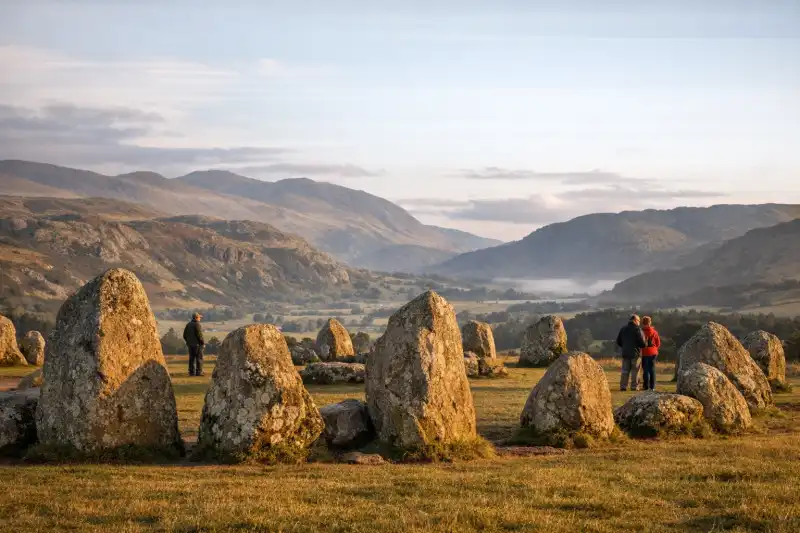
Castlerigg Stone Circle
Neolithic BritainAncient stone circle near Keswick in the United Kingdom, famed for dramatic mountain views and one o...
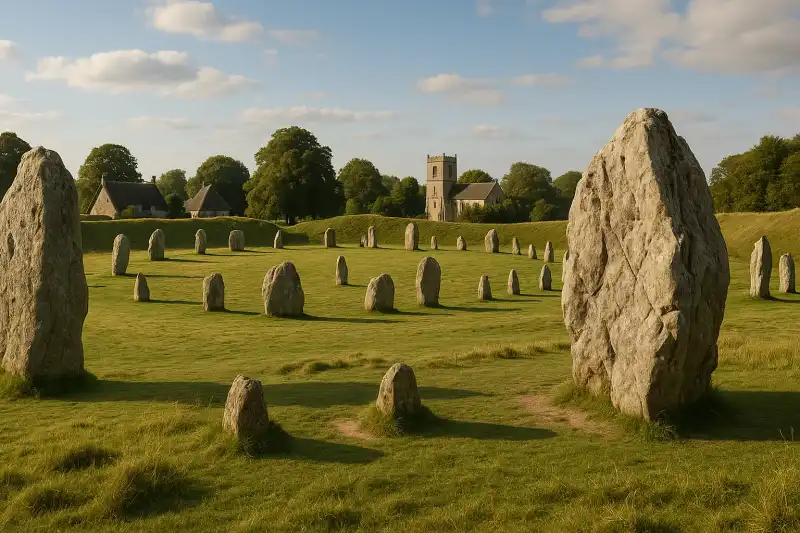
Avebury Stone Circle Travel Guide 2026: Best Walk Routes, History, and Visit Planning
Neolithic BritainPlan a stronger visit to Avebury Stone Circle with practical walking routes, landscape context, and ...
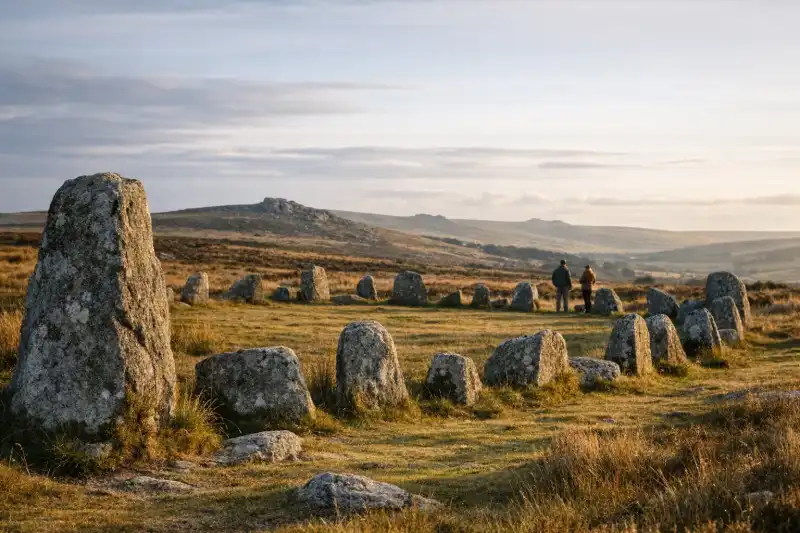
Dartmoor Stone Circles
Bronze Age communities of southwest BritainExplore Dartmoor Stone Circles in the United Kingdom, where Bronze Age ritual monuments stand across...