Quick Info
At a glance
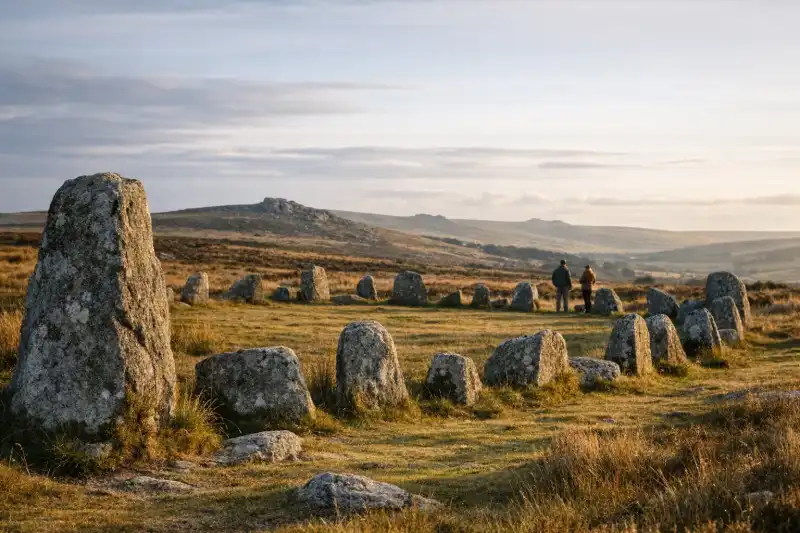
Dartmoor Stone Circles in the United Kingdom rise from one of England’s most atmospheric landscapes: a high granite moor where wind, mist, and open sky make prehistory feel unusually close. Rather than a single fenced monument, the name refers to a group of ritual sites scattered across Dartmoor in Devon, each standing among tors, heather, peat, streams, and broad grazing land. Some circles are complete enough to read at a glance; others survive as broken arcs, fallen stones, or subtle earthfast markers that reveal themselves slowly as your eye adjusts to the terrain.
That wide, elemental setting is a large part of their appeal. On Dartmoor, ancient monuments are rarely isolated. A stone circle may sit near a stone row, burial cairn, hut circle, or reave, suggesting that ceremonial, funerary, and domestic life once overlapped across the same upland routes. The effect for modern visitors is powerful. You do not simply arrive at a monument and leave; you walk through a prehistoric landscape where one feature leads to another, and where changes in weather can transform the entire mood in minutes.
For travelers interested in ancient Britain, Dartmoor offers something different from more monumental sites like Avebury or Stonehenge. Its circles are less formal, less restored, and often more remote. They demand a little effort, but they reward that effort with solitude, scale, and the sense of encountering archaeology in its natural setting rather than in a curated park.
History
Early settlement and the prehistoric moor
Human activity on Dartmoor stretches back to the Mesolithic, when hunter-gatherers moved through wooded valleys and upland clearings long before the open moorland scenery seen today had fully developed. By the Neolithic, communities were leaving more permanent marks on the land. Farming spread, forests were cleared in places, and ceremonial monuments began to appear across southwest Britain. On Dartmoor, this long transition set the stage for the construction of stone circles, rows, cairns, and enclosed settlements that still define the archaeological character of the moor.
The circles themselves are generally associated with the late Neolithic and especially the Bronze Age, roughly from the third to second millennia BCE. This was a period when communities in Britain were creating ritual landscapes on a large scale. Though Dartmoor lacked the giant megaliths of some other regions, it developed a distinctive tradition of smaller circles and linear arrangements of stone that worked with the terrain rather than overpowering it. Their builders selected ridges, slopes, and plateau edges with broad views toward tors, valleys, and the changing sky.
Bronze Age ceremonial landscapes
Most of the surviving Dartmoor circles were likely raised between about 2500 and 1500 BCE, when the moor supported far more sustained settlement than many people imagine today. Archaeology shows a busy prehistoric landscape of field systems, round houses, trackways, and burial monuments. Within this context, stone circles probably served ceremonial and social purposes rather than practical domestic ones. They may have been places for seasonal gathering, rites connected with ancestors, funerary activity, territorial identity, or observations tied to the sun and moon.
Scorhill, one of the best-known examples, stands on the northwestern moor and remains especially striking because of its relative completeness and dramatic siting. Elsewhere, monuments at Merrivale and around Yellowmead demonstrate that circles often existed alongside stone rows and cairn groups. This clustering suggests that the people of Bronze Age Dartmoor were not building isolated shrines but integrated sacred landscapes, where movement between monuments may have been part of ritual practice.
Because the monuments are modest in scale compared with famous megalithic centers elsewhere in Britain, interpretation remains careful and open-ended. Archaeologists can measure alignments, compare artifact scatters, and excavate nearby burials, but the exact ceremonies once held there are unknowable. What is clear is that these circles formed part of a broad regional pattern of monument building at a time when social identity and relationships to land, ancestry, and sky were being expressed in stone.
Decline, survival, and rediscovery
After the Bronze Age, changing climate, soil conditions, and economic patterns altered life on Dartmoor. Some upland areas became less intensively occupied, while later communities reused or ignored older monuments. Weathering, stone robbing, and gradual collapse reduced many circles from their original form. Yet Dartmoor’s relative isolation also helped preserve them. Because large parts of the moor escaped dense modern development, prehistoric features remained embedded in the living landscape.
Antiquarians began paying closer attention to Dartmoor’s ancient remains from the eighteenth and nineteenth centuries. They recorded circles, rows, and hut settlements, though early interpretation often mixed careful observation with romantic speculation. By the late nineteenth and twentieth centuries, more systematic surveys and excavations created a firmer archaeological framework. Researchers mapped monuments, compared construction styles, and linked them to broader Bronze Age patterns across Britain.
Today the Dartmoor stone circles are protected as scheduled monuments and studied as part of one of Europe’s richest surviving prehistoric upland landscapes. Their importance lies not just in any single ring of stones but in the network they form across the moor. To visit them now is to encounter monuments that have endured thousands of years of wind, livestock, lichen, and human curiosity, still holding their place in a landscape shaped by both memory and weather.
Key Features
What makes the Dartmoor Stone Circles memorable is their combination of understatement and setting. These are not giant monumental rings dominating a plain; they are often low, weather-softened arrangements of granite that ask visitors to slow down and look carefully. The stone itself usually comes from the moor, giving each monument a natural relationship with the land around it. Instead of seeming imported or imposed, the circles feel as if they have emerged from the ground, shaped by the same granite geology that produced Dartmoor’s tors.
Scorhill is perhaps the most visually compelling of the group. Set in open country above the Teign valley, it has a roughly circular arrangement of tall, irregular stones, some still standing impressively upright. The ring’s apparent simplicity is part of its strength. There is little to distract from the relationship between stone, horizon, and weather. On a bright day, the site feels expansive and legible; in rain or mist, it can become almost theatrical, with individual stones appearing and disappearing against the moor. Its survival gives visitors a strong sense of what a Dartmoor circle might once have looked like in more complete form.
Merrivale, on the western moor, is especially important because it shows how circles fit into a broader ceremonial complex. Here, visitors encounter not just standing stones but famous stone rows, a small circle, and nearby burial features. The site helps explain that prehistoric monument building on Dartmoor was rarely about a single form in isolation. Rows may have guided approach or attention; cairns marked burial or remembrance; circles provided a gathering point. Even when archaeologists cannot reconstruct the exact sequence of ritual action, the proximity of these monuments suggests that movement through the landscape mattered.
Another feature of Dartmoor’s circles is their variability. Some are broad and clear, others fragmentary. Some occupy commanding positions with extensive views, while others feel tucked into more intimate spaces. This variation reminds visitors that there was no single fixed blueprint. Local communities may have adapted a shared ceremonial tradition to specific places, choosing locations meaningful for reasons now lost: a line of sight to a tor, a route between seasonal pasture grounds, a spring, or an ancestral burial area.
The surrounding landscape is itself a key feature and should be treated as part of the site. Heather, gorse, granite outcrops, boggy hollows, and fast-moving cloud create a setting unlike lowland monument parks. Walking to a circle is often part of the experience, and that approach changes how the monument is perceived. A ring first seen from a distance can seem tiny against the moor, then surprisingly solid when reached on foot. Sound also matters. Often there is little beyond wind, birds, sheep, and water. That quiet helps explain why these places continue to feel ceremonial even without any certain knowledge of ancient rites.
Visitors should also notice the wear of time on the stones themselves. Many are lichen-covered, weather-rounded, or slightly leaning. This texture is not damage to be regretted but part of their authenticity. Unlike heavily restored monuments, Dartmoor’s circles often retain a directness that comes from long exposure and minimal intervention. They are not polished into museum pieces. Their rough edges, fallen elements, and partial survival make them more evocative of deep time.
For many travelers, the greatest feature of all is the sense of discovery. Because these monuments are dispersed, visiting them can feel more like exploration than checklist tourism. A day on Dartmoor might include a stone circle, a tor, a medieval bridge, and traces of abandoned settlements, all connected by paths or open-access walking. The circles reward those who enjoy landscape archaeology rather than standalone spectacle. They are best appreciated not as isolated attractions but as doorways into the entire prehistoric world of the moor.
Getting There
Reaching the Dartmoor Stone Circles usually involves combining road travel with some walking. The nearest main gateway cities are Exeter and Plymouth. From Exeter, driving to central or northern Dartmoor typically takes about 45 to 70 minutes, depending on which circle you plan to visit. Car rental from Exeter often starts around £35-£60 per day, and this is the most practical option if you want to see more than one site in a day. Parking charges vary: some moorland lay-bys are free, while village or visitor car parks can cost roughly £2-£6 for several hours.
Public transport is possible but less flexible. Trains from London Paddington to Exeter St Davids generally take around 2 to 2.5 hours, with advance fares often starting at about £25-£50 each way, though last-minute tickets can be much higher. From Exeter, local buses serve some Dartmoor towns such as Moretonhampstead, Tavistock, and Princetown, with single fares often in the £2-£5 range. However, stone circles themselves are rarely right beside a bus stop, so expect additional walking on minor roads, tracks, or open moorland.
Guided day tours can be a good alternative for travelers without a car. These may depart from Exeter, Plymouth, or other Devon bases, and prices commonly start around £60-£120 per person depending on group size and itinerary. Private tours cost more but can be useful if you want to focus specifically on prehistoric Dartmoor rather than general sightseeing.
If you walk independently, carry an Ordnance Survey map or offline navigation app, as weather can reduce visibility quickly. Good boots are strongly recommended, and waterproof clothing is essential in almost every season.
When to Visit
Late spring through early autumn is the easiest time to visit the Dartmoor Stone Circles, especially for first-time travelers. From May to September, days are longer, paths are easier to follow, and the moor often shows its most inviting colors, from fresh greens to purple heather later in summer. Temperatures are usually mild rather than hot, often around 12-20°C, making walking comfortable. This is the best period if you want to combine several sites in one day and avoid the challenges of short daylight hours.
Spring can be especially rewarding. The landscape feels open and fresh, and visibility is often excellent after passing rain. Summer offers the longest days, useful for slow exploration, photography, or combining circles with hikes to nearby tors. The trade-off is that popular Dartmoor villages and roads can be busier, especially on weekends and school holidays, though the circles themselves often remain peaceful.
Autumn brings a more dramatic mood. Lower light, shifting mist, and quieter roads can make the monuments feel especially atmospheric. September and early October are often excellent if you are prepared for cooler weather and occasional heavy rain. Photographers often prefer this season for the changing colors and moody skies.
Winter visits are possible and can be unforgettable, but they require care. Conditions may include icy ground, dense fog, saturated paths, and very short daylight. Some access points feel far more remote in winter weather than they do on a summer map. If you choose this season, start early, check forecasts closely, and keep plans conservative.
For the best balance of access, scenery, and comfort, aim for a weekday in late spring or early autumn. Whatever the month, Dartmoor’s defining rule is simple: prepare for weather changes at any time.
| Quick Facts | Details |
|---|---|
| Location | Dartmoor, Devon, England, United Kingdom |
| Type | Prehistoric stone circles and associated ritual landscape |
| Main Period | Late Neolithic to Bronze Age |
| Date | Approximately 2500-1500 BCE |
| Best-Known Circle | Scorhill Stone Circle |
| Related Monuments | Stone rows, cairns, hut circles, reaves, standing stones |
| Access | Mostly open landscape access, often requiring a walk from parking areas |
| Nearest Gateway City | Exeter |
| Typical Visit Length | 2 hours for one circle, full day for multiple prehistoric sites |
| Entry Fee | Usually free |
| Best Season | Late spring to early autumn |
| What to Bring | Waterproofs, sturdy boots, map, water, snacks |
Guided tours: worth it?
Most travelers can visit Dartmoor Stone Circles independently. Compare a tour only if you want a tighter history-focused visit, easier logistics, or a guide who can answer questions on the spot.
Best for
- Short visits where a planned route saves time
When to go self-guided
Go independently if you prefer setting your own pace, reading as you go, and checking official hours or ticket rules directly before you arrive.
What I’d avoid
Skip paid tours that bundle unrelated stops you do not actually want. The best option should either save meaningful planning time or add historical context you would miss on your own.
Dartmoor National Park and Prehistoric Sites Tours
Useful when: you want to compare guided formats before deciding
Devon Day Trips to Dartmoor
Useful when: transport or pickup logistics matter
Private Dartmoor Stone Circles and Tors Tour
Useful when: you want flexible timing or a private guide
Some tour links are affiliate links, which may earn Ancient Travel a small commission at no extra cost to you. I try to surface options that make practical sense for the site—not just anything bookable.
Frequently Asked Questions
What are the Dartmoor Stone Circles?
Dartmoor Stone Circles are prehistoric ceremonial monuments on Dartmoor in Devon, mainly dating to the Bronze Age and found across the moor among cairns, rows, and settlements.
Which stone circle is easiest to visit on Dartmoor?
Scorhill is often considered one of the easiest and most rewarding to visit, with a clear path from nearby parking and an impressive setting beside the River Teign valley.
Do I need to pay an entrance fee to see Dartmoor Stone Circles?
Most Dartmoor stone circles are open-access landscape monuments with no entry fee, though you may need to pay for parking in some villages or car parks.
Can I visit Dartmoor Stone Circles without a guide?
Yes, many visitors explore independently using maps and marked routes, but a guide can help explain the archaeological context and make navigation easier in poor weather.
What should I wear when visiting Dartmoor Stone Circles?
Wear waterproof layers, sturdy walking boots, and bring food, water, and navigation tools, since the moor's weather changes quickly and ground can be uneven or boggy.
Are Dartmoor Stone Circles suitable for children?
They can be suitable for older children who enjoy walking and open landscapes, but some sites require uneven moorland hikes and are not ideal for strollers.
Nearby Ancient Sites
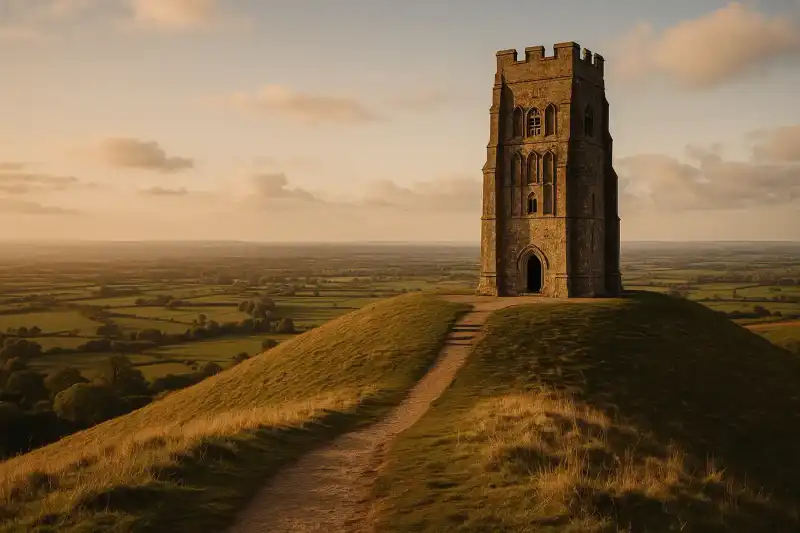
Glastonbury Tor Travel Guide 2026: Best Walk Times, History, and Visit Planning
Early Medieval EnglandPlan a smarter visit to Glastonbury Tor with practical climb timing, weather tips, and context on wh...
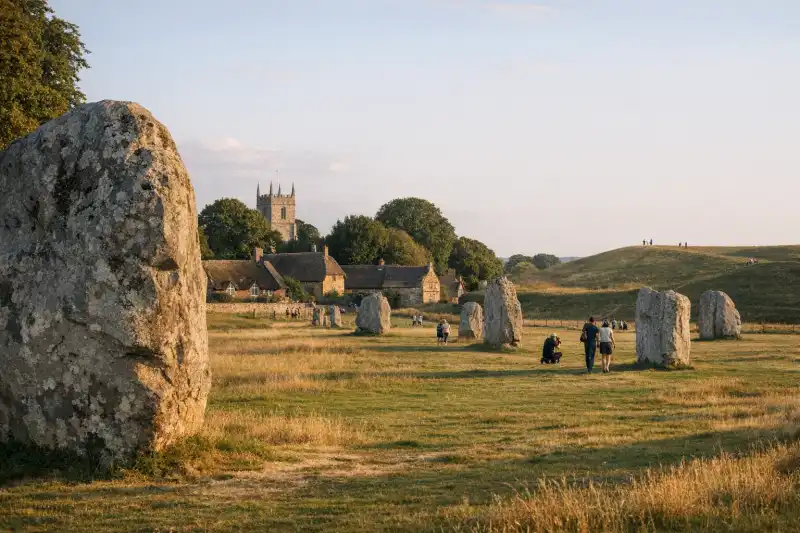
Avebury
Neolithic BritainExplore Avebury in the United Kingdom, a vast prehistoric stone circle and ritual landscape in the h...
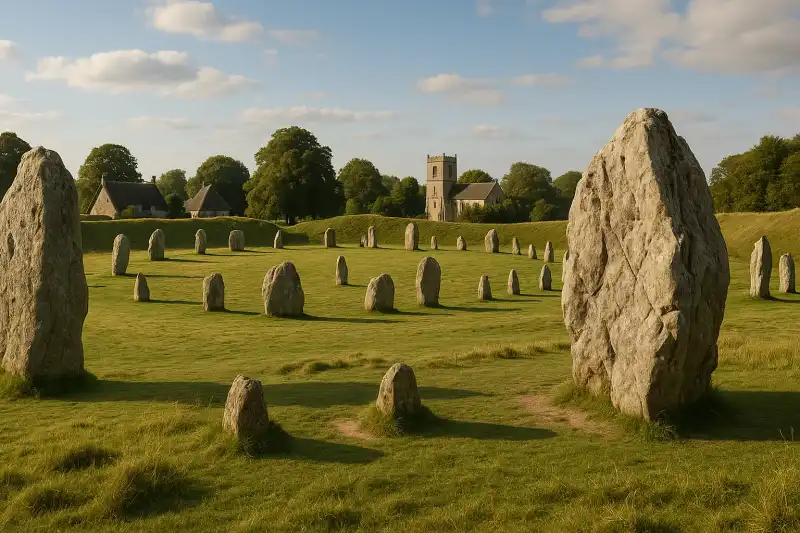
Avebury Stone Circle Travel Guide 2026: Best Walk Routes, History, and Visit Planning
Neolithic BritainPlan a stronger visit to Avebury Stone Circle with practical walking routes, landscape context, and ...
Chedworth Roman Villa
RomanExplore Chedworth Roman Villa, a remarkably preserved Roman countryside estate in the United Kingdom...