Quick Info
Curated Experiences
Caral Day Trip from Lima
Private Caral Archaeological Tour from Lima
Caral and Barranca Cultural Route
In the dry light of Peru’s Supe Valley, Caral-Supe, Peru can feel almost impossible: broad ceremonial plazas, terraced pyramids, and planned urban sectors rising from a landscape that still looks austere and elemental. Long before imperial roads, long before the Inca, and long before most of the monumental cities travelers associate with ancient civilizations, Caral was already organizing labor, ritual, and civic space at a scale that changed the history of the Americas. This is not just “old” by regional standards. It is foundational, dating to the late fourth and early third millennia BCE, in the same deep historical horizon as early urban experiments in other parts of the world.
What makes Caral so compelling is that its importance is both archaeological and emotional. You are not walking through a single temple or an isolated ruin; you are moving through a complete social project: plazas designed for ceremony, elevated architecture built for visibility and authority, residential and craft sectors laid out with intent, and landscape positioning that ties the city to the valley’s agricultural rhythms. For Ancient Travels, Caral belongs at the top of any serious Peru itinerary because it rewrites your timeline before you ever reach Cusco. This guide covers the site’s historical sequence, the key monuments to prioritize, transport and ticket logistics from Lima and Barranca, the best seasons for comfort and visibility, and practical ways to combine Caral with other major Peruvian archaeological stops.
History: The Deep Beginning of Andean Urban Life
Archaic foundations in the Supe Valley (c. 3500-3000 BCE)
Before Caral emerged as a monumental city, communities in the Supe and neighboring valleys were already experimenting with settled life, irrigation, exchange, and ritual architecture. The coast offered rich marine resources, while inland floodplains supported cotton, gourds, beans, and other crops that made larger populations more sustainable. Over generations, these communities developed stronger networks of specialization, and ritual space became increasingly central to social organization. By the late fourth millennium BCE, the valley had the conditions for leaders, planners, and work groups to coordinate projects larger than any household could produce alone. Caral did not appear from nowhere; it crystallized a regional process already underway.
The rise of Caral as a planned sacred city (c. 3000-2600 BCE)
During this phase, Caral expanded into a formally organized urban center with monumental platform mounds, large public plazas, and carefully controlled circulation corridors. The city’s planning signals political and ceremonial sophistication: structures are positioned for processions, visibility, and acoustic impact, not random settlement growth. Archaeologists have identified sectors that suggest differentiated social functions, including elite compounds, communal ritual spaces, and areas linked to daily production. Rather than conquest fortifications, the architecture emphasizes authority through ceremony and coordination. This matters because it challenges old assumptions that early urban complexity required militarized states. At Caral, monumental order appears to have grown from ritual legitimacy, inter-valley exchange, and long-term management of people and resources.
Peak florescence and regional integration (c. 2600-2000 BCE)
At its height, Caral operated within the broader Norte Chico cultural sphere, interacting with other Supe, Pativilca, and Fortaleza valley centers in a network of related ceremonial and economic communities. Cotton production likely played a key role in exchange, especially with fishing populations along the coast that depended on nets and cordage. Material evidence points to long-distance contacts, including objects and raw materials not native to the immediate valley. Public architecture continued to be modified and renewed, suggesting repeated communal investment rather than one-time construction episodes. The city functioned as both symbolic and practical hub, where ritual gatherings reinforced social ties while coordinated labor sustained infrastructure and agricultural productivity.
Transformation, decline, and abandonment (c. 2000-1800 BCE)
Like many early complex societies, Caral eventually entered a period of contraction. Environmental stress, shifting river behavior, and broader regional reorganization are all considered contributing factors. Monument use changed, population patterns dispersed, and the city ceased to operate as the same central node it had been for centuries. Importantly, “decline” here does not mean abrupt disappearance or civilizational failure in simplistic terms. Knowledge, practices, and social memory moved through later Andean traditions, even when specific urban forms faded. Caral’s end as a major center is better understood as transformation in a dynamic coastal world adapting to ecological and social pressure.
Modern rediscovery and scientific archaeology (20th-21st centuries)
Although local communities long knew of the mounds, systematic archaeological work intensified in the late twentieth century, when research teams demonstrated Caral’s extraordinary antiquity through stratigraphy, radiocarbon dating, and regional comparison. These studies repositioned Peru in global discussions of early civilization by confirming that one of the planet’s earliest large-scale urban traditions developed independently in the central Andes. Ongoing excavation, conservation, and site management now focus on stabilizing earthen architecture, improving interpretation for visitors, and protecting the valley context that made the city possible. Caral’s modern chapter is still being written, with each season refining how we understand early Andean state formation, ritual authority, and urban planning.
The Key Monuments: What to See at Caral-Supe
The Greater Pyramid (Pirámide Mayor)
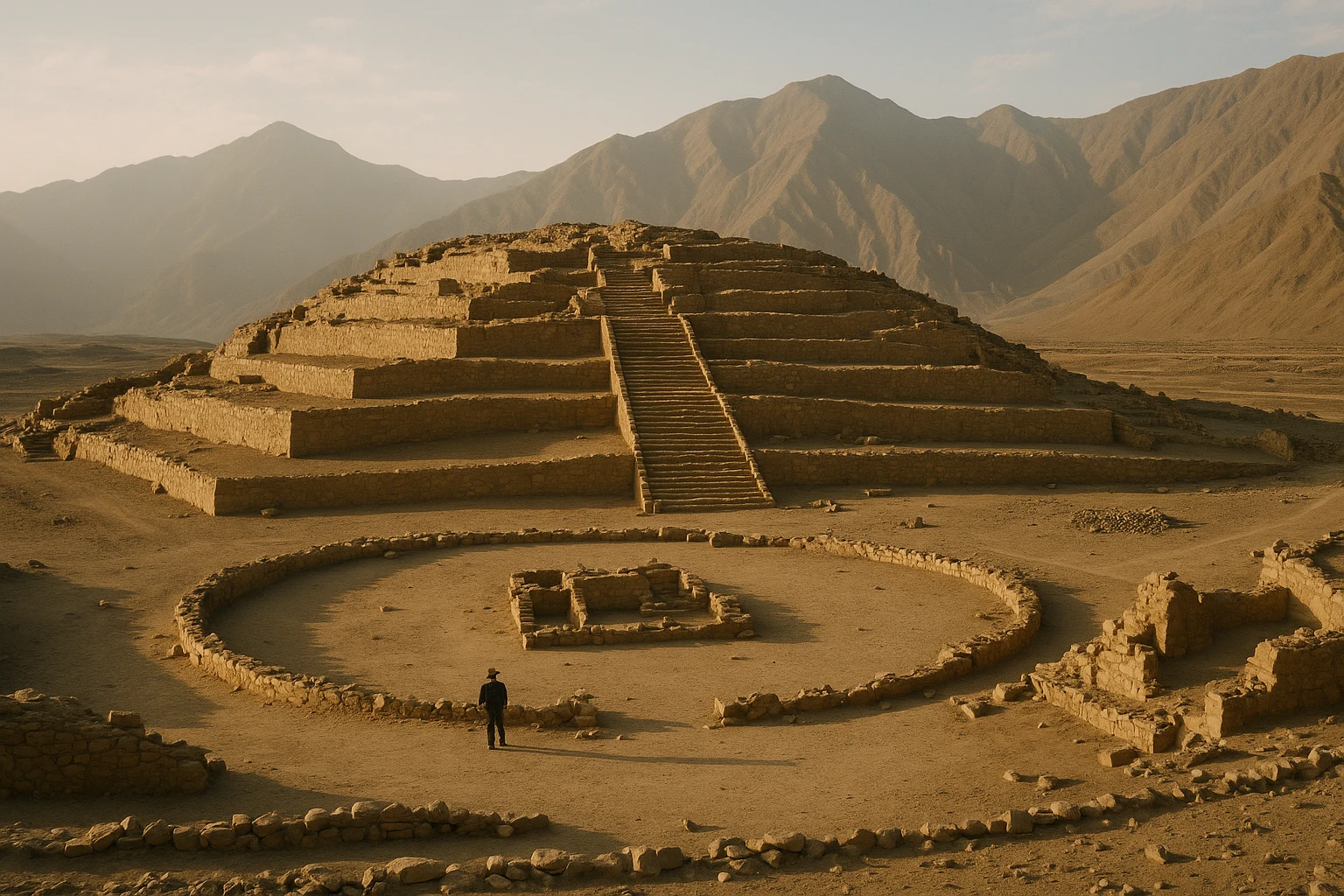
The Greater Pyramid is the architectural anchor of Caral and the best place to begin your on-site orientation. Rising in layered terraces above the valley floor, it was built and rebuilt over generations, reflecting continuity rather than a single construction event. The structure’s mass makes immediate sense of Caral’s labor organization: thousands of people had to coordinate earth movement, retaining walls, stairways, and platform maintenance in repeated cycles. Standing near its base, you can trace stair alignments and processional approaches that likely structured ceremonial movement. This is where Caral’s political language becomes visible — height, perspective, and controlled access used to communicate sacred order and social hierarchy.
From elevated points around the pyramid, you can read the city plan in relation to surrounding sectors and riverine agriculture. That broader view is crucial. Caral is not one monument isolated in desert silence; it is a valley-scale strategy of ritual architecture and settlement design. For photography, early morning gives cleaner contrast on terrace edges, while late afternoon often produces warmer texture across earthen surfaces.
The sunken circular plaza
In front of major platform architecture, Caral’s sunken circular plaza provides one of the clearest windows into public ritual life. The geometry is deliberate and dramatic: stepped descent into a circular enclosure, enclosed enough to focus attention but open enough to stage collective ceremony. Similar plaza concepts later appear in other Andean contexts, making this feature especially important for long-term cultural continuity. Acoustic behavior inside these spaces may have amplified speech, chant, music, and controlled ritual performance, giving leaders both symbolic and practical influence over gathered audiences.
As you descend and look back toward the surrounding platforms, the design logic becomes apparent. Vertical and horizontal spaces work together — elevated authority above, communal participation below. This arrangement suggests ritual was not peripheral but central to how Caral organized social life. If your time is limited, pairing the Greater Pyramid with at least one sunken circular plaza gives the strongest interpretive framework in under an hour.
The Temple of the Amphitheater sector
Often called the Temple of the Amphitheater, this zone combines architectural form with evidence of performative ritual activity. Excavations have documented contexts associated with offerings, burned materials, and intentionally arranged deposits, all pointing to repeated ceremonial use. The amphitheater-like design supports the idea that gatherings here involved orchestrated participation, where sound, movement, and visual staging reinforced social cohesion. Caral’s planners understood crowd dynamics, and this sector illustrates that sophistication as clearly as any large pyramid.
Archaeological interpretations also emphasize musical instruments from the broader Caral tradition, including flutes made from bird bones, which help bridge architecture and sensory experience. Even without reconstructive spectacle, the space invites you to imagine how rhythm, procession, and voice once activated these forms. Mid-morning is usually best for walking this area comfortably before stronger valley heat builds.
Residential and administrative compounds
Caral’s residential compounds are essential if you want to avoid seeing the site as only a ceremonial stage set. These sectors, varying in size and apparent status, help reconstruct daily governance and social differentiation. Some compounds show controlled entrances and internal organization that suggest administrative or elite functions; others point to craft, storage, and routine domestic activity. Together they demonstrate that Caral was not a periodic pilgrimage ground alone. It was a living city with institutional rhythms: food preparation, material production, planning, and oversight happening alongside ritual events.
For many visitors, these zones are less visually dramatic than the major mounds, but they are where Caral’s urban reality becomes concrete. Monumentality impresses; compounds explain. If you are traveling with a guide, ask them to contrast circulation patterns in residential sectors with those around ceremonial cores. That comparison makes social hierarchy legible in the architecture itself.
The urban panorama and valley setting
A final must-see is not a single structure but the panoramic relationship between city and landscape. Caral’s builders placed monuments to command views across the Supe Valley, connecting ritual space to agricultural land and movement corridors. From designated viewpoints, you can trace how architecture frames terrain, with platform mounds acting as visual anchors in a wider ecological system. This is one reason Caral has enduring interpretive power: the context still reads. You can still see why this location worked.
Plan at least one stop simply to stand still and look outward for several minutes. It helps shift the visit from checklist tourism to spatial understanding. In strong afternoon light, bring sun protection and lens shade; in cooler-season haze, patience is rewarded as valley contours gradually sharpen.
Getting There: Transportation and Access
Caral is reachable from Lima, but it is a long day and rewards early starts, realistic timing, and a plan for return transport before evening.
From Lima
Most visitors begin in Lima, typically from Miraflores, San Isidro, or the historic center.
- Organized day tour: Usually the easiest option, with hotel pickup, site entry coordination, and guide interpretation included. Expect 11-13 hours total and prices around S/445-780 ($120-210 USD), depending on group size and whether the service is shared or private.
- Intercity bus + local transfer: Take a bus from Lima to Barranca (about 3.5-4.5 hours), then continue by taxi or local transport to Caral (roughly 45-60 minutes each way). Combined costs often land near S/95-170 ($25-45 USD) depending on comfort class and negotiation.
- Rental car: Drive north via Panamericana, then follow valley roads toward the archaeological zone. Total one-way time is commonly 4-5 hours with traffic variables. Fuel, tolls, and parking logistics make this best for confident long-distance drivers.
From Barranca
Barranca is the nearest practical hub if you want to reduce same-day road fatigue.
- Taxi: The most direct transfer; fares commonly range S/70-110 ($19-30 USD) round trip with waiting, depending on season and negotiation.
- Local shared transport: Cheaper but less predictable in schedule and comfort; good for flexible travelers, not ideal if you have fixed return constraints.
- Private driver arrangement through lodging: Often slightly more expensive but smoother for timing and communication, especially if you want an early or late site window.
Admission and hours
Entry generally runs around S/11-15 ($3-4 USD) for adults, with reduced categories for students and children. Carry cash in soles, since payment systems can be inconsistent. Typical opening windows are daytime hours with last entry in the afternoon; verify current schedules before departure because staffing, conservation work, or national holidays can affect access. The site is exposed, so early arrivals are best for cooler walking conditions and softer photography light.
When to Visit: Seasonal Considerations
Spring (September-November)
Spring in the central coast-valley corridor is often the most balanced period for Caral. Temperatures are usually warm but manageable, commonly around 18-27°C (64-81°F), and road conditions are generally stable. Crowd levels remain moderate outside national holiday peaks, and visibility across the valley is often clearer than in deeper winter haze. For most travelers, this is an ideal season to pair comfort with good photo conditions.
Summer (December-March)
Summer brings stronger heat, brighter sun, and potentially demanding midday exposure, often around 22-31°C (72-88°F) and sometimes higher in sheltered areas. Crowds can increase during domestic travel periods, especially weekends. If you visit in summer, plan to enter the site early, carry more water than you think you need, and schedule shaded breaks where possible. Light clothing, hats, and sunscreen are non-negotiable.
Autumn (April-May)
Autumn is another strong window, with gradually moderating temperatures around 19-28°C (66-82°F) and generally calmer visitation patterns after peak summer travel. The site remains dry and open, and walking is often more comfortable through late morning than in hotter months. If your priorities are lower crowd pressure and steady weather without winter chill, autumn is a practical choice.
Winter (June-August)
Winter is cooler, often about 15-24°C (59-75°F), and can bring muted skies or morning haze tied to coastal conditions. The upside is softer light and fewer heat-related challenges during longer circuits. Crowds are typically manageable except around major travel periods. Bring a light layer for early starts, then adjust as temperatures rise through midday. Winter is perfectly workable; it just trades dramatic blue-sky contrast for gentler atmospheric tones.
Combining Caral-Supe with Lima and the North Coast
Caral works best when treated as a narrative anchor rather than an isolated checklist stop. A classic approach is an early departure from Lima, reaching the site in late morning for a focused 2.5- to 4-hour visit, then returning south before night traffic thickens. In this sequence, the day starts before 6:00 AM, uses the road efficiently, and leaves you back in Lima by 8:00-9:00 PM depending on traffic and meal breaks. It is long, but it provides an immediate chronological reset: by the next day, even familiar Lima landmarks feel newer in historical context because Caral has already moved your baseline back several millennia.
If you want a less exhausting rhythm, overnight in Barranca and visit Caral with a fresh morning start. Arrive in town the afternoon before, settle in, and begin the site around 8:30-9:00 AM. That pacing reduces transit fatigue and gives you room for slower interpretation, especially in residential sectors often skipped by rushed tours. By 1:00 PM, you can be back in Barranca for lunch, then choose whether to continue north or return to Lima the next morning.
For travelers building a broader Peru archaeology circuit, Caral pairs conceptually with Pachacamac and Huaca Pucllana near Lima. One practical sequence is Caral first, then Pachacamac the following day, and Huaca Pucllana at sunset or evening. The contrast is excellent: Caral for deep antiquity and urban origins, Pachacamac for long-duration pilgrimage religion, and Huaca Pucllana for pre-Hispanic architecture embedded in modern city life. If your trip continues north, adding Chan Chan extends the storyline into later large-scale coastal statecraft.
In other words, Caral is not just a destination. It is a timeline pivot. Once you stand in the Supe Valley and see monumental planning from around 3000 BCE, every later site in Peru fits into a clearer, richer arc.
Why Caral-Supe Matters
Caral matters because it expands what most travelers think civilization looks like. There are no giant stone walls here, no imperial iconography everyone recognizes, and no cinematic skyline. Instead, there is something arguably more profound: evidence that complex urban life in the Americas emerged very early through planning, ritual coordination, agricultural management, and durable social imagination. Caral asks you to value system over spectacle.
It also matters because its survival is fragile. Earthen architecture, open exposure, and regional pressures mean conservation is a continuous project, not a finished achievement. Visiting responsibly supports that work and helps keep this foundational chapter readable for future travelers and researchers. When you leave the valley, what lingers is not only the age of the site but its quiet confidence — a city that helped define the Andean world long before empires, still teaching anyone willing to look carefully.
Quick Facts
| Attribute | Details |
|---|---|
| Location | Supe Valley, Lima Region, Peru |
| Ancient Name | Caral (within the Norte Chico sphere) |
| UNESCO Status | World Heritage Site (2009) |
| Established | c. 3000 BCE |
| Distance from nearest hub | ~23 km from Barranca (about 45-60 min by road) |
| Entry Fee | S/11-15 (about $3-4 USD) |
| Hours | Daytime access; verify current seasonal schedule |
| Best Time | Spring and autumn mornings |
| Suggested Stay | 2.5-4 hours on-site |
| Primary Highlights | Greater Pyramid, sunken plaza, amphitheater sector |
Explore More Peru
- Pachacamac: Long-lived coastal oracle sanctuary south of Lima with major multi-civilization layers.
- Huaca Pucllana: Pre-Hispanic adobe pyramid complex in the heart of modern Miraflores.
- Chan Chan: Vast Chimu adobe capital near Trujillo, among the most important urban sites in the Americas.
Plan your wider journey with our Peru Ancient Sites Guide and map practical routes in our Peru transportation guide.
Frequently Asked Questions
How much time should I plan for Caral-Supe?
Plan about 2.5 to 4 hours at the site itself, plus a long overland transfer from Lima. Most visitors do Caral as a full-day excursion because road time often exceeds six hours round trip.
Is Caral-Supe really the oldest city in the Americas?
Caral is widely recognized as the oldest known monumental urban center in the Americas, with major construction beginning around 3000 BCE. Ongoing research keeps refining details, but its antiquity and scale are firmly established.
Can I visit Caral independently from Lima?
Yes, but it requires early departure, multiple transport legs, and careful timing for return buses. A guided day trip is simpler for most travelers because logistics are long and signage context at the site is easier to understand with interpretation.
What is the entrance fee at Caral-Supe?
Adult admission is typically around S/11-15 (about $3-4 USD), with reduced rates for students and children. Carry cash in Peruvian soles since digital payment availability can vary by season and staffing.
What should I prioritize if I only have a short visit?
Focus on the Greater Pyramid, the sunken circular plaza, and one elevated viewpoint over the urban core. That sequence gives you the clearest sense of Caral's ritual architecture and city planning in limited time.
Is Caral-Supe suitable for families?
Yes, if everyone is prepared for heat, long transfers, and walking on exposed terrain. Bring water, hats, and patience for the drive; the site itself is spacious and visually engaging for older children interested in history.
Nearby Ancient Sites
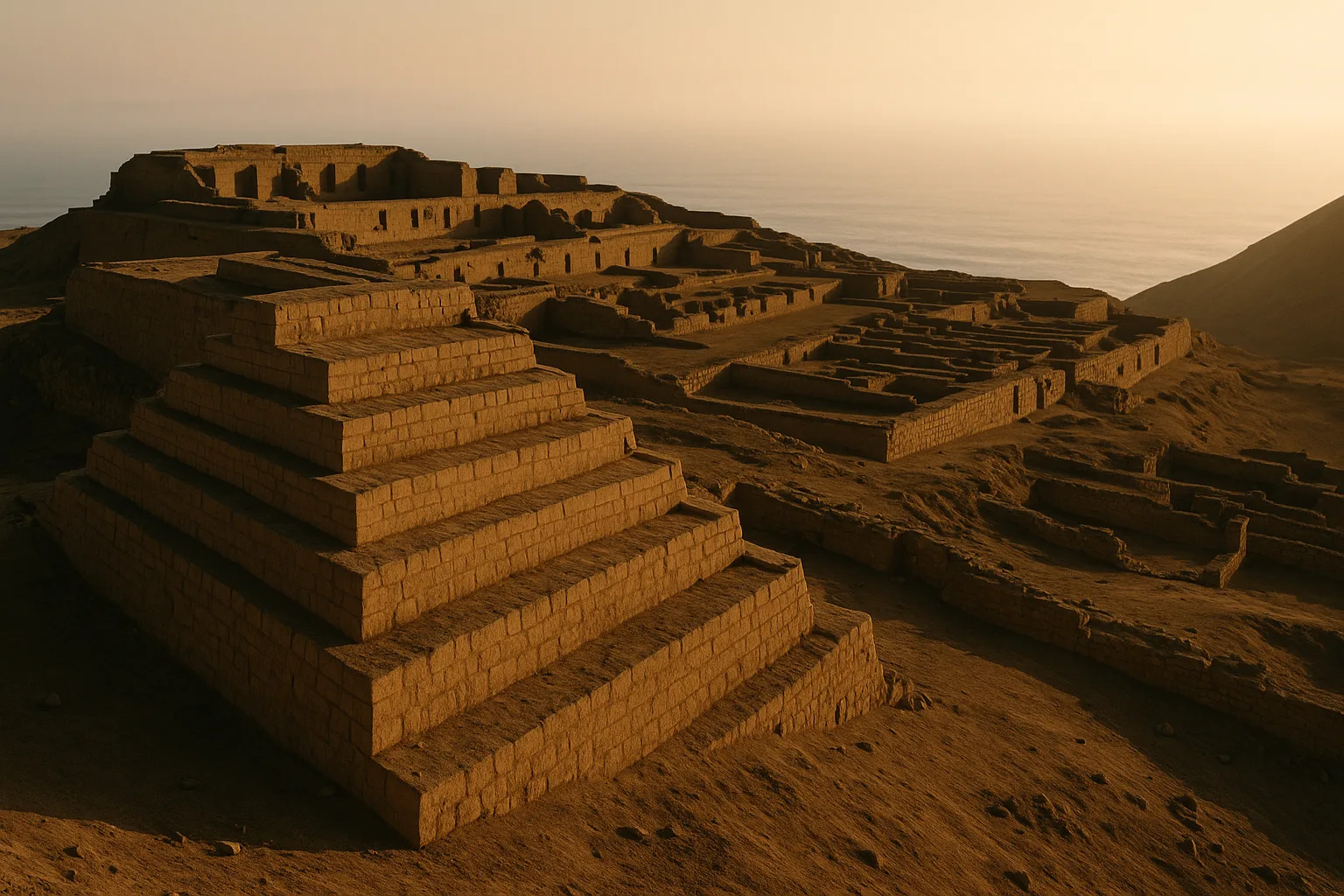
Pachacamac Peru Guide 2026: Oracle Temple, Pilgrimage Roads & Lima Coast
Lima-Wari-Ychsma-IncaExplore Pachacamac near Lima: ancient oracle temples, multi-civilization coastal history, practical ...
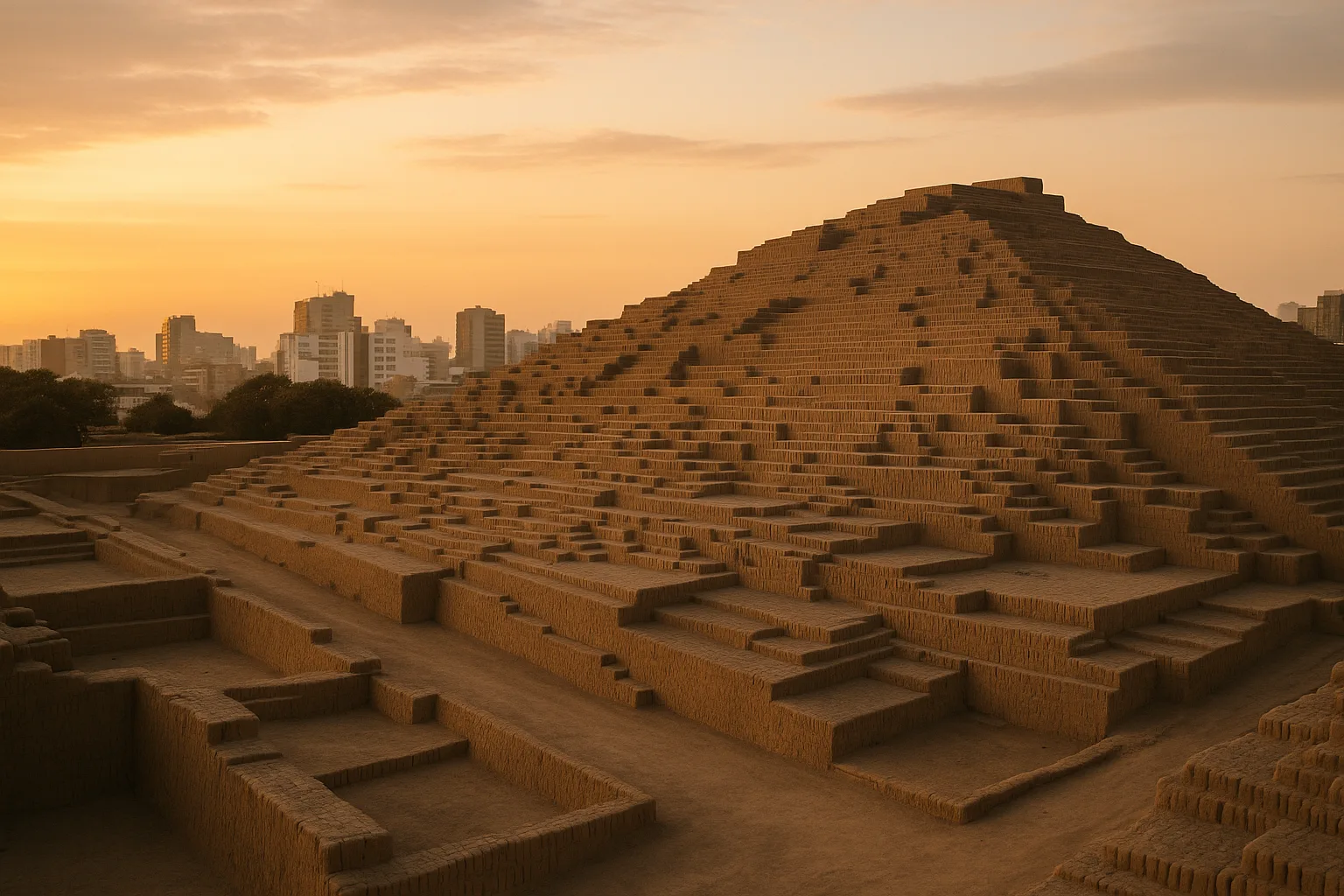
Huaca Pucllana Peru Guide 2026: Lima Adobe Pyramid & Lima Culture
Lima-Ychsma-IncaExplore Huaca Pucllana in Lima: pre-Inca adobe pyramid architecture, museum circuit, practical entry...
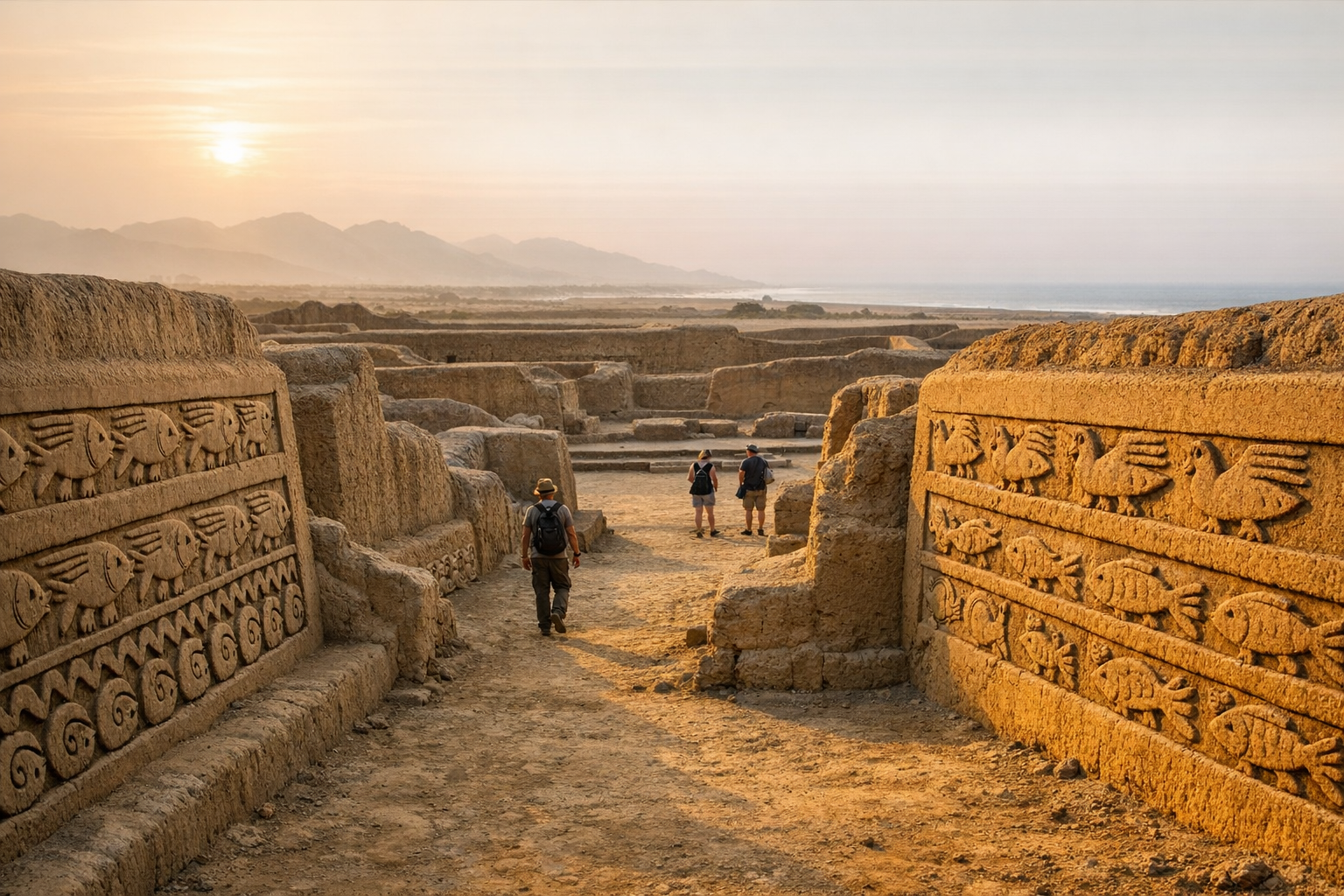
Chan Chan Peru Guide 2026: Chimu Capital & Adobe Citadels
ChimuExplore Chan Chan near Trujillo — the largest pre-Columbian city in the Americas. Discover the Chimu...