Quick Info
At a glance
Carn Euny in the United Kingdom sits high in the wind-shaped landscape of west Cornwall, where granite outcrops, rough pasture, and long Atlantic skies create a setting that feels both exposed and deeply ancient. Even before you reach the settlement itself, the mood of the place begins to gather: narrow lanes edged with hedges, sudden openings toward moor and coast, and the unmistakable sense that this southwestern corner of Britain has preserved older rhythms more stubbornly than many other regions.
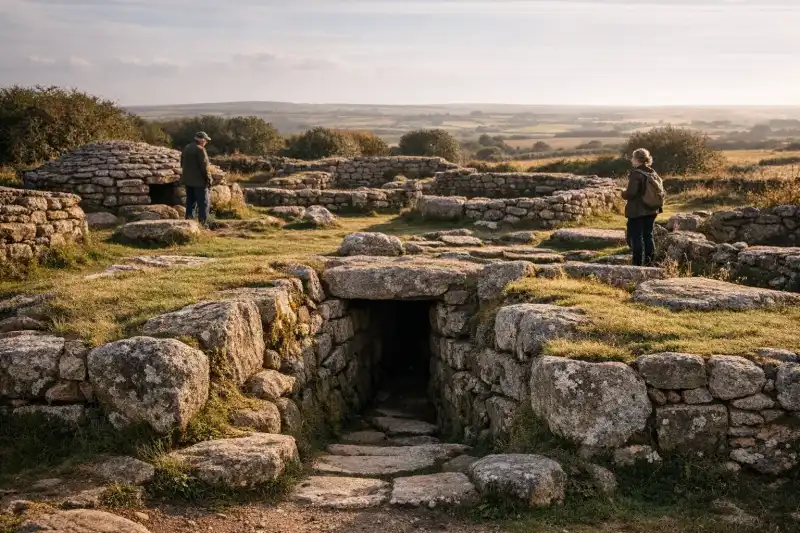
What survives at Carn Euny is not a temple, fortress, or royal monument in the grand classical sense. Instead, it is something quieter and in many ways more revealing: the remains of a lived-in community. Circular house foundations, enclosing walls, courtyards, and the famous underground fogou together offer a rare glimpse into daily life in Iron Age and Romano-British Cornwall. The settlement is compact enough to explore in a single visit, yet layered enough to reward slow attention. Standing among its stones, you can imagine cooking fires, storage pits, livestock, seasonal routines, and generations who reshaped the same site over centuries.
That combination of intimacy and mystery is what makes Carn Euny memorable. The village ruins are easy to read as domestic archaeology, but the fogou introduces uncertainty. Was it used for storage, refuge, ritual, or some combination of purposes now lost to time? The answer remains debated, and that ambiguity only adds to the site’s power. Carn Euny is a place where ordinary life and unresolved symbolism meet in stone.
History
Early settlement in the Iron Age
Carn Euny’s origins lie in the later prehistoric period, probably beginning around the Iron Age, when communities across Cornwall developed enclosed settlements adapted to local terrain and climate. In this western peninsula, people built with readily available granite, creating round houses and field systems that fit into a mixed farming economy. Carn Euny was not isolated in this pattern. It formed part of a wider landscape of defended enclosures, farmsteads, ritual sites, and trackways that tied together small but resilient communities.
The earliest phase at Carn Euny likely consisted of one or more simple round houses within a modest enclosure. These circular buildings were common in Atlantic Britain and suited to the practical needs of the time: thick walls offered shelter from harsh winds, and conical roofs of thatch or turf would have shed rain effectively. Archaeology suggests that the settlement expanded gradually rather than appearing all at once according to a single plan. That kind of organic growth points to long occupation and adaptation over generations.
Its location was well chosen. The site stands in a region with access to arable land, grazing, freshwater sources, and routes toward the coast. While west Cornwall may seem peripheral from a modern map, in later prehistory it was connected to broader cultural networks, especially through trade in metals and other goods. Communities here were not cut off; they were participants in local and regional exchange.
Development into a substantial village
Over time, Carn Euny grew into a more complex settlement. Additional round houses were built, and the internal layout became more structured. Stone-lined entrances, courtyard spaces, and carefully constructed walls show a degree of planning and continuity. By this stage, Carn Euny appears to have been a settled farming village rather than a temporary or seasonal occupation.
One of the most striking developments belongs to this mature phase: the construction of the fogou. Fogous are underground passages found mainly in Cornwall, and Carn Euny’s is among the best preserved. Built of dry stone with a corbelled roof, the passage would have required skill, labor, and a strong reason to justify the effort. Its exact date is debated, but it is usually associated with the later Iron Age. Whether it served as cool storage for food, a place of refuge during raids, a status symbol, or a setting for ceremonial acts remains uncertain.
That uncertainty matters because it reminds us that prehistoric communities organized space in ways not always legible to modern expectations. The fogou was clearly important enough to be built into the village’s life, and its presence implies a community with technical skill, shared purpose, and perhaps traditions that extended beyond purely domestic concerns.
Life under Romano-British influence
When Rome conquered much of Britain in the 1st century CE, Cornwall was never romanized in the same intense urban way as regions farther east. There were no great Roman cities in west Cornwall, and local settlement traditions remained strong. Carn Euny continued to be occupied into the Romano-British period, and this continuity is one of the site’s key historical values.
At Carn Euny, the evidence suggests adaptation rather than replacement. The round-house tradition persisted, but contact with the Roman world may have influenced trade, material culture, and local status patterns. Imported goods and changing habits elsewhere in Britain show that even remote communities were aware of larger political and economic systems. West Cornwall remained culturally distinctive, but it was not frozen in time.
The surviving remains at Carn Euny reflect this long transition. Some houses were rebuilt or modified, and the settlement layout evolved. Rather than a dramatic break between Iron Age and Roman periods, the archaeology suggests endurance, adjustment, and local choice. For visitors, this continuity is especially important: the ruins represent centuries of occupation, not a single moment.
Decline, rediscovery, and preservation
Like many ancient rural settlements, Carn Euny was eventually abandoned. The reasons may have included changing agricultural patterns, social reorganization, or the gradual movement of communities to more favorable sites. Abandonment was likely a process rather than an event. Buildings decayed, roofs collapsed, and walls softened into the landscape.
Local awareness of the ruins persisted, but archaeological investigation in the modern sense came later. Excavations in the 20th century brought the settlement into clearer focus, revealing the plan of the houses and the extraordinary preservation of the fogou. These investigations transformed Carn Euny from a scattered ruin into one of the most important prehistoric settlement sites open to the public in Cornwall.
Today the site is protected as a scheduled monument and managed for both conservation and access. Its exposed setting makes preservation an ongoing challenge, but it also contributes to the site’s authenticity. Carn Euny still feels inseparable from the land around it, which is perhaps the best way to understand it: not as an isolated ruin, but as an ancient village rooted in the living Cornish landscape.
Key Features
The first feature most visitors notice at Carn Euny is the plan of the settlement itself. Unlike monumental sites designed to overwhelm from a distance, this village reveals itself through close looking. Low granite walls trace circles and enclosures across the ground, allowing you to read the outlines of ancient homes. Several round houses survive as stone foundations, and their forms are still clear enough to suggest how rooms, thresholds, and domestic zones once worked. Walking among them, you begin to understand the village as a shared but carefully organized place where each household had its own space within a larger community.
The round houses are especially evocative because they retain a human scale. Their diameters are modest, and their entrances often seem practical rather than ceremonial. This gives Carn Euny an unusual immediacy. You are not just viewing archaeology; you are moving through what were once living interiors. The stone rings invite reconstruction in the mind: central hearths, smoke rising into rafters, tools stored against walls, and the daily rhythms of food preparation, repair, conversation, and rest.
The enclosing walls and passageways between structures are another important feature. They show that the settlement was not random. There was a logic to movement, access, and division of space. Some areas may have been used for livestock, storage, or communal activity. The village was built to function, but it was also built to endure. The surviving masonry speaks to careful craftsmanship and long familiarity with granite construction in a demanding environment.
Carn Euny’s most famous feature, however, is the fogou. Entering or even simply standing beside this underground structure changes the tone of the visit immediately. The word “fogou” derives from the Cornish language and is often translated as “cave,” though the structure is man-made. At Carn Euny, the fogou consists of a stone-lined passage roofed by overlapping masonry, creating a dim, enclosed space beneath the settlement. It is one of the finest examples in Cornwall and one of the main reasons the site is so significant.
The fogou’s atmosphere is unlike anything else on site. Above ground, the landscape is open to wind and weather; below, sound softens and light narrows. This contrast may help explain why the structure has inspired so many interpretations. If it served as storage, the cool stable conditions would have been useful. If it functioned as a refuge, its hidden nature would have been valuable. If it had ritual or symbolic meaning, the descent itself may have been part of its purpose. The archaeology does not provide a definitive answer, and that lingering uncertainty gives Carn Euny a depth beyond its visible remains.
Another notable feature is the relationship between the village and the wider landscape. Carn Euny is not packed into an urban setting or enclosed by modern infrastructure. Instead, it sits within open countryside near other prehistoric remains, field boundaries, and ancient routeways. This allows visitors to appreciate the settlement as part of a broader inhabited terrain. The surrounding fields are not merely scenic background; they were once the economic basis of life here, supporting crops, animals, and the household activities that made the village viable.
The granite outcrop from which the site takes part of its name also shapes the experience. “Carn” in Cornwall often refers to a rocky hill or tor, and the local geology is never far from view. Stone was not imported as a luxury building material; it was part of the environment itself. This direct relationship between landscape and architecture is one of the qualities that makes Carn Euny feel so grounded and authentic.
Finally, interpretation at the site tends to encourage imagination without forcing certainty. Carn Euny is powerful precisely because so much can still be inferred from what remains. It is readable enough to engage newcomers and subtle enough to hold the attention of serious history lovers. Few places in Britain communicate prehistoric domestic life with such clarity while still preserving an essential air of mystery.
Getting There
Carn Euny is located in west Cornwall, a few miles northwest of Penzance, and the easiest base for most visitors is Penzance itself. If you are arriving by rail, direct trains from London Paddington to Penzance typically take around 5 to 5.5 hours, with advance one-way fares often starting from about £35 to £70 depending on timing and availability. From Penzance station, you can continue by taxi, local bus, bicycle, or car.
By car, the journey from Penzance usually takes around 15 to 20 minutes, depending on your route and road conditions. Expect narrow country lanes near the site, with passing places rather than wide roads. Car hire is practical if you want to combine Carn Euny with other west Cornwall sites. Taxi fares from central Penzance are often in the range of £18 to £30 each way.
Public transport is possible but less direct. Local buses toward villages in west Penwith may get you part of the way, with single fares often around £2 to £4 under current regional fare schemes, but you will usually still need to walk the final stretch along rural lanes and footpaths. Check current timetables carefully, especially outside summer, as services can be limited.
Walking access involves uneven ground, and sensible footwear is recommended, particularly after rain. There may be limited formal parking close to the approach, so arrive prepared for a short walk. If you are visiting multiple archaeological sites in the area, a car or guided heritage tour is often the most convenient option.
When to Visit
Spring through early autumn is generally the best time to visit Carn Euny. From April to June, west Cornwall is often at its most appealing: days are longer, the countryside is green, and wildflowers soften the stone ruins without obscuring them. Temperatures are usually mild, often between 10°C and 17°C, making it comfortable for walking. This season also tends to offer clearer light for photography and a quieter atmosphere than the height of summer.
Summer brings the warmest weather, usually around 16°C to 21°C, and the longest daylight hours. This is ideal if you want to combine Carn Euny with coastal walks or a broader tour of Penwith. However, west Cornwall can be busy in July and August, especially on roads near major attractions. Carn Euny itself rarely feels crowded in the way famous urban monuments do, but parking and transport can be more complicated.
Autumn, especially September and early October, is another excellent time. The landscape remains attractive, visitor numbers usually ease, and the lower sun can give the site a dramatic, almost theatrical quality. Rain becomes more likely, though, and exposed granite can be slippery.
Winter visits have a certain stark beauty, with big skies and a stronger sense of isolation, but conditions can be challenging. Wind, mud, and sudden showers are common, and daylight is short. If you visit in winter, go early, wear waterproof layers, and check the ground conditions in advance.
For the best experience in any season, aim for a dry morning or late afternoon when the light is gentle and the site feels most atmospheric.
| Quick Facts | Details |
|---|---|
| Location | Near Penzance, Cornwall, United Kingdom |
| Site Type | Iron Age and Romano-British settlement |
| Famous For | Exceptionally preserved fogou and round-house remains |
| Period | c. 500 BCE to Roman era occupation |
| Nearest Major Town | Penzance |
| Best Visit Length | 45 minutes to 1.5 hours |
| Terrain | Uneven grass, stone remains, rural paths |
| Best Season | Spring to early autumn |
| Family Friendly | Yes, with supervision on uneven ground |
| Accessibility Note | Rural access and rough surfaces may limit mobility access |
Carn Euny rewards visitors who like ancient places that feel rooted in ordinary life rather than spectacle. Its ruins are modest in scale but unusually rich in meaning, showing how a community in prehistoric and Romano-British Cornwall built, adapted, and endured over centuries. The village layout makes domestic history visible, while the fogou keeps part of the story intriguingly out of reach. That balance of clarity and mystery is rare.
In west Cornwall, where prehistoric sites are woven into fields, hills, and coastlines, Carn Euny stands out for the completeness of its surviving plan and the atmosphere of its setting. It is not a place to rush. The more slowly you walk its rings of stone and the more carefully you picture the lives once lived there, the more memorable it becomes. For anyone interested in ancient Britain beyond its most famous monuments, Carn Euny is one of the United Kingdom’s most rewarding archaeological visits.
Guided tours: worth it?
Most travelers can visit Carn Euny independently. Compare a tour only if you want a tighter history-focused visit, easier logistics, or a guide who can answer questions on the spot.
Best for
- Short visits where a planned route saves time
When to go self-guided
Go independently if you prefer setting your own pace, reading as you go, and checking official hours or ticket rules directly before you arrive.
What I’d avoid
Skip paid tours that bundle unrelated stops you do not actually want. The best option should either save meaningful planning time or add historical context you would miss on your own.
West Cornwall Archaeology and Ancient Sites Tours
Useful when: you want to compare guided formats before deciding
Penzance and Land's End Day Tours
Useful when: you want to compare guided formats before deciding
Cornwall Heritage and Historical Tours
Useful when: you want to compare guided formats before deciding
Some tour links are affiliate links, which may earn Ancient Travel a small commission at no extra cost to you. I try to surface options that make practical sense for the site—not just anything bookable.
Frequently Asked Questions
What is Carn Euny best known for?
Carn Euny is best known for its Iron Age and Romano-British settlement remains and for its remarkably preserved fogou, a stone-lined underground passage unique to Cornwall.
Do you need to pay to visit Carn Euny?
Carn Euny is generally accessible as an open historic site without a formal ticket office, but visitors should check current local management information before traveling.
How long should I spend at Carn Euny?
Most visitors spend 45 minutes to 1.5 hours exploring the settlement, reading interpretation panels, and walking the surrounding landscape.
Is Carn Euny suitable for children?
Yes, families often enjoy the site, but uneven ground, exposed stonework, and rural paths mean children should be supervised closely.
Can you go inside the fogou at Carn Euny?
Access conditions vary for safety and conservation reasons, so you should check the latest on-site guidance before your visit.
What is the nearest town to Carn Euny?
Penzance is the nearest major town and the most practical base for visiting Carn Euny and other ancient sites in west Cornwall.
Nearby Ancient Sites
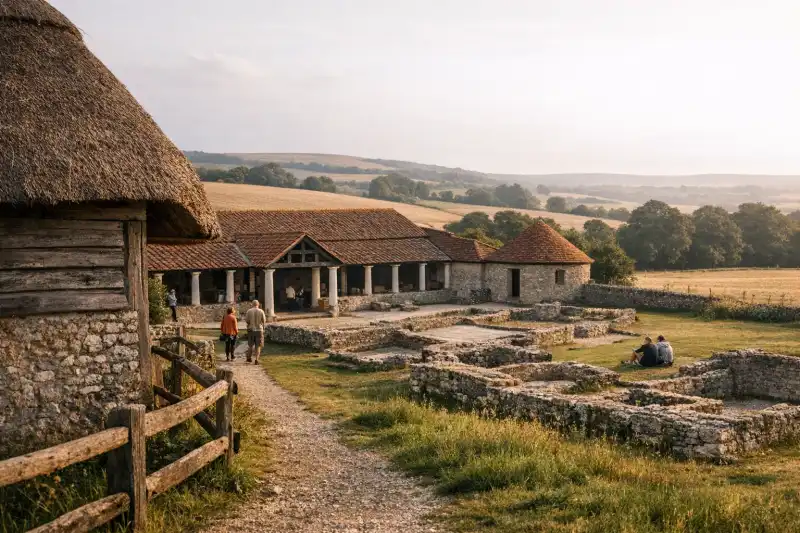
Bignor Roman Villa
RomanExplore Bignor Roman Villa in the United Kingdom, home to some of Britain's finest surviving Roman m...
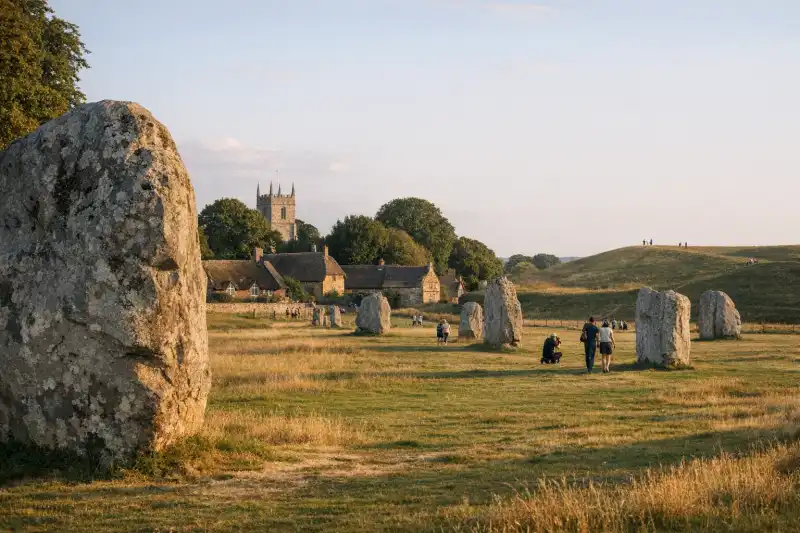
Avebury
Neolithic BritainExplore Avebury in the United Kingdom, a vast prehistoric stone circle and ritual landscape in the h...
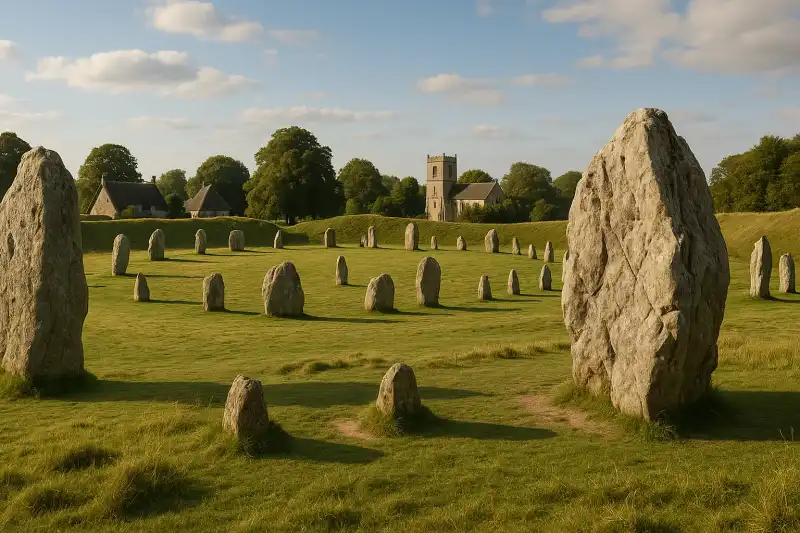
Avebury Stone Circle Travel Guide 2026: Best Walk Routes, History, and Visit Planning
Neolithic BritainPlan a stronger visit to Avebury Stone Circle with practical walking routes, landscape context, and ...