Quick Info
At a glance
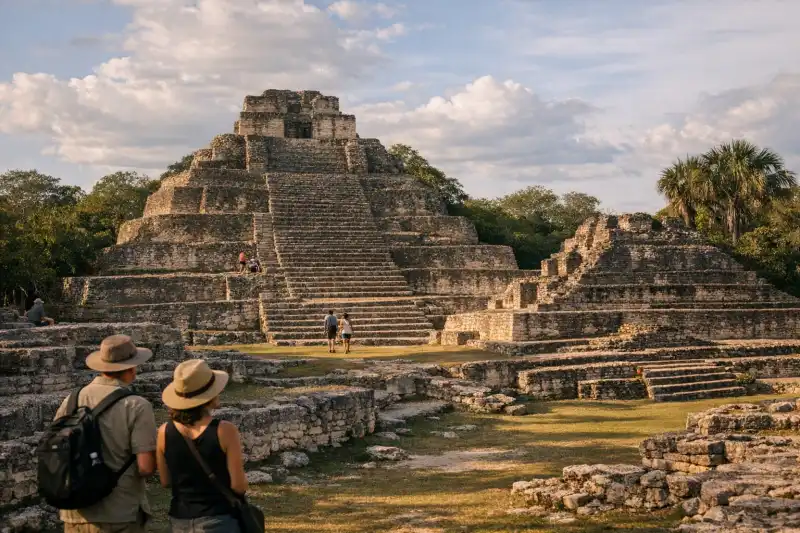
Chacchoben in Mexico feels very different from the country’s most famous archaeological zones. Rather than arriving to a broad plain crowded with vendors and buses, many travelers first encounter this Maya site through a gradual transition: paved highway gives way to greener roadside vegetation, the tropical air grows heavier, and the surrounding landscape begins to hint at hidden structures beneath the forest. The ruins rise from low jungle in southern Quintana Roo, a region better known to many visitors for Caribbean beaches and cruise itineraries than for inland ceremonial centers. That contrast is part of Chacchoben’s appeal. It offers a quieter, more intimate experience of the ancient Maya world, with restored pyramidal platforms, shaded pathways, and the sounds of birds and insects accompanying nearly every step.
Although Chacchoben is often visited as a shore excursion from Costa Maya or as a side trip from Bacalar, it rewards travelers who approach it with patience and curiosity. The site is neither the largest nor the most heavily monumental Maya center in Mexico, but it preserves a compelling sense of place. Broad plazas, temple mounds, stairways, and ceremonial architecture emerge from the greenery in a way that makes it easier to imagine how an ancient settlement once interacted with wetlands, trade routes, and nearby lagoons. For visitors interested in archaeology without the intensity of larger tourist circuits, Chacchoben offers something special: a chance to experience Maya history in a setting that still feels connected to the landscape that sustained it.
History
Early settlement and Preclassic origins
Chacchoben’s story begins long before the visible structures that attract visitors today. Archaeological research indicates occupation in the area as early as the Late Preclassic period, around 200 BCE, when Maya communities across the wider region were developing increasingly complex political, agricultural, and ceremonial systems. The site’s location was strategically favorable. Southern Quintana Roo was connected to inland and coastal networks, and nearby water resources, fertile zones, and wetland environments made sustained settlement possible.
During these early centuries, Chacchoben likely emerged as a local center serving surrounding communities. Architecture from this period was often built in stages, with earlier constructions buried beneath later enlargements. This practice was common in the Maya world, where buildings could embody continuity, dynastic legitimacy, and ritual renewal. While the earliest phases at Chacchoben were more modest than what visitors see now, they laid the foundation for the ceremonial core that would eventually define the site.
The name Chacchoben is usually translated as “place of red corn,” a phrase that evokes both agriculture and sacred symbolism. In Maya thought, maize was not merely a crop but a central element of cosmology, identity, and survival. Whether the ancient inhabitants used exactly the same name remains uncertain, but the modern designation captures the close relationship between settlement, cultivation, and ritual that characterized Maya centers.
Growth during the Classic period
Chacchoben reached its greatest development during the Classic period, especially between roughly 250 and 700 CE. This was the era when many Maya cities expanded their political influence, refined their architectural styles, and constructed ceremonial spaces on an impressive scale. At Chacchoben, elevated platforms, temple structures, and organized plazas suggest a community of substantial importance within the southern Quintana Roo landscape.
The site likely functioned as both a ceremonial and administrative center. Its elite residents would have coordinated local authority, religious observance, agricultural management, and regional interaction. Unlike some Maya capitals famous for towering inscriptions and dynastic monuments, Chacchoben is less known for carved stelae than for its architectural plan and setting. Even so, the surviving buildings indicate social hierarchy and ceremonial ambition. Structures were arranged to create visual prominence, directional alignment, and movement through open ritual spaces.
Its broader connections also mattered. Chacchoben stood within a world of exchange linking inland Maya communities to the Caribbean coast, the Petén lowlands, and northern Yucatán. Goods such as obsidian, shell, jade, and ceramics moved through these networks, along with ideas about kingship, religion, and art. The site’s growth should be understood not as isolated development but as participation in a larger Mesoamerican system.
Transformation, decline, and later use
Like many Maya centers, Chacchoben changed significantly after the peak of the Classic era. By the Terminal Classic and into the Postclassic period, political patterns across the Maya lowlands were shifting. Some cities declined dramatically, others reorganized, and still others persisted in reduced form. Chacchoben appears to have experienced contraction rather than a single catastrophic ending. Population may have decreased, ceremonial construction slowed, and the site’s regional role diminished.
This pattern aligns with what archaeologists see elsewhere in the Maya world: decline was often uneven and prolonged, influenced by changing trade routes, local environmental pressure, political fragmentation, and evolving social structures. Chacchoben was not simply “abandoned” overnight. Instead, it likely passed through phases of reduced occupation, selective reuse, and eventual encroachment by vegetation.
Over time, buildings collapsed, masonry became buried, and the forest reclaimed the ceremonial core. Yet the memory of ancient remains persisted in the broader landscape. Local knowledge of ruins often survives long after formal political systems disappear, and Chacchoben was no exception.
Rediscovery and modern excavation
Although local residents were aware of mounds and ancient remains, Chacchoben entered broader archaeological attention in the 20th century. More systematic investigation developed in the later decades of that century, particularly as infrastructure and regional tourism grew in Quintana Roo. Excavation and restoration revealed substantial ceremonial architecture hidden beneath earth and dense vegetation.
Archaeologists worked to clear structures, stabilize masonry, and interpret the site’s sequence of development. Restoration has made several major groups accessible to visitors while preserving the atmosphere of a forested archaeological zone. This work transformed Chacchoben from a little-known ruin into one of the key inland heritage attractions of the Costa Maya region.
Today, Chacchoben occupies an interesting position in Mexico’s archaeological landscape. It is significant enough to reward serious historical interest, yet still modest enough in scale to feel approachable. Its modern visitation has been shaped by cruise tourism, independent road travel, and growing appreciation for lesser-known Maya sites. In that sense, its history continues: once a regional ceremonial center, then a sleeping ruin beneath the jungle, Chacchoben is now a place where ancient architecture and contemporary travel intersect.
Key Features
One of the most striking aspects of Chacchoben is the way its architecture emerges from a tropical setting rather than dominating an open, cleared horizon. The site’s pathways curve through vegetation, and the movement between structures creates a sense of discovery. Visitors do not simply stand at a single overlook and absorb the entire site at once. Instead, Chacchoben reveals itself gradually through plazas, stairs, platforms, and raised temple masses, making the experience feel exploratory even on a well-maintained route.
The best-known architectural groups include the Gran Basamento, Structure 1, and the area often referred to as Las Vasijas. The Gran Basamento is a large elevated platform that anchors much of the ceremonial core. It demonstrates how Maya builders shaped both architecture and topography to create hierarchy in space. Elevated constructions provided not only visual power but ritual separation, lifting important structures above surrounding plazas and reinforcing the symbolic authority of those who used them. When standing near these foundations, it becomes easier to appreciate how architecture ordered social and ceremonial life.
Structure 1 is among the most memorable buildings at Chacchoben, with its restored stairway and prominent profile. It may not have the overwhelming scale of the largest pyramids in Mexico, but its proportions are elegant, and its relationship to the surrounding plaza is effective. The building shows how Classic Maya architecture balanced monumentality with harmony. Visitors often find that Chacchoben’s ruins feel especially photogenic in morning or late-afternoon light, when the stone surfaces and nearby foliage create strong contrast.
Las Vasijas adds another dimension to the site by highlighting the ceremonial and residential complexity of the ancient center. Rather than presenting a single dramatic monument, this sector suggests a network of structures that once supported ritual gatherings, elite activity, and local administration. Chacchoben’s significance lies in this ensemble. It was not merely a place for isolated temple worship but an organized settlement with multiple architectural functions.
Another major feature is the atmosphere created by the landscape itself. Mature trees, palms, and dense undergrowth frame the ruins in a way that many travelers find deeply appealing. Wildlife sightings are common: birds move through the canopy, insects hum along the paths, and the surrounding environment gives the impression that the site still belongs partly to the forest. For visitors accustomed to heavily urbanized heritage attractions, this setting can make Chacchoben feel more immersive. The jungle is not just background scenery; it is an essential part of how the ruins are perceived.
The site’s pathways are generally accessible and easy to follow, making Chacchoben suitable for travelers who want a manageable archaeological visit without a strenuous hike. At the same time, the layout preserves enough variation in height and perspective to keep the experience dynamic. Climbing options are more limited than they once were at many archaeological sites in Mexico, in keeping with conservation priorities, but the visual rewards remain strong from ground level and designated viewpoints.
Interpretive value is another important feature. Because Chacchoben is often visited with guides from Costa Maya or Bacalar, many travelers receive a narrative that connects architecture to agriculture, cosmology, trade, and the wider Maya world. Even independent visitors can appreciate the clarity of the site’s main areas. The remains are substantial enough to illustrate ceremonial planning, but not so extensive that the overall layout becomes confusing.
Finally, Chacchoben stands out for what it lacks: overwhelming commercialization. There are basic visitor facilities, and tourism is an important part of the local economy, but the archaeological core still feels calm compared with more famous Yucatán Peninsula attractions. That relative quiet is itself a feature. It allows visitors to focus on texture, scale, birdsong, humidity, and stonework rather than constant crowd movement. In a region where travel can be dominated by beach schedules and port timetables, Chacchoben offers a slower and more reflective encounter with ancient Mexico.
Getting There
Most visitors reach Chacchoben by road, either on a cruise excursion from Costa Maya, a private transfer, rental car, or organized trip from Bacalar or Chetumal. From the Costa Maya cruise port near Mahahual, the drive is typically 50 to 70 minutes each way. Cruise line excursions and independent shore tours usually cost about $55 to $110 USD per person depending on group size, transport quality, and whether guides, drinks, or combined stops are included.
From Bacalar, Chacchoben is much closer and easier to visit independently. A taxi or private driver generally takes around 30 to 45 minutes and may cost roughly 500 to 900 MXN one way, though negotiated round-trip rates are common. Rental cars are a practical option for travelers touring southern Quintana Roo, since roads are usually straightforward and the site has parking. If you are based in Chetumal, expect a drive of approximately 1.5 hours. A private transfer from there can range from 1,200 to 2,500 MXN depending on the vehicle and waiting time.
Public transportation is less direct. You may be able to take a bus or colectivo toward the Chacchoben village area and then continue by taxi, but schedules can be irregular and are not ideal if you are short on time. Independent budget travelers should verify current routes locally in Bacalar or Chetumal before relying on this option.
Entrance fees can change, but visitors should expect to pay an archaeological site admission charge in pesos, often around 100 to 200 MXN for many INAH-managed sites, sometimes with separate rates or tax components for foreign visitors. Bring cash, water, and sun protection, as services near the entrance may be limited compared with major tourist hubs.
When to Visit
Chacchoben can be visited year-round, but the best experience usually comes in the drier and slightly cooler months from November through April. During this period, temperatures are still warm, but the humidity is often more manageable, and walking the site is more comfortable, especially in the morning. This is also the most convenient season for cruise passengers and independent travelers combining the ruins with Bacalar or Costa Maya.
The hottest months, generally from May through August, can feel intense by late morning and afternoon. Southern Quintana Roo’s tropical climate means heat builds quickly, and shaded paths help only somewhat. If visiting in summer, aim to arrive as early as possible, wear breathable clothing, and carry more water than you think you need. Insect repellent is also wise, particularly after rain.
Rainy season conditions, usually peaking from June into October, make the forest especially lush and atmospheric. For photographers and travelers who enjoy vivid greenery, this can be a beautiful time to go. The trade-off is a higher chance of downpours, muddy patches, and oppressive humidity. Tropical systems can also affect travel plans in late summer and early autumn, so monitor forecasts carefully if you are visiting the Caribbean coast during hurricane season.
Timing within the day matters as much as timing within the year. Early morning is ideal for softer light, cooler air, and fewer people. Midday visits, especially when multiple shore excursions arrive, can feel busier and hotter. Late afternoon can also be pleasant if opening hours permit enough time for a relaxed visit. If you are arriving from a cruise ship, choose a tour with reliable port return timing rather than trying to improvise at the last minute.
| Quick Facts | Details |
|---|---|
| Location | Southern Quintana Roo, Mexico |
| Nearest city | Bacalar |
| Nearest cruise gateway | Costa Maya (Mahahual) |
| Civilization | Maya |
| Main period | Late Preclassic to Postclassic |
| Best for | Half-day archaeological visit, shore excursions, jungle atmosphere |
| Typical visit length | 1.5 to 3 hours on site |
| Access style | Road access with guided tours, taxi, rental car, or private transfer |
| Terrain | Shaded walking paths, plazas, low inclines, some stairs |
| Best time of day | Early morning |
Chacchoben is one of those archaeological sites that tends to exceed expectations precisely because it is less famous than its counterparts. Travelers may arrive thinking of it as a convenient excursion from the coast, yet leave remembering the quiet paths, the rise of stone structures through the trees, and the sense that ancient life once unfolded here in close conversation with the landscape. It does not rely on spectacle alone. Instead, its appeal lies in proportion, atmosphere, and legibility: the ruins are large enough to impress, compact enough to understand, and calm enough to absorb at a human pace.
For visitors interested in the Maya world beyond the headline sites, Chacchoben offers a rewarding balance of accessibility and depth. It can fit neatly into a cruise schedule, but it also deserves the attention of travelers exploring inland Quintana Roo more deliberately. Combined with Bacalar’s lagoon country or a broader route through southeastern Mexico, the site reveals a side of the region often overshadowed by beach tourism. In practical terms, it is easy to visit. In experiential terms, it lingers. Chacchoben invites you not only to look at ancient architecture, but to notice how stone, vegetation, heat, and memory shape one another in the Mexican Caribbean hinterland.
Guided tours: worth it?
A guide can be genuinely useful at Chacchoben, especially if you want help with transport, timing, tickets, or understanding a large site without losing half the day to logistics.
Best for
- First-time visitors who want context, not just photos
- Travelers who want transport, timing, or entry logistics handled
- Short visits where a planned route saves time
When to go self-guided
Go independently if you already have transport and tickets sorted, enjoy moving at your own pace, and are comfortable checking the latest official rules before you arrive.
What I’d avoid
Skip paid tours that bundle unrelated stops you do not actually want. The best option should either save meaningful planning time or add historical context you would miss on your own.
Chacchoben Ruins Tours
Useful when: you want to compare guided formats before deciding
Costa Maya to Chacchoben Excursions
Useful when: you want to compare guided formats before deciding
Chacchoben and Bacalar Tours
Useful when: you want to compare guided formats before deciding
Some tour links are affiliate links, which may earn Ancient Travel a small commission at no extra cost to you. I try to surface options that make practical sense for the site—not just anything bookable.
Frequently Asked Questions
Where is Chacchoben located?
Chacchoben is in the Mexican state of Quintana Roo, inland from the Costa Maya cruise port and not far from Bacalar.
How far is Chacchoben from Costa Maya port?
The ruins are roughly 55 kilometers from the Costa Maya cruise area, and road transfers usually take about 50 to 70 minutes depending on traffic.
How much time do you need at Chacchoben?
Most visitors spend 1.5 to 3 hours exploring the site, though guided excursions from the coast often include transport time and last half a day.
Can you visit Chacchoben without a guide?
Yes. You can walk the marked paths independently, but a guide adds valuable context about Maya history, architecture, and the restoration of the site.
Is Chacchoben suitable for cruise passengers?
Yes. It is one of the most popular archaeological excursions from Costa Maya because it is reachable in a manageable half-day trip.
What should you bring to Chacchoben?
Bring water, insect repellent, sun protection, comfortable walking shoes, and cash for entry fees, snacks, or transportation if not on a prepaid tour.
Nearby Ancient Sites
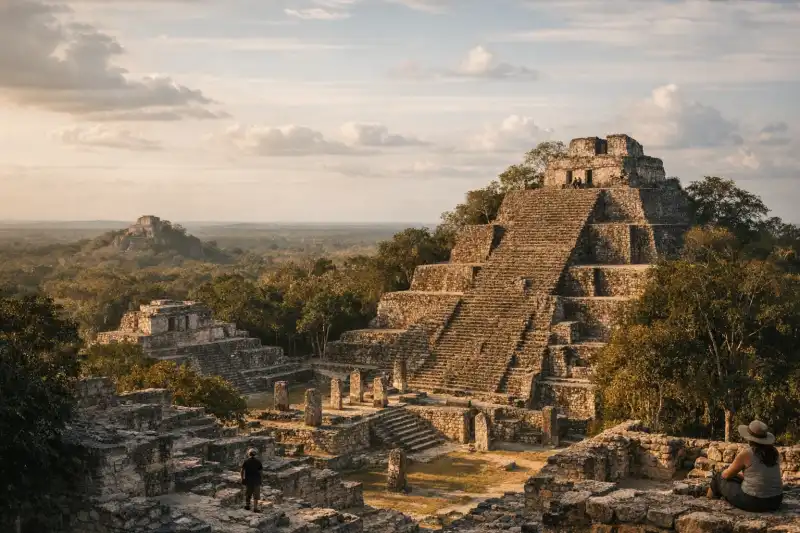
Calakmul
MayaExplore Calakmul, a vast Maya city deep in the forests of Campeche, Mexico, known for towering pyram...
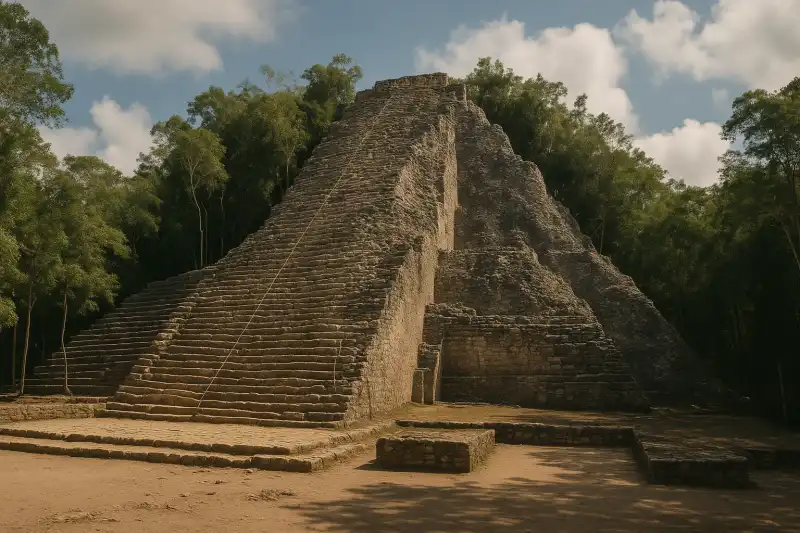
Coba Travel Guide 2026: Ruins Route, Timing, and Practical Day Planning
MayaPlan a better Coba visit with route strategy, realistic timing from Tulum or Cancun, and practical t...
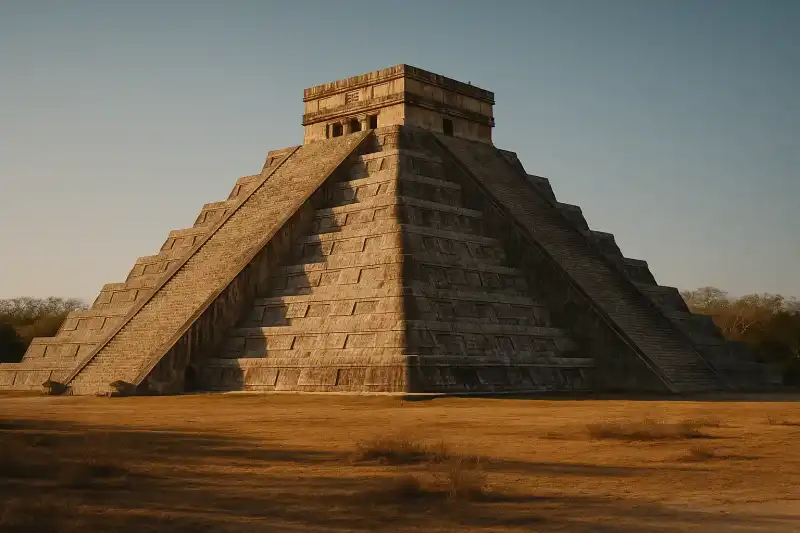
Chichen Itza Travel Guide 2026: Maya Secrets, Sacred Cenote, and Smart Timing
MayaChichen Itza stands as the most visited ancient site in Mexico, showcasing the architectural genius ...
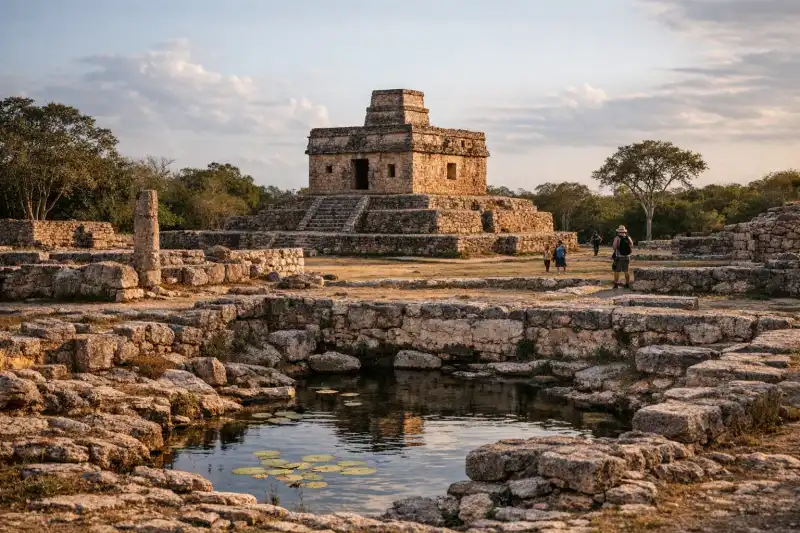
Dzibilchaltún
MayaExplore Dzibilchaltún, an ancient Maya city in Mexico known for its Temple of the Seven Dolls, sacbe...