Quick Info
At a glance
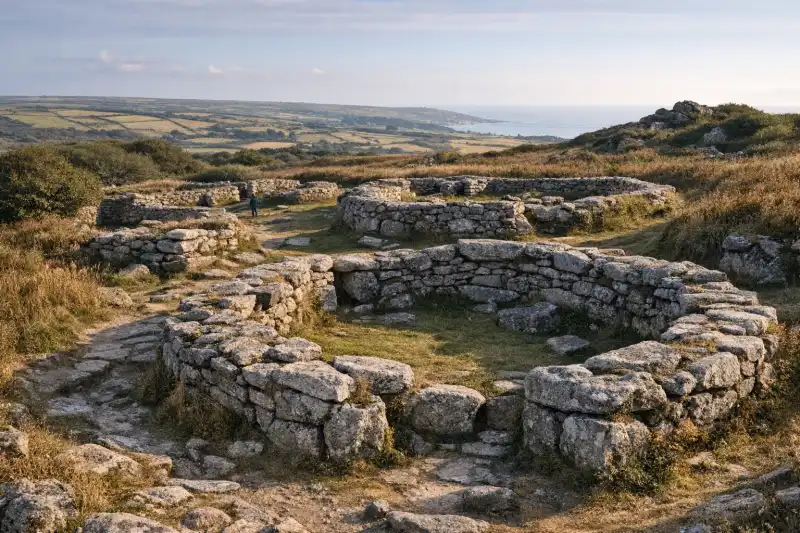
Chysauster Ancient Village in the United Kingdom sits quietly on a Cornish hillside, where low stone walls, open skies, and windswept fields create one of the most atmospheric archaeological landscapes in southwest Britain. Unlike a grand fortress or a monumental temple, Chysauster impresses through intimacy. This was a lived-in place: a community of families, neighbors, routines, meals, storage, shelter, and seasonal work. Walking through its carefully planned stone compounds today, you are not looking at a distant abstraction but at the outline of ordinary life from nearly two thousand years ago.
The setting matters as much as the ruins themselves. Cornwall’s ancient field systems, granite uplands, and coastal weather give the site a sense of continuity with the deep past. Chysauster is not isolated from its landscape; it belongs to it. The village stands in an area shaped for millennia by farming, movement, and settlement, and its position hints at practical choices as well as social ones. It was high enough for visibility and drainage, but also close to cultivable land and wider networks of exchange. That balance helps explain why the village endured from the late Iron Age into the Romano-British era.
For modern visitors, Chysauster offers something rare: a settlement whose layout can still be read on the ground. You can follow doorways, courtyards, rooms, and pathways, and imagine how architecture organized daily life. It is a site that rewards patience, close observation, and an appreciation for how much history survives in modest stones.
History
Late Iron Age Origins
Chysauster Ancient Village developed during the late Iron Age, probably beginning in the last centuries before the Roman conquest of Britain. At this time, communities across Cornwall were adapting to local conditions with regionally distinctive architecture and settlement patterns. In west Cornwall, one of the most notable forms was the courtyard house settlement, and Chysauster is among the finest surviving examples.
The people who established the village were likely farming families whose livelihoods depended on mixed agriculture. They would have grown crops suited to the local climate and kept livestock, while also making use of surrounding natural resources. The architecture reflects a practical response to weather and terrain. Stone was abundant, durable, and well suited to the exposed Cornish environment. The clustered layout of homes suggests not a scattered hamlet but a planned community where households lived in close proximity.
This period in Cornwall was not one of isolation. Even before Rome, the southwest was connected to wider trade routes, especially through its mineral wealth, including tin. While Chysauster itself appears primarily domestic rather than elite, the community would have been part of broader regional systems of exchange and contact. Everyday objects, foodways, and technologies likely reflected both local traditions and outside influences moving through the peninsula.
Life Under Roman Influence
After the Roman invasion of Britain in AD 43, Cornwall occupied a peripheral position within Roman-controlled territory. The region was never urbanized in the same way as parts of southern and eastern Britain, yet Roman influence still reached local communities. Chysauster continued to be occupied into the Romano-British period, showing that life here adapted rather than abruptly ended.
This continuity is one of the site’s most important historical features. Rather than being replaced by Roman town planning or villa culture, Chysauster retained its local architectural identity. The courtyard houses remained central, indicating that indigenous ways of organizing domestic space persisted even as trade, material culture, and political realities changed. Archaeological finds from the site have included evidence of imported goods, showing that the settlement was linked, however indirectly, to Roman economic networks.
The endurance of the village suggests resilience and flexibility. Local inhabitants may have incorporated new objects or practices without abandoning established traditions. This was common in many parts of Britain where Roman rule did not erase regional identity. Chysauster therefore offers a valuable window into how communities on the margins of empire negotiated change: selectively, pragmatically, and on their own terms.
Decline and Abandonment
Like many ancient settlements, Chysauster was not occupied indefinitely. By the later Roman period or soon after, the village appears to have been abandoned. The exact reasons remain uncertain, but several possibilities are plausible. Economic patterns may have shifted, local agricultural arrangements could have changed, or wider instability in Roman Britain may have affected settlement life. Environmental pressures and evolving social organization may also have played a part.
Abandonment does not necessarily imply sudden collapse. It may have been gradual, with households leaving over time and buildings falling out of use. As roofs decayed and timber elements disappeared, the stone walls remained, preserving the footprint of the community even as its living memory faded. Over centuries, the site blended back into the working landscape, its significance obscured but not lost.
Rediscovery and Archaeology
Interest in Cornwall’s ancient past grew significantly in the modern era, and Chysauster eventually became a subject of archaeological study and conservation. Excavations helped clarify the site’s plan and chronology, revealing the characteristic arrangement of courtyard houses and associated structures. These investigations transformed Chysauster from an intriguing ruin into one of the key reference points for understanding later prehistoric and Romano-British settlement in the far southwest of Britain.
Today the village is protected as an ancient monument and managed for public access. Conservation work has aimed to stabilize the masonry while preserving the site’s readability. Unlike heavily reconstructed attractions, Chysauster remains relatively understated, allowing visitors to engage directly with original fabric and archaeological form. Its historical importance lies not in spectacle, but in the clarity with which it documents continuity, adaptation, and everyday life in ancient Cornwall.
Key Features
What makes Chysauster Ancient Village so memorable is the unusual completeness of its layout. The settlement is best known for its courtyard houses, a building type strongly associated with west Cornwall. Each compound typically centers on an open, roughly circular or oval courtyard, around which several stone-walled rooms are arranged. Even without roofs or upper structures, the design remains easy to understand on the ground. This legibility gives visitors a rare chance to grasp how domestic space was organized in the Iron Age and Romano-British periods.
The courtyards were more than just open spaces. They likely acted as the heart of household life, places for movement, work, storage, and social interaction. Around them, the rooms probably served multiple purposes, including sleeping, preparing food, storing supplies, and carrying out craft activities. Because the settlement contains several such compounds, visitors can compare one household arrangement with another and begin to see the village as a functioning community rather than a collection of isolated ruins.
Another striking feature is the quality of the stonework. The surviving walls are built from local granite, giving the site a visual harmony with the surrounding landscape. The masonry is robust but not monumental, emphasizing utility over display. This is architecture shaped by climate, resources, and communal habit. The thickness and curvature of the walls would have helped create sheltered interiors, while the clustered arrangement of structures may have reduced exposure to wind.
The village’s setting also contributes significantly to its character. Chysauster occupies a gentle slope with broad views across west Cornwall. The relationship between settlement and landscape is easy to appreciate here. You can see why this location would have appealed to ancient inhabitants: it is defensible enough to feel secure, open enough to allow movement and visibility, and close to arable land. The countryside around the site still carries traces of long-term human use, making the ruins feel embedded in a much older agricultural world.
Visitors should also look for the subtle details that distinguish Chysauster from more dramatic archaeological attractions. There are entrance passages, room divisions, and evidence of planning that reveal a high degree of settlement organization. The pathways between compounds suggest that movement through the village was structured, not random. Space was shaped by habit, family identity, and practical concerns. That social logic is one of the most compelling aspects of the site.
Interpretation at Chysauster tends to highlight the lived experience of the inhabitants rather than simply listing dates. This is appropriate, because the site’s greatest strength is its human scale. You do not stand far below a towering monument; you walk among homes. That changes the emotional register of the visit. Chysauster invites curiosity about ordinary ancient lives: what people ate, how they stored grain, how children moved through the courtyards, how smoke drifted from roofs, and how households responded to changing seasons.
The absence of heavy reconstruction is another virtue. At some ancient sites, modern additions can dominate the experience. At Chysauster, the restraint of presentation leaves room for imagination. The ruins remain authentic and open-ended. For travelers interested in archaeology, architecture, and settlement history, this makes the site especially rewarding. It is both evocative and intellectually valuable, a place where form, landscape, and chronology align with unusual clarity.
Getting There
Chysauster Ancient Village is located in west Cornwall, a few miles north of Penzance, making that town the most practical base for most visitors. If you are arriving by train from London, the main route is to Penzance, typically taking around 5 to 6 hours from London Paddington. Advance rail fares can start from about £35 to £70 one way, though last-minute tickets are often higher. From Penzance station, you can continue by taxi or local bus depending on schedules.
A taxi from central Penzance to Chysauster usually takes around 15 to 20 minutes and commonly costs about £15 to £25 each way. This is often the easiest option if you want flexibility, especially outside peak summer months. If you are driving, the journey from Penzance is straightforward and generally takes under 20 minutes. Car hire in Cornwall varies by season, but daily rates often begin around £35 to £60 for a small vehicle.
Public buses in west Cornwall can help with part of the journey, though service frequency may be limited and a walk may still be required. Single fares are often in the range of £2 to £5 depending on the route and operator. Because rural timetables change seasonally, it is wise to confirm connections in advance. Cycling is also possible for confident riders, but expect narrow lanes and occasional steep sections.
If you are already exploring Cornwall by car, Chysauster pairs well with nearby prehistoric and coastal stops. However you arrive, wear sturdy footwear: the final approach and the site itself can involve uneven ground, grass, and weather-exposed paths.
When to Visit
The best time to visit Chysauster Ancient Village is usually from late spring to early autumn, when longer daylight hours and milder weather make it easier to appreciate the site and surrounding landscape. May, June, and September are especially attractive months. During these periods, Cornwall often offers a balance of greener scenery, manageable visitor numbers, and more comfortable walking conditions than the busiest high-summer weeks.
Summer brings the warmest temperatures and the greatest chance of combining Chysauster with a broader west Cornwall itinerary. Average daytime conditions are usually pleasant rather than hot, often ranging from about 17°C to 22°C. This is ideal for exploring open-air ruins. The downside is that school holidays and peak travel season can make roads, parking, and nearby attractions busier. Accommodation in Penzance and across Cornwall is also more expensive during July and August.
Spring is excellent for those who prefer quieter visits. The landscape feels fresh, wildflowers may be visible, and the site has a particularly atmospheric quality under shifting Cornish skies. Autumn can also be rewarding, especially in early September, when the light is softer and the countryside still holds summer color. Winter visits are possible, but conditions are more unpredictable. Rain, strong wind, and muddy paths can reduce comfort and visibility.
Because Chysauster is an outdoor archaeological site, weather plays a major role in the experience. Even in summer, west Cornwall can change quickly from sunshine to mist or showers. Bring layers, waterproofs, and shoes with good grip. If you enjoy photography, morning and late afternoon often produce the most evocative light on the granite walls. For the most relaxed experience, aim for a weekday outside school holidays.
| Quick Facts | Details |
|---|---|
| Location | Near Penzance, Cornwall, United Kingdom |
| Site Type | Iron Age and Romano-British courtyard house settlement |
| Best Known For | Exceptionally preserved stone house compounds |
| Period | Late Iron Age to Romano-British |
| Managed By | English Heritage |
| Typical Visit Length | 1–2 hours |
| Nearest Town | Penzance |
| Best Season | Late spring to early autumn |
| Terrain | Uneven grass paths and exposed hillside |
| Why Visit | To experience one of Britain’s clearest surviving ancient village layouts |
Chysauster Ancient Village rewards a slower style of travel. It is not a place of theatrical ruins or overwhelming scale, but of detail, pattern, and presence. In its stone circles of domestic space, you can see how ancient households organized their world and persisted through political and cultural change. For anyone interested in the deeper history of Cornwall, or in the everyday realities of life in ancient Britain, Chysauster is one of the most compelling sites in the region. It offers a direct encounter with a settlement that still feels understandable, grounded, and human after nearly two millennia.
Guided tours: worth it?
Most travelers can visit Chysauster Ancient Village independently. Compare a tour only if you want a tighter history-focused visit, easier logistics, or a guide who can answer questions on the spot.
Best for
- Short visits where a planned route saves time
When to go self-guided
Go independently if you prefer setting your own pace, reading as you go, and checking official hours or ticket rules directly before you arrive.
What I’d avoid
Skip paid tours that bundle unrelated stops you do not actually want. The best option should either save meaningful planning time or add historical context you would miss on your own.
Cornwall Ancient Sites Tour
Useful when: you want to compare guided formats before deciding
Penzance and West Cornwall Day Tours
Useful when: you want to compare guided formats before deciding
Iron Age and Megalithic Cornwall Experiences
Useful when: you want to compare guided formats before deciding
Some tour links are affiliate links, which may earn Ancient Travel a small commission at no extra cost to you. I try to surface options that make practical sense for the site—not just anything bookable.
Frequently Asked Questions
What is Chysauster Ancient Village?
Chysauster Ancient Village is an Iron Age and Romano-British courtyard house settlement in Cornwall, England, known for its distinctive stone-built house compounds.
Where is Chysauster Ancient Village located?
The site lies near Penzance in western Cornwall, United Kingdom, on a hillside with views across the surrounding countryside.
Do you need to pay to enter Chysauster Ancient Village?
Admission policies can change, so it is best to check the current English Heritage listing before visiting for the latest ticket and opening information.
How long should I spend at Chysauster Ancient Village?
Most visitors spend around 1 to 2 hours exploring the settlement, reading interpretation panels, and enjoying the landscape.
Is Chysauster Ancient Village suitable for families?
Yes, families often enjoy the open-air ruins and the chance to walk through an ancient settlement, though uneven ground means care is needed.
Can you visit Chysauster Ancient Village without a car?
Yes, but it is easier with a car. Public transport options from Penzance usually require a bus plus a walk or a taxi for the final stretch.
Nearby Ancient Sites
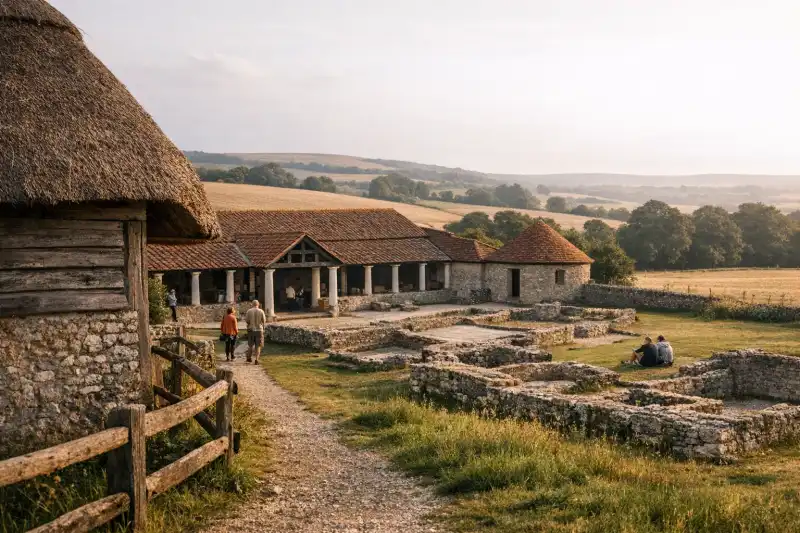
Bignor Roman Villa
RomanExplore Bignor Roman Villa in the United Kingdom, home to some of Britain's finest surviving Roman m...
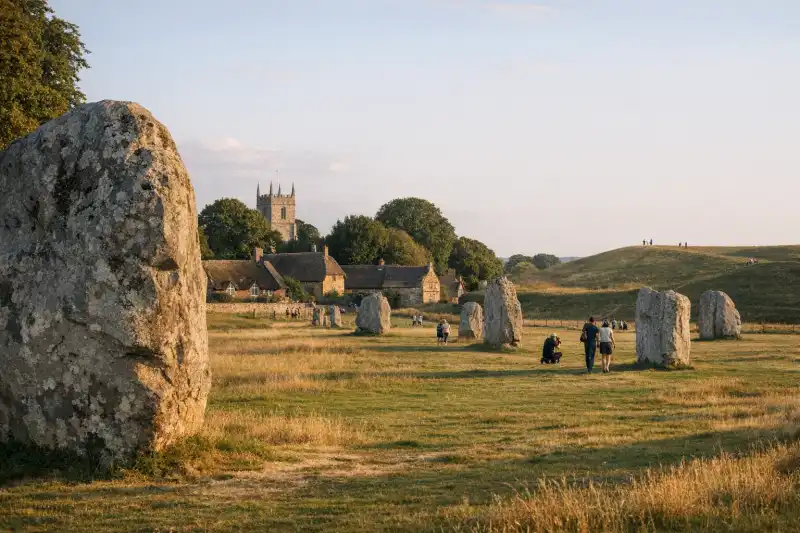
Avebury
Neolithic BritainExplore Avebury in the United Kingdom, a vast prehistoric stone circle and ritual landscape in the h...
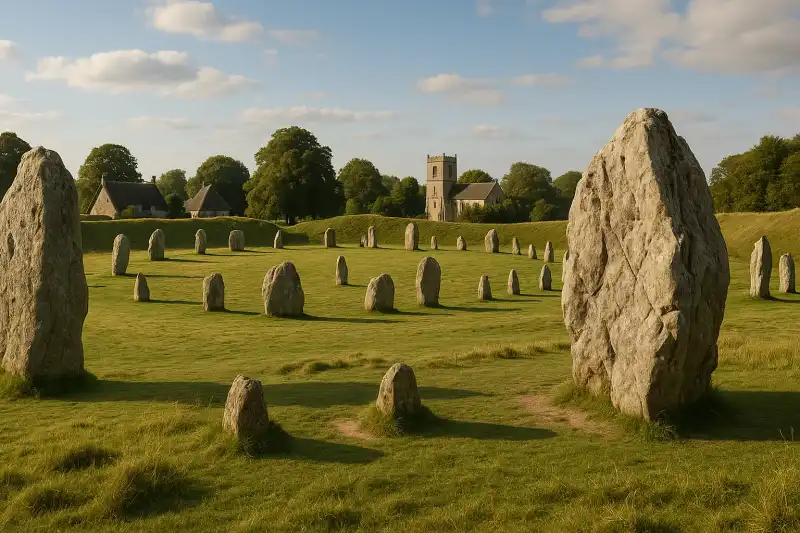
Avebury Stone Circle Travel Guide 2026: Best Walk Routes, History, and Visit Planning
Neolithic BritainPlan a stronger visit to Avebury Stone Circle with practical walking routes, landscape context, and ...