Quick Info
At a glance
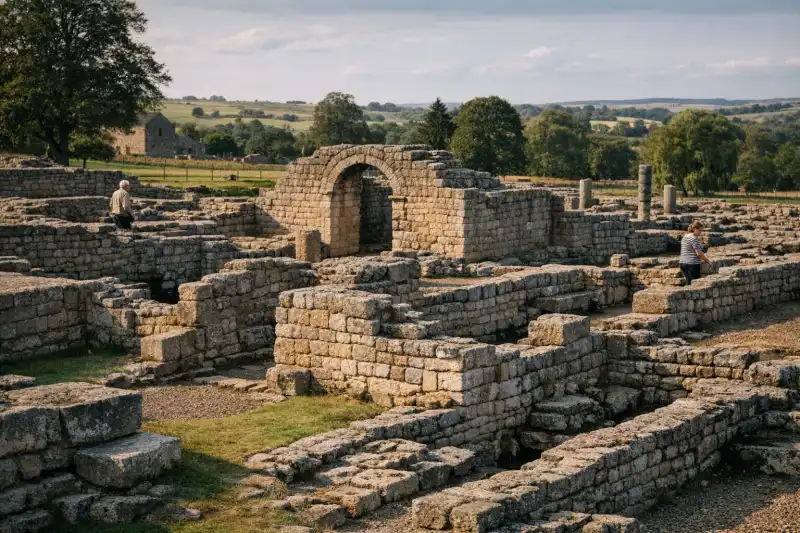
Corbridge Roman Town in the United Kingdom is one of the most revealing Roman sites in northern Europe, a place where the frontier world of soldiers, merchants, engineers, and families can still be traced in stone. Set in the gentle Tyne Valley of Northumberland, the site feels less like an isolated ruin and more like the surviving outline of a once-busy community. Paths cross old streets, low walls define workshops and storehouses, and the surrounding countryside gives a strong sense of why the Romans valued this location so highly.
Unlike a hilltop temple or a monumental amphitheater, Corbridge rewards visitors through the texture of everyday life. This was a strategic crossroads where military roads met, supplies moved toward the forts on Hadrian’s Wall, and civilian settlement grew beside official power. As you walk through the excavated remains, you can imagine carts rattling over stone, traders unloading goods, and officers checking stores destined for the northern frontier. The museum deepens that experience with objects that connect the site to real individuals, from armor fragments and tools to delicate personal items.
For travelers interested in Roman Britain, Corbridge offers a different perspective from the wall forts themselves. It shows how empire functioned behind the frontier line: how armies were supplied, how towns evolved, and how local landscapes were woven into a much larger imperial network stretching across Europe and the Mediterranean. The result is a destination that feels both intimate and historically expansive.
History
Early Roman occupation
The story of Corbridge begins in the decades after the Roman conquest of Britain, when the army pushed north and established routes through what is now northern England. The site occupied a naturally useful position near the River Tyne and at the junction of important roads, including Dere Street, which linked York with the far north. In military terms, this made Corbridge a logistical prize. It could serve as a staging point for movement, supply, and communication in a region that was still being brought under Roman control.
The earliest occupation appears to have been military rather than urban. Roman forces likely established successive forts or compounds here during the late 1st century CE as frontier policy shifted and commanders adjusted to the demands of northern campaigning. This was a period when Rome’s hold on the area was not yet expressed through a single fixed frontier. Instead, forts, roads, and depots formed a flexible system supporting conquest and control.
Corbridge and the frontier system
By the early 2nd century CE, Roman policy in northern Britain was becoming more structured. The construction of Hadrian’s Wall, beginning around 122 CE, created a formal frontier line to the north of Corbridge. Although Corbridge was not itself a wall fort, it became essential to the frontier’s operation. Troops stationed on the wall required food, equipment, animals, replacement materials, and administrative oversight. Corbridge sat in exactly the right place to help provide all of these.
At this stage, the settlement evolved from a purely military base into something more complex. It contained granaries, workshops, storage buildings, and official compounds, but it also developed the marks of a town. Soldiers, veterans, traders, craftspeople, and families all contributed to a community that was tied to the army yet not limited to it. Corbridge became one of the most important supply centers in Roman Britain, effectively supporting imperial power through organization and infrastructure rather than sheer defensive spectacle.
Civilian growth and urban character
During the 2nd and 3rd centuries CE, Corbridge increasingly took on the appearance of a small Roman town. Its streets were laid out in a regular plan, and substantial stone buildings replaced earlier timber phases. Warehouses, domestic spaces, courtyards, and water features suggest a settlement with both official and commercial life. The wealth moving through the site would have supported markets, repair work, transport services, and a broad range of local activity.
This urban character is part of what makes Corbridge so valuable today. Many Roman military sites tell us a great deal about troops and fortifications, but Corbridge also reveals the civilian side of frontier existence. Here, the Roman world was not just a line of forts facing an uncertain north. It was also a functioning community linked to trade, road networks, and regional administration. Imported goods and carefully planned buildings show that even on the edge of empire, Roman standards of urban organization and daily comfort could be maintained.
Decline, abandonment, and rediscovery
Like many Roman sites in Britain, Corbridge changed significantly during the later imperial period. By the 4th century CE, the political and military systems that had sustained northern Britain were under growing pressure. Imperial priorities shifted, resources thinned, and frontier administration became harder to maintain. Corbridge may have continued in some form, but its role diminished as Roman authority in Britain weakened.
After the end of Roman rule in the early 5th century, the settlement was gradually abandoned or transformed beyond recognition. Stone from the site was likely reused over many centuries, as happened with numerous Roman remains across Britain. Buildings collapsed, ground levels shifted, and the visible town disappeared into the landscape.
Modern understanding of Corbridge emerged through archaeological excavation, especially from the late 19th and early 20th centuries onward. These excavations revealed not only major structures but also extraordinary finds, including the Corbridge Hoard, a collection of Roman military equipment buried in a chest. Such discoveries transformed the site from a local curiosity into one of the key archaeological locations for studying Roman Britain. Today, Corbridge stands as one of the clearest windows into how the Roman frontier actually worked on the ground.
Key Features
What first strikes many visitors at Corbridge Roman Town is the clarity of the street plan. Even though the buildings survive mostly as low stone foundations, the settlement’s layout is easy to read. You are not just looking at scattered ruins but moving through an intelligible urban space. Roads, enclosures, and room divisions give shape to the town and help the imagination rebuild its missing height. This legibility is one of Corbridge’s great strengths. It allows visitors to understand the site spatially rather than only through labels and reconstructions.
Among the most impressive remains are the granaries. These massive store buildings speak directly to Corbridge’s strategic function as a supply base. Their substantial construction reflects the importance of protecting food and other provisions in a frontier environment where logistics mattered as much as military force. Looking at them, it becomes easier to appreciate how an empire was sustained: not simply by battles, but by grain management, transport planning, and secure storage.
The fountain house adds a different dimension to the site. It hints at infrastructure and daily routine, reminding visitors that Roman settlements depended on carefully organized water systems. Features like this soften the stereotype of frontier life as purely harsh and martial. Corbridge was practical, but it was also ordered and maintained in recognizably Roman ways, even far from the great cities of the Mediterranean.
Excavated compounds and workshops reveal the town’s mixed character. Some areas feel official, linked to military administration and supply. Others suggest industry, repair, trade, and ordinary domestic activity. This combination is what makes Corbridge especially meaningful. It was neither a simple fort nor a fully independent city; it occupied the dynamic middle ground between military necessity and civilian growth. The result is a site that tells a fuller story about life in Roman Britain than many monuments focused on one function alone.
The museum is essential to the visit rather than an optional extra. Many of the site’s most important details become vivid only when you see the artifacts recovered here. These include tools, inscriptions, pottery, glass, personal items, and military objects that bring human scale to the ruins outside. The famous Corbridge Hoard is especially significant because it preserves pieces of Roman armor and equipment that have shaped modern understanding of how soldiers on the frontier were equipped. Finds like these reveal the site not as an abstract archaeological plan but as a lived environment filled with labor, bureaucracy, trade, and personal experience.
Another appealing feature is the landscape setting. Corbridge lies in a gentle valley rather than on a dramatic peak, and that suits the site’s identity. This was a place chosen for access, movement, and connection. The surrounding fields and nearby modern village help visitors grasp the continuity of settlement in the Tyne Valley. It is easy to see why this location worked in Roman times and why it remains a pleasant place to spend time today.
For travelers exploring Hadrian’s Wall country, Corbridge offers a useful contrast to the frontier forts. At forts such as Housesteads or Chesters, the focus is naturally on defense and military position. Corbridge, by comparison, tells the story behind those installations. It shows the mechanisms of support: storage, repair, distribution, planning, and commerce. In that sense, it can deepen an entire regional itinerary. You leave not only with memories of Roman stones but with a clearer understanding of how the frontier operated as a system.
Getting There
Corbridge Roman Town is in Northumberland, a short distance from the village of Corbridge and within easy reach of Newcastle upon Tyne. If you are arriving by rail, the simplest route is usually to take a train from Newcastle to Corbridge station. The journey typically takes around 35 to 45 minutes, and standard fares are often in the range of £6 to £12 one way depending on time and ticket type. From the station, the site is roughly a 20 to 30 minute walk, or a brief taxi ride that may cost around £5 to £8.
By car, Corbridge is straightforward to reach via the A69, which connects Newcastle and Carlisle. Driving from central Newcastle usually takes around 35 to 45 minutes in normal traffic. Parking availability can vary, so it is wise to check current visitor information before setting out, especially in summer or during school holidays. A car is especially useful if you plan to combine Corbridge with other Roman sites in the Hadrian’s Wall region on the same day.
Bus connections are possible from Newcastle and nearby towns, though they tend to be slower and less frequent than trains. Expect fares of roughly £2 to £8 depending on distance and operator. If you are using public transport, combining train travel with a local taxi can be the most efficient option.
Visitors already touring Hadrian’s Wall often reach Corbridge as part of a self-drive route. It pairs well with Hexham, Chesters Roman Fort, and the central wall sites. Admission prices may change, but budgeting roughly £10 to £15 for adult entry is a sensible starting point, with discounts often available for children, families, and heritage members.
When to Visit
The best time to visit Corbridge Roman Town is generally from late spring to early autumn, when Northumberland’s longer daylight hours and milder temperatures make it easier to enjoy both the open-air ruins and the surrounding countryside. From May through September, you are more likely to have pleasant conditions for walking the site slowly, reading interpretive panels, and combining your visit with other stops in the Tyne Valley or along Hadrian’s Wall.
Summer offers the greenest landscape and the most relaxed atmosphere, but it also brings the highest visitor numbers. Corbridge rarely feels overwhelmingly crowded compared with some major heritage attractions, yet weekends and school holidays can be busier in the museum and around key remains. If you want good weather with a quieter feel, June and September are excellent choices.
Spring can be particularly rewarding. The site begins to emerge from winter with clearer skies, fresh grass, and fewer visitors than in peak summer. Temperatures are cooler, so a waterproof jacket and sturdy shoes are helpful, especially after rain. The open setting means weather can change quickly even on seemingly mild days.
Autumn brings softer light and attractive colors to the surrounding valley, and it can be one of the most atmospheric seasons for photography. Winter visits are still possible and can be very enjoyable if you prefer solitude, but shorter opening hours, colder winds, and wet ground may limit the experience. If you are traveling in winter, check seasonal schedules in advance and allow flexibility for weather.
Whatever the season, try to visit earlier in the day if you want a calmer experience in the museum and more time to appreciate the outdoor remains at an unhurried pace.
| Quick Facts | Details |
|---|---|
| Location | Corbridge, Northumberland, United Kingdom |
| Historical Era | Roman Imperial period |
| Established | 1st century CE |
| Main Significance | Roman supply base and civilian settlement linked to Hadrian’s Wall |
| Best For | Roman Britain history, archaeology, museum collections |
| Typical Visit Length | 1.5 to 3 hours |
| Nearest Major City | Newcastle upon Tyne |
| Nearest Village | Corbridge |
| Access Style | Best by car or train plus walk/taxi |
| Notable Highlight | Granaries, planned streets, and the Corbridge Hoard in the museum |
Guided tours: worth it?
Most travelers can visit Corbridge Roman Town independently. Compare a tour only if you want a tighter history-focused visit, easier logistics, or a guide who can answer questions on the spot.
Best for
- Short visits where a planned route saves time
When to go self-guided
Go independently if you prefer setting your own pace, reading as you go, and checking official hours or ticket rules directly before you arrive.
What I’d avoid
Skip paid tours that bundle unrelated stops you do not actually want. The best option should either save meaningful planning time or add historical context you would miss on your own.
Hadrian's Wall and Roman Britain Tours
Useful when: you want to compare guided formats before deciding
Northumberland Roman Sites Tours
Useful when: you want to compare guided formats before deciding
Corbridge and Hadrian's Wall Day Tours
Useful when: you want to compare guided formats before deciding
Some tour links are affiliate links, which may earn Ancient Travel a small commission at no extra cost to you. I try to surface options that make practical sense for the site—not just anything bookable.
Frequently Asked Questions
What is Corbridge Roman Town?
Corbridge Roman Town is the archaeological remains of a major Roman military and civilian settlement in Northumberland, just south of Hadrian's Wall. It is known for its planned streets, granaries, workshops, and museum collection.
Is Corbridge Roman Town part of Hadrian's Wall?
Corbridge itself lies slightly south of Hadrian's Wall, but it was closely connected to the frontier system and served as an important supply and transport hub for troops stationed along the wall.
How much time do you need to visit Corbridge Roman Town?
Most visitors spend 1.5 to 3 hours exploring the site and museum. If you enjoy Roman archaeology in depth, allow extra time to read the displays and walk the excavated streets.
Can you visit Corbridge Roman Town without a car?
Yes. You can reach nearby Corbridge by train from Newcastle and continue on foot or by local taxi. Bus services in the Tyne Valley may also help, though schedules are less frequent than in major cities.
What can you see at Corbridge Roman Town?
Visitors can see the remains of Roman streets, granaries, a fountain house, military compounds, domestic areas, and the on-site museum with objects found during excavations, including the famous Corbridge Hoard.
Is Corbridge Roman Town suitable for families?
Yes. The open-air ruins, museum exhibits, and manageable site size make it a good stop for families, especially those interested in Roman Britain and Hadrian's Wall.
Nearby Ancient Sites
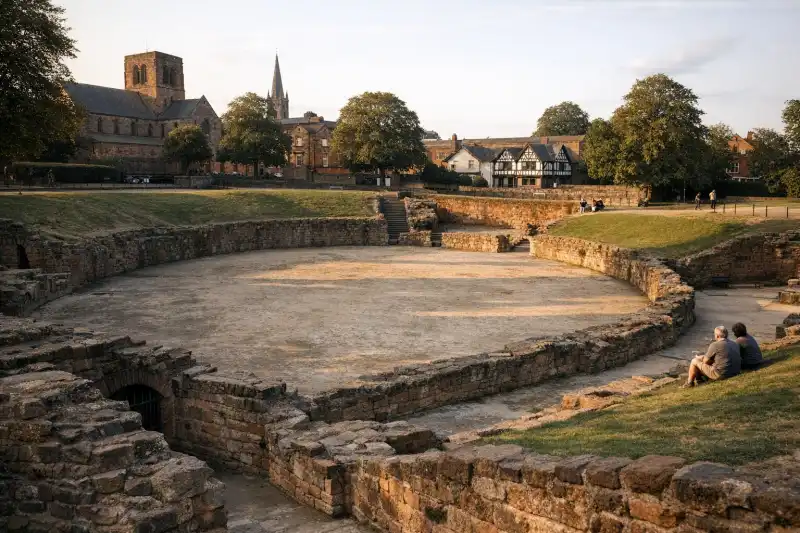
Chester Roman Amphitheater
Explore Chester Roman Amphitheater in the United Kingdom, the largest known Roman amphitheater in Br...
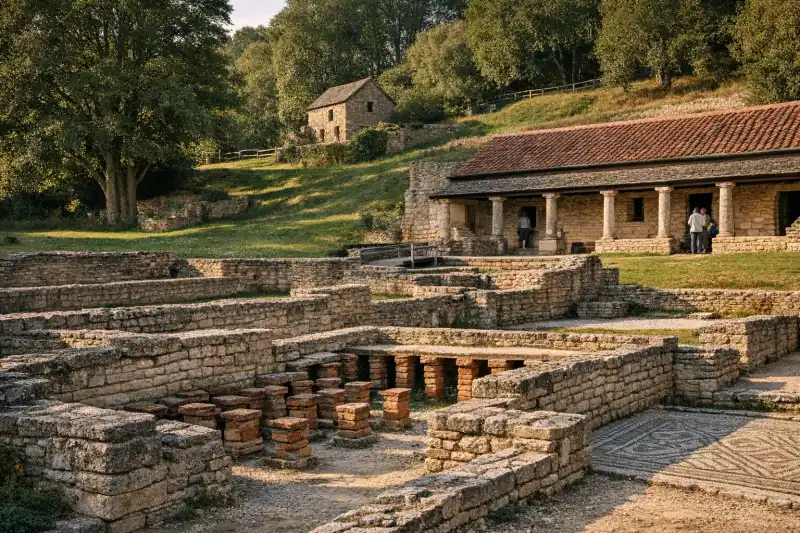
Chedworth Roman Villa
RomanExplore Chedworth Roman Villa, a remarkably preserved Roman countryside estate in the United Kingdom...
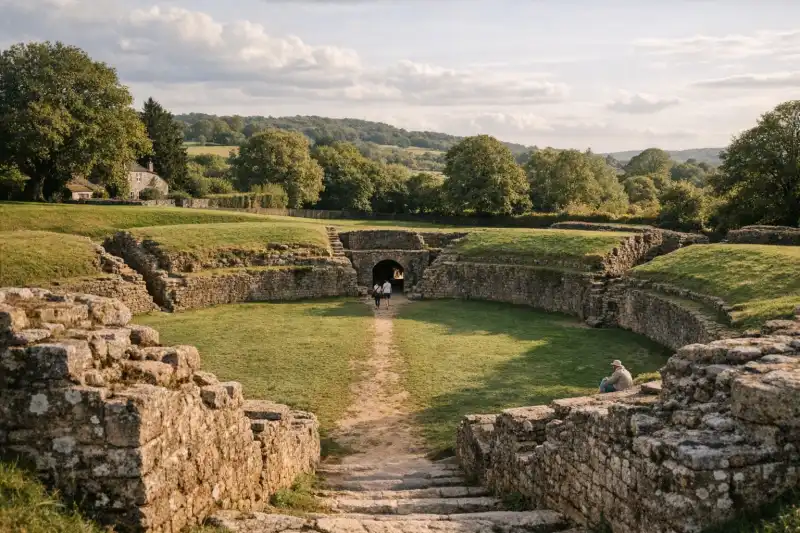
Caerleon Roman Fortress
RomanExplore Caerleon Roman Fortress in the United Kingdom, one of Roman Britain's best-preserved legiona...