Quick Info
Curated Experiences
Ancient Corinth and Canal Half-Day Tour from Athens
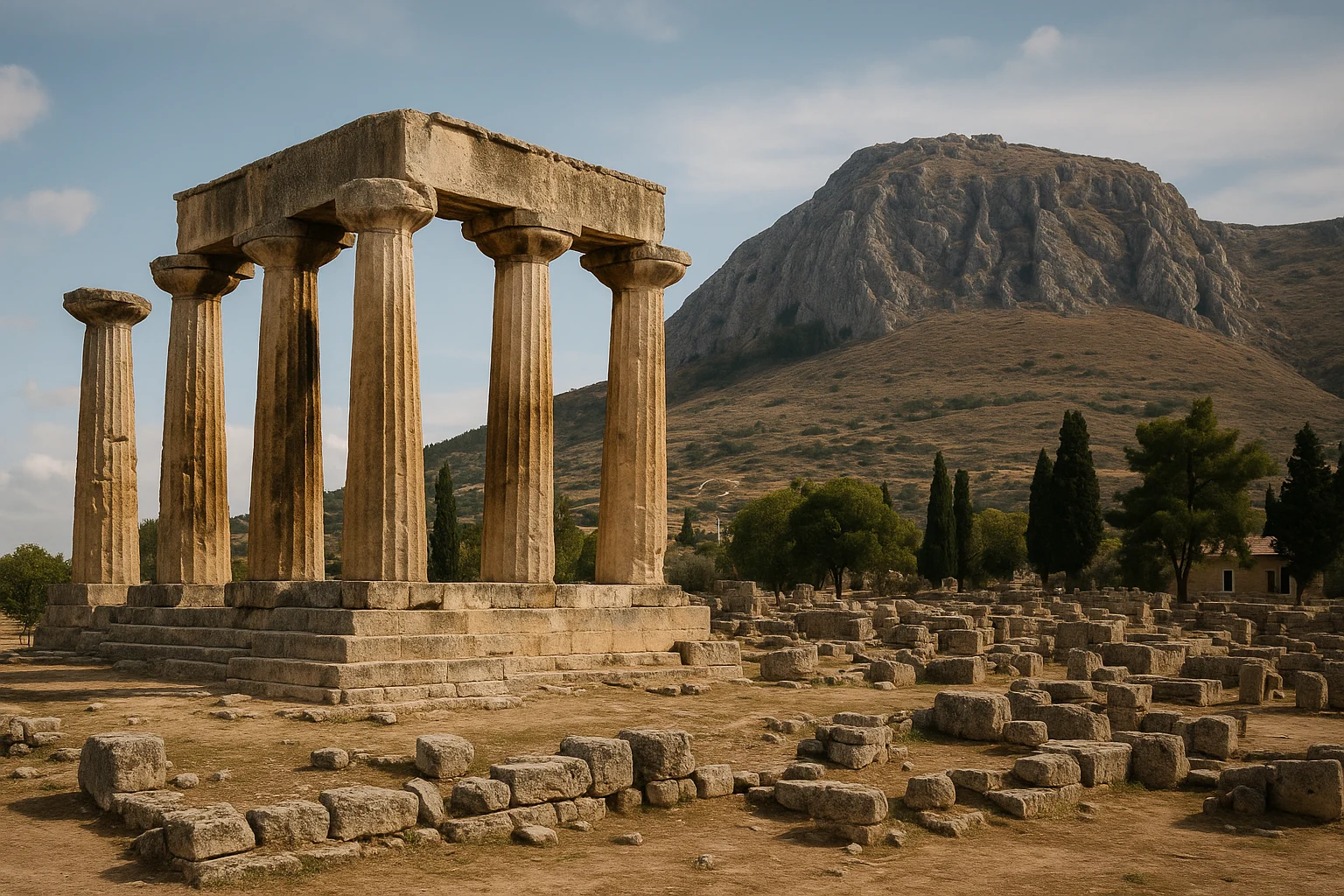
Seven Doric columns stand against the Peloponnese sky, the color of dry honey in the morning light. They are all that remains upright of the Temple of Apollo at Ancient Corinth, built around 540 BCE, and they mark one of the oldest stone temples in Greece. Behind them, the ruins of a Roman forum spread across a wide plateau. Above everything, the flat-topped mass of Acrocorinth rises 575 meters, crowned with fortifications from half a dozen civilizations. This is not a site that delivers its story in a single glance. It accumulates, layer by layer, and the more time you give it the more it reveals about how the ancient world actually functioned.
Ancient Corinth controlled the four-mile-wide Isthmus that connects mainland Greece to the Peloponnese. Every overland traveler, every army, and every shipment of goods moving between the two had to pass through Corinthian territory. The city monetized that geography with a ruthlessness that made it one of the wealthiest places in the ancient Mediterranean — richer than Athens at its commercial peak, with a reputation for luxury, innovation, and moral license that echoed across centuries of Greek and Roman literature.
What you walk through today is the physical record of that ambition: Greek temple columns rising from Roman pavement, a forum designed for the business of empire, and a fortress hill that was fought over from antiquity through the Ottoman period. The site is compact enough to cover in a focused half-day, close enough to Athens for a comfortable day trip, and interpretively rich enough to justify a slow visit with a good guidebook or audio guide.
Historical Context
Corinth’s strategic value was recognized from the earliest periods of Greek settlement. The city controlled both the land route across the Isthmus and the short overland portage known as the diolkos, a paved trackway that allowed ships to be dragged on wheeled cradles between the Saronic Gulf and the Gulf of Corinth. This portage effectively linked the eastern and western Mediterranean without requiring the dangerous and time-consuming sail around the Peloponnese. Every merchant, diplomat, and military commander in the region understood the value of that shortcut, and Corinth collected tolls on all of it.
By the 8th century BCE, Corinth was a major naval power, fielding fleets that dominated western Greek trade routes. By the 7th century, it was minting some of the earliest Greek coins — silver staters stamped with the image of Pegasus, the winged horse of Corinthian mythology — and exporting its distinctive pottery across the Mediterranean. Corinthian potters pioneered the black-figure technique that Athenian artists later adopted and perfected.
The city’s political influence was substantial. Corinth founded Syracuse, which became the most powerful Greek city in Sicily, and played a pivotal role in the Peloponnesian War as Sparta’s most important ally against Athens. The Corinthian order of architecture — the most ornate of the three Greek column styles, with its carved acanthus-leaf capitals — was developed here and later adopted by Rome as the empire’s preferred architectural vocabulary. Corinthian shipbuilders are also credited with inventing the trireme, the three-banked warship that dominated Mediterranean naval warfare for centuries.
Rome destroyed Corinth in 146 BCE, a calculated act of violence intended to punish the city for its role in the Achaean League’s resistance. The Roman general Mummius ordered the population killed or enslaved, the buildings razed, and the site left desolate as a warning. For a century, one of the Mediterranean’s wealthiest cities lay empty.
Then, in 44 BCE, Julius Caesar refounded Corinth as a Roman colony — Colonia Laus Iulia Corinthiensis — settled largely by freedmen and veterans from Italy. The new city was built directly over the Greek ruins, adopting Roman urban planning while preserving certain Greek landmarks, most notably the Temple of Apollo. Roman Corinth quickly regained its commercial importance and became the capital of the Roman province of Achaea.
The Apostle Paul lived in Corinth for eighteen months around 50-52 CE, working as a tentmaker and establishing one of the earliest Christian communities in Greece. His two letters to the Corinthians are among the most important documents in early Christianity, and the bema (raised platform) in the Roman forum is traditionally identified as the spot where Paul was brought before the proconsul Gallio — an identification supported by both archaeological and textual evidence.
What to See
Temple of Apollo
The seven standing columns of the Temple of Apollo are the visual anchor of the site and one of the most recognizable images of ancient Greece. Built around 540 BCE in the Archaic Doric style, the temple is a monolithic limestone structure that predates the Parthenon by nearly a century. The columns are thicker and more closely spaced than later Doric examples, giving the temple a visual weight that feels almost muscular compared to the refined elegance of Classical architecture.
The temple’s survival through Corinth’s destruction by Rome in 146 BCE is remarkable and suggests that even the Romans recognized the building’s sacred or symbolic significance. The interior originally housed cult statues, and the temple platform offers a commanding view over the surrounding forum.
Practical tip: the temple is best photographed in early morning, when warm light hits the columns from the east and the crowds have not yet arrived. Sunset light from the west is a close second. From the platform, orient yourself to the forum layout below before descending.
The Roman Forum and Bema
The forum is the spatial heart of Roman Corinth — a large rectangular open space surrounded by foundations of shops, basilicas, and administrative buildings that give you a readable map of how a Roman commercial city operated. The sheer size of the forum tells you something about Corinth’s self-image: this was a city that intended to impress.
The South Stoa, one of the longest ancient Greek buildings at over 160 meters, lined the forum’s southern edge and housed dozens of shops and taverns. Archaeological evidence indicates that some of these shops served food and wine, their counters and storage jars still identifiable in the foundations. The Bema — a raised stone platform on the forum’s south side — served as the speaker’s platform for public addresses and legal proceedings.
The Bema’s identification as the place where Paul stood before the proconsul Gallio draws significant visitor attention, and the connection rests on solid evidence. An inscription found at Delphi mentioning Gallio’s service in Achaea provides independent dating for Paul’s time in Corinth, making this one of the most historically anchored locations in New Testament geography.
Practical tip: walk the full perimeter of the forum to appreciate its scale. The shop foundations along the south side are remarkably legible and help you visualize the commercial bustle that defined Corinthian daily life.
The Archaeological Museum
Housed in a modest building near the site entrance, the museum punches well above its weight. The collection focuses on finds from the site itself: painted pottery in the distinctive Corinthian style, Roman mosaic fragments, architectural details from the forum buildings, and a strong collection of sculpture including pieces from the forum and temple precincts.
Highlights include the sphinx reliefs, the mosaic of Dionysus, and a collection of Roman portrait heads that provide an unusually direct connection to the individuals who inhabited this city. The museum also displays models and diagrams of Ancient Corinth at various periods that make the surrounding ruins far more readable.
Practical tip: visit the museum before the ruins. Thirty to forty-five minutes here gives you the visual vocabulary to decode what you see outside, and the chronological models are particularly useful for understanding the Greek-to-Roman transition that defines the site.
The Peirene Fountain
The Peirene Fountain was Corinth’s most celebrated water source, a natural spring that was elaborated over centuries into a monumental public fountain house. The Roman-era facade, with arched chambers and a decorative front, survives in recognizable form. In myth, the spring was created by the hoof of Pegasus or by the tears of the nymph Peirene mourning her son. In practice, it was an engineering achievement that supplied water to the forum and surrounding neighborhoods through a system of underground channels.
The chambers behind the facade retain traces of the painted plaster that once decorated their interiors, and the cool shade they provide was as welcome in antiquity as it is today.
Practical tip: the fountain is partially shaded and offers a welcome cool spot in the heat. Look for the remains of the painted plaster and take a moment to consider the urban infrastructure that made a city of this size functional.
Acrocorinth
The fortified hilltop above Ancient Corinth is one of the most impressive natural fortresses in Greece and arguably the most important in the Peloponnese. The summit rises 575 meters above sea level and was fortified continuously from the Archaic period through the Ottoman era. The climb from the lower site takes 30 to 45 minutes on a steep path, or you can drive most of the way up a paved road to a parking area near the upper gate.
The fortifications are a layer cake of construction: Greek walls at the base, Byzantine towers, Frankish modifications, Venetian gates, and Ottoman additions, each conqueror building on the defenses of the previous occupant. At the summit, the remains of a Temple of Aphrodite — later converted to a church and then to a mosque — mark the highest point. In antiquity, the temple was staffed by sacred prostitutes whose reputation contributed significantly to Corinth’s fame (and infamy) across the ancient world.
Views from the top span both the Saronic and Corinthian Gulfs, the Isthmus, and the mountains of the central Peloponnese. On clear days, you can see the Acropolis of Athens to the northeast. The panorama makes the strategic logic of Corinth’s location immediately and viscerally clear.
Practical tip: the climb is exposed and strenuous in summer heat. Bring at least a liter of water and go early or late. Sturdy shoes are essential — the path is loose stone and uneven rock. Allow two hours for the round trip including time at the summit.
The Lechaion Road
This wide, paved Roman road ran from the forum north to the harbor at Lechaion on the Gulf of Corinth. The surviving stretch near the forum preserves its stone paving, wheel ruts from ancient carts, and flanking sidewalks with evidence of shops and structures along the route. The Propylaea (monumental gateway) at the road’s forum end marked the formal entrance to the commercial heart of the city.
The Lechaion Road is the best-preserved Roman street section at the site and gives you a vivid sense of the traffic that flowed through ancient Corinth — a continuous stream of goods, people, and information moving between the city’s two harbors.
Practical tip: walk the full visible length of the road for a sense of the city’s urban scale. The wheel ruts in the pavement are a particularly evocative detail.
Timing and Seasons
The best months to visit Ancient Corinth are April, May, September, and October. Spring temperatures run 60-78°F (16-26°C) with wildflowers on the surrounding hillsides and comfortable conditions for the Acrocorinth climb. Autumn is similar, with slightly warmer afternoons and thinning crowds.
Summer (June through August) pushes temperatures to 90-100°F (32-38°C), and the site is almost entirely exposed to sun. If visiting in summer, arrive at 8 a.m. and plan to finish the lower site by noon. Tour groups from Athens typically arrive between 10 a.m. and 1 p.m., so an early start avoids the worst congestion. Do not attempt the Acrocorinth climb in midday summer heat — it is exposed, steep, and dangerous in extreme temperatures.
Winter (December through February) brings temperatures of 45-55°F (7-13°C) with occasional rain. The site is open year-round and winter visits are uncrowded, though the Acrocorinth path can be slippery when wet. The lower site is perfectly manageable in cool weather.
The best time of day is first thing in the morning, both for light (warm eastern sun on the Temple of Apollo columns) and for solitude. Late afternoon offers good conditions as well, with fewer visitors, softer light, and a golden quality to the limestone that photographs beautifully.
Tickets, Logistics, and Getting There
Admission to the archaeological site and museum is approximately 8 euros ($9 USD). EU students under 25 and children under 18 enter free with valid ID. The site opens at 8 a.m. daily. Closing time is 8 p.m. from April through October and 5 p.m. from November through March. Acrocorinth is free to enter and has the same opening hours. Ticket lines are rarely an issue at either site.
Ancient Corinth sits about 80 kilometers (50 miles) west of Athens, roughly 1 to 1.5 hours by car via the A8 motorway. The drive is straightforward and the highway well-maintained. KTEL buses run from Athens’ Kifissos terminal to the modern city of Corinth (about 1.5 hours), from which local buses or taxis cover the remaining 7 kilometers to the archaeological site. A taxi from modern Corinth costs approximately 10-15 euros.
The Corinth Canal — a 19th-century engineering marvel that cuts a narrow channel through the Isthmus at a depth of 80 meters — is a short detour on the Athens-Corinth route and worth a five-minute stop for the view from the bridge. There is no admission charge.
Free parking is available at the archaeological site entrance. For food, the village adjacent to the site has a few tavernas serving solid Greek fare at reasonable prices. The closest wide range of dining and accommodation is in modern Corinth (7 kilometers) or the resort town of Loutraki across the canal (15 kilometers).
Driving is the most practical option for a day trip from Athens and allows you to combine Ancient Corinth with other Peloponnese sites. The route to Nafplio, Mycenae, and Epidaurus continues directly from Corinth, making it a natural first stop on a Peloponnese circuit.
Practical Tips
- Wear sturdy, closed-toe shoes. The site terrain is uneven stone, packed earth, and rubble, especially around the forum edges and on the Acrocorinth path.
- Bring at least one liter of water per person, two if climbing Acrocorinth in warm months. There is a small cafe near the site entrance.
- Sun protection is essential from April through October. Shade is limited to the museum interior, the Peirene Fountain chambers, and a few scattered trees.
- A guidebook or audio guide significantly enhances the visit. The Greek-to-Roman layering is the site’s defining feature, and it requires context to read.
- Photography is permitted throughout the site and museum (no flash in the museum).
- The lower site is partially accessible for mobility-limited visitors. The forum area is relatively flat, but peripheral areas involve rough terrain. Acrocorinth is not accessible.
- Allow extra time if you have biblical history interests. The Bema, the Erastus inscription (identifying a city official mentioned in Paul’s letters), and the Jewish synagogue inscription are all identifiable features at the site.
- Binoculars are useful for viewing the Acrocorinth fortifications in detail from the lower site if you choose not to make the climb.
Suggested Itinerary
Begin at the Archaeological Museum (8 a.m. opening, 30-40 minutes). Study the chronological models and pottery collection to establish context. Exit and walk to the Temple of Apollo for photographs in the morning light (15 minutes). Descend to the Roman Forum and walk the full perimeter, spending time at the Bema, the South Stoa shop foundations, and the Peirene Fountain (45 minutes).
Follow the Lechaion Road north from the forum (10 minutes). Return through the site, revisiting anything that warrants a second look. Total time for the lower site: 2 to 2.5 hours.
If climbing Acrocorinth, drive or walk to the base (10-minute drive, 20-minute walk from the site). The ascent through the triple gates takes 30-45 minutes depending on fitness level. Allow 30-45 minutes at the summit for the fortifications and panoramic views, plus 20-30 minutes for the descent. Add 2 hours total for the Acrocorinth excursion.
For a full-day plan from Athens, combine the drive (1.5 hours), the lower site and museum (2.5 hours), lunch at a village taverna (45 minutes), and Acrocorinth (2 hours) for a return to Athens by late afternoon.
Nearby Sites
The Acropolis in Athens is roughly 1.5 hours east by car and provides the natural counterpoint to Ancient Corinth. Where Corinth built on commerce and strategic geography, Athens built on civic ideology and architectural ambition. Visiting both in sequence sharpens your understanding of how Greek city-states differed in their fundamental priorities — and how those differences shaped the rivalry that defined the Classical period.
The Ancient Agora of Athens sits at the base of the Acropolis and offers a closer parallel to Corinth’s forum — a commercial and civic center where daily life played out among temples, stoas, and law courts. Budget a full day for the Agora and Acropolis together.
Olympia is roughly 2.5 to 3 hours west by car and represents the sanctuary tradition that both Corinth and Athens participated in but neither controlled. Its athletic and religious focus complements Corinth’s commercial emphasis and completes a Peloponnese triangle that covers the major dimensions of ancient Greek life.
For travelers heading south into the Peloponnese, Mycenae (45 minutes) and Epidaurus (1 hour) are each a short drive from Corinth. Mycenae’s Bronze Age citadel and Lion Gate extend the timeline back a millennium, while Epidaurus’s perfectly preserved theater and healing sanctuary offer an experience unlike anything at Corinth.
Final Take
Ancient Corinth does not have the visual drama of the Acropolis or the single-minded grandeur of Olympia. What it offers is something more instructive: a ground-level view of how wealth, geography, and political ambition shaped the ancient world.
The Temple of Apollo’s stubborn columns, the Roman forum’s commercial grid, the Acrocorinth’s layered fortifications — these are the physical evidence of a city that sat at the crossroads and made the crossroads pay. Every conqueror who passed through this landscape understood what Corinth controlled, and every one of them fought to hold it.
Give it a proper half-day, climb the hill if your legs allow it, and you will leave with a sharper sense of how the Classical world actually connected than any single monument in Athens provides.
Discover More Ancient Wonders
- Acropolis, Athens — the architectural and symbolic heart of Classical Greece
- Ancient Agora of Athens — civic life, philosophy, and commerce in the ancient world
- Olympia — the Panhellenic sanctuary where the Greek world gathered every four years
- Explore more Peloponnese archaeology with our Greece Ancient Sites Guide
- Plan your route with our beginner’s guide to archaeological sites
Quick Facts
| Attribute | Details |
|---|---|
| Location | Corinth, Peloponnese, Greece |
| Country | Greece |
| Region | Peloponnese |
| Civilization | Classical Greek |
| Historical Period | 8th century BCE-6th century CE |
| Established | c. 8th century BCE |
| Coordinates | 37.9060, 22.8800 |
Frequently Asked Questions
How long should I spend at Ancient Corinth?
Most travelers need 1.5 to 2.5 hours for the archaeological site and museum combined.
Can I visit Ancient Corinth as a day trip from Athens?
Yes. The drive is roughly 1 to 1.5 hours each way, making it a comfortable half-day or full-day trip.
Is the Acrocorinth climb worth it?
If you have the stamina and footwear, yes. The hilltop fortress offers wide Peloponnese views and centuries of layered fortification history.
Nearby Ancient Sites
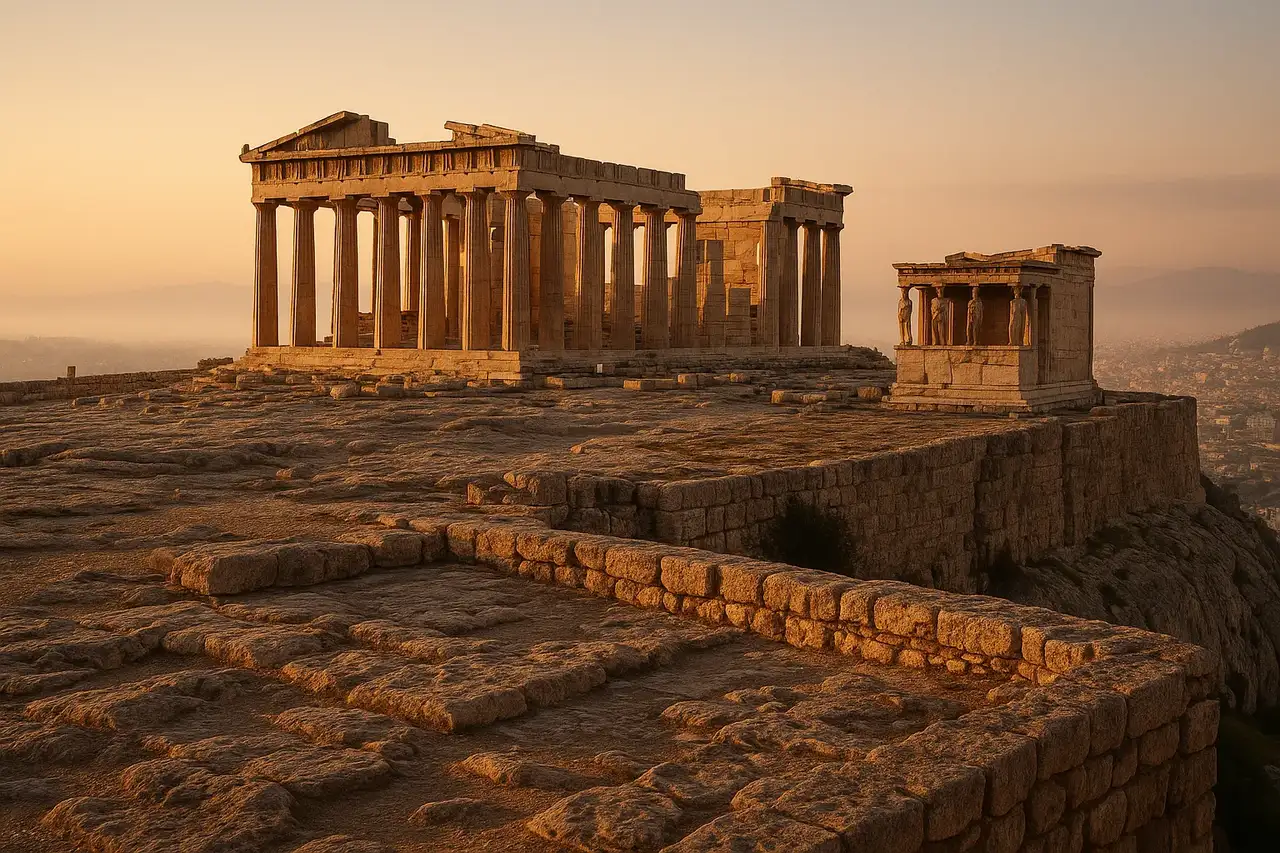
Acropolis Travel Guide 2026: Parthenon, Tickets, and Best Time
Ancient GreecePlan an efficient Acropolis visit with practical ticket timing, key monuments, and museum pairing ti...
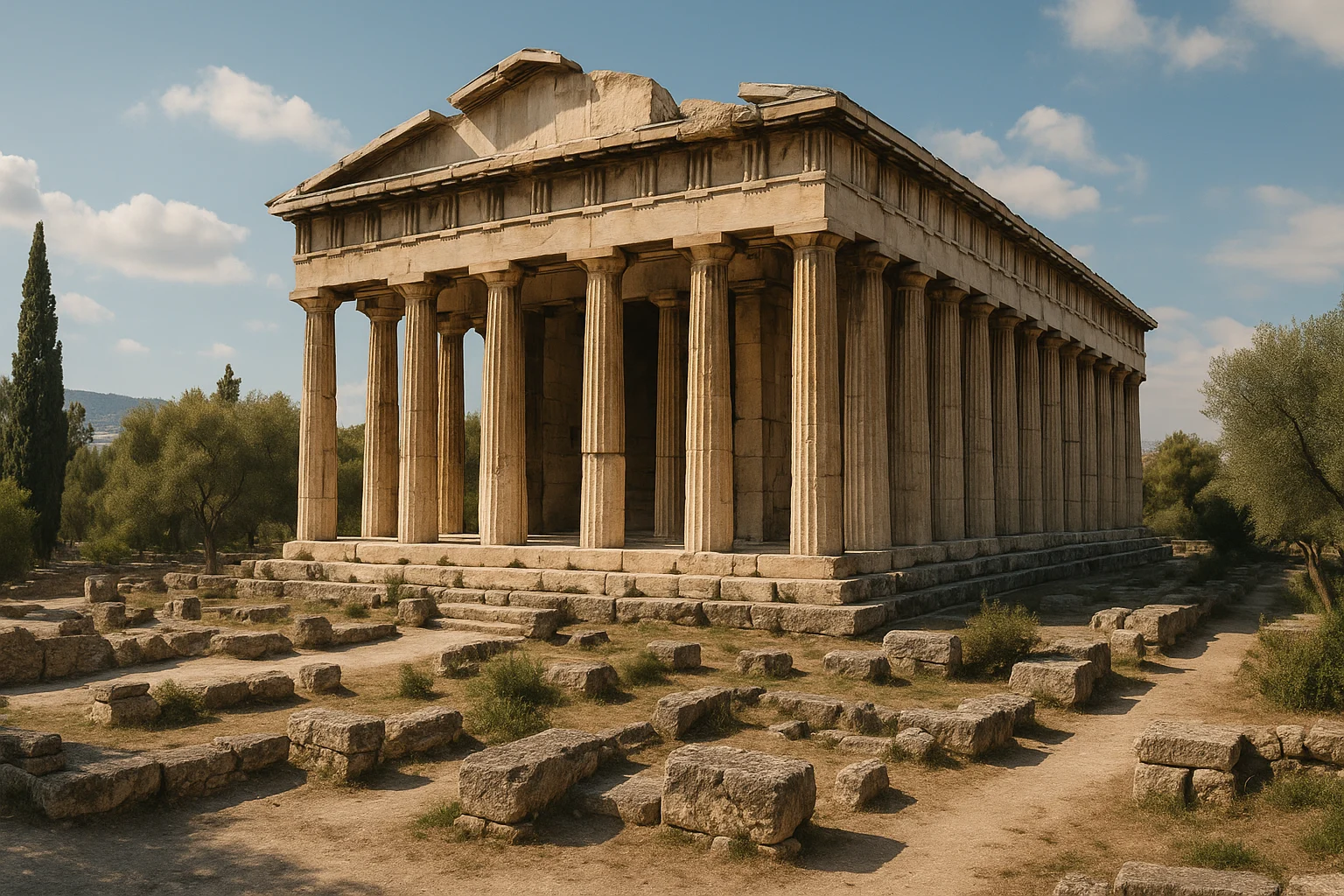
Ancient Agora of Athens Travel Guide 2026: Route, Tickets, and Context
Classical GreekPlan a better Ancient Agora visit with practical timing, monument priorities, and clear historical c...
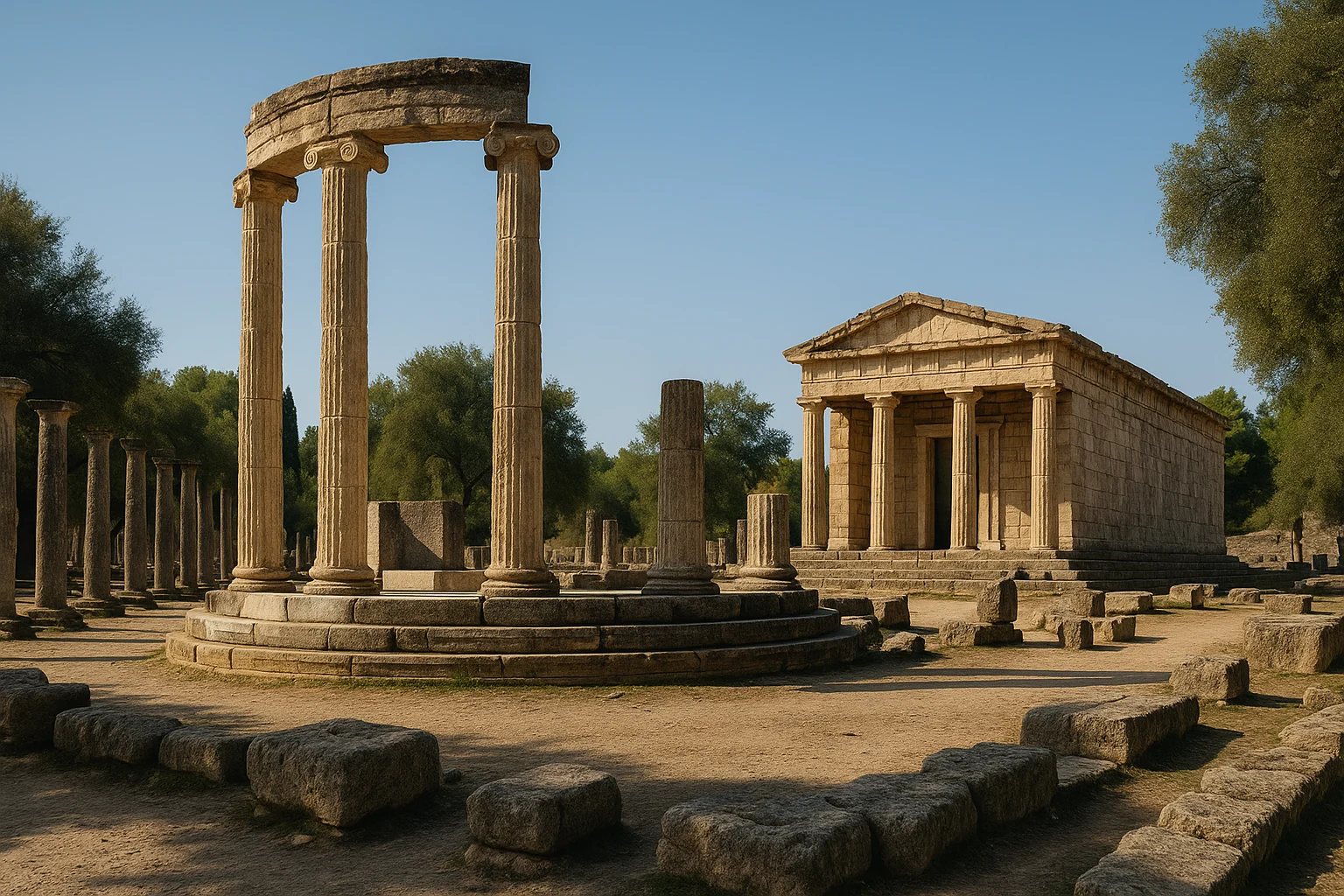
Olympia Travel Guide 2026: Archaeological Site, Museum, and Visit Plan
Classical GreekPlan a better Olympia visit with practical timing, key monument priorities, and realistic route plan...