Quick Info
At a glance
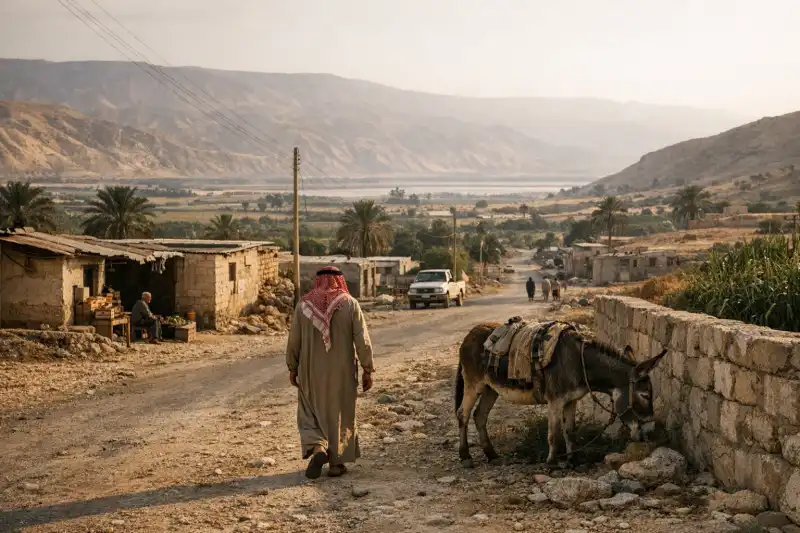
Deir Alla in Jordan rises from the fertile floor of the Jordan Valley as a place that rewards patient travelers more than hurried sightseers. Rather than dazzling with towering columns or monumental façades, it offers something quieter and, in many ways, more intimate: a layered archaeological mound that preserves traces of everyday life, regional exchange, religious memory, and literary history across centuries. The landscape around it is broad and low, with cultivated fields, distant ridgelines, and the unmistakable sense of being in one of the Levant’s oldest inhabited corridors. Here, geography has always mattered. The Jordan Valley linked communities, shaped agriculture, and carried goods, ideas, and beliefs between uplands and river plains.
For visitors interested in how ancient societies actually lived, Deir Alla is unusually compelling. Its significance lies not only in architecture and settlement remains, but also in what archaeologists have recovered from the site: evidence of Bronze and Iron Age occupation and, most famously, the Deir Alla inscription, an extraordinary painted text associated with Balaam son of Beor. That discovery gave the site a wider historical and biblical resonance, drawing attention from scholars well beyond Jordan. Today, a visit to Deir Alla is best approached as an encounter with the deep stratigraphy of the Jordan Valley, where history survives in mudbrick walls, occupation layers, and fragments of writing that connect this seemingly modest tell to the larger story of the ancient Near East.
History
Early settlement in the Bronze Age
Deir Alla’s story begins in the Bronze Age, when the Jordan Valley supported a chain of settlements sustained by fertile soils, water access, and routes connecting inland Jordan with the western side of the valley. The site developed as a tell, or settlement mound, formed by repeated cycles of building, collapse, and rebuilding over generations. This accumulation is typical of long-lived Near Eastern settlements, and at Deir Alla it reflects a community that was deeply tied to agricultural rhythms while also participating in wider regional networks.
During the Middle and Late Bronze Ages, the valley was not an isolated frontier. It was a connective zone where local communities interacted with larger political systems across the Levant. Excavated remains at Deir Alla suggest domestic occupation, storage, and craft activity rather than purely ceremonial or military use. That makes the site especially valuable to archaeologists, because it illuminates ordinary settlement patterns and local adaptation in a region often overshadowed by more famous royal centers. Its inhabitants likely cultivated crops in the surrounding plain, managed livestock, and took advantage of routes that linked the valley to highland settlements and trade flows.
Transition into the Iron Age
The Iron Age brought shifts in political landscapes throughout the southern Levant, and Deir Alla continued to be occupied during this transformative period. The site appears to have remained an important local center, perhaps because its location allowed it to function as a node between ecological zones. Such places could collect produce, host exchange, and maintain cultural links even when larger kingdoms rose and fell around them.
Archaeological evidence from the Iron Age points to substantial occupation and rebuilding episodes. Mudbrick architecture, installations, and occupational debris reveal a settlement that was still active and significant. The continuity is important: Deir Alla was not a single-period site frozen in time, but a community that adapted across centuries. Scholars have debated the site’s precise political affiliations at different moments, since the Jordan Valley lay within a dynamic zone influenced by neighboring groups and states. Yet whatever the precise alignments, Deir Alla clearly belonged to a vibrant cultural world shaped by Canaanite traditions, local Levantine practices, and changing regional power structures.
The Balaam inscription and religious significance
Deir Alla became internationally famous because of the discovery of the inscription often called the Deir Alla inscription or Balaam text. Found in fragments on plaster, it dates to the Iron Age and includes references to “Balaam son of Beor,” a figure also known from biblical tradition. This alone made the discovery remarkable, but its importance goes further. The inscription is written in a local script and language form that has offered scholars rare insight into the literary, religious, and linguistic world of the ancient Jordan Valley.
Rather than being a simple monumental dedication, the text appears to preserve a prophetic or visionary narrative. It opens a window onto beliefs about divine beings, revelation, and omens in the region. For historians of religion, the inscription is one of the most important textual finds from Iron Age Jordan. It demonstrates that Deir Alla was not merely an agricultural village; it was also connected to broader currents of ritual and literary culture. The text suggests a society in which sacred communication, scribal practice, and public or communal memory all had a place.
Modern excavation and interpretation
Modern archaeological work at Deir Alla began in the twentieth century and brought renewed attention to the site. Excavations were especially associated with Dutch-led teams, whose careful fieldwork exposed architectural phases, material culture, and the inscriptional evidence that transformed the site’s scholarly profile. As with many tells, interpreting the remains has required patience. Mudbrick structures erode, layers overlap, and chronology must be reconstructed through ceramics, context, and comparison with other regional sites.
What has emerged is a picture of Deir Alla as a durable Jordan Valley settlement with exceptional textual significance. It may not have the imposing visual profile of Petra or Jerash, but within archaeology it occupies a respected place because it helps bridge gaps between text and landscape, religion and settlement, local life and regional history. Today, Deir Alla stands as one of Jordan’s key sites for understanding the lived world of the Bronze and Iron Age valley.
Key Features
The defining feature of Deir Alla is the tell itself. Unlike a freestanding ruin with obvious walls and monuments visible from afar, this is a layered mound that rewards informed observation. Its form reflects centuries of habitation, with each era building atop earlier remains. For visitors, the mound communicates time physically. You are not simply looking at a single ruin; you are standing on a compressed archive of settlement history. The uneven terrain, the subtle rises and cuts in the earth, and the traces of excavated areas all speak to a long sequence of occupation rather than one dramatic architectural moment.
Another key aspect is the site’s relationship with the Jordan Valley landscape. Deir Alla makes most sense when seen in environmental context. The valley is warm, fertile, and strategically placed between uplands and river systems. Standing at the site, it becomes easier to understand why people returned here over so many generations. Ancient communities needed arable land, communication routes, and manageable access to water, and Deir Alla offered all three. Even if some of the ancient built fabric survives only in low remains, the setting still explains the logic of settlement with unusual clarity.
The archaeological remains themselves are modest but meaningful. Visitors may encounter exposed mudbrick architecture, occupational layers, and excavated sectors that reveal domestic and communal spaces rather than grand imperial design. This is part of the site’s appeal. Deir Alla tells the story of how people lived, stored goods, rebuilt after destruction, and organized space in a valley settlement. Its remains help shift attention away from kings and monuments toward households, practical economy, and local continuity. For travelers used to more visually spectacular ruins, this can be a refreshing change: the value here lies in interpretation and imagination.
The site’s most celebrated feature, though not something visitors usually see in its original place, is the association with the Balaam inscription. Even without the fragments physically before you, knowledge of the discovery transforms the experience of walking the mound. It gives Deir Alla a voice. Ancient settlements often leave behind walls and pottery, but fewer preserve textual traces that reveal religious ideas and narrative traditions. The inscription connects Deir Alla to the intellectual and spiritual world of the Iron Age Levant, making the site important not only to archaeologists but also to historians of religion, biblical scholars, linguists, and anyone interested in how stories circulated in antiquity.
Deir Alla also has value as a less crowded archaeological destination. It is not among Jordan’s busiest tourist sites, which means a visit often feels contemplative. You can spend time observing the terrain, considering the excavation history, and appreciating the quiet continuity between the ancient settlement and the agricultural valley around it. In practical terms, this also means that travelers should arrive with realistic expectations. The site does not depend on theatrical presentation. Its atmosphere is subdued, academic, and landscape-oriented.
Finally, Deir Alla works especially well as part of a broader Jordan Valley itinerary. Paired with Bethany Beyond the Jordan, Amman’s museums and citadel, or other historical stops in central Jordan, it helps fill in a crucial chapter of the country’s past. Visitors who come prepared with some background reading often find that the site’s apparent simplicity becomes a strength. Deir Alla is not trying to overwhelm. Instead, it invites you to look carefully and think historically, which is often the most rewarding kind of archaeological travel.
Getting There
Deir Alla is most easily reached from Amman by car or private driver. The journey typically takes around 1 to 1.5 hours depending on traffic and your exact route into the Jordan Valley. A rental car gives the most flexibility, especially if you plan to combine Deir Alla with Bethany Beyond the Jordan or other nearby sites. In Jordan, a standard rental car often costs roughly 25 to 45 JOD per day before fuel, while gasoline and short valley drives add a manageable extra expense. Hiring a private driver for a half-day or full-day trip from Amman may cost approximately 50 to 100 JOD depending on timing, waiting time, and vehicle type.
Public transport is less straightforward. Service taxis and minibuses can connect parts of the Jordan Valley with Amman or As-Salt, but schedules may be limited and not especially convenient for independent site-hopping. If using local transport, expect low fares, often in the range of 2 to 5 JOD for regional segments, but also allow extra time and be prepared for route changes or informal stops. For most international visitors, public transport is possible in theory but inefficient in practice.
Organized tours are a good option if you want historical context without managing logistics yourself. While Deir Alla is not always the headline stop on mainstream itineraries, some Jordan Valley or biblical heritage tours can include the area on request. If you are self-driving, bring water, sun protection, and offline navigation, as the valley heat can be intense and signage may not always meet international expectations.
When to Visit
The best times to visit Deir Alla are spring and autumn, when temperatures in the Jordan Valley are warm but usually more comfortable than in peak summer. From March to May, fields can still be green, visibility is often pleasant, and outdoor walking is easier in the morning and late afternoon. Autumn, especially October and November, is similarly favorable, offering clearer conditions for exploring the mound and combining the trip with nearby sites.
Summer can be challenging. The Jordan Valley is one of the warmer regions in the country, and daytime temperatures often climb quickly. If visiting between June and September, aim to arrive as early as possible, ideally soon after opening hours or in the first part of the morning. Midday heat can make even a short archaeological visit tiring, especially because shade may be limited. Carry plenty of water, wear a hat, and expect stronger sun exposure than in Amman’s higher elevation.
Winter is viable and often underrated. Temperatures are milder than in the uplands, which can make valley travel pleasantly manageable. Occasional rain or muddy ground may affect conditions, but winter light can be excellent for photography and the atmosphere is generally calm. Overall, the ideal strategy is simple: avoid the hottest hours, check local conditions in advance, and pair your Deir Alla visit with other lowland sites on the same day for the most efficient itinerary.
| Quick Facts | Details |
|---|---|
| Location | Jordan Valley, Balqa Governorate, Jordan |
| Site Type | Archaeological tell |
| Main Periods | Bronze Age and Iron Age |
| Known For | Long settlement sequence and the Balaam inscription |
| Best For | Archaeology enthusiasts, history travelers, biblical-era studies |
| Typical Visit Length | 1–2 hours |
| Nearest Major Base | Amman |
| Best Seasons | Spring and autumn |
| Access | Best by rental car, private driver, or arranged tour |
| Terrain | Exposed mound and archaeological remains; sturdy shoes recommended |
Deir Alla is one of those destinations whose importance grows the more you know about it. It does not rely on spectacle, but on depth: depth of occupation, depth of scholarship, and depth of connection to the wider history of the ancient Levant. In Jordan, a country blessed with world-famous ruins, that quieter character can be easy to overlook. Yet for travelers willing to engage with archaeological landscapes rather than just iconic monuments, Deir Alla offers something distinctive and memorable. It places you in a settlement zone where agriculture, movement, religion, and writing intersected over long stretches of time.
What lingers after a visit is not a single grand view, but a sense of accumulated human presence. The mound, the valley, and the story of the inscription all combine to show how even modest-looking places can hold exceptional historical weight. Deir Alla reminds visitors that ancient history was not only made in capitals and temples, but also in regional communities whose voices survive in fragments of plaster, earth, and text. For anyone tracing Jordan’s deeper past, it is a valuable and rewarding stop.
Guided tours: worth it?
A guide can be genuinely useful at Deir Alla, especially if you want help with transport, timing, tickets, or understanding a large site without losing half the day to logistics.
Best for
- Travelers who want transport, timing, or entry logistics handled
- Short visits where a planned route saves time
When to go self-guided
Go independently if you already have transport and tickets sorted, enjoy moving at your own pace, and are comfortable checking the latest official rules before you arrive.
What I’d avoid
Skip paid tours that bundle unrelated stops you do not actually want. The best option should either save meaningful planning time or add historical context you would miss on your own.
Jordan Valley and Bethany Beyond the Jordan Tours
Useful when: you want to compare guided formats before deciding
Amman to Jordan Valley Archaeology Day Tours
Useful when: you want to compare guided formats before deciding
Balqa Governorate and Jordan Valley Private Tours
Useful when: you want flexible timing or a private guide
Some tour links are affiliate links, which may earn Ancient Travel a small commission at no extra cost to you. I try to surface options that make practical sense for the site—not just anything bookable.
Frequently Asked Questions
What is Deir Alla known for?
Deir Alla is known for its large archaeological tell in the Jordan Valley and for the famous inscription mentioning Balaam, one of the most important Iron Age texts found in Jordan.
Where is Deir Alla located?
Deir Alla is located in Jordan's Jordan Valley within Balqa Governorate, northwest of Amman and not far from the Jordan River corridor.
Can visitors see the original Balaam inscription at Deir Alla?
The inscription fragments were removed for conservation and study, so visitors should not expect to see the original text in situ on the mound.
How do you get to Deir Alla from Amman?
Most travelers reach Deir Alla by rental car, private driver, or organized tour from Amman, usually via roads descending into the Jordan Valley.
How much time do you need at Deir Alla?
A focused visit usually takes 1 to 2 hours, though history enthusiasts may want longer if combining the site with nearby Jordan Valley stops.
Is Deir Alla suitable for casual tourists?
Yes, but it is best for travelers with an interest in archaeology, ancient history, and biblical-era landscapes rather than monumental ruins.
Nearby Ancient Sites
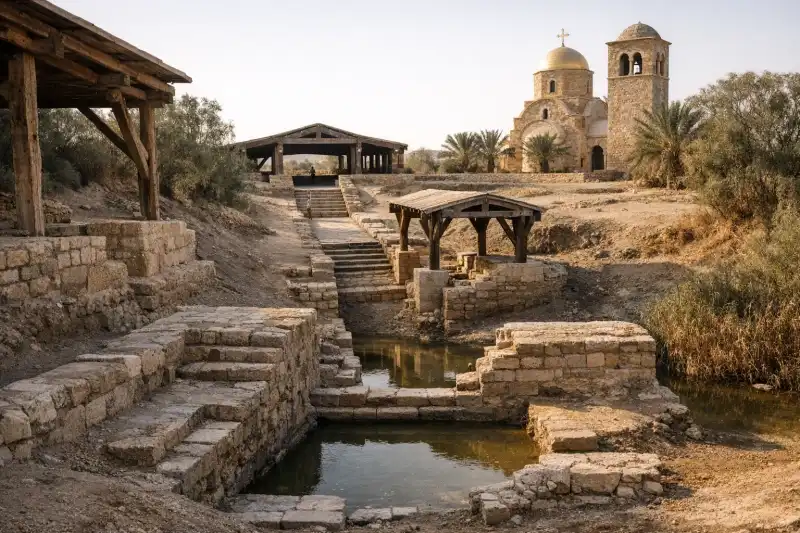
Bethany Beyond the Jordan
Bethany Beyond the Jordan in Jordan is an archaeological and religiously significant site believed t...
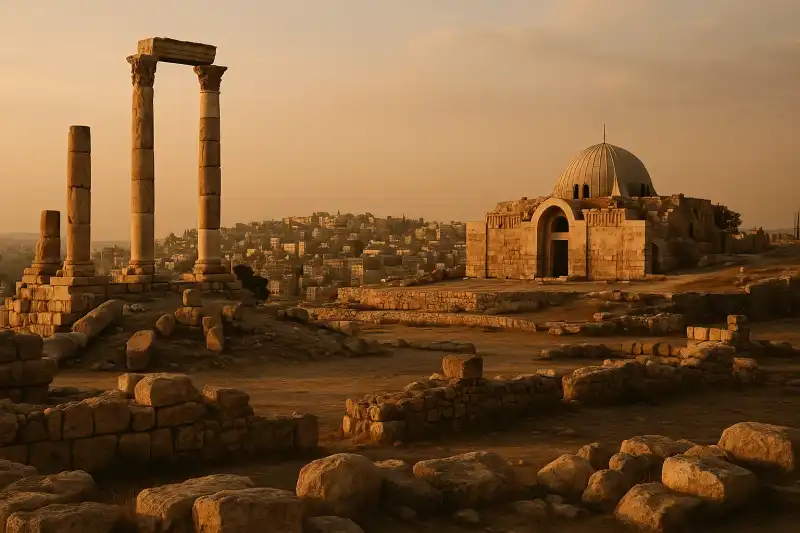
Amman Citadel Jordan Guide 2026: Temple of Hercules & Ancient Rabbah
Ammonite-Roman-UmayyadExplore Jordan's ancient citadel overlooking modern Amman. Discover the Temple of Hercules, Umayyad ...
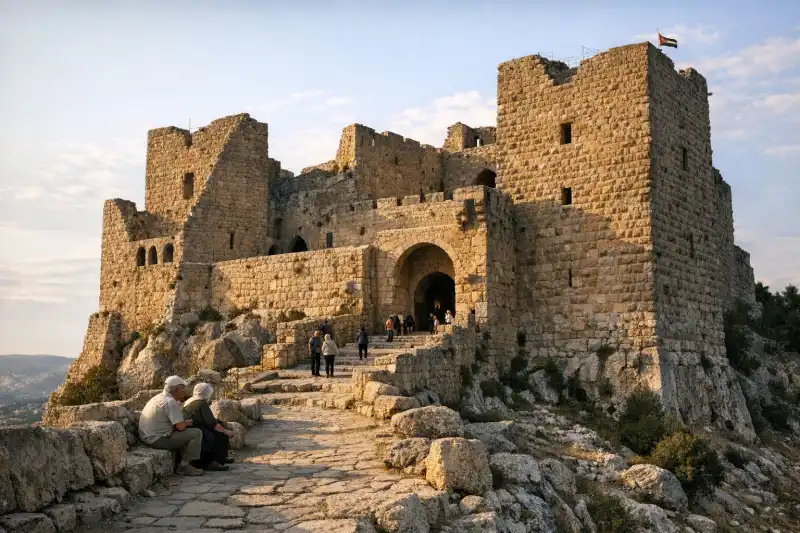
Ajloun Castle
Ajloun Castle in Jordan is a 12th-century Muslim fortress renowned for its strategic hilltop locatio...
Desert Castles (Qasr al-Hallabat)
Roman and UmayyadExplore Qasr al-Hallabat, a striking Umayyad desert castle in Jordan with Roman roots, mosaics, and ...