Quick Info
At a glance
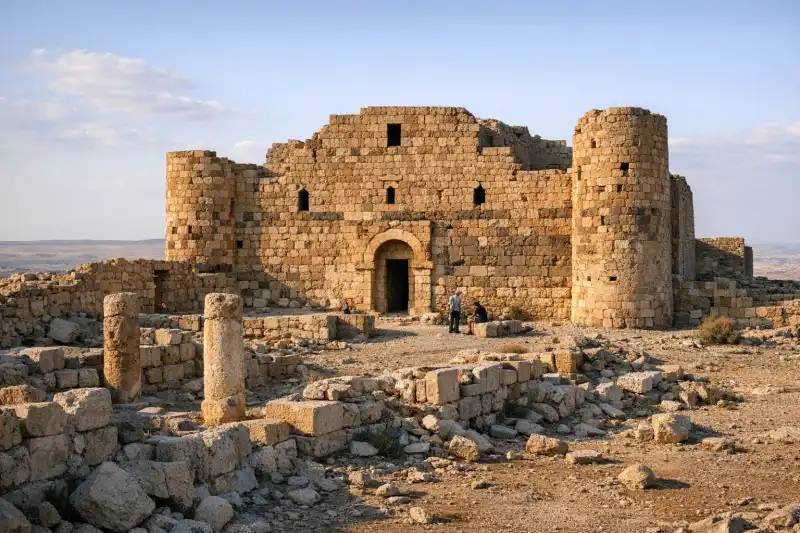
Desert Castles (Qasr al-Hallabat) in Jordan sits in the open steppe east of Amman, where the land stretches wide beneath a pale sky and ancient stone seems to rise naturally from the earth. Unlike the dramatic canyon cities or cliff-hugging fortresses that often dominate travel brochures, Hallabat is quieter and more understated. Its appeal lies in the way multiple histories overlap in one compact complex: Roman military planning, Byzantine adaptation, and Umayyad ambition all leave visible marks on the same walls.
Arriving here feels less like entering a single monument and more like stepping into a conversation across centuries. The squared enclosure, built from contrasting bands of limestone and basalt, catches light differently through the day. Nearby stand the remains of a small mosque and hydraulic works that hint at a once-organized settlement in an environment that could be unforgiving without careful planning. Though grouped with Jordan’s “Desert Castles,” Qasr al-Hallabat was not simply an isolated desert palace in the romantic sense. It was a strategic, ceremonial, and productive site tied to routes, power, and survival. For visitors willing to look beyond its austere exterior, Hallabat offers one of the most rewarding introductions to Jordan’s eastern desert heritage: intimate in scale, rich in texture, and deeply revealing about how empires reused landscapes and architecture to express authority.
History
Roman foundations
The earliest phase of Qasr al-Hallabat likely belongs to the Roman era, when the eastern frontier of the empire demanded a network of forts, watchpoints, and support stations. This region, on the margins of settled agricultural zones and steppe pastureland, was strategically significant. Rome needed to monitor movement, protect communication lines, and manage relations with local tribes and communities. Hallabat appears to have begun as part of this broader frontier landscape, probably as a military fort or fortified station established to support imperial control in what was then the province of Arabia.
Its rectangular layout reflects this practical beginning. Roman military architecture favored order, legibility, and control, and the plan at Hallabat still preserves that disciplined geometry. Even in later alterations, the site retains the skeleton of an earlier defensive logic. The use of local stone also speaks to Roman pragmatism: building with what was available while creating an installation durable enough to withstand climate and conflict alike.
Byzantine transition
As political and religious life changed in the late Roman and Byzantine periods, so too did the purpose of many frontier structures. Hallabat seems to have evolved beyond its strictly military character. During this phase, the complex may have served a more mixed role, perhaps combining defense, administration, agricultural management, and local settlement. Archaeological evidence suggests occupation and reuse rather than abandonment, which is common in long-lived sites across the Levant.
This transitional era matters because it laid the groundwork for the more visible Umayyad transformation that followed. Buildings were not erased and replaced from nothing; they were adapted. Stone was reused, layouts were modified, and new meanings were layered over old ones. In frontier zones like this, continuity was often more practical than radical rebuilding. Hallabat’s later life depended on these inherited foundations.
Umayyad reconstruction and expansion
The most significant and best-known chapter in Hallabat’s history belongs to the Umayyad period in the 8th century CE. Under the Umayyads, who ruled from Damascus and oversaw a vast early Islamic empire, a number of complexes in Jordan and Syria were built, enlarged, or repurposed. Today these are collectively called the Desert Castles, though they actually served different functions: estates, hunting lodges, caravan stations, agricultural centers, retreats, and symbols of elite authority.
At Qasr al-Hallabat, the Umayyads transformed the earlier Roman-Byzantine site into a more elaborate compound. The enclosure was rebuilt or heightened, decorative details were introduced, and the site’s role likely broadened beyond defense alone. The nearby mosque is especially important, as it points to the complex’s place within the new Islamic political and religious order. Water systems, including cisterns and channels, show that Hallabat was designed to support sustained use in a dry environment, not just brief occupation.
The Umayyad approach to architecture often blended inherited classical traditions with new artistic and political priorities. Hallabat exemplifies that synthesis. Its plan and masonry reveal continuity with earlier construction, while its ornament and associated structures reflect a distinctly early Islamic elite culture. In this sense, it is not only a building but evidence of a larger historical process: the adaptation of late antique landscapes into the world of the early caliphate.
Decline, abandonment, and rediscovery
Like many desert complexes, Hallabat eventually declined as political centers shifted, routes changed, and local patterns of occupation evolved. Earthquakes, weathering, and stone robbing likely contributed to its deterioration over the centuries. By the modern period, much of the site had fallen into ruin, though enough survived to reveal its original form and historical significance.
Modern archaeological work and restoration have played a major role in making Hallabat accessible to visitors today. Conservation efforts stabilized standing walls and clarified the relationship between the main enclosure, mosque, and associated water infrastructure. While restoration always raises questions about how best to present ancient remains, at Hallabat it has helped travelers grasp the site’s plan and atmosphere more easily than at some more fragmentary ruins. What visitors see now is therefore a combination of ancient fabric and careful modern intervention, intended to preserve a complex that represents Roman frontier policy, Byzantine continuity, and Umayyad adaptation in one place.
Key Features
The first thing most visitors notice at Qasr al-Hallabat is the enclosure itself. The main structure forms a strong geometric presence in the landscape, with thick walls and corner towers that immediately recall its military ancestry. Yet the closer you get, the more the building reveals subtleties beyond defense. Alternating tones in the masonry create a gentle visual rhythm, and the stonework conveys both utility and prestige. It is not monumental on the scale of a great imperial city, but it has a compact confidence that suits its role on the frontier.
Inside, the central courtyard is essential to understanding the complex. Rather than a dense maze of ruins, Hallabat opens up around an internal space that once organized movement, access, and daily activity. Standing here, you can imagine soldiers, officials, laborers, and later elite visitors sharing the same architectural frame across different periods. The courtyard also helps visitors read the site’s changing identity: a Roman fort can become an Umayyad residence or estate center not by abandoning order, but by repurposing it.
One of the most rewarding aspects of Hallabat is the evidence of decoration. The Desert Castles are sometimes assumed to be severe because of their dry settings, but many were visually rich. At Hallabat, carved stone details and traces of embellishment suggest that this was a place where appearance mattered. Decorative programs in Umayyad complexes often projected status, cultivated taste, and engagement with earlier Mediterranean artistic traditions. Even when only fragments survive, they remind you that the site was never merely functional.
The small mosque near the main enclosure is another defining feature. Its presence anchors Hallabat firmly within the early Islamic period and offers a more intimate architectural counterpoint to the fortress-like central compound. For many travelers, this structure is especially evocative because it makes the site feel lived in rather than abstract. It speaks to routine devotion and the organization of daily life. Seen together, the palace-like enclosure and the mosque reveal how power and piety were spatially linked in Umayyad Jordan.
Water management may be the least glamorous feature on first glance, but it is among the most important. In a landscape where rainfall is seasonal and unreliable, a large complex could not function without carefully planned collection and storage systems. Cisterns, channels, and reservoirs around Hallabat show that engineering was central to its success. These hydraulic elements also suggest broader economic possibilities. The site was not simply surviving in the steppe; it was attempting to structure and exploit the environment. Water made residence, agriculture, hospitality, and administration possible.
Another notable aspect is the relationship between Hallabat and its surroundings. Unlike sites hemmed in by modern development, this one still benefits from a relatively open setting. The horizon helps explain the logic of the place. You can see why a fort or estate would rise here: visibility, strategic position, and access to surrounding land all become legible. This openness gives Hallabat a contemplative quality. It rewards slow observation, especially for travelers interested in how architecture interacts with terrain.
The restored condition of parts of the complex can also be considered a feature in itself. Purists may prefer untouched ruins, but Hallabat’s conservation allows non-specialists to understand the building more readily. Walls stand high enough to create a sense of enclosure, doorways suggest patterns of movement, and the whole site reads as a coherent architectural statement rather than a scatter of stones. That makes it especially good for first-time visitors to Jordan’s Desert Castles, who may find Hallabat easier to interpret than some more eroded sites.
Finally, Hallabat’s greatest feature may be comparative value. On its own, it is compelling; combined with nearby Qasr Kharana and Qasr al-Azraq, it becomes part of a richer story about early Islamic Jordan. Each castle differs in plan, purpose, and atmosphere. Hallabat stands out for its layered chronology and its balance between military order, domestic adaptation, and ceremonial ambition. It is the site that most clearly invites you to think about continuity across empires rather than isolated episodes.
Getting There
Qasr al-Hallabat is most easily reached from Amman, which lies about 60 kilometers to the west. By rental car, the trip usually takes around 1 to 1.5 hours depending on traffic and your exact starting point. Driving is the most practical option if you want to combine Hallabat with other Desert Castles in a single day. Car rental in Amman often starts at around 25-40 JOD per day for a basic vehicle, excluding fuel. Roads are generally straightforward, though navigation apps are helpful once you leave the capital.
A private taxi from Amman is another convenient choice, especially for travelers who do not want to self-drive. A return trip with waiting time for Hallabat alone may cost roughly 35-60 JOD, while a multi-stop Desert Castles itinerary can range from 60-90 JOD depending on negotiation, duration, and season. Always agree on the fare before departure.
Organized day tours are often the simplest option for first-time visitors. Many operators in Amman offer half-day or full-day Desert Castles excursions that include Qasr al-Hallabat, Qasr Kharana, and Qasr al-Azraq. Group tours typically start around 40-80 JOD per person, while private tours cost more but provide flexibility and historical commentary.
Public transportation is limited and not ideal for independent sightseeing. You may be able to reach parts of the Zarqa area by bus or service taxi for a few dinars, but getting from there to Hallabat can be difficult without arranging a local taxi. If you are short on time, private transport is worth the extra cost.
When to Visit
The best time to visit Qasr al-Hallabat is during spring and autumn, when Jordan’s eastern steppe is most comfortable for outdoor exploration. From March to May, temperatures are usually mild, skies are often clear, and the surrounding landscape can briefly show touches of green after winter rains. This season offers the most pleasant conditions for walking between the castle, mosque, and water structures without feeling rushed by heat.
Autumn, especially from late September through November, is another strong choice. The summer intensity has eased, but days remain bright and generally dry. Light at this time of year is especially attractive for photography, bringing out the contrast in Hallabat’s stone masonry and the openness of the surrounding plain.
Summer visits are possible, but the midday heat can be severe. If you come between June and August, aim to arrive early in the morning or later in the afternoon. Bring plenty of water, sunscreen, a hat, and light but modest clothing. Shade on site is limited, so even a short visit can feel draining in peak sun.
Winter can be rewarding for travelers who prefer fewer crowds and cooler temperatures, though conditions may be windy and occasionally cold. Rain is infrequent but possible, and overcast skies can make the landscape feel stark. Even so, winter often gives the site a quiet, reflective atmosphere that suits its frontier character. In any season, a weekday morning usually offers the calmest experience.
| Quick Facts | Details |
|---|---|
| Location | Eastern Jordan, in Zarqa Governorate |
| Nearest major city | Amman |
| Nearby city | Zarqa |
| Historical phases | Roman, Byzantine, Umayyad |
| Best known for | Restored desert castle complex, mosque, and water systems |
| Typical visit length | 45 minutes to 1.5 hours |
| Best season | Spring and autumn |
| Good to combine with | Qasr Kharana and Qasr al-Azraq |
| Access | Best by rental car, taxi, or organized tour |
| What to bring | Water, sun protection, sturdy shoes, camera |
Qasr al-Hallabat may not be Jordan’s most famous monument, but that is part of its charm. It rewards visitors who appreciate nuance over spectacle and who enjoy places where history is read in layers rather than grand statements. Here, Roman discipline, Byzantine continuity, and Umayyad reinvention coexist within a single compact complex. The result is a destination that feels both approachable and intellectually rich. For travelers exploring the Desert Castles circuit, Hallabat is far more than a stop between bigger names. It is one of the clearest windows into how architecture, power, faith, and environment shaped Jordan’s eastern frontier across centuries.
Guided tours: worth it?
A guide can be genuinely useful at Desert Castles (Qasr al-Hallabat), especially if you want help with transport, timing, tickets, or understanding a large site without losing half the day to logistics.
Best for
- Travelers who want transport, timing, or entry logistics handled
- Short visits where a planned route saves time
When to go self-guided
Go independently if you already have transport and tickets sorted, enjoy moving at your own pace, and are comfortable checking the latest official rules before you arrive.
What I’d avoid
Skip paid tours that bundle unrelated stops you do not actually want. The best option should either save meaningful planning time or add historical context you would miss on your own.
Jordan Desert Castles
Useful when: you want to compare guided formats before deciding
Amman to Desert Castles Day Tour
Useful when: you want to compare guided formats before deciding
Qasr al-Hallabat and Qasr Kharana Tour
Useful when: you want to compare guided formats before deciding
Some tour links are affiliate links, which may earn Ancient Travel a small commission at no extra cost to you. I try to surface options that make practical sense for the site—not just anything bookable.
Frequently Asked Questions
What is Qasr al-Hallabat?
Qasr al-Hallabat is one of Jordan’s famous Desert Castles, an architectural complex with Roman origins that was later transformed and expanded in the Umayyad period.
How far is Qasr al-Hallabat from Amman?
Qasr al-Hallabat lies roughly 60 kilometers east of Amman, making it a practical half-day or full-day excursion from the capital.
Is Qasr al-Hallabat worth visiting with other Desert Castles?
Yes. It is often combined with Qasr Kharana and Qasr al-Azraq, and it stands out for its restored walls, mosque, cisterns, and decorative stonework.
How much time should I spend at Qasr al-Hallabat?
Most visitors spend 45 minutes to 1.5 hours exploring the main enclosure, nearby mosque, water structures, and the surrounding landscape.
What should I wear when visiting Qasr al-Hallabat?
Wear comfortable walking shoes, sun protection, and modest clothing suitable for Jordan’s climate and cultural norms, especially in hotter months.
Can I visit Qasr al-Hallabat independently?
Yes. Many travelers visit by rental car or taxi from Amman or Zarqa, though guided desert castle tours are the easiest option for first-time visitors.
Nearby Ancient Sites
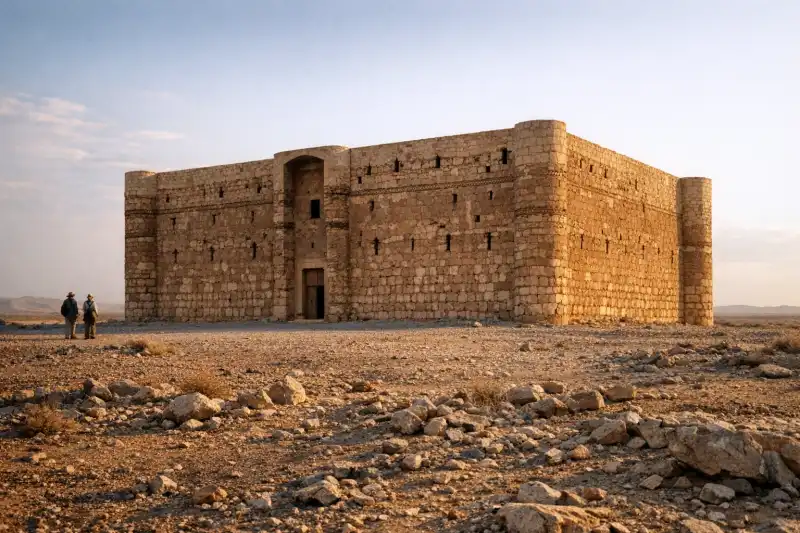
Desert Castles (Qasr Kharana)
UmayyadA remarkably preserved early Islamic desert castle in Jordan, Qasr Kharana reveals Umayyad architect...
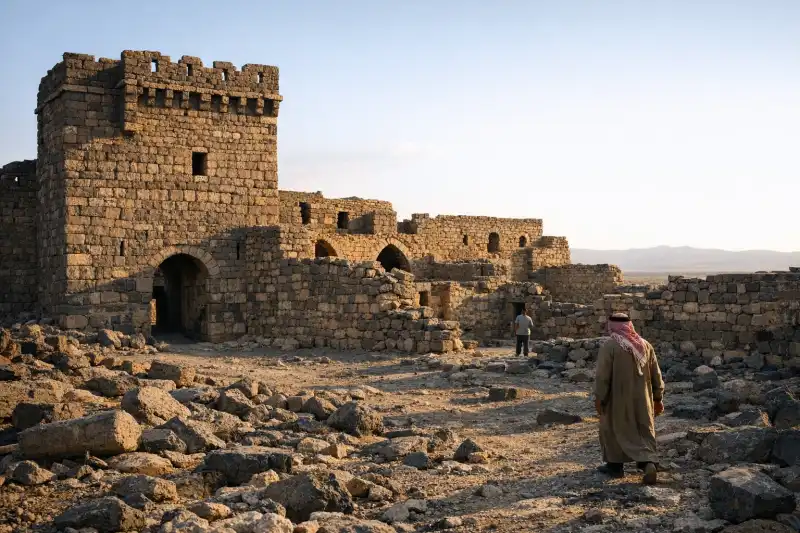
Desert Castles (Qasr al-Azraq)
Roman, Byzantine, Umayyad, OttomanQasr al-Azraq in Jordan is a striking basalt desert castle linked to Roman frontiers, Umayyad rule, ...
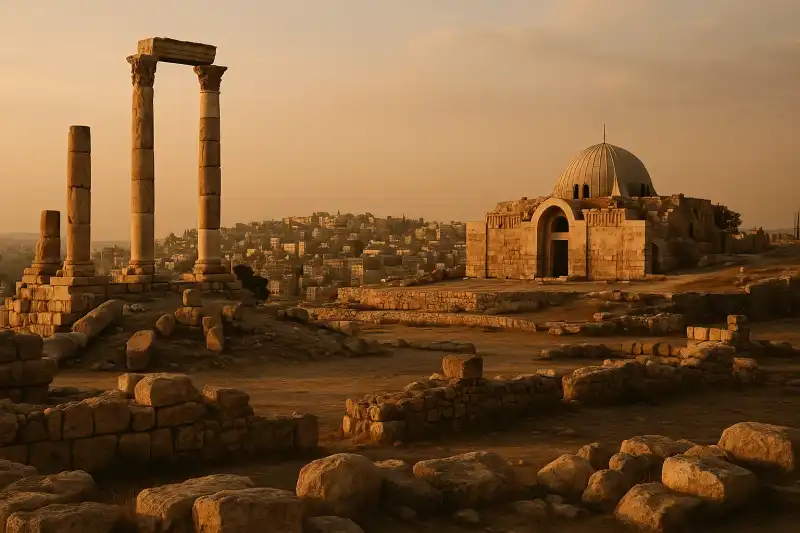
Amman Citadel Jordan Guide 2026: Temple of Hercules & Ancient Rabbah
Ammonite-Roman-UmayyadExplore Jordan's ancient citadel overlooking modern Amman. Discover the Temple of Hercules, Umayyad ...
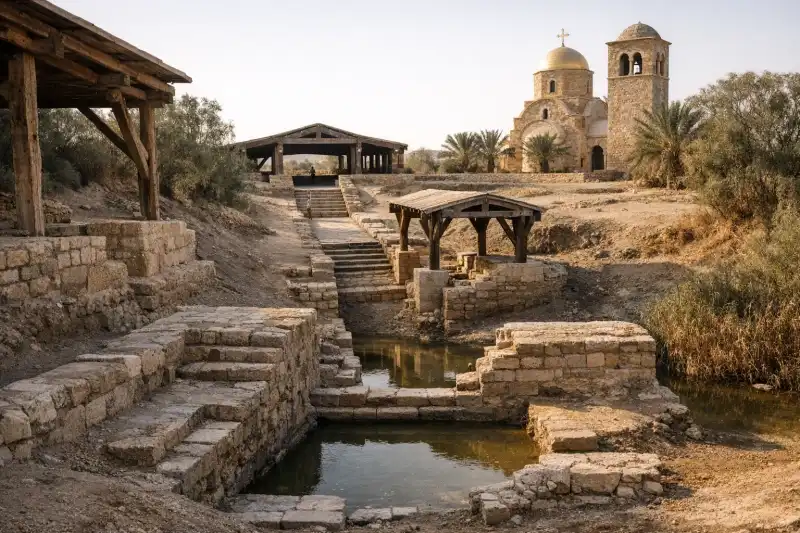
Bethany Beyond the Jordan
Bethany Beyond the Jordan in Jordan is an archaeological and religiously significant site believed t...