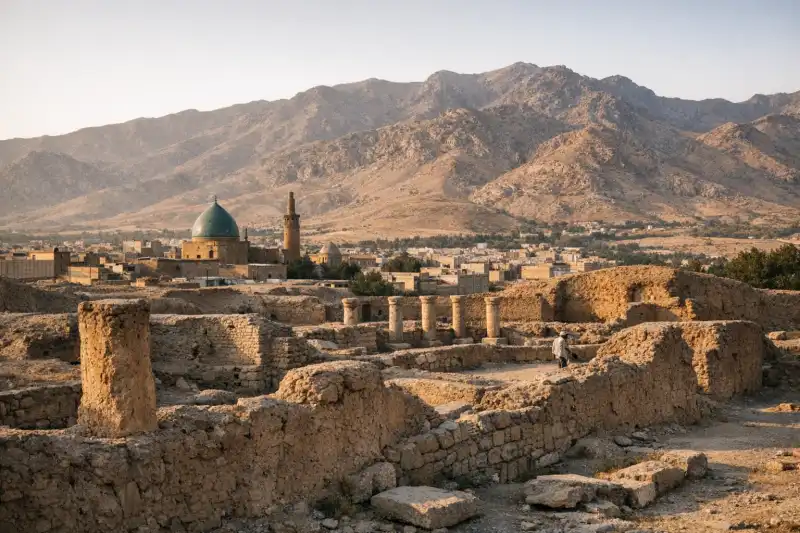
Quick Info
At a glance
Ecbatana in Iran sits beneath the modern city of Hamadan, where busy streets, markets, and apartment blocks rise over one of the most storied urban centers of the ancient Near East. For travelers, that layered setting is part of the site’s fascination. This is not a lonely ruin in a desert plain, but an archaeological landscape embedded in a living city, a place where history survives in trenches, walls, objects, and memory rather than in one grand standing monument. The name itself carries a powerful resonance: classical authors described Ecbatana as a royal capital of the Medes, later used by Persian kings and remembered as a place of wealth, fortification, and strategic importance.
Visiting Ecbatana means adjusting expectations in the best possible way. Instead of arriving at a fully reconstructed ancient city, you enter a site that invites interpretation. Excavated foundations, urban layers, and museum collections help you imagine a settlement that once linked mountain routes, imperial politics, and seasonal court life. The air in Hamadan is cooler than in many Iranian cities because of its altitude, and the nearby Alvand Mountains give the landscape a dramatic frame. Together, the city, the mountain backdrop, and the archaeological remains create a destination that feels both scholarly and atmospheric. For anyone interested in Iran’s deep past, Ecbatana offers a rare chance to stand where multiple empires overlapped and where one of antiquity’s most famous capitals may still be partially hidden below the modern ground.
History
The Median foundation and ancient tradition
Ecbatana is most famous as the reputed capital of the Medes, an Iranian people who emerged as a major political force in the 1st millennium BCE. Ancient literary sources, especially Herodotus, associated the city with Deioces, a Median ruler who was said to have founded a royal capital protected by concentric walls. Those vivid descriptions helped shape Ecbatana’s later legend as a place of grandeur and royal ceremony. Archaeology has not confirmed every classical detail, and scholars continue to debate how closely the literary image matches the excavated reality. Even so, the historical importance of the site is not in doubt.
Its location explains much of its significance. Hamadan lies in a highland region with access to routes connecting Mesopotamia, the Iranian plateau, and the interior of western Asia. A major center here could control movement, gather tribute, and serve as a secure political hub. The city’s elevation also made it attractive as a seasonal residence. In an era when climate, agriculture, and overland trade shaped state power, Ecbatana’s position was a major advantage.
Under the Achaemenid Empire
When Cyrus the Great defeated the Medes in the 6th century BCE, Ecbatana became part of the Achaemenid Empire. Rather than fading into obscurity, it continued to matter. The Achaemenid kings maintained multiple capitals and royal centers, each serving different ceremonial, administrative, or seasonal functions. Ecbatana was one of them, especially valued for its cooler summer conditions compared with lowland imperial centers.
Classical and Near Eastern traditions suggest that Ecbatana held royal treasuries and palatial complexes. While sites such as Persepolis dominate the public imagination today, Ecbatana was a key part of the same imperial network. Administrators, guards, artisans, and courtiers would have moved through its compounds, and goods from across the empire may have been stored or redistributed here. Its role reminds visitors that Achaemenid kingship was never confined to a single city. Power was mobile, and Ecbatana was one of the places where that power took architectural and administrative form.
Hellenistic and Parthian continuity
After Alexander’s conquest of the Achaemenid Empire in the late 4th century BCE, Ecbatana remained important. In the Seleucid era, the city retained strategic value thanks to its geography and earlier prestige. Hellenistic political culture often relied on preexisting urban centers, and Ecbatana was too significant to ignore. It remained a point of military and administrative relevance in western Iran.
The city continued into the Parthian period as well, when the Arsacid rulers governed a vast realm stretching between Rome and Central Asia. Parthian power relied on a network of cities, roads, and regional centers, and Ecbatana fit naturally into that system. Though many visible remains at the site are fragmentary, the archaeological layers suggest long occupation rather than a short-lived golden age followed by abandonment. This continuity is one of Ecbatana’s most important historical traits. It was not simply a Median capital frozen in legend; it was a city repeatedly reused, reshaped, and reinterpreted over centuries.
Late antiquity, Islamic era, and modern excavation
Under the Sasanians, Hamadan and the Ecbatana area continued to have regional importance. By late antiquity, the city’s identity had been transformed many times, yet its strategic position endured. After the Islamic conquest, Hamadan remained a prominent urban center, and the ancient city gradually became part of the deep stratigraphy below later settlement. As so often in the Near East, the old capital was never truly lost; it was built over.
Modern archaeological work has sought to recover that buried past. Excavations at Ecbatana have revealed architectural remains, urban planning elements, and material evidence from several periods, though the challenge is considerable because modern Hamadan sits directly atop the ancient site. This makes Ecbatana both scientifically rich and methodologically difficult. Each trench opens only a partial window into a much larger ancient city. For visitors, that unfinished quality is part of the story. Ecbatana is not merely a relic from the past; it is an active historical puzzle, still being assembled from foundations, artifacts, texts, and topography.
Key Features
What stands out first at Ecbatana is the sense of layered urban archaeology. The site does not overwhelm with towering columns or intact temples. Instead, it reveals itself through plans, alignments, walls, and excavated sectors that help you read the footprint of an ancient city. Long stretches of exposed foundations suggest formal organization, while the excavation grid gives visitors a clear impression of the scale and complexity hidden under modern Hamadan. If you enjoy sites where interpretation matters as much as spectacle, Ecbatana is deeply rewarding.
The architectural remains are often modest in height, but they are significant in what they imply. Mud-brick and stone foundation lines indicate substantial buildings once stood here, probably including administrative, residential, and defensive structures. The repeated rebuilding of the site over many centuries created a dense stratigraphy, and that depth is one of Ecbatana’s defining features. You are looking not at a single moment in time, but at the remains of a city continually reused by successive powers.
Another major feature is the site museum and associated displays, which provide crucial context. Because Ecbatana’s visible ruins can appear understated to non-specialists, the interpretive material is especially valuable. Pottery, coins, tools, inscriptions, and small finds bring human life back into the picture. They show that this was not only a royal or ceremonial center but also a lived urban environment. Objects from different eras underscore the city’s long continuity and help visitors connect broad imperial history with everyday experience.
The relationship between the archaeological zone and modern Hamadan is itself a feature worth appreciating. Standing at Ecbatana, you are never far from the sounds and rhythms of the present city. This juxtaposition is unusually powerful. In some destinations, ancient history feels distant and isolated; here, it remains embedded in civic life. That setting also reminds visitors how much of the ancient city may still lie below houses, roads, and public spaces. The visible site is only a fraction of the historical whole.
The broader Hamadan area enhances the visit. The city’s high altitude gives it a distinct climate, and the Alvand Mountains provide a dramatic natural frame. This landscape helps explain why ancient rulers valued Ecbatana as a seasonal center. Cooler summers, defensible terrain, and access to regional routes all become easier to understand when you see the geography for yourself. A visit is therefore not just about excavated walls; it is also about understanding why a capital emerged here in the first place.
Finally, Ecbatana’s greatest feature may be intellectual rather than visual: its connection to some of the central questions of Iranian antiquity. How did the Medes organize power? What did the transition from Median to Achaemenid rule look like on the ground? How do literary traditions compare with archaeological evidence? Ecbatana sits at the center of these debates. For travelers with an interest in ancient empires, it offers something rare: a site where legend, text, and excavation actively speak to one another.
Getting There
Ecbatana is located in Hamadan, making access relatively straightforward once you are in western Iran. The easiest starting point for most international visitors is Tehran. From Tehran, you can travel to Hamadan by domestic flight, intercity bus, private car, or shared taxi. Flights, when available, are the quickest option, though schedules can vary. Overland travel is more common and often more practical. VIP buses from Tehran to Hamadan typically take around 4.5 to 5.5 hours, with fares often in the rough range of 2,500,000 to 4,500,000 Iranian rials depending on operator and seat class. Shared taxis or private transfers are faster but more expensive, and prices vary widely with fuel costs and negotiation.
If you are already in western Iran, Hamadan is also well connected by road from cities such as Kermanshah and Sanandaj. Driving gives the most flexibility, especially if you plan to combine Ecbatana with other regional attractions. Roads are generally good on major routes, though mountain weather can occasionally affect conditions in colder months.
Once in Hamadan, reaching Ecbatana is easy because the site is inside the city. A local taxi or ride-hailing service is usually the simplest option and should be inexpensive by city standards, often equivalent to just a few US dollars or less depending on distance. Some travelers prefer to walk if staying centrally, especially in mild weather. Allow extra cash for entrance fees, which are modest but can change. Because prices in Iran may shift over time, it is wise to confirm current fares locally rather than relying on older guidebooks.
When to Visit
Spring is generally the best time to visit Ecbatana. From roughly April to early June, Hamadan usually enjoys cool to mild temperatures, greener surroundings, and comfortable conditions for walking around the excavation area. The city’s elevation makes it more pleasant than many lower and hotter parts of Iran during this season. Light layers are still a good idea, especially in the morning and evening, when temperatures can drop.
Early autumn is another excellent window. September and October often bring stable weather, clearer skies, and fewer seasonal extremes. This is a particularly good time for travelers who want to combine archaeology with broader sightseeing in western Iran. The open-air nature of Ecbatana means that comfort matters; a temperate day makes it easier to spend time reading signage, examining foundations, and visiting the museum without fatigue.
Summer is possible, and Hamadan is cooler than places such as Khuzestan or central desert cities, but midday sun can still be strong. If visiting in July or August, aim for morning or late afternoon and carry water, sunscreen, and a hat. Winter visits can be atmospheric, especially with the mountain setting, but cold weather and occasional snow may make the experience less convenient. Visibility of the ruins can also feel flatter under gray skies.
If your main interest is photography, spring and autumn usually offer the best balance of light and comfort. If your main interest is historical study, any season works, provided you dress appropriately. The key is to remember that Ecbatana rewards slow observation, and the best visiting season is the one that allows you to move unhurriedly through the site.
| Quick Facts | Details |
|---|---|
| Location | Hamadan, Hamadan Province, Iran |
| Ancient significance | Traditionally the capital of the Medes; later used by Achaemenid and later Iranian empires |
| Modern setting | Archaeological site within the modern city of Hamadan |
| Best for | Ancient history enthusiasts, archaeology travelers, cultural visitors to western Iran |
| Recommended visit length | 1–2 hours for the site and museum; longer if combined with Hamadan landmarks |
| Best seasons | Spring and early autumn |
| Elevation context | Highland setting near the Alvand Mountains, contributing to cooler weather |
| Access | Easy by taxi or on foot from central Hamadan |
| Site character | Excavated urban remains, foundations, stratified archaeology, museum interpretation |
| Combine with | Other cultural stops in Hamadan and broader western Iran itineraries |
Ecbatana is a destination for travelers who value depth over display. It asks you to imagine, to compare text and terrain, and to appreciate the difficulty of uncovering an ancient capital beneath a modern city. That challenge is precisely what makes it memorable. In Hamadan, Iran, the story of Ecbatana remains incomplete, but the visible fragments are enough to convey the importance of a place that once stood at the center of imperial power. For thoughtful visitors, few sites offer such a direct encounter with the long continuity of Iranian urban history.
Guided tours: worth it?
Self-guided works here, but a guide can add real value if you want the ruins explained as a living place rather than just a sequence of monuments.
Best for
- First-time visitors who want context, not just photos
- Short visits where a planned route saves time
When to go self-guided
Go independently if you prefer setting your own pace, reading as you go, and checking official hours or ticket rules directly before you arrive.
What I’d avoid
Skip paid tours that bundle unrelated stops you do not actually want. The best option should either save meaningful planning time or add historical context you would miss on your own.
Hamadan and Ecbatana tours
Useful when: you want to compare guided formats before deciding
Iran ancient history tours
Useful when: you want to compare guided formats before deciding
Western Iran archaeological tours
Useful when: you want to compare guided formats before deciding
Some tour links are affiliate links, which may earn Ancient Travel a small commission at no extra cost to you. I try to surface options that make practical sense for the site—not just anything bookable.
Frequently Asked Questions
What is Ecbatana?
Ecbatana is an important ancient city in modern Hamadan, Iran, traditionally associated with the Median capital and later used by Achaemenid, Seleucid, Parthian, and Sasanian rulers.
Where is Ecbatana located?
The archaeological site of Ecbatana lies in central Hamadan in western Iran, in Hamadan Province, at the foot of the Alvand Mountains.
How much time should I allow for a visit?
Most visitors spend 1 to 2 hours at the Ecbatana excavations and museum, though history enthusiasts may want half a day to combine it with other Hamadan landmarks.
Is Ecbatana suitable for independent travelers?
Yes. The site is in the city of Hamadan and can be reached easily by taxi or local transport, making it practical for independent travelers as well as guided tours.
What can you see at Ecbatana today?
Visitors can see excavated architectural remains, mud-brick and stone foundations, defensive traces, archaeological grids, and museum displays that explain the long history of the ancient city.
When is the best time to visit Ecbatana?
Spring and early autumn are usually the most comfortable times, with milder temperatures and clearer conditions for walking through the open-air excavation area.
Nearby Ancient Sites
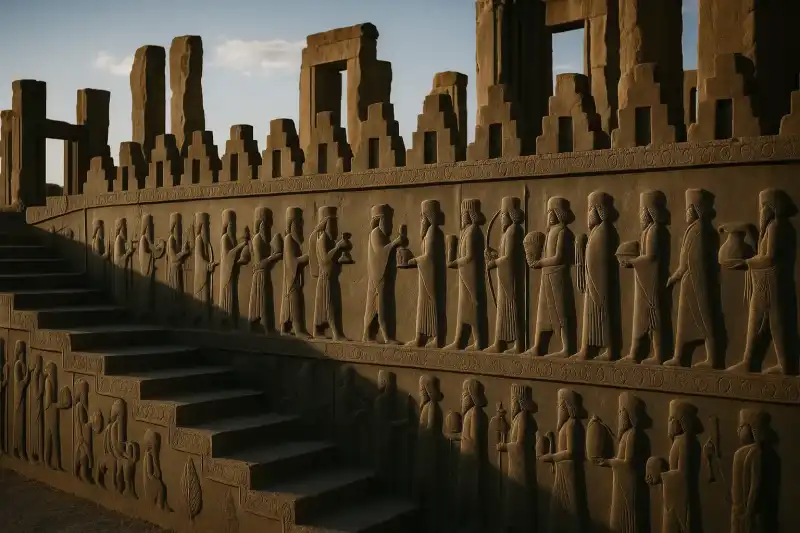
Persepolis: The Glorious Capital of the Persian Empire
Achaemenid Persian EmpireExplore Persepolis, the magnificent ceremonial capital of the Achaemenid Empire. Walk among towering...
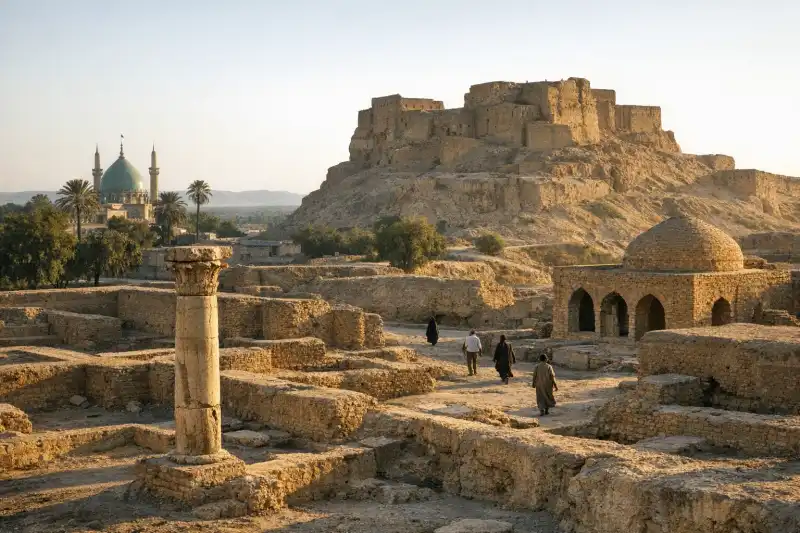
Susa
Elamite, Achaemenid Persian, Seleucid, Parthian, SasanianExplore Susa in Iran, an ancient capital of Elam, Persia, and Parthia with royal ruins, archaeology,...
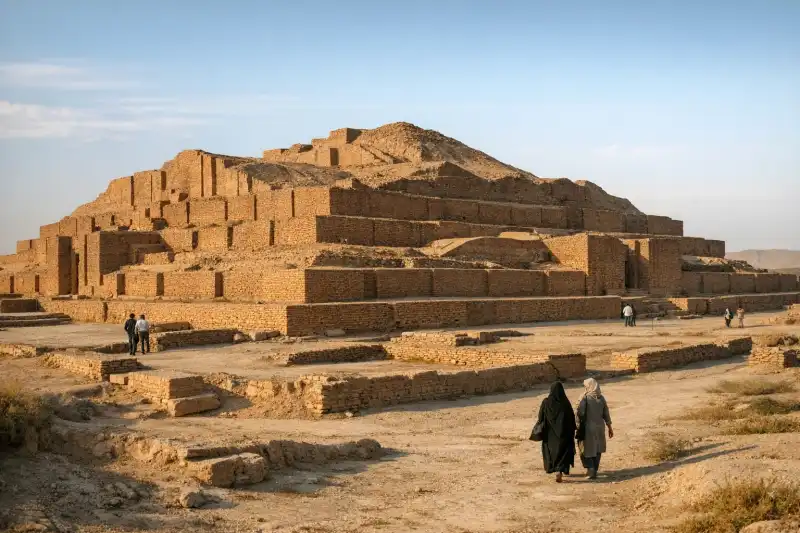
Chogha Zanbil
ElamiteExplore Chogha Zanbil, Iran’s remarkable Elamite ziggurat complex and one of the best-preserved anci...