Quick Info
At a glance
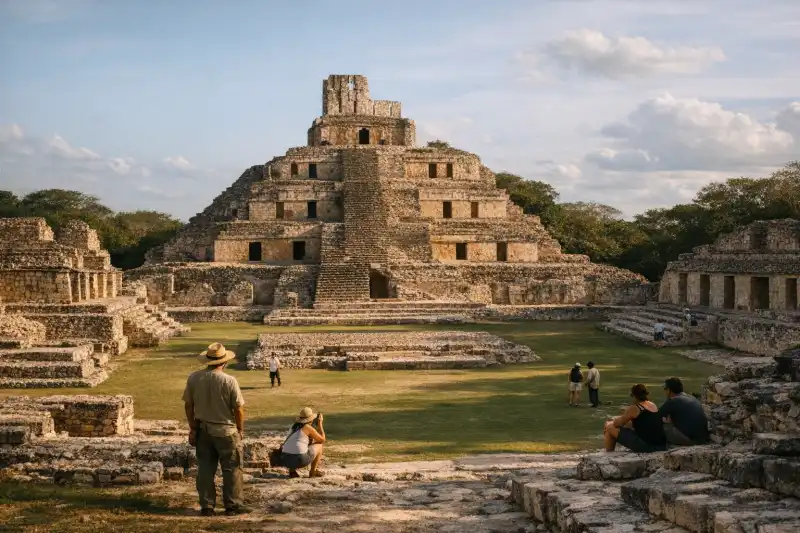
Edzná, in Mexico, rises from the low green plains of Campeche with a quiet grandeur that surprises almost everyone who visits. Unlike some archaeological sites that reveal themselves slowly through dense jungle, Edzná opens dramatically: broad plazas, tiered platforms, temple silhouettes, and the striking mass of the Temple of the Five Stories all appear in a landscape shaped as much by human ingenuity as by nature. The setting feels spacious and ordered, as if the ancient city still remembers the authority it once projected across the region. Birds wheel above the lawns, iguanas warm themselves on sunlit stone, and long shadows emphasize the geometry of stairways and terraces.
For travelers exploring the Yucatán Peninsula, Edzná offers something distinctive. It is undeniably Maya, yet it feels different from more heavily visited ruins elsewhere in southeastern Mexico. Here, one of the most memorable stories is not only about dynasties, rituals, and monumental architecture, but also about water. In a region where successful settlement depended on control of seasonal rains and wetlands, Edzná became an impressive example of hydraulic planning. The city’s canals, reservoirs, and engineered landscape supported urban life over many centuries, helping it flourish as both a ceremonial and political center. Today, that combination of scale, historical depth, and relative calm makes Edzná one of Mexico’s most rewarding ancient destinations.
History
Early settlement and the rise of Edzná
Archaeological evidence suggests that Edzná was first occupied around 600 BCE, during the Late Preclassic period. At that time, communities across the Maya world were developing more complex social and political structures, and Edzná benefited from a favorable location in a fertile basin. Seasonal water was both an opportunity and a challenge, and one of the city’s most important achievements appears to have been the transformation of this environment through hydraulic engineering. Canals and water-management systems allowed agriculture to intensify and population to grow, laying the foundation for urban development.
Over time, what may have begun as a regional settlement expanded into an organized ceremonial center with substantial public architecture. Raised platforms, plazas, and early monumental buildings signal the presence of centralized leadership and coordinated labor. As in many Maya cities, religion, political authority, and social hierarchy were closely connected. Rulers likely justified their power through ritual performance, control of surplus production, and the ability to sponsor ambitious building programs.
The Classic period peak
Edzná reached its greatest prosperity during the Classic period, roughly between 250 and 900 CE. This was the era when many of its most visible structures were built, expanded, or remodeled. The city became a significant regional capital, with architecture that shows both local traditions and broader influences from across Mesoamerica. Scholars have noted traits associated with the Puuc style in some later buildings, while other elements hint at connections to the Petén area and perhaps to wider exchange networks that linked cities through trade, diplomacy, and rivalry.
The urban core was carefully organized. Massive plazas provided space for ceremony, processions, and public display. Elevated buildings reinforced social hierarchy, physically placing elites and sacred architecture above the surrounding landscape. The Temple of the Five Stories, the most iconic structure at Edzná, likely served as both a ceremonial focal point and a visual statement of political power. Its commanding position over the Great Acropolis and central plaza would have made it central to state ritual.
Inscriptions from Edzná are less abundant than at some other Maya sites, but epigraphic evidence indicates that the city had its own dynastic history. Like many Classic Maya centers, it probably navigated a changing political environment in which alliances could shift and warfare could reshape regional power. Even when kings and nobles remain only partially known to us, the architecture demonstrates a city with resources, administrative capacity, and ambition.
Transformation and decline
After the height of the Classic era, Edzná, like many Maya cities, entered a period of transformation. The so-called Maya collapse was not a single event, and at Edzná the process seems to have been gradual rather than sudden. Political structures weakened, populations changed, and some monumental spaces were reused in new ways. Certain buildings continued to receive attention into the Terminal Classic and Postclassic periods, suggesting that the site remained meaningful even as its role shifted.
A mix of factors likely contributed to the decline: changing trade routes, environmental stress, political fragmentation, and broader regional instability. The sophisticated hydraulic system that had once supported growth may have required sustained coordination and labor to maintain. As centralized authority weakened, such systems could become harder to manage effectively. Over time, Edzná lost its position as a major urban center.
By the time the Spanish arrived in the region in the 16th century, the ancient city had long since ceased to function as it had in its prime. The structures stood in varying states of abandonment, their former plazas quiet except for local memory and the encroaching vegetation of the Campeche plain.
Rediscovery and archaeological work
Modern archaeological interest in Edzná developed gradually, with reports and investigations increasing in the 19th and 20th centuries. More systematic excavation and conservation revealed the true scale of the site and clarified its importance within the Maya world. Restoration has focused especially on the monumental core, allowing visitors today to appreciate the city’s layout and its major buildings with unusual clarity.
Research continues to refine understanding of Edzná’s chronology, architecture, and water management. The site has become an important case study in how ancient Maya communities adapted to their environments through engineering as well as ritual and political organization. While much remains to be learned, Edzná now stands recognized as one of Campeche’s most significant archaeological treasures.
Key Features
The first thing many visitors notice at Edzná is its openness. The monumental core unfolds across a spacious central area where the lines of architecture are easy to read. This gives the site a very different feel from heavily forested ruins. You can stand at one end of a plaza and understand how the city was staged for movement, spectacle, and authority. The scale is impressive, but so is the coherence. Buildings seem placed to create a carefully controlled visual experience, guiding the eye toward temples, stairways, and elevated ceremonial zones.
The unquestioned centerpiece is the Temple of the Five Stories, a tall pyramid-temple rising from the Great Acropolis. Despite its name, the structure is not a residential building but a layered ceremonial monument whose stacked levels create a striking vertical profile. Broad stairways, rooftop architectural elements, and commanding views make it the image most associated with Edzná. It would have dominated civic and ritual life, serving as a platform for ceremonies visible to the crowds assembled below. Even from a distance, it communicates the grandeur and confidence of the city at its height.
Surrounding the pyramid is a broader complex of terraces, substructures, and ceremonial spaces that show how public architecture functioned as an integrated whole. The Great Acropolis itself is a raised platform carrying temples, administrative buildings, and ritual spaces. Walking through it, you begin to see how Maya architecture shaped social relationships. Elevation mattered. Movement up stairways and onto platforms was not just practical but symbolic, marking transitions into more restricted or sacred areas.
Elsewhere in the site, the Nohoch Ná, often described as a large elongated structure, stands out for its monumental length and its probable administrative or elite function. It helps balance the composition of the main plaza, showing that Edzná was not built around a single temple alone but around a larger civic program. Nearby, the Small Acropolis and other complexes add depth to the city plan, suggesting zones with different ceremonial, residential, and political uses.
One of the most fascinating aspects of Edzná is less visually dramatic at first glance but arguably just as significant: the hydraulic system. Canals, reservoirs, and modified terrain point to a city that invested heavily in water control. In the seasonal environment of Campeche, this was essential. The system likely helped drain excess water, store it for drier periods, and support agriculture on a substantial scale. For modern visitors, this feature transforms the way the site is understood. Edzná was not simply a cluster of temples in the landscape; it was a carefully engineered urban environment.
Architectural details across the site reward close attention. Some façades and upper sections preserve decorative elements that hint at changing styles over time. You may notice combinations of solid geometric massing and more delicate ornamental features. Doorways, roof comb remnants, and sculptural fragments all suggest buildings that were once painted in vivid colors and animated by banners, ritual offerings, and movement.
The atmosphere is also part of the appeal. Because Edzná is usually less crowded than marquee Maya destinations, the site often feels contemplative. You can pause in the plaza and imagine ceremonies, marketplaces, or gatherings without the constant pressure of large tour groups moving around you. The broad lawns and cleared sightlines make it an excellent place for photography, particularly in the early morning or late afternoon when warm light sharpens the contours of stone. In these moments, Edzná feels less like a ruin isolated from its past and more like a city whose ceremonial logic is still visible.
Getting There
Edzná is most easily reached from the city of Campeche, the usual base for visiting the site. The ruins lie about 50 kilometers southeast of the city, and the journey by car typically takes around 50 minutes to 1 hour, depending on traffic and road conditions. Renting a car is the most flexible option if you want to travel independently and arrive early. Daily rental rates in Campeche often start around MXN 700 to 1,200, depending on vehicle type and season, with fuel costs extra.
Taxis and private drivers are another convenient choice, especially for travelers who prefer not to drive. A round-trip taxi from Campeche to Edzná with waiting time commonly costs about MXN 900 to 1,500, though prices vary and should be agreed in advance. Some hotels can also arrange private transport or half-day excursions.
Budget travelers can look for local buses or colectivos from Campeche, but schedules may be limited and less convenient than private transport. Fares are generally inexpensive, often in the range of MXN 50 to 100 each way, but departures may not align well with a leisurely visit. It is wise to confirm return options before setting out, especially outside peak travel periods.
Guided tours from Campeche are widely available and can be a good value if you want transport, site context, and logistics handled together. Group excursions often cost around MXN 700 to 1,800 per person, depending on inclusions. Bring cash for entry fees, water, and snacks, as services on site can be basic.
When to Visit
The most comfortable time to visit Edzná is generally from November to March, when temperatures are milder and humidity is less oppressive than in late spring and summer. During these months, daytime conditions are still warm, but walking the open plazas and exposed stone surfaces is far more pleasant. This is the best season for travelers who want to explore at a relaxed pace, take photographs, and spend time studying the architecture without feeling rushed by the heat.
April and May are often the hottest months. At Edzná, where there is limited shade in many of the main ceremonial areas, midday sun can feel intense. If you visit then, aim to arrive right at opening time, wear a hat, use sunscreen, and carry plenty of water. The reward is often clearer skies and excellent visibility for photos, but the climate can be demanding.
The rainy season usually runs from roughly June through October. Afternoon showers can cool things down, and the surrounding landscape becomes greener, which can make the site especially beautiful. However, humidity is higher, storms can interrupt visits, and mosquitoes are more active. Morning visits are usually the safest plan during this period.
For the best overall experience, arrive early in the day regardless of season. Early hours offer softer light, fewer visitors, and a quieter atmosphere that suits the site’s broad ceremonial spaces. If you value calm exploration over peak convenience, weekdays outside major holiday periods are ideal.
| Quick Facts | |
|---|---|
| Location | Campeche state, Mexico |
| Civilization | Maya |
| Earliest occupation | c. 600 BCE |
| Peak era | Classic period, especially c. 250-900 CE |
| Signature monument | Temple of the Five Stories |
| Known for | Monumental plazas, elevated acropolis, hydraulic engineering |
| Nearest city | Campeche |
| Typical visit length | 2-4 hours |
| Best season | November to March |
| Best time of day | Early morning |
Edzná rewards travelers who want more than a checklist stop. It is visually impressive, historically rich, and unusually legible as an ancient urban landscape. You can appreciate its monumental architecture on first sight, but the site becomes even more compelling once you understand how thoroughly it was shaped by water management, political ceremony, and long-term adaptation to the environment. In that sense, Edzná offers a fuller picture of Maya civilization than many visitors expect.
For anyone traveling through southeastern Mexico, it makes an excellent complement to the better-known ruins of the Yucatán Peninsula. The journey from Campeche is straightforward, the atmosphere is generally calmer than at the most famous archaeological parks, and the central monuments are memorable enough to stay with you long after the visit ends. Standing before the Temple of the Five Stories and looking across the great plaza, it is easy to imagine Edzná not as a ruined place, but as a thriving city of priests, rulers, engineers, and farmers who built a remarkable world in the Campeche plain.
Guided tours: worth it?
Self-guided works here, but a guide can add real value if you want the ruins explained as a living place rather than just a sequence of monuments.
Best for
- First-time visitors who want context, not just photos
- Short visits where a planned route saves time
When to go self-guided
Go independently if you prefer setting your own pace, reading as you go, and checking official hours or ticket rules directly before you arrive.
What I’d avoid
Skip paid tours that bundle unrelated stops you do not actually want. The best option should either save meaningful planning time or add historical context you would miss on your own.
Edzná tours from Campeche
Useful when: transport or pickup logistics matter
Campeche archaeological tours
Useful when: you want to compare guided formats before deciding
Maya ruins tours in Campeche
Useful when: you want to compare guided formats before deciding
Some tour links are affiliate links, which may earn Ancient Travel a small commission at no extra cost to you. I try to surface options that make practical sense for the site—not just anything bookable.
Frequently Asked Questions
Where is Edzná located?
Edzná is in the state of Campeche in southeastern Mexico, about 50 kilometers southeast of the city of Campeche.
How much time do you need to visit Edzná?
Most visitors spend 2 to 4 hours at Edzná, depending on interest in photography, walking the wider complex, and visiting the on-site museum.
Can you climb the pyramids at Edzná?
Access rules can change, but climbing is often restricted on major structures for conservation and safety, so check current site regulations when you arrive.
Is Edzná worth visiting from Campeche?
Yes. Edzná is one of the most impressive Maya sites in Campeche and makes an easy half-day or full-day trip from the city.
What is Edzná famous for?
Edzná is especially known for the Temple of the Five Stories, its vast ceremonial plaza, and its sophisticated network of canals and hydraulic engineering.
When is the best time to visit Edzná?
The best months are generally from November to March, when temperatures are more comfortable and rain is less frequent.
Nearby Ancient Sites
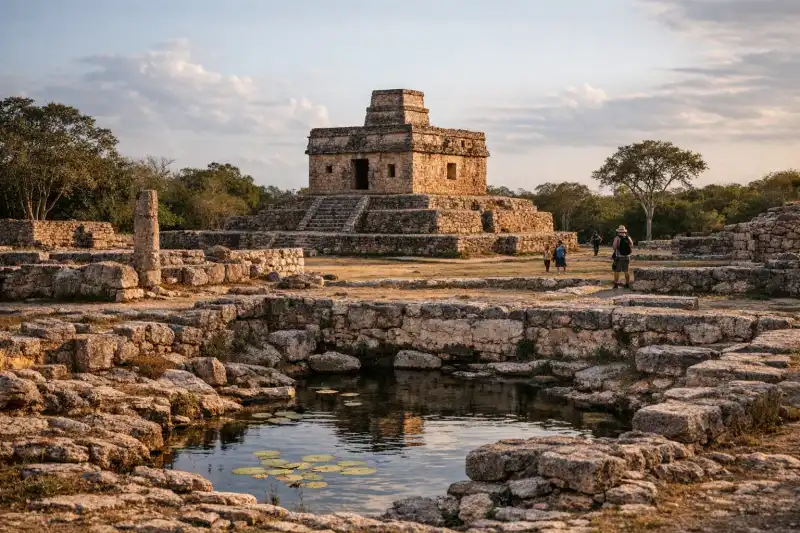
Dzibilchaltún
MayaExplore Dzibilchaltún, an ancient Maya city in Mexico known for its Temple of the Seven Dolls, sacbe...
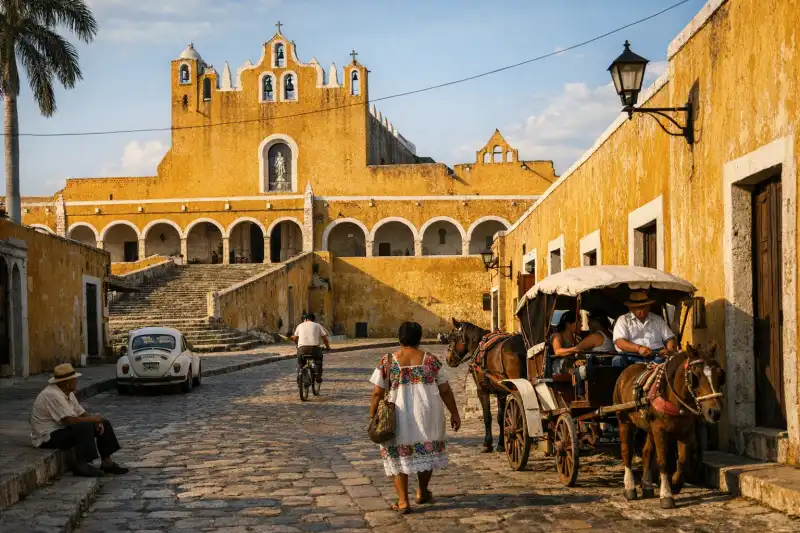
Izamal
Izamal, known as the 'Yellow City,' is a magical town in Yucatán, Mexico, famed for its golden-hued ...
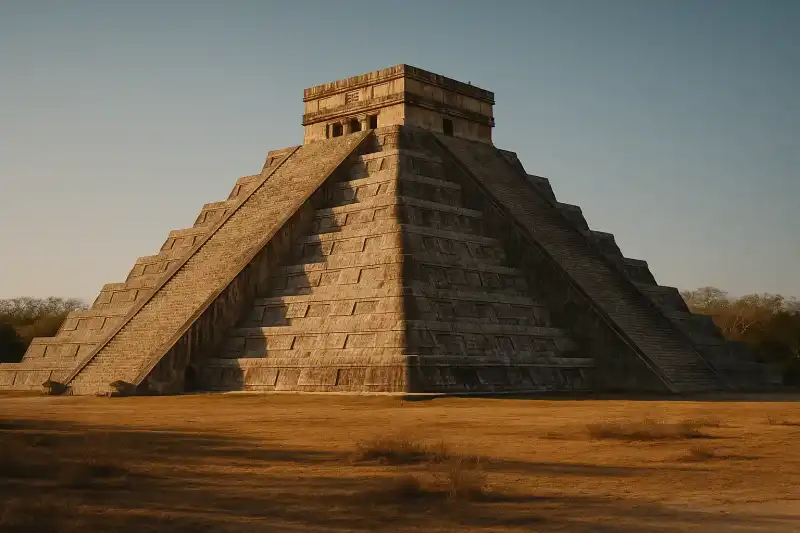
Chichen Itza Travel Guide 2026: Maya Secrets, Sacred Cenote, and Smart Timing
MayaChichen Itza stands as the most visited ancient site in Mexico, showcasing the architectural genius ...