Quick Info
At a glance
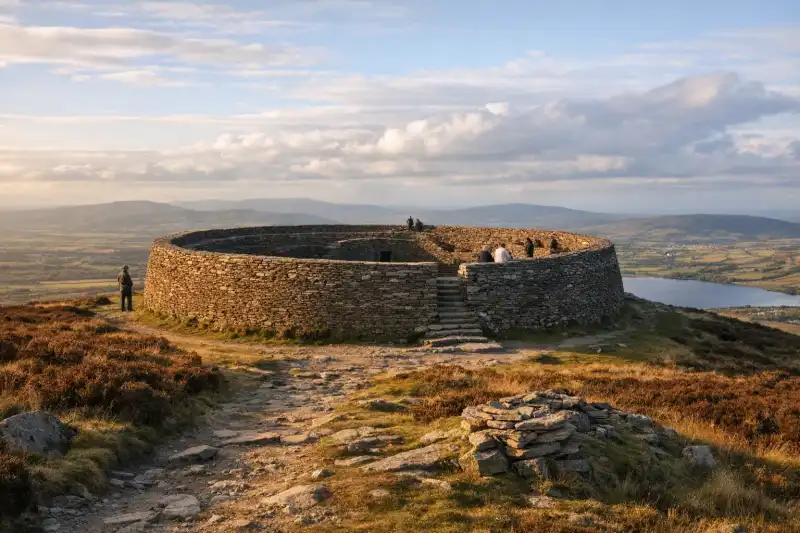
Grianan of Aileach in Ireland rises from a commanding hilltop in County Donegal, where stone walls, shifting cloud, and long views over Lough Swilly and Lough Foyle create one of the most memorable historic landscapes on the island. Even before you reach the fort itself, the setting tells part of the story. Roads narrow, fields open, and the summit begins to feel less like a stop on an itinerary and more like a threshold between the everyday and the legendary. This is one of those places where archaeology, folklore, royal memory, and scenery are all bound together so tightly that it is almost impossible to separate them.
For many travelers, Grianan of Aileach is a short detour from Derry, Letterkenny, or the Inishowen Peninsula. Yet it rarely feels like a minor stop. The circular stone enclosure crowns Greenan Mountain with an authority that makes immediate sense, even if you arrive knowing little about early medieval Ireland. The fort’s elevated position offers not only defensive advantages but also symbolic power. Ancient royal centers were often meant to be seen as much as occupied, and from here the rulers associated with Aileach could look across a broad territory shaped by political ambition, kinship, and conflict. Today, visitors come for the same commanding outlook, but they also come for the sense that this hill has carried meaning for a very long time. Grianan of Aileach is not simply a ruin in a beautiful place. It is a place where landscape itself became part of kingship, identity, and memory.
History
Prehistoric and legendary beginnings
Like many prominent hilltop sites in Ireland, Grianan of Aileach is wrapped in layers of legend that reach further back than the surviving masonry. Some traditions connect the hill with very ancient occupation, even suggesting a prehistoric burial mound or ceremonial origin beneath the later fort. While archaeological certainty is limited, the prominence of the site makes such long-term significance plausible. Elevated locations with sweeping views often attracted repeated use over centuries, whether for ritual, assembly, burial, or defense.
The name itself invites interpretation. “Grianan” can be translated in ways that suggest a sunny place or palace-like structure, while “Aileach” is linked to the regional kingdom that later made the site famous. Medieval literary traditions tied the place to heroic cycles and ancestral narratives, blending politics and myth in a way typical of early Irish historical writing. Such stories mattered because they gave ruling dynasties a past deeper than memory and more prestigious than simple inheritance. In other words, legend helped legitimize power.
Royal stronghold of the kings of Aileach
By the early medieval period, Grianan of Aileach had become associated with the Cenél nEógain, one of the major branches of the northern Uí Néill. This made it an important royal site in the political world of northern Ireland. The kingdom of Aileach extended influence over substantial parts of modern Donegal and Derry, and the hilltop fort seems to have served as a ceremonial and dynastic center rather than as a purely military installation.
That distinction matters. Although the fort’s circular enclosure and elevated position could certainly provide protection, sites like this were also places of inauguration, assembly, hospitality, and display. Kingship in early medieval Ireland depended not only on force but on ritual status, alliances, and public visibility. A ruler needed a place that embodied legitimacy. Grianan’s commanding setting, monumental ring of stone, and association with a recognized royal lineage made it ideal for that role.
Historical sources from the medieval period refer to Aileach as a significant royal place. It appears in annals and literary traditions tied to regional power struggles. This was an age of shifting alliances, rival dynasties, Viking interaction, ecclesiastical influence, and periodic warfare. Through it all, Aileach remained one of the symbolic centers of northern kingship.
Destruction and decline
The fortunes of royal sites changed with politics, and Grianan of Aileach was no exception. In 1101, the fort is traditionally said to have been destroyed by Muirchertach Ua Briain, High King of Ireland and ruler of Munster, during a major campaign in the north. According to later accounts, the destruction was a deliberate humiliation aimed at the northern Uí Néill. Pulling down stones from a royal center was more than military damage. It was a public statement about dominance.
After this episode, Aileach’s role as an active royal seat appears to have diminished. Power in medieval Ireland was never static, and older ceremonial centers could lose practical importance even while retaining symbolic prestige. Over time, the fort fell into ruin. The hill remained part of local memory, but the structure that visitors see today is not a simple untouched survival from the early Middle Ages.
Antiquarian interest and reconstruction
Interest in Irish antiquities grew strongly in the 18th and 19th centuries, when scholars, clergy, and local enthusiasts began documenting old monuments with new urgency. Grianan of Aileach attracted attention both for its striking position and its historic associations. In the 1870s, much of the visible stone fort was reconstructed by Dr. Walter Bernard, who sought to stabilize and re-erect the monument using fallen stones from the site.
This reconstruction has shaped modern experience of Grianan. It allows visitors to perceive the fort as an architectural whole rather than a low ruin, but it also raises the usual questions about restoration, authenticity, and interpretation. What you see is partly ancient and partly Victorian understanding of ancient design. Still, the reconstruction followed the footprint and surviving fabric closely enough to preserve the monument’s essential form and power. Today, Grianan of Aileach stands not as a frozen untouched relic, but as a layered historic place where early medieval origins, later collapse, and modern restoration all remain part of the story.
Key Features
The first thing most visitors notice about Grianan of Aileach is its position. The fort sits at about 244 meters above sea level, high enough to dominate the surrounding landscape without feeling remote from it. This is not a mountain citadel in the dramatic continental sense; instead, it occupies a distinctly Irish kind of elevated ground, where soft contours and open skies make the horizon feel enormous. On a clear day, the views take in Lough Swilly, Lough Foyle, the Inishowen Peninsula, and broad stretches of Donegal and Derry. Those panoramas are not an accidental bonus. They are central to understanding why the site mattered.
The fort itself is a substantial circular stone enclosure, roughly 23 meters in diameter externally, built of dry stone masonry. Its thick walls create an impression of both compactness and sophistication. Rather than sprawling across the hilltop, Grianan presents itself as a tightly controlled architectural form: a ring, a boundary, a statement. The entrance passage cuts through the wall and gives the visitor a brief sense of transition from outer world to interior space. Even with modern tourism and open access, passing through the doorway still feels ceremonial.
Inside, the enclosed space is surprisingly intimate when compared with the vast outward views. That contrast is part of the fort’s appeal. From a distance, Grianan reads as a public monument visible across territory. From within, it becomes a contained, almost inward-looking place. The central grassy interior would once have framed activity, gathering, or display, though exactly how it was used remains debated. For modern visitors, the interior offers a pause from the wind and a chance to appreciate the geometry of the structure.
One of the most discussed architectural features is the presence of galleries or passages built within the thickness of the wall. These chambers are characteristic of some Irish stone forts and add complexity to what might otherwise seem like a simple ring. They suggest considerable planning and masonry skill. Whether they had practical, symbolic, or multi-purpose use, they remind us that this was a high-status construction rather than an improvised refuge.
The stonework itself deserves attention. Because much of the fort was reconstructed, visitors sometimes assume it lacks authenticity. In fact, the visible masonry is part of the site’s story and can still reveal important things about ancient building traditions. The dry stone method, careful coursing, and massive wall thickness all point to a long Irish tradition of stone fortification adapted to local conditions. Standing close to the wall, you can appreciate how the structure balances weight, curvature, and durability without mortar.
The surrounding earthworks also matter. Grianan is not only the stone ring on the summit but part of a broader defended and ceremonial hilltop complex. Traces of terraces and banks around the site hint at an outer arrangement that may once have enhanced both status and protection. Even if these features are less immediately legible than the restored fort, they expand the monument beyond a single circular building and encourage visitors to think in terms of landscape planning.
Perhaps the most striking feature of all, though, is harder to photograph. Grianan of Aileach has an unusually strong sense of symbolic geography. It feels placed not merely on a hill but over a domain. Many ancient sites are impressive in isolation; this one makes the wider region feel like part of the monument. Rivers, inlets, farmlands, and distant ridges become components of the experience. That is why weather changes the site so dramatically. In bright sun, it can seem triumphant and almost celebratory. In mist or rain, it turns austere and elemental. At sunset, the stone can glow warm against the cool greens and blues of the surrounding country. Every condition reveals a different version of the same essential truth: Grianan was built to occupy the eye as well as the ground.
Getting There
Grianan of Aileach is easiest to reach by car, and most visitors arrive either from Derry, Letterkenny, or elsewhere in County Donegal and the northwest. From Derry, the drive usually takes around 20 to 30 minutes depending on traffic and your exact starting point. From Letterkenny, allow roughly 30 minutes. Parking is available near the base of the hill, from which a short but moderately steep uphill walk leads to the fort. The final approach is part of the experience, so wear shoes with decent grip, especially after rain.
If you are driving a rental car in Ireland, expect fuel costs from Derry or Letterkenny to be modest, often under €10 for a return journey depending on vehicle type and route. Car hire rates in the region vary seasonally, but budget options often begin around €35 to €60 per day before insurance.
Public transport is possible but less convenient. You can take regional bus services to nearby areas such as Burt or to larger transport hubs like Derry and Letterkenny, then continue by taxi. A taxi from central Derry to Grianan of Aileach may cost roughly €25 to €40 each way depending on time of day and provider. From Letterkenny, taxi fares are often a little higher because of the longer distance. For travelers without a car, combining a bus to Derry with a pre-booked taxi is often the simplest option.
Guided day tours occasionally include Donegal viewpoints and historic stops, though Grianan is not always guaranteed on standard itineraries. If this site is a priority, check carefully before booking. Cycling is possible for experienced riders, but the climb and exposed conditions mean it is best suited to confident cyclists in good weather.
When to Visit
The best time to visit Grianan of Aileach is usually from late April through September, when daylight is long, road conditions are easy, and the surrounding landscape is at its greenest. In these months, clearer weather improves the wide views that are such an essential part of the site. Summer also gives you the best chance to linger without battling strong wind or heavy rain, though northwest Ireland can produce all four seasons in a single afternoon.
Spring is especially rewarding if you prefer quieter conditions. The fields below the hill begin to brighten, visibility can be excellent on crisp days, and crowds are typically lighter than in peak summer. Early autumn is another strong choice, with softer light and fewer visitors while temperatures often remain comfortable for walking.
Winter visits can be atmospheric, especially when low sun and shifting clouds dramatize the fort’s silhouette. However, the site is exposed, and wind chill on the summit can be severe. Wet or icy conditions can make the uphill path slippery, and fog may erase the famous panoramas completely. If you go in winter, choose a dry day, dress warmly in layers, and bring waterproof outerwear.
Time of day matters almost as much as season. Early morning and late afternoon provide the most beautiful light for photography and the most powerful sense of solitude. Sunset can be spectacular when skies are clear, but check daylight hours and road conditions if you plan to stay late. Midday is practical and often easiest for families, yet the fort is at its most evocative when the angle of light emphasizes both stone texture and the huge sweep of the surrounding landscape.
| Quick Facts | Details |
|---|---|
| Location | Near Burt, County Donegal, Ireland |
| Site Type | Early medieval royal hillfort / stone fort |
| Historical Association | Kings of Aileach, especially the Cenél nEógain |
| Present Appearance | Largely reconstructed in the 19th century from surviving stone |
| Setting | Hilltop with panoramic views over Lough Swilly, Lough Foyle, and surrounding countryside |
| Typical Visit Length | 45 minutes to 1.5 hours |
| Entry Fee | Usually free |
| Best For | History lovers, landscape photography, short scenic detours from Derry or Donegal |
| Access Notes | Short uphill walk from parking area; uneven surfaces and exposed weather |
| Best Seasons | Late spring to early autumn |
Guided tours: worth it?
Most travelers can visit Grianan of Aileach independently. Compare a tour only if you want a tighter history-focused visit, easier logistics, or a guide who can answer questions on the spot.
Best for
- Short visits where a planned route saves time
When to go self-guided
Go independently if you prefer setting your own pace, reading as you go, and checking official hours or ticket rules directly before you arrive.
What I’d avoid
Skip paid tours that bundle unrelated stops you do not actually want. The best option should either save meaningful planning time or add historical context you would miss on your own.
Donegal Day Tours
Useful when: you want to compare guided formats before deciding
Derry and Donegal Tours
Useful when: you want to compare guided formats before deciding
Northern Ireland Ancient Sites Tours
Useful when: you want to compare guided formats before deciding
Some tour links are affiliate links, which may earn Ancient Travel a small commission at no extra cost to you. I try to surface options that make practical sense for the site—not just anything bookable.
Frequently Asked Questions
What is Grianan of Aileach?
Grianan of Aileach is a reconstructed circular stone hillfort in County Donegal, Ireland, traditionally associated with the kings of Aileach and the wider history of early medieval Ulster.
Is there an entrance fee to visit Grianan of Aileach?
Access is generally free, making it one of the most rewarding no-ticket historic stops in northwest Ireland.
How long do you need at Grianan of Aileach?
Most visitors spend 45 minutes to 1.5 hours exploring the fort, reading the landscape, and enjoying the panoramic views.
Can you go inside the fort?
Yes, visitors can usually walk through the entrance and stand within the circular interior, though care is needed on uneven stone steps and surfaces.
When is the best time to visit Grianan of Aileach?
Late spring to early autumn offers the clearest weather and longest daylight, but sunrise or sunset on a dry day can be especially memorable year-round.
Is Grianan of Aileach suitable for children?
Yes, older children often enjoy the dramatic hilltop setting, but parents should supervise closely because of steep drops, exposed weather, and uneven stonework.
Nearby Ancient Sites
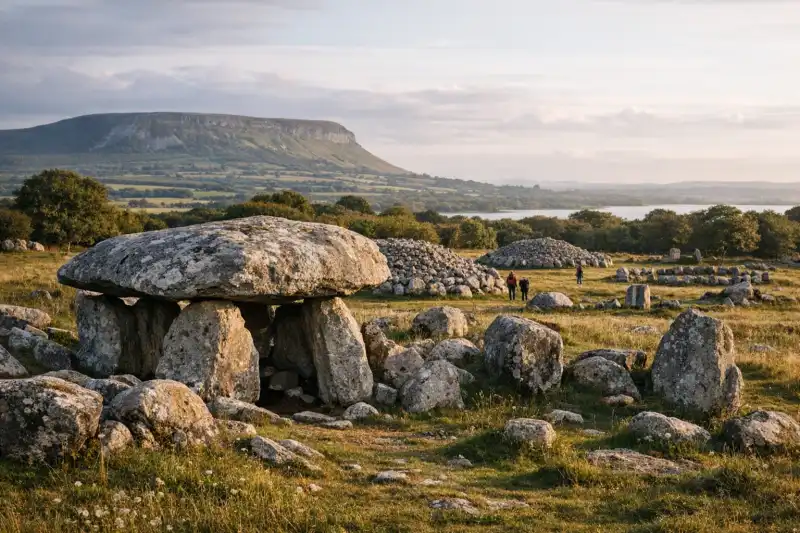
Carrowmore Megalithic Cemetery
Neolithic communities of prehistoric IrelandExplore Carrowmore Megalithic Cemetery, Ireland’s vast Neolithic burial landscape near Sligo, with t...
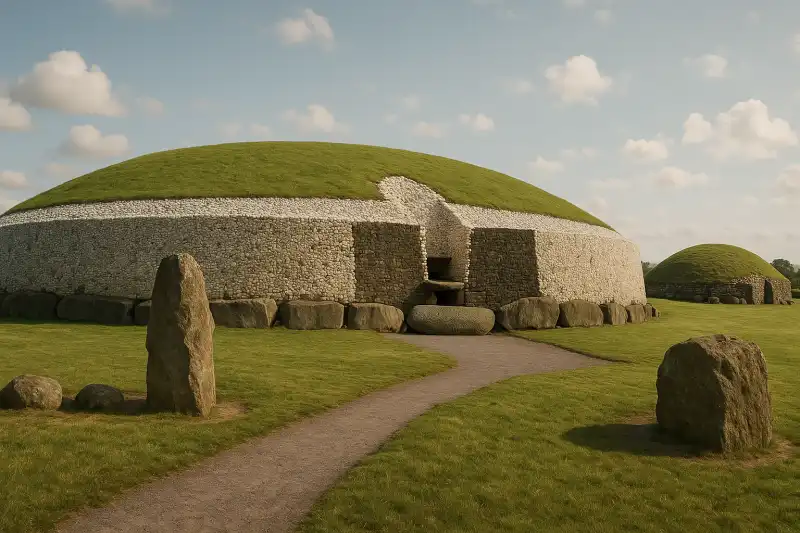
Boyne Valley Passage Tombs Travel Guide 2026: Newgrange, Knowth, and Dowth Visit Strategy
Neolithic IrelandPlan your first Boyne Valley passage tombs visit with practical timing, Brú na Bóinne access flow, a...
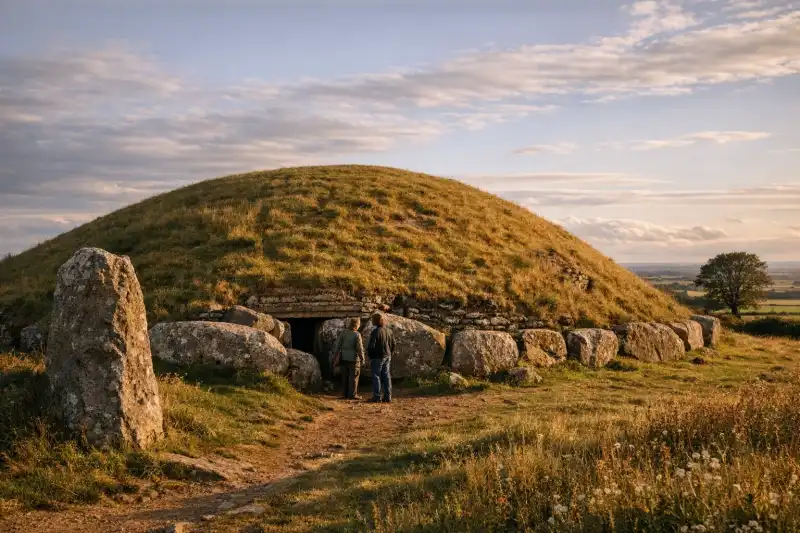
Dowth
Neolithic communities of Brú na BóinneAncient passage tomb in Ireland's Boyne Valley, famed for Neolithic art, winter light, and sweeping ...