Quick Info
At a glance
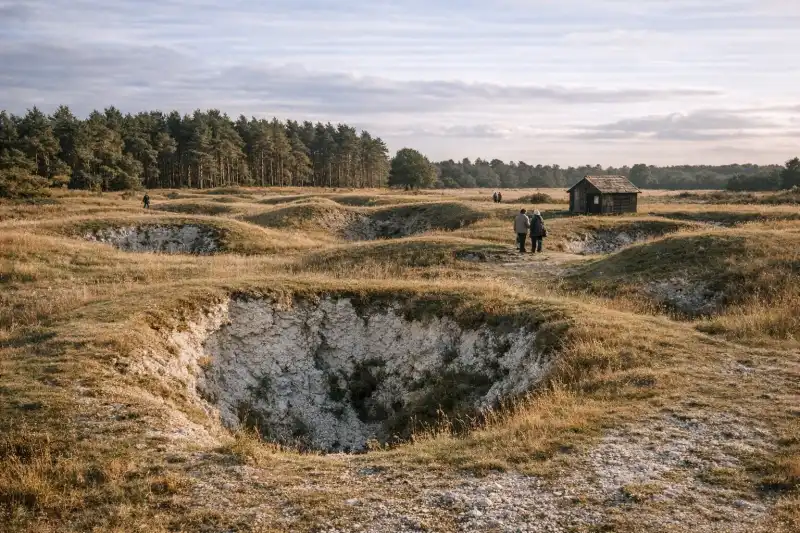
Grime’s Graves in the United Kingdom is one of the strangest and most revealing prehistoric landscapes in Britain: a quiet Norfolk heath pocked with hollows that are actually the collapsed mouths of ancient mines. At first glance, the site can look deceptively simple, a grassy expanse interrupted by shallow craters and low ridges beneath a wide East Anglian sky. But that calm surface conceals a place of extraordinary human effort. Around 5,000 years ago, Neolithic miners dug deep shafts through chalk to reach prized seams of black flint, then followed them underground in narrow galleries lit only by flickering lamps and driven by stone, antler, and human determination.
Today, Grime’s Graves offers something rare among prehistoric sites in Europe: not just standing stones or earthworks to admire from above, but a direct route into the working world of ancient people. The site allows visitors to understand that prehistory was not abstract or mystical alone; it was also practical, skilled, and demanding. Flint from places like this was essential for tools, shaping daily life from farming and craft to hunting and construction. Walking here, you are not simply visiting a monument but entering an industrial landscape from the Neolithic age. The silence of the heath, the depth of the mine shaft, and the evidence of hard labor combine to make Grime’s Graves feel both remote and deeply human.
History
Early Neolithic mining beginnings
The story of Grime’s Graves begins in the Neolithic period, roughly around 3000 BCE, when communities in what is now Norfolk recognized the exceptional quality of the flint buried beneath the chalk. In prehistoric Britain, flint was one of the most important raw materials available. Before metal became widespread, it was used to create axe heads, knives, scrapers, arrowheads, and other sharp-edged implements essential to everyday life.
The flint at Grime’s Graves was especially valued because it came in thick, high-quality seams below the surface. Rather than relying only on loose flint nodules found nearer the ground, miners sank vertical shafts, sometimes more than 10 meters deep, to reach the best material. They then excavated horizontal galleries at the base, following the seam through the chalk. This was highly organized work. It required planning, labor coordination, and detailed knowledge of the underground geology.
Archaeological evidence shows that antler picks, particularly from red deer, were among the main tools used to loosen the chalk. These implements survive in abundance and are among the most evocative finds from the site. The choice of antler was practical: it was tough enough to break chalk but more widely available than any metal tool at the time. The work would have been slow, repetitive, and physically exhausting, yet the scale of the site proves it was carried out over generations.
A vast prehistoric industrial landscape
What makes Grime’s Graves particularly remarkable is its size. The area contains around 400 visible pits, though the original extent of mining may have been even greater. Each depression visible today marks a former shaft or a collapse above one, turning the landscape into a honeycomb of prehistoric extraction. This was not the work of a single family group digging opportunistically. It was a major production center in Neolithic Britain.
The flint mined here did not remain local. Finished and partly worked tools from Grime’s Graves and similar mining centers likely moved through exchange networks that linked distant communities. In this way, the site belonged to a wider world of prehistoric trade and communication. Mining here tied Norfolk into larger patterns of movement and interaction across Britain.
Archaeologists have also found that some shafts appear to have had more than purely economic significance. In one excavated shaft, a carved chalk object known as the “goddess” or “idol” was discovered, suggesting ritual behavior associated with the mine. Animal remains and carefully deposited objects hint that mining may have involved acts of offering or belief as well as production. This blend of utility and ritual is common in prehistoric contexts, where work, environment, and spirituality often overlapped rather than standing apart.
Rediscovery and archaeological investigation
Although the site had long been known locally, its true nature was not always understood. The name “Grime’s Graves” itself is much later than the Neolithic and probably derives from folklore. “Grime” or “Grim” was a name sometimes associated with a supernatural figure, perhaps linked to Woden or the devil in later tradition. As with many mysterious ancient earthworks in Britain, local people created stories to explain hollows and mounds whose real origin had been forgotten.
Serious archaeological study began in the 19th century, when increasing interest in prehistory led scholars to examine the pits more carefully. Excavations in the 1870s demonstrated that the hollows were indeed mine shafts, not burial mounds or defensive works. Later investigations in the 20th century provided more detail about the methods, chronology, and organization of the mining.
These excavations transformed understanding of prehistoric Britain. Grime’s Graves showed clearly that Neolithic communities were capable of large-scale, technically demanding extraction industries. The site helped challenge outdated assumptions that prehistoric societies were simple or unsophisticated.
Preservation and public access
In modern times, Grime’s Graves has been protected as a scheduled ancient monument and is now cared for by English Heritage. Conservation has focused on balancing access with protection. Because the site is both fragile and unusual, visitor management is important: the pits, grassland, and underground features all require careful oversight.
Public interpretation has made the site especially valuable. Rather than remaining an abstract archaeological reserve, Grime’s Graves has become a place where visitors can learn by direct experience. Descending into the accessible shaft gives a powerful sense of scale and labor that no display case alone can match. The preserved landscape, combined with archaeological interpretation, ensures that this prehistoric mine continues to illuminate a distant past in immediate and memorable ways.
Key Features
The defining feature of Grime’s Graves is the surface landscape itself. Seen from ground level, the site appears as a broad field of bowl-shaped depressions, uneven but strangely rhythmic, each one the scar of a shaft sunk into the chalk. Unlike a fortress, temple, or stone circle, this is a monument made by extraction. Its beauty lies not in ornament or architecture but in the visible imprint of effort. The pits create a pattern that is subtle from close up and more dramatic as you move across the site, especially in low light when shadows gather in the hollows. It is one of the clearest examples in Britain of a prehistoric industrial terrain surviving in open countryside.
The most memorable experience for many visitors is the opportunity to descend into the excavated shaft. This is what sets Grime’s Graves apart from almost every other ancient site in the country. Going below the surface changes your understanding instantly. What seems from above like a modest depression becomes the entrance to a vertical drop and a world of confined space, darkness, and raw chalk walls. At the bottom, the side galleries reveal how miners followed the flint seam laterally. These passages are narrow, low, and intimate, emphasizing the skill and courage required to work there with prehistoric tools.
Inside the shaft, visitors can see the contrast between white chalk and dark flint, a visual reminder of exactly what miners were seeking. This direct geological context is one of the site’s great strengths. Rather than imagining where materials came from, you can stand in the extraction zone itself. The underground setting also makes the physical reality of Neolithic labor easier to grasp. Every flake of chalk removed, every antler pick stroke, and every basket of spoil hauled upward represented time and strength.
Another key feature is the evidence of the tools used in mining. Although original artifacts are not all visible in situ, interpretation at the site explains the importance of red deer antler picks and other simple implements. This is crucial to understanding Grime’s Graves. The achievements here were not based on metal technology but on intimate environmental knowledge and persistent manual work. The miners selected the right materials, understood the chalk layers, and organized labor in a way that enabled deep extraction with basic means.
The surrounding heathland also deserves attention. Grime’s Graves sits in the Breckland landscape, an area of sandy soils, open skies, and distinctive ecology. This setting contributes significantly to the atmosphere of the site. There is often a sense of exposure here, with wind moving across the grass and very little to distract from the form of the ancient pits. The relative remoteness helps preserve the feeling of discovery. Unlike urban archaeological sites hemmed in by later development, Grime’s Graves remains legible as a landscape.
Interpretive displays and the small visitor facilities add context without overwhelming the monument. Good interpretation is particularly important here because the site can be visually understated if approached without background knowledge. Once the historical function of the pits is understood, however, every hollow becomes meaningful. Visitors begin to see a network of shafts, spoil heaps, and work zones rather than random undulations in the ground.
Finally, Grime’s Graves has the intangible feature of rarity. Prehistoric flint mines exist elsewhere in Europe, but very few are so accessible or so clearly interpreted for the public. It offers an unusual perspective on prehistory: not ceremonial, not royal, not military, but economic and technical. That makes it indispensable for anyone interested in how ancient people actually lived and worked. The site reveals that prehistoric Britain was not only a land of ritual monuments but also one of specialists, resources, and organized production.
Getting There
Grime’s Graves is located in rural Norfolk, around 8 miles (13 km) northwest of Thetford, so reaching it is easiest by car. From Thetford, the drive usually takes about 20 to 25 minutes via local roads toward the Breckland countryside. If you are coming from Norwich, allow roughly 1 hour 15 minutes by car, while Cambridge is usually around 1 hour 20 minutes depending on traffic. Parking is generally available on site or nearby through the visitor area.
If you are relying on public transport, the nearest major rail stop is Thetford. Direct and connecting trains from London Liverpool Street or Cambridge usually make Thetford the most practical gateway. Off-peak rail fares vary widely, but a one-way ticket from Cambridge can often start around £12 to £20, while journeys from London commonly range from £20 to £45 depending on timing and advance purchase. From Thetford station, a taxi to Grime’s Graves typically costs about £20 to £30 each way, so booking in advance is wise.
Bus options in this part of Norfolk are limited and may not bring you directly to the site, especially on weekends or outside peak seasons. If you want to avoid driving, the best combination is usually train to Thetford plus taxi. Cyclists with confidence on rural roads may also consider riding from Thetford in fair weather, though services are sparse, so bring water and check opening times before setting out. Because the site is in a remote area, planning ahead matters more here than at many better-connected heritage attractions.
When to Visit
The best time to visit Grime’s Graves is generally from late spring to early autumn, when Norfolk’s weather is milder and the open landscape is at its most inviting. From May through September, daylight is long, the grassland is greener, and walking between the pits is more comfortable. Summer offers the easiest conditions for exploring the site and enjoying the broader Breckland scenery, though even then the exposed setting can feel windy. Light layers are useful in every season.
Spring is particularly rewarding if you want a quieter, fresher atmosphere. The heath begins to come alive, temperatures are usually pleasant, and the lower visitor numbers can make the site feel especially contemplative. Autumn can also be excellent, with softer light that brings out the contours of the pits and a calmer mood across the landscape. Photographers often appreciate these shoulder seasons more than high summer.
Winter visits are certainly possible, but conditions can be muddy, cold, and less predictable. Because much of the experience depends on walking outdoors across uneven ground, wet weather can make the site less comfortable. Short daylight hours also reduce flexibility. If underground access is an important part of your visit, always check current opening arrangements in advance, as weather, maintenance, or safety considerations can affect availability.
For the fullest experience, try to visit on a dry day with enough time to explore both above and below ground. Morning or late afternoon light often gives the pits greater definition, helping the surface pattern of the ancient mine stand out more clearly than under a flat midday sky.
| Quick Facts | Details |
|---|---|
| Location | Near Thetford, Norfolk, England |
| Country | United Kingdom |
| Type | Neolithic flint mine |
| Date | c. 3000 BCE |
| Managed by | English Heritage |
| Main highlight | Descent into an excavated prehistoric mine shaft |
| Best base | Thetford |
| Suggested visit length | 1 to 2 hours |
| Best season | Late spring to early autumn |
| Terrain | Open heathland with uneven ground |
Grime’s Graves is one of those places that quietly reshapes your idea of the ancient world. It lacks the immediate grandeur of a stone temple or the iconic profile of a hilltop fort, yet its impact can be deeper because it reveals something fundamental: prehistoric people were not only monument builders but also miners, engineers, and skilled workers. They understood materials, organized labor, and transformed the land in pursuit of a resource that mattered profoundly to their society.
That is why a visit here stays with so many travelers. The landscape asks you to look twice, then rewards your attention with a story of ingenuity hidden beneath the turf. The hollows across the heath are not natural quirks but the remains of a coordinated industry from five millennia ago. Standing on the surface, you feel the scale. Descending below, you feel the human effort. Together, those experiences make Grime’s Graves one of the most distinctive prehistoric sites in the United Kingdom and one of the best places in Europe to understand the working life of the Neolithic world.
Guided tours: worth it?
Most travelers can visit Grime's Graves independently. Compare a tour only if you want a tighter history-focused visit, easier logistics, or a guide who can answer questions on the spot.
Best for
- Short visits where a planned route saves time
When to go self-guided
Go independently if you prefer setting your own pace, reading as you go, and checking official hours or ticket rules directly before you arrive.
What I’d avoid
Skip paid tours that bundle unrelated stops you do not actually want. The best option should either save meaningful planning time or add historical context you would miss on your own.
Norfolk day tours and history experiences
Useful when: you want to compare guided formats before deciding
East Anglia archaeological and heritage tours
Useful when: you want to compare guided formats before deciding
United Kingdom prehistoric sites tours
Useful when: you want to compare guided formats before deciding
Some tour links are affiliate links, which may earn Ancient Travel a small commission at no extra cost to you. I try to surface options that make practical sense for the site—not just anything bookable.
Frequently Asked Questions
What is Grime's Graves?
Grime's Graves is a large Neolithic flint-mining complex in Norfolk, England, made up of hundreds of mining pits dug around 5,000 years ago.
Can you go inside a mine shaft at Grime's Graves?
Yes, when open and conditions allow, visitors can descend into a reconstructed-access prehistoric shaft managed by English Heritage.
How much time do you need to visit Grime's Graves?
Most visitors spend 1 to 2 hours exploring the visitor area, museum displays, paths across the pits, and the accessible shaft.
Is Grime's Graves suitable for children?
Yes, older children often enjoy the unusual landscape and underground experience, though supervision is essential and some areas are uneven.
When is the best time to visit Grime's Graves?
Late spring through early autumn usually offers the best weather, clearer walking conditions, and the most comfortable time to explore the open heathland.
Do you need a car to reach Grime's Graves?
A car is the easiest option because the site is in a rural part of Norfolk, though it can also be reached by combining rail, taxi, and local road travel.
Nearby Ancient Sites
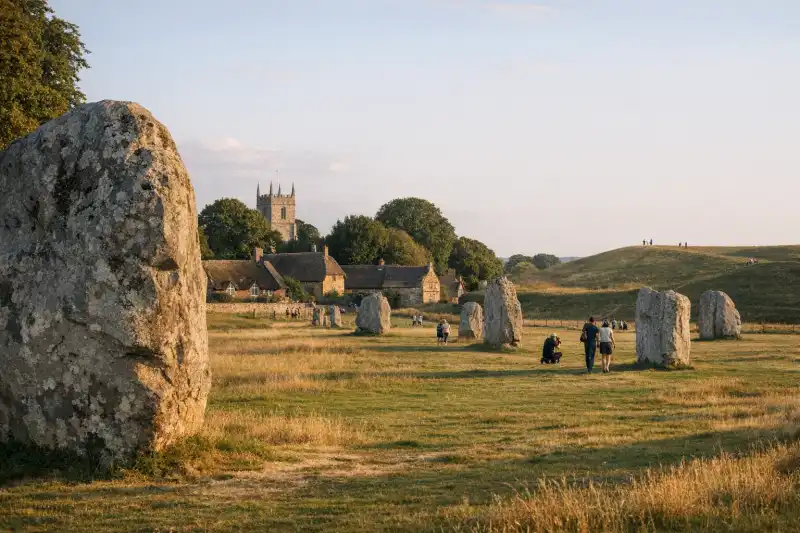
Avebury
Neolithic BritainExplore Avebury in the United Kingdom, a vast prehistoric stone circle and ritual landscape in the h...
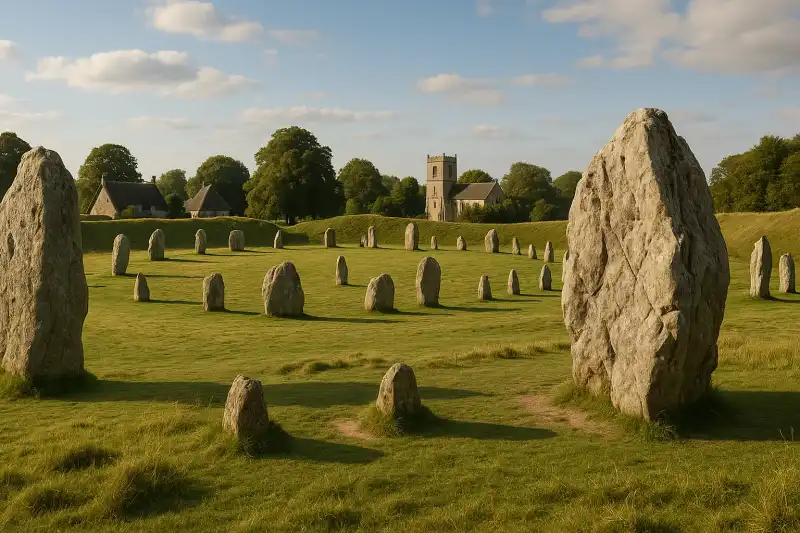
Avebury Stone Circle Travel Guide 2026: Best Walk Routes, History, and Visit Planning
Neolithic BritainPlan a stronger visit to Avebury Stone Circle with practical walking routes, landscape context, and ...
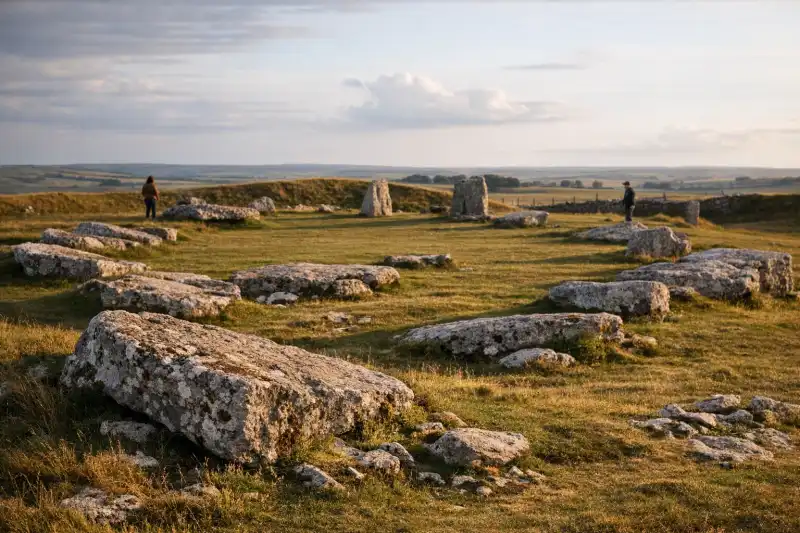
Arbor Low Stone Circle
Neolithic BritainExplore Arbor Low Stone Circle, a dramatic Neolithic henge and stone circle in the United Kingdom’s ...