Quick Info
At a glance
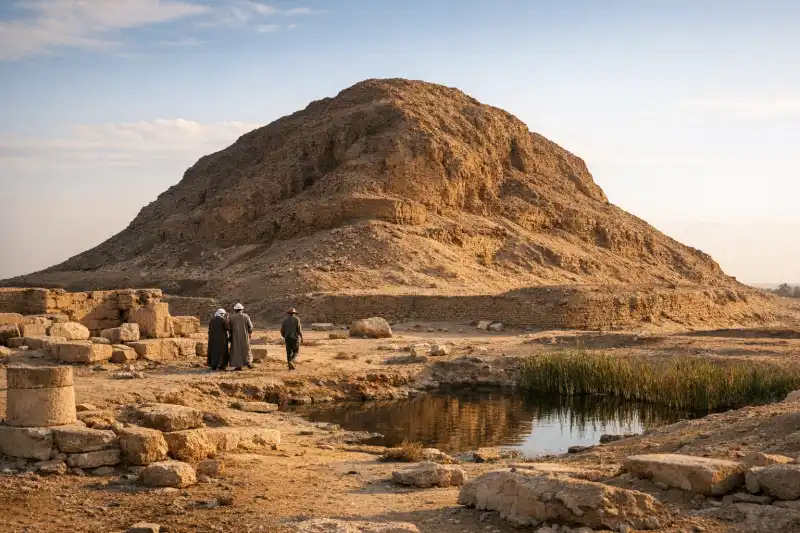
Hawara Pyramid in Egypt stands on the desert fringe near the Faiyum oasis, where cultivation gives way to sand and broken stone. At first glance it can seem less dramatic than the sharper, more intact pyramids farther north, yet this quiet, weathered monument rewards visitors with something different: a sense of archaeological depth, royal ambition, and the ghostly memory of one of the ancient world’s most celebrated lost structures. Built for Pharaoh Amenemhat III, the pyramid belongs to the Middle Kingdom, a period that combined technical experimentation with strong central rule and renewed royal confidence.
The site is evocative precisely because it feels incomplete. Time, stone robbing, erosion, and centuries of neglect have left Hawara as a low mass rather than a soaring geometric landmark. But its importance is far greater than its present silhouette suggests. Classical authors wrote with wonder about the enormous “Labyrinth” that once stood beside it, a mortuary complex so impressive that some ancient observers ranked it above even the pyramids in marvel. Today, visitors encounter a place that asks for imagination. The desert wind, the low ruins, and the broad Faiyum horizon invite you to picture a once-active royal landscape of priests, processions, tomb builders, and travelers. Hawara is not simply a ruin to photograph; it is a site that reveals how ancient Egypt evolved after the Old Kingdom’s pyramid age into something more experimental, more regionally connected, and in many ways more mysterious.
History
Amenemhat III and the Middle Kingdom
Hawara Pyramid was constructed for Amenemhat III, one of the most powerful rulers of Egypt’s 12th Dynasty. His reign, generally placed in the 19th century BCE, came during the Middle Kingdom, a period often described as a classical age of Egyptian statecraft, literature, and monumental building. By Amenemhat III’s time, Egypt had regained strength after earlier instability and had developed sophisticated systems of administration, agriculture, and royal patronage. The Faiyum region, in particular, became closely associated with his rule because of major land and water management projects that expanded agricultural productivity.
The decision to build at Hawara reflected both royal ideology and regional strategy. Earlier pharaohs had concentrated pyramid building in areas such as Saqqara, Dahshur, and Giza. Amenemhat III already had a pyramid at Dahshur, sometimes called the Black Pyramid, but structural problems there appear to have led to the creation of a second major funerary monument at Hawara. This shift was not random. The Faiyum oasis zone had growing economic and symbolic significance, and Hawara’s placement near its gateway connected kingship to fertile reclaimed lands and state-managed prosperity.
Construction and design
The Hawara Pyramid was built primarily of mudbrick, with a limestone casing that has long since been stripped away. This was not unusual for Middle Kingdom pyramids, many of which relied on mudbrick cores rather than the massive stone-block construction of earlier Old Kingdom monuments. The pyramid originally rose to a considerable height and would have had a smooth, bright exterior when finished. Beneath it, engineers created a complicated internal arrangement intended to secure the king’s burial and protect the funerary equipment.
One of the most remarkable surviving details associated with Hawara is the quartzite burial chamber, a huge monolithic construction set within the pyramid. Ancient builders lowered this enormous stone chamber into place with extraordinary technical skill. Even in ruin, the monument points to a period of experimentation in pyramid engineering. Middle Kingdom architects did not simply imitate earlier traditions; they adapted them, trying new structural and symbolic approaches while retaining the powerful royal language of the pyramid form.
The Labyrinth of Hawara
Hawara’s fame in antiquity came not only from the pyramid itself but from the vast mortuary temple complex attached to it, later known to Greek and Roman writers as the Labyrinth. Herodotus and Strabo described an immense structure of courts, halls, and chambers that inspired awe through both scale and complexity. While their accounts contain exaggeration and interpretation filtered through foreign eyes, archaeology confirms that the temple at Hawara was exceptionally large and elaborate.
The Labyrinth may have served multiple functions, combining mortuary ritual, royal cult practice, administration, and symbolic architecture. Some scholars have suggested that its many chambers reflected the nomes, or administrative districts, of Egypt, giving the building a unifying political message. Whether or not every classical description can be taken literally, the prestige of the complex was real. It entered Mediterranean imagination as a place of order, mystery, and monumental intricacy. Much of it has since disappeared, quarried for building stone over many centuries, but its ancient reputation continues to define Hawara.
Excavation and modern understanding
European archaeological attention intensified in the 19th century, particularly through the work of Flinders Petrie, whose excavations at Hawara and nearby areas advanced the scientific study of Egyptian sites. Petrie investigated the pyramid, the mortuary complex, and the broader necropolis. Hawara also became known for remarkable mummy portraits from the Roman period cemetery in the area, though these belong to a much later chapter in the site’s history and show how the region remained important long after the age of pyramid building.
Modern scholarship sees Hawara as a key site for understanding the later development of pyramid construction, the political geography of the Faiyum, and the long afterlife of sacred landscapes in Egypt. Though the monument is badly ruined, it remains central to discussions of Middle Kingdom kingship and funerary architecture. In many ways, Hawara tells two stories at once: the story of a king who sought permanence through monumental building, and the story of how monuments change, erode, and are rediscovered across nearly four millennia.
Key Features
What strikes many visitors first is the pyramid’s altered form. Unlike the sharply defined silhouettes of Egypt’s better-preserved pyramids, Hawara appears as a worn, massive earthen rise, its geometry softened by collapse and time. This weathered profile is not a sign of insignificance but of the building materials and long history of decay. The mudbrick core, once protected by limestone casing, has suffered heavily since the casing blocks were removed. Looking closely, you can sense the different life of a Middle Kingdom pyramid: less eternal in material than the great stone pyramids of the Old Kingdom, yet no less ambitious in royal intent.
The pyramid’s most important hidden feature is its burial system, especially the immense quartzite chamber associated with Amenemhat III’s interment. Though ordinary visitors may not always have access to interior spaces, awareness of this chamber adds depth to the site experience. It represents a high level of engineering sophistication and an obsession with securing the royal body and burial goods. In Hawara, the drama is often subterranean and conceptual rather than immediately visible. This is a place where archaeology helps the imagination reconstruct what the surface no longer shows.
The broader archaeological setting is equally important. Hawara is not just a single monument standing in isolation; it was the center of a funerary landscape. Nearby were cemeteries, subsidiary structures, and above all the huge mortuary temple that classical writers transformed into legend as the Labyrinth. Today, only traces survive, and much of the visitor’s experience depends on understanding that absence. Standing on the site, you are effectively on top of one of antiquity’s great vanished architectural ensembles. That sense of loss can be surprisingly powerful. Hawara teaches visitors to value foundations, outlines, and archaeological memory as much as standing walls.
The relationship between the site and the Faiyum is another defining feature. Unlike the stark desert settings of some pyramid fields, Hawara belongs to a threshold landscape. It marks a transition between cultivable land and desert edge, between hydraulic wealth and royal mortuary symbolism. Amenemhat III’s reign was deeply associated with the management and development of the Faiyum basin, so the pyramid’s location carries political meaning. It linked kingship with abundance, order, and the harnessing of nature for the state. For travelers interested in ancient environmental history, this context makes Hawara especially compelling.
A further point of interest is the site’s long chronological life. The area around Hawara remained active in later periods, including the Greco-Roman era, when burials produced the celebrated Fayum mummy portraits now displayed in museums around the world. Although these later remains are not the pyramid itself, they show how sacred and funerary landscapes in Egypt were repeatedly reused. Hawara therefore offers visitors a layered site rather than a single-period snapshot. The Middle Kingdom monument, classical memory of the Labyrinth, and Roman-era burials all overlap in one place.
Finally, Hawara’s atmosphere is one of quiet contemplation. It lacks the crowds and polished visitor infrastructure of Egypt’s most famous pyramid zones. For some travelers, that is exactly the appeal. The site invites slower looking and historical reflection. You are not only seeing what survives but confronting what has vanished: casing stones, temple walls, decorated chambers, ritual movement, and royal cult. Hawara’s key feature, in a sense, is its ability to turn fragment and ruin into a meaningful encounter with the scale of ancient Egyptian ambition.
Getting There
Hawara Pyramid is usually visited from Cairo or from the city of Faiyum. From Cairo, the most practical option is a private car, taxi, or arranged day tour. The drive generally takes around 2 to 3 hours depending on departure point and traffic. A private car for the day from Cairo to Faiyum region sites often costs roughly 2,500 to 4,500 EGP, while a guided private tour including transport can range from about $60 to $150 per person depending on inclusions, vehicle quality, and whether other stops are added.
Public transport is possible but less straightforward. Shared minibuses and buses run between Cairo and Faiyum, often departing from major transport hubs. A one-way fare is commonly in the range of 40 to 100 EGP. From Faiyum city, you would then need a local taxi or hired driver to reach Hawara itself, which may cost another 150 to 400 EGP depending on waiting time and negotiation. This route is more budget-friendly, but it requires flexibility and some comfort with local transport logistics.
If you are already in Faiyum, hiring a taxi for a half-day circuit that includes Hawara and nearby archaeological points can be efficient. Self-driving is also an option for experienced travelers comfortable with Egyptian road conditions. Because signage and on-site services may be limited, many visitors find it easier to arrange a driver who knows the area. Carry water, sun protection, and cash, as amenities at the site can be minimal.
When to Visit
The best time to visit Hawara Pyramid is between October and April, when temperatures are milder and exploring exposed desert sites is much more comfortable. In these cooler months, daytime conditions are usually pleasant enough for unhurried walking, photography, and spending time trying to interpret the site’s subtle remains. Winter light can also be excellent for appreciating the tones of the desert and nearby cultivated land.
From May through September, the region can become extremely hot, especially around midday. Summer visits are still possible, but they require planning. If you travel in hotter months, aim to arrive early in the morning, bring plenty of water, wear a hat, and avoid the strongest sun in the early afternoon. Hawara has little shade, and because much of the experience is outdoors and exposed, heat can quickly limit how long you want to stay.
Spring can occasionally bring dusty or windy conditions, particularly during khamsin weather, when visibility may drop and the air can feel harsh. Autumn is often a good balance, with warm days but generally more manageable temperatures than summer. Weekdays tend to feel quieter than weekends or Egyptian public holidays, though Hawara is rarely crowded compared with major sites around Cairo.
If you want to combine Hawara with a broader Faiyum itinerary, consider the season carefully. Cooler months make it easier to add other desert, oasis, or archaeological stops without fatigue. Early morning or late afternoon is especially atmospheric, when the low sun gives the mound of the pyramid more definition and the edge-of-oasis setting becomes most photogenic.
| Quick Facts | Details |
|---|---|
| Location | Hawara, Faiyum Governorate, Egypt |
| Ancient Builder | Amenemhat III |
| Dynasty | 12th Dynasty |
| Period | Middle Kingdom |
| Date | c. 19th century BCE |
| Type | Royal pyramid and mortuary complex |
| Famous For | The pyramid of Amenemhat III and the lost Labyrinth of Hawara |
| Main Material | Mudbrick core with lost limestone casing |
| Nearest City | Faiyum |
| Best Visit Season | October to April |
Hawara Pyramid may not be Egypt’s most visually intact royal monument, but it is one of the country’s most intellectually rewarding. It captures a moment when pyramid building was still alive yet changing, when royal architecture became tied to the opportunities of the Faiyum, and when a funerary complex could be so vast that ancient visitors compared it to a wonder of the world. For travelers willing to look beyond preservation and scale alone, Hawara offers something rarer than spectacle: a direct encounter with the complexity of historical survival. Here, broken form and lost architecture do not diminish the past. They make it more intriguing.
Guided tours: worth it?
Most travelers can visit Hawara Pyramid independently. Compare a tour only if you want a tighter history-focused visit, easier logistics, or a guide who can answer questions on the spot.
Best for
- Short visits where a planned route saves time
When to go self-guided
Go independently if you prefer setting your own pace, reading as you go, and checking official hours or ticket rules directly before you arrive.
What I’d avoid
Skip paid tours that bundle unrelated stops you do not actually want. The best option should either save meaningful planning time or add historical context you would miss on your own.
Cairo to Faiyum day tours
Useful when: you want to compare guided formats before deciding
Egypt pyramids and Faiyum private tour
Useful when: you want flexible timing or a private guide
Cairo archaeological tours to Hawara and Faiyum
Useful when: you want to compare guided formats before deciding
Some tour links are affiliate links, which may earn Ancient Travel a small commission at no extra cost to you. I try to surface options that make practical sense for the site—not just anything bookable.
Frequently Asked Questions
Where is Hawara Pyramid located?
Hawara Pyramid stands in Egypt's Faiyum Governorate, near the entrance to the Faiyum oasis southwest of Cairo and close to the village of Hawara.
Who built the Hawara Pyramid?
The pyramid was built for Pharaoh Amenemhat III of Egypt's 12th Dynasty during the Middle Kingdom, in the 19th century BCE.
Why is Hawara Pyramid famous?
It is best known as the burial monument of Amenemhat III and for its association with the legendary Labyrinth of Hawara, a vast mortuary complex admired by classical writers.
Can visitors go inside the Hawara Pyramid?
Interior access is usually limited or closed for safety and conservation reasons, so most visits focus on the exterior mound and the surrounding archaeological area.
How do you visit Hawara Pyramid from Cairo?
Most travelers visit by private car or guided day trip from Cairo to Faiyum, a journey that generally takes around 2 to 3 hours depending on traffic and route.
What should I combine with a visit to Hawara?
Hawara is often combined with other Faiyum sights such as Lahun, Meidum, Wadi El Rayan, or the oasis landscapes if you are planning a full day in the region.
Nearby Ancient Sites
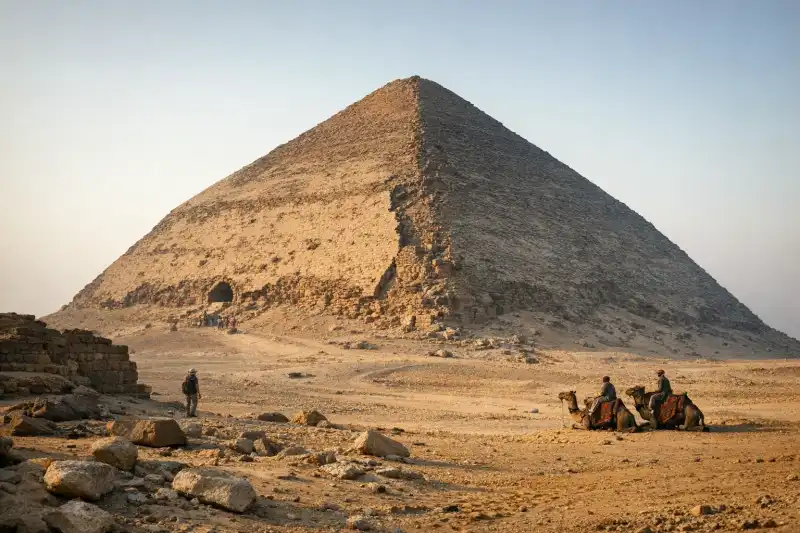
Bent Pyramid
Ancient EgyptianThe Bent Pyramid in Egypt is a rare Old Kingdom monument where a dramatic change in angle reveals th...
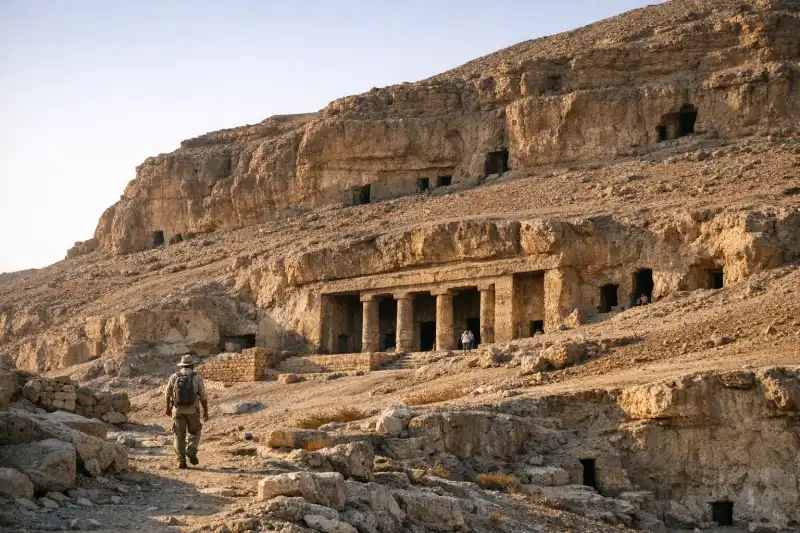
Beni Hassan Tombs
Ancient EgyptianRock-cut Middle Kingdom tombs in Egypt famed for vivid wall paintings, provincial elite burials, and...
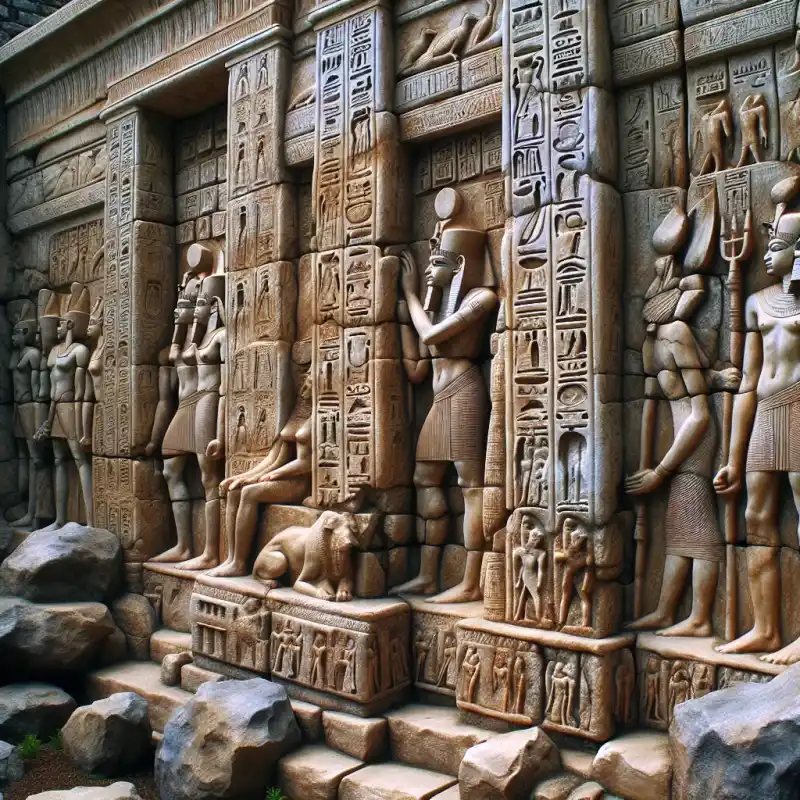
Abydos Temple Egypt Guide 2026: Temple of Seti I & King List
New Kingdom-PtolemaicAbydos Temple near Luxor: magnificent Temple of Seti I with war reliefs, ancient king list, and vibr...