Quick Info
Curated Experiences
Heraklion Archaeological Museum and Knossos Guided Tour
You walk into a room of painted plaster fragments, reassembled with painstaking care, and a civilization that left no readable history books suddenly has a face. A young man leaps over the back of a charging bull, his body arched in mid-flight. Women in tiered skirts process through a garden. Dolphins chase each other across an azure sea. These are the frescoes of Minoan Crete — pulled from the walls of Knossos, Agia Triada, and other palace sites — and seeing the originals in the Heraklion Archaeological Museum is a fundamentally different experience from seeing photographs in a textbook. The colors are vivid. The movement is immediate. The culture they represent feels startlingly alive.
The Heraklion Archaeological Museum holds the most comprehensive collection of Minoan artifacts anywhere in the world. It is not simply the best Minoan museum; it is the only one where the full arc of this civilization — from its origins around 3000 BCE through its mysterious collapse a millennium and a half later — can be traced in continuous material evidence. Everything that was stripped from Crete’s major excavation sites over a century of archaeology has been gathered here: frescoes, ritual objects, gold jewelry, ceramic vessels, stone tools, sealstones, and the undeciphered Phaistos Disc.
Without this museum, Knossos is a maze of reconstructed walls and guesswork. With it, the palace ruins click into focus as the physical evidence of a sophisticated, seafaring society that shaped the ancient Mediterranean. If you are visiting Crete and have any interest in antiquity, this museum is not optional. It is the key that makes the rest of the island’s archaeological landscape legible.
Historical Context
Minoan civilization emerged on Crete around 3000 BCE and developed, over the following millennium, into the first advanced civilization in Europe. The Minoans built elaborate palace complexes — Knossos, Phaistos, Malia, Zakros — that served simultaneously as administrative, religious, and economic centers. These were not palaces in the medieval European sense of royal residences; they were complex institutions that organized agriculture, craft production, trade, and religious life for large surrounding populations.
The Minoans developed two writing systems: Linear A, which remains undeciphered, and Linear B, which was adapted from Linear A by Mycenaean Greeks and has been partially decoded. They controlled extensive maritime trade networks that connected Crete to Egypt, the Levant, and the Cycladic islands, and they produced art of extraordinary refinement — sophisticated fresco painting, intricately carved sealstones, gold jewelry of remarkable delicacy, and ceramic vessels that remain among the finest objects produced in the ancient Mediterranean.
At their peak, around 1700 to 1450 BCE, the Minoans were the dominant cultural force in the Aegean. The palaces reached their greatest extent and elaboration, trade networks expanded, and Minoan artistic influence spread across the eastern Mediterranean.
The civilization’s decline and eventual collapse remain subjects of active scholarly debate. A catastrophic volcanic eruption on the island of Thera (modern Santorini) around 1628 BCE likely caused massive disruption through tsunamis, ashfall, and climate effects. Whether this event was the primary cause of decline or merely one factor among several — including Mycenaean Greek invasion, internal political fragmentation, and environmental degradation — continues to generate competing theories. What is clear is that by around 1400 BCE, Mycenaean Greeks had taken control of Knossos, and Minoan culture as a distinct entity was gradually absorbed into the broader Greek world.
The museum itself has its own significant history. The current building dates to 1937, designed by architect Patroklos Karantinos in a modernist style to house the growing collection from Crete’s excavations. A major renovation completed in 2014 reorganized the galleries chronologically, dramatically improved lighting and display, and brought the interpretive materials up to modern standards. The renovated museum is a genuine pleasure to visit — well-labeled in Greek and English, logically arranged, and designed to build understanding progressively.
The collection draws from excavations across the island, but the Knossos material dominates. Arthur Evans’ excavations at Knossos, beginning in 1900, produced the most spectacular finds, and the museum’s relationship to Knossos is essentially symbiotic: each site makes the other comprehensible.
What to See
The Bull-Leaping Fresco and Palace Frescoes (Galleries VII-VIII)
The restored frescoes from Knossos and other palace sites are the museum’s emotional and artistic centerpiece. The Bull-Leaping Fresco — depicting a figure somersaulting over the back of a charging bull while two other figures flank the animal — is the single most iconic image of Minoan civilization. The scene almost certainly depicts a real ritual practice, though whether it was athletic competition, religious ceremony, or both remains debated. The fresco’s vitality is remarkable: the bull charges forward with muscular energy, the leaper is frozen in mid-arc, and the composition conveys movement with a dynamism that Greek art would not match for another thousand years.
Surrounding galleries display the Prince of the Lilies relief, the Ladies in Blue fresco, the Saffron Gatherer, and the dolphin fresco from the Queen’s Megaron at Knossos. The Ladies in Blue — three women in elaborate dress with carefully styled hair — offers one of the most direct glimpses of Minoan court life, their posture suggesting a ceremonial or social occasion of some formality.
Together, these works create a portrait of a society that valued grace, nature, and ritual — and that invested enormous artistic skill in depicting all three. Give these galleries at least thirty minutes. Gallery fatigue is real in a museum this rich; front-loading the frescoes ensures you see them with fresh eyes.
Practical tip: the fresco galleries are the museum’s most crowded rooms. Arriving at opening (8 a.m. in summer) gives you fifteen to twenty minutes of relative quiet before the first tour groups arrive.
The Snake Goddess Figurines (Gallery IV)
These small faience (glazed ceramic) sculptures from the temple repositories at Knossos are among the most reproduced images of the ancient world. The larger figure, roughly 34 centimeters tall, holds a snake in each raised hand and wears a tiered skirt with a fitted bodice that leaves the breasts exposed. Her posture is commanding, her expression serene. Whether she represents a goddess, a priestess, or a votary performing a ritual remains unclear.
What the figurines demonstrate beyond debate is the prominent role that women played in Minoan ceremonial life. Across Minoan art, women appear more frequently and more centrally in religious contexts than men — a pattern that distinguishes Minoan culture sharply from the patriarchal societies that succeeded it in the Greek world.
Seeing the originals is genuinely different from seeing photographs. The figurines are smaller than most people expect, and their craftsmanship — the delicate modeling of the snakes, the fine detail of the clothing, the confident glaze work — is more impressive at actual scale than any reproduction conveys.
Practical tip: the figurines are displayed in a case that can draw a crowd. If the room is busy, circle back later in your visit when groups have moved on.
The Phaistos Disc (Gallery III)
The Phaistos Disc is one of archaeology’s most famous unsolved puzzles: a fired clay disc, roughly 16 centimeters in diameter, covered on both sides with 241 stamped symbols arranged in a spiral pattern. Discovered at the palace of Phaistos in 1908, the disc has resisted decipherment despite thousands of scholarly attempts over more than a century.
The symbols were made with individual stamps — an early form of movable type that predates Gutenberg by roughly three millennia — which implies standardized production. But no other example of this script has ever been found. Theories about the disc’s language and meaning range from ritual hymn to astronomical calendar to administrative inventory. Some scholars have questioned its authenticity, though the majority of the field accepts it as genuine.
The disc occupies a modest display case, and its power is largely conceptual. This is a message from a literate society that we cannot read — a reminder that the ancient world still holds secrets that resist modern analysis.
Practical tip: read the interpretive panel carefully. The disc’s significance lies in its context as much as its content, and the museum’s explanation is clear and well-written.
The Agia Triada Sarcophagus (Gallery XIV)
This painted limestone sarcophagus, discovered at a Late Minoan villa site near Phaistos, is the single most detailed surviving depiction of Minoan funerary ritual. Both long sides and both short ends are covered in painted scenes showing processions, animal sacrifice, libation offerings, and what appears to be a figure of the deceased receiving gifts at a shrine.
The colors — blue, red, yellow, white on a cream ground — are remarkably well preserved. The narrative detail is dense: priests pour libations between double axes (a central Minoan religious symbol), a bull lies trussed on a sacrificial table, musicians accompany the procession. Scholars have spent decades debating individual figures and gestures.
What makes the sarcophagus exceptional is its specificity. Where most Minoan art depicts general scenes — nature, ritual, athletics — this piece tells a particular story: someone important died, and this is what was done for them. It is the closest thing in Minoan archaeology to a written historical narrative, and it deserves careful attention.
Practical tip: the sarcophagus is in one of the upper galleries. Many visitors run out of energy before reaching it. Budget your time to ensure you do not miss this piece — it is one of the museum’s most important objects.
Jewelry, Sealstones, and Goldwork (Gallery VI)
These galleries are easy to rush past, which would be a mistake. The Minoan goldsmiths achieved a level of miniature craftsmanship that rivals anything produced in the ancient Mediterranean. The gold bee pendant from Malia — two bees facing each other around a honeycomb, with granulated detail so fine it is barely visible to the naked eye — is a masterpiece of ancient metalwork that still astonishes professional jewelers.
The sealstones, tiny carved gems used as personal seals and amulets, depict scenes of hunting, ritual, and daily life with an intricacy that demands slow looking. Some are so small they benefit from the magnifying glasses provided in the display cases. The material range — agate, carnelian, jasper, rock crystal — shows the Minoans’ command of hard-stone carving techniques.
Gold rings with engraved bezels offer another window into elite Minoan life: ritual scenes, religious processions, and depictions of nature compressed into tiny circular compositions of surprising clarity.
Practical tip: these galleries reward patience. Slow down, use the magnifying aids, and give yourself at least fifteen to twenty minutes among the goldwork and sealstones.
Minoan Daily Life Galleries (Galleries IX-XIII)
The upper-floor galleries shift from elite art to the material evidence of everyday Minoan life: cooking pots, agricultural tools, storage vessels, weapons, and religious objects from peak sanctuaries and cave shrines. The enormous pithoi — storage jars some taller than a person, used for olive oil, wine, and grain — demonstrate the agricultural productivity that underpinned palace economies.
The peak sanctuary figurines — small clay figures with raised arms, wide eyes, and stylized bodies — are particularly evocative. These objects, found at mountaintop shrines across Crete, suggest a popular religious practice that extended far beyond the palace elites. The figurines are humble in material and execution, but they represent the faith of ordinary Minoans in a way that palace frescoes do not.
Tools, weapons, and household objects round out the picture: bronze double axes (both functional tools and religious symbols), stone vases, loom weights that attest to textile production, and medical instruments that suggest a level of practical knowledge.
Practical tip: if time is limited, walk through these galleries at a faster pace but do not skip them entirely. The pithoi and peak sanctuary figurines are worth a few minutes each.
Timing and Seasons
The museum is in central Heraklion, indoors and air-conditioned, so weather is less of a factor than at outdoor sites. That said, timing matters significantly for crowd management.
The best months for overall Crete travel are April, May, September, and October, when temperatures are comfortable (65-80°F / 18-27°C) and tourist numbers are moderate. The museum is pleasant in any of these months, and the reduced crowds make it easier to linger in the popular galleries.
In summer (June through August), the museum’s air conditioning is a welcome relief from Heraklion’s heat (85-95°F / 29-35°C), but crowds are at their peak. Cruise ship arrivals in Heraklion harbor generate surges of visitors, particularly between 10 a.m. and 2 p.m. The single best strategy is to arrive right at the 8 a.m. opening. By 10 a.m., the fresco galleries can feel congested, and the Snake Goddess case draws a persistent knot of visitors.
Late afternoon (after 4 p.m.) is the second-best window. Tour groups have typically departed by then, and you can move through the galleries at your own pace.
Winter (November through March) offers quiet galleries and reduced admission prices. Heraklion’s winter temperatures (50-60°F / 10-16°C) are mild, and the museum is an ideal activity for the occasional rainy day that Crete’s winter produces.
If pairing the museum with Knossos on the same day — and you should — the recommended order is museum first, Knossos second. The frescoes and artifacts provide the visual context that transforms Knossos from an abstract ruin into a comprehensible place.
Tickets, Logistics, and Getting There
Admission to the Heraklion Archaeological Museum is approximately 12 euros ($13 USD) in the summer season (April through October). Winter admission (November through March) is typically reduced to 6 euros ($7 USD). A combined ticket covering the museum and Knossos is available for approximately 20 euros ($22 USD) and represents good value if visiting both on the same day, which is the recommended approach. EU students under 25 and children under 18 enter free with valid ID.
The museum is open daily. Summer hours are 8 a.m. to 8 p.m. (Monday from 10 a.m. or noon — check the current schedule, as Monday hours vary). Winter hours are typically 9 a.m. to 4 p.m. Timed-entry tickets can be purchased online through the Greek Culture Ministry website during peak season, and booking online is recommended in July and August to avoid the ticket-office queue.
The museum is centrally located on Xanthoudidou Street, a short walk from Heraklion’s Venetian harbor, the city’s main plateia (Eleftherias Square), and most central hotels. It is easily accessible on foot from any part of central Heraklion — no taxi or bus needed.
If arriving by cruise ship, the harbor is less than a ten-minute walk away. For Knossos, local buses (number 2) depart from the bus stop near the harbor every twenty minutes and reach the site in about twenty minutes. A taxi from the museum to Knossos costs approximately 10-15 euros each way.
Heraklion is served by Nikos Kazantzakis International Airport, with direct flights from Athens (45 minutes) and seasonal connections from across Europe. Ferries from Piraeus (Athens) reach Heraklion in roughly 8 hours on the overnight service, arriving in the morning — a practical and inexpensive option that frees up a full day for the museum and Knossos upon arrival.
Practical Tips
- Budget at least two hours for the museum, ideally closer to three. The collection is dense and gallery fatigue is real. Take breaks in the museum’s courtyard or cafe between floors.
- Photography is generally allowed without flash. Check current signage at the entrance, as policies can change for traveling exhibitions.
- The museum shop stocks good reproductions, scholarly publications, and Minoan-themed gifts. The guidebook published by the museum itself is well-illustrated and useful for reference during and after your visit.
- Bring a light layer in summer — the air conditioning can feel chilly after outdoor heat, especially if you arrive sweaty from walking.
- Guided tours in English are available and significantly deepen the experience. The museum’s layout is logical, but the connections between objects and their original archaeological contexts benefit from expert interpretation. Budget an additional 20-30 euros for a licensed guide.
- Lockers are available for bags. Large backpacks may need to be stored before entry.
- The museum cafe on the ground floor serves coffee and light food and is a good place to decompress between the museum and your next destination. The surrounding streets also have numerous cafes and restaurants.
- Families with children should note that the frescoes and bull-leaping scenes tend to engage younger visitors more than the pottery and sealstone galleries. Focus energy on the visual highlights if attention spans are limited.
Suggested Itinerary
Arrive at 8 a.m. (summer) or 9 a.m. (winter). Begin on the ground floor with Gallery III (Phaistos Disc and early Minoan material) to set the chronological context — fifteen minutes here establishes the timeline. Move to Gallery IV for the Snake Goddess figurines (ten minutes). Proceed to Gallery VI for the gold jewelry, bee pendant, and sealstones — slow down here and use the magnifying aids (twenty minutes).
Continue to Galleries VII-VIII for the frescoes. Plan thirty minutes here, and do not rush. The Bull-Leaping Fresco, Prince of the Lilies, and Ladies in Blue are the highlights, but the smaller fragments reward attention too.
Move through the remaining ground-floor galleries at your own pace (twenty minutes). Ascend to the upper floor for the daily life galleries (IX-XIII) and the Agia Triada Sarcophagus in Gallery XIV. Allow at least fifteen minutes for the sarcophagus. Total museum time: 2 to 3 hours.
Exit and walk to the bus stop for the number 2 bus to Knossos (five-minute walk from the museum). Arrive at Knossos by late morning and spend 1.5 to 2 hours at the site, using the morning’s museum context to decode the reconstructed ruins. Return to Heraklion by early afternoon for lunch near the Venetian harbor.
For travelers with two days in Heraklion, split the museum and Knossos across separate mornings for a more relaxed and deeper experience.
Nearby Sites
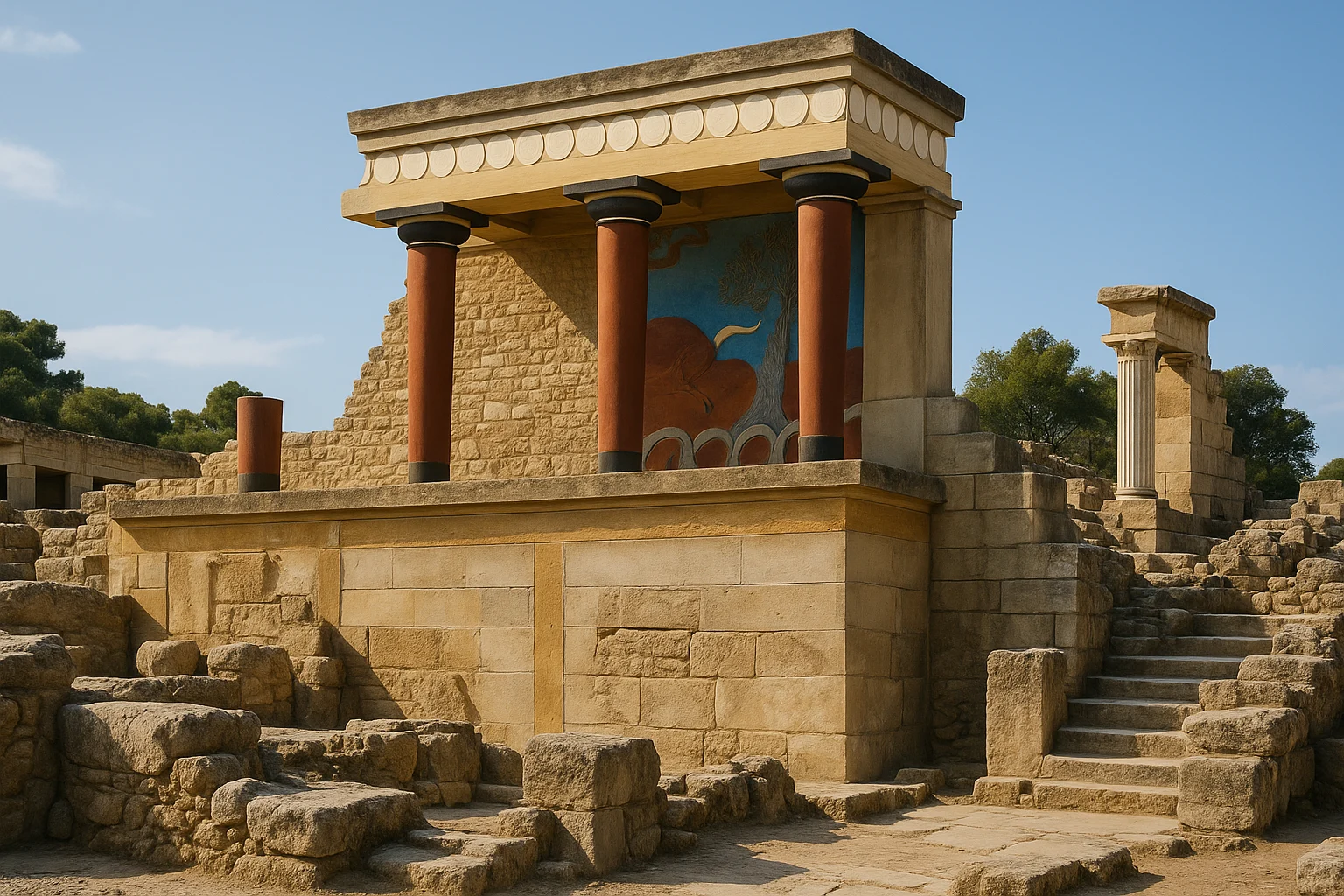
Knossos is the museum’s essential partner site, located 5 kilometers south of Heraklion. The palace complex is the largest and most elaborately reconstructed Minoan site on Crete, and virtually every major artifact in the museum was found there. Arthur Evans’ controversial concrete reconstructions — which remain divisive among archaeologists — give Knossos a visual specificity that other Minoan sites lack. Plan to visit both in the same day, with the museum first. Local buses run every twenty minutes and the ride takes twenty minutes.
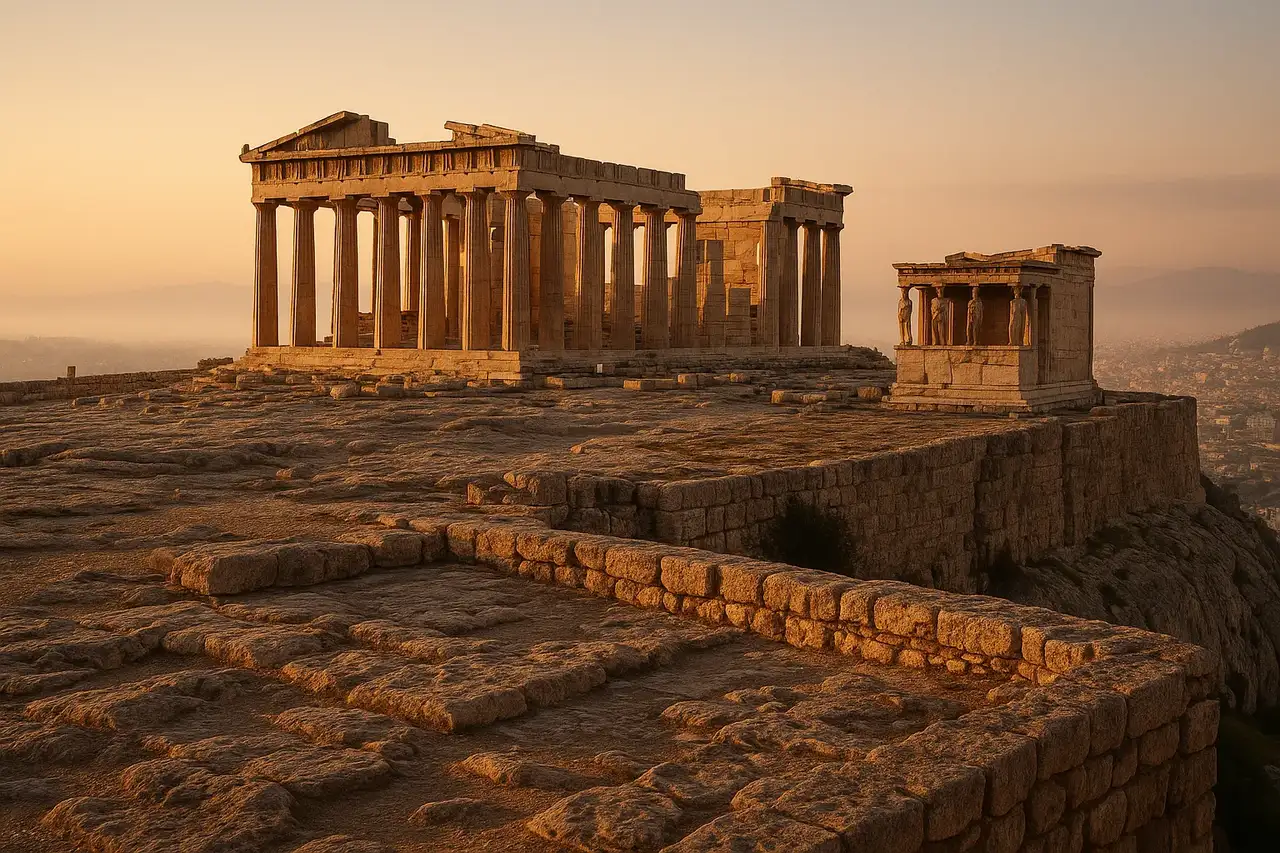
The Acropolis in Athens offers the natural next step in a Greek archaeology sequence. The Minoans preceded Classical Athens by over a millennium, and visiting both gives you the two poles of the ancient Aegean world: Crete’s palace civilization and Athens’ monumental civic architecture. Direct flights connect Heraklion and Athens in 45 minutes.
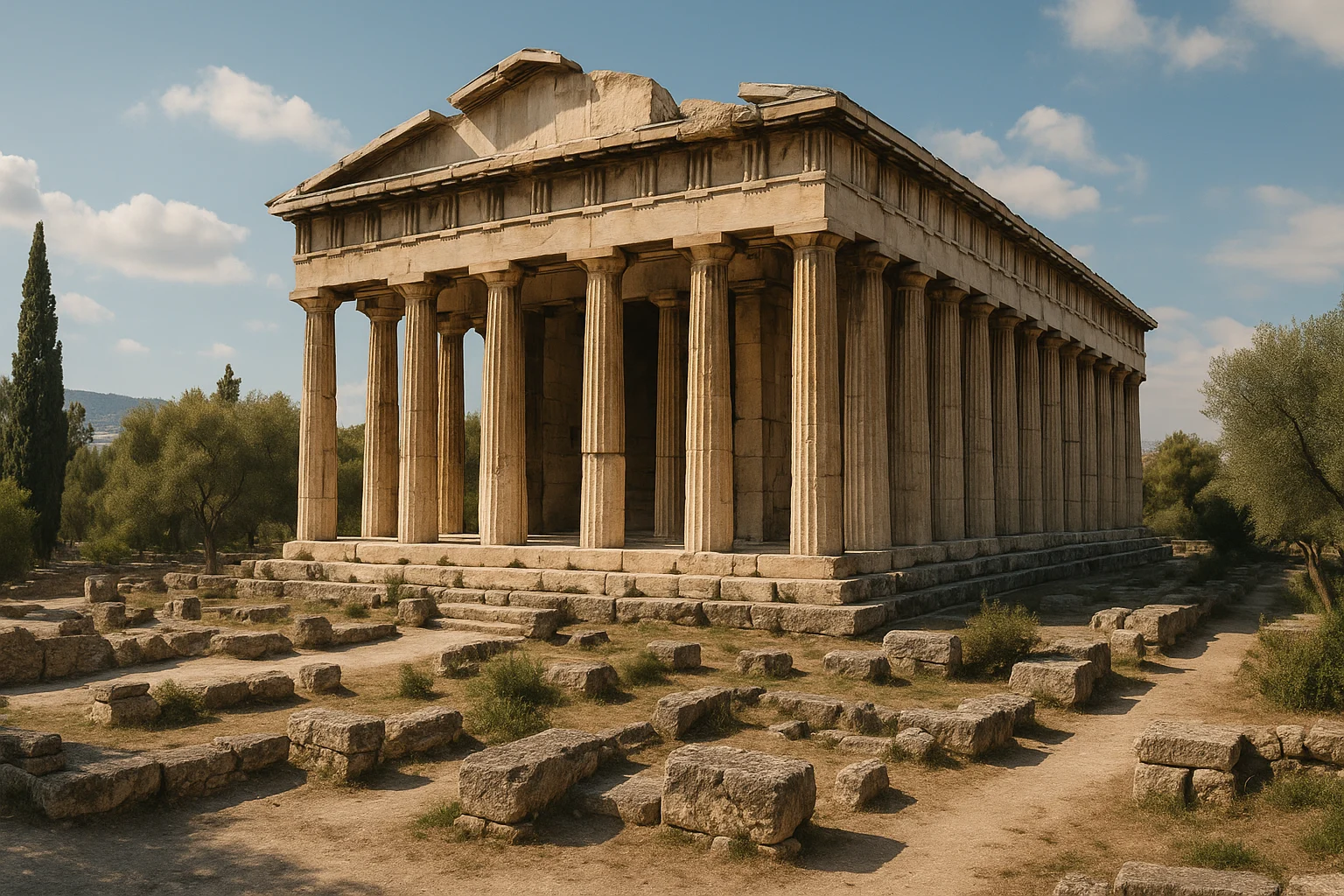
The Ancient Agora of Athens complements the Acropolis with daily-life context, much as the Heraklion museum complements Knossos. The parallel is instructive: both museums serve as interpretive keys to their adjacent archaeological sites.
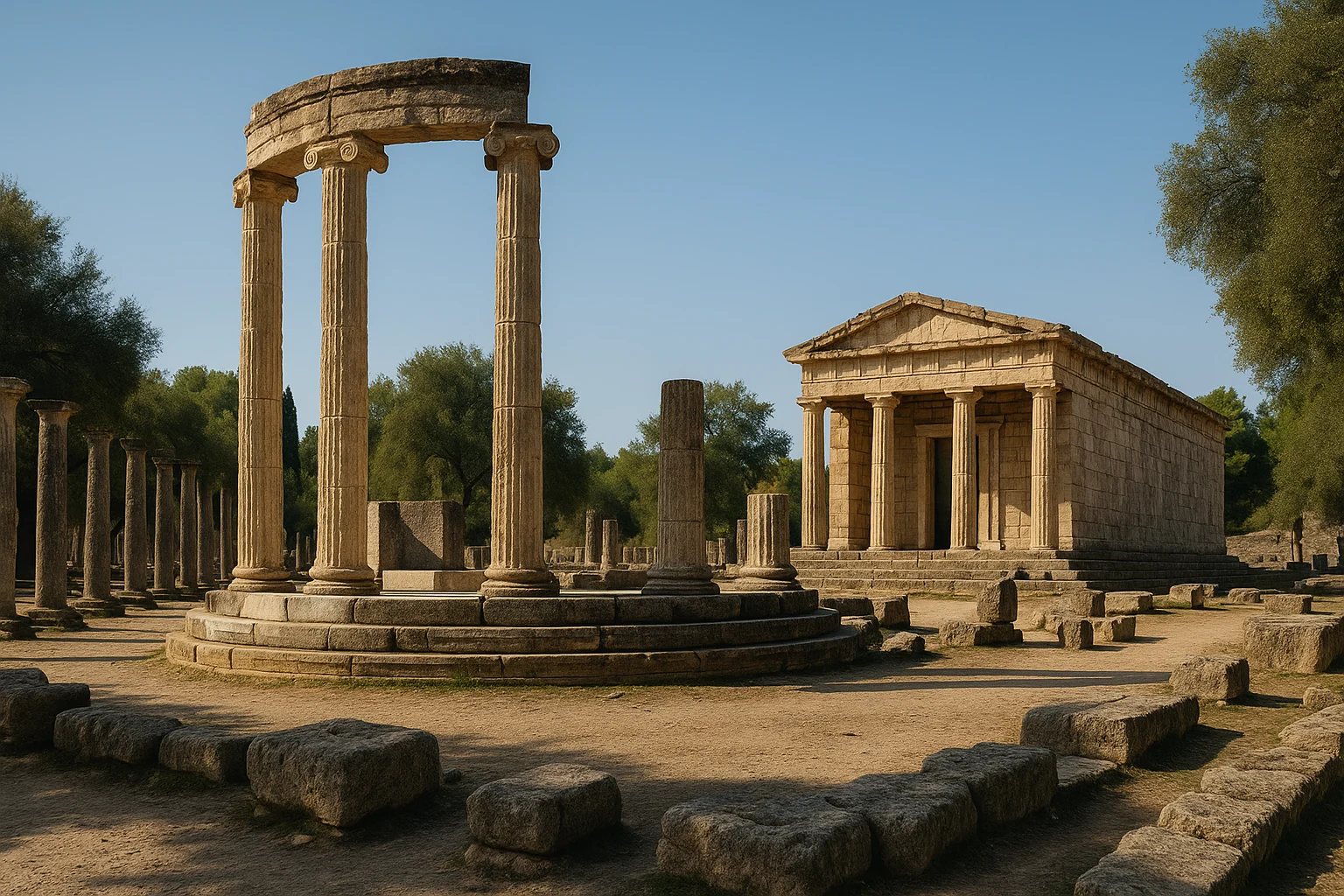
Olympia in the western Peloponnese represents the Panhellenic sanctuary tradition that followed the Minoans by centuries. Its museum houses sculpture of comparable importance to the Heraklion collection, and the two museums together span the full range of ancient Greek art from Minoan fresco painting to Classical marble sculpture.
Final Take
The Heraklion Archaeological Museum is not a supplement to a Crete vacation. It is the intellectual core of the island, the place where a civilization that vanished three thousand years ago becomes tangible and specific. The frescoes show you what Minoans looked like, what they wore, what they valued. The goldwork shows you the precision of their craft. The Phaistos Disc reminds you of everything they said that we can no longer hear.
Give this museum the unhurried time it deserves. Start with the frescoes, end with the sarcophagus, and leave room for the small objects that demand slow looking. Done well, this is one of the strongest single-museum experiences in the Mediterranean, and it transforms every other archaeological site you visit on Crete from scenery into story.
Discover More Ancient Wonders
- Acropolis, Athens — the architectural crown of Classical Greece
- Ancient Agora of Athens — civic and commercial life in the ancient world
- Olympia — the sanctuary where the Greek world competed and worshipped
- Explore more Crete archaeology with our Greece Ancient Sites Guide
- Plan your route with our beginner’s guide to archaeological sites
Quick Facts
| Attribute | Details |
|---|---|
| Location | Heraklion, Crete, Greece |
| Country | Greece |
| Region | Crete |
| Civilization | Minoan and Classical Greek |
| Historical Period | 3000 BCE-4th century CE |
| Established | 1937 (modern museum building) |
| Coordinates | 35.3387, 25.1366 |
Frequently Asked Questions
How long should I spend at the Heraklion Archaeological Museum?
Most travelers need 1.5 to 3 hours, depending on how deeply they want to engage with the Minoan galleries.
Is this museum worth visiting if I am already going to Knossos?
Yes. The museum provides essential context and houses many of the major finds that make Knossos easier to understand.
Can I do the museum and Knossos in one day?
Yes, and that is the most common approach. Start early and allow buffer time for transport and ticket lines.
Nearby Ancient Sites
Acropolis Travel Guide 2026: Parthenon, Tickets, and Best Time
Ancient GreecePlan an efficient Acropolis visit with practical ticket timing, key monuments, and museum pairing ti...
Ancient Agora of Athens Travel Guide 2026: Route, Tickets, and Context
Classical GreekPlan a better Ancient Agora visit with practical timing, monument priorities, and clear historical c...
Olympia Travel Guide 2026: Archaeological Site, Museum, and Visit Plan
Classical GreekPlan a better Olympia visit with practical timing, key monument priorities, and realistic route plan...