Quick Info
At a glance
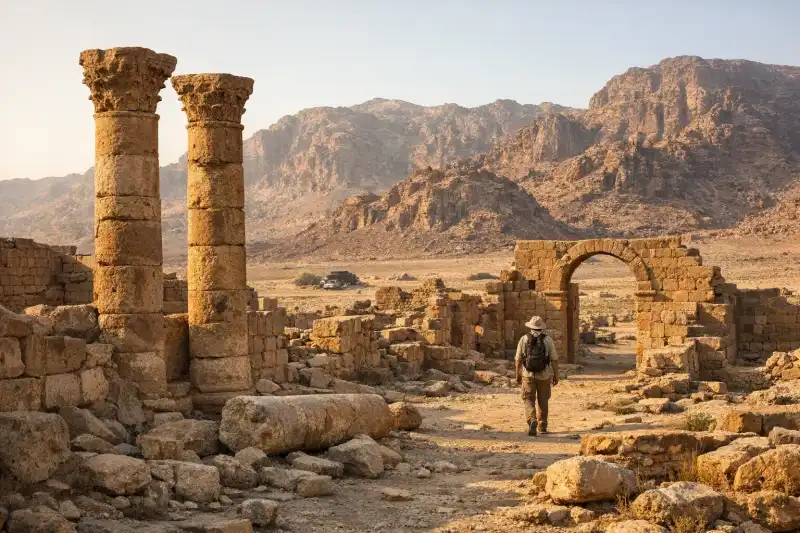
Humayma, Jordan, sits quietly in the southern desert, far from the crowds that gather at Petra or the Red Sea resorts of Aqaba. At first glance it can seem almost too still to be significant: a scattering of low stone remains, open ground, and the pale light of an arid landscape stretching toward distant hills. Yet that quiet is part of its power. Humayma is one of those places where history does not announce itself through towering monuments, but through layers—Nabataean foundations, Roman planning, Byzantine churches, and early Islamic occupation all preserved in a settlement that once depended on ingenuity as much as geography.
For travelers interested in ancient Jordan beyond the famous highlights, Humayma offers a rare experience. This was not simply a ceremonial center or isolated outpost. It was a living community positioned along important routes between Petra, Aqaba, and the wider Arabian and Levantine worlds. It developed under the Nabataeans, adapted within the Roman Empire, continued through the Byzantine era, and became notable in early Islamic history through its connection with the Abbasid family. The result is a site where the story is not about one empire replacing another in a single dramatic stroke, but about continuity, adaptation, and survival in a harsh environment. To walk here is to see how water, trade, religion, and politics shaped a desert town over centuries.
History
Nabataean foundations
Humayma, often identified with ancient Hawara, emerged during the Nabataean period, likely in the late Hellenistic or early Roman era, when the Nabataean kingdom was expanding its network of settlements across southern Jordan. The Nabataeans are best known for Petra, but their success depended on more than monumental tombs and facades. They controlled caravan routes, developed regional administration, and mastered water management in dry landscapes. Humayma fit naturally into that larger system.
Its location helped connect inland Jordan with the Gulf of Aqaba and routes leading into Arabia. In a desert environment where reliable settlement required careful planning, the Nabataeans created an organized town sustained by wells, cisterns, channels, and reservoirs. Archaeological remains suggest a planned settlement rather than an accidental cluster of buildings. This indicates economic value and likely official investment. Humayma probably served both local agricultural needs and passing trade, supporting movement through a region where every dependable stop mattered.
Roman annexation and military adaptation
In 106 CE, the Roman Empire annexed the Nabataean kingdom, transforming it into the province of Arabia. Like many former Nabataean settlements, Humayma did not disappear after this change. Instead, it was folded into Roman systems of administration, defense, and communication. The nearby Via Nova Traiana, the great Roman road linking Bostra to Aqaba, reinforced the strategic importance of settlements in southern Jordan.
At Humayma, the Roman period brought modifications that reflected imperial priorities. A fort was established, and the settlement became part of a broader frontier and transport landscape. Roman military presence in such places was rarely just about warfare. Garrisons protected routes, monitored movement, and supported the flow of goods and official communications. The continued use of local water infrastructure was essential, and Roman occupation often built on earlier Nabataean expertise rather than replacing it outright.
This phase highlights one of Humayma’s most interesting qualities: continuity through political change. While emperors and provincial boundaries shifted, daily life in the settlement still depended on practical systems—water supply, roads, domestic space, and small-scale production. The Roman layer at Humayma is therefore not simply a military chapter but part of a longer pattern of adaptation.
Byzantine community and Christian landscape
By the Byzantine period, roughly from the 4th to 7th centuries, Humayma remained inhabited and developed a more visibly Christian character. Churches were built, and the settlement continued to function despite the changing balance of power in the eastern Mediterranean. The remains of ecclesiastical buildings indicate an organized religious community and suggest that Humayma was still sufficiently prosperous and populated to support communal construction.
The Byzantine era in Jordan often left behind churches with mosaic floors, chapels, and reworked civic spaces, and Humayma followed this broad regional trend in its own modest way. Rather than becoming a grand pilgrimage center, it appears to have remained a practical town whose inhabitants integrated Christian institutions into an existing urban fabric. Domestic areas, infrastructure, and agricultural activity likely continued alongside religious life.
What makes this period important at Humayma is the evidence of endurance. Desert settlements can easily be imagined as vulnerable or temporary, but the Byzantine remains show that Humayma continued to matter for centuries after its Nabataean origins and Roman incorporation.
Early Islamic significance and the Abbasids
Humayma gained a special place in Islamic history because it became associated with the Abbasid family before the Abbasid Revolution of the mid-8th century. Members of the family of al-Abbas, the uncle of the Prophet Muhammad, are believed to have resided here, and the site served as an important base before the Abbasids overthrew the Umayyads in 750 CE. This gives Humayma an importance disproportionate to its modest appearance today.
The choice of Humayma was not accidental. Its relative remoteness offered security, while its location still allowed communication with wider networks. From here, ideas, alliances, and plans could move across regions without the visibility of major urban centers. In this way, Humayma became part of a story much larger than southern Jordan: the transfer of power that reshaped the Islamic world.
After the Abbasid rise, the settlement gradually declined, though not necessarily all at once. As trade patterns shifted, political centers moved, and environmental challenges persisted, Humayma lost the importance it once held. Over time, the desert reclaimed much of the town. What remains today is the archaeological record of a place that bridged multiple civilizations and participated in both local and imperial histories.
Key Features
Humayma’s most compelling feature is its layered settlement plan. Unlike a site dominated by one spectacular structure, it rewards visitors who look at how buildings, roads, and infrastructure relate to one another across time. The ruins spread low across the desert, and their modest height can initially make them seem difficult to interpret. But as you move through the site, patterns emerge. House walls define domestic quarters, open spaces suggest streets or courtyards, and later constructions overlap or repurpose earlier layouts. This is a place best understood as a town rather than a single monument.
The water system is one of Humayma’s defining achievements. In southern Jordan’s dry environment, no long-lived settlement could survive without carefully engineered supply and storage. Archaeologists have identified channels, cisterns, reservoirs, and related installations that show how inhabitants captured and managed scarce water. For modern visitors, this infrastructure can be easy to underestimate because it is not as photogenic as a temple or theater. Yet it is arguably the truest expression of the site’s intelligence. The Nabataeans in particular were famous for their hydraulic skill, and Humayma preserves that tradition in a practical setting. Water here was not only a resource but the foundation of urban possibility.
The Roman fort adds another dimension. Though not massive by the standards of the empire’s great frontier installations, it reveals the site’s strategic role after the Roman annexation of the Nabataean kingdom. The fort’s presence shows that Humayma mattered to imperial logistics and route control. Standing near its remains, it becomes easier to imagine soldiers, officials, merchants, and local residents moving through the same landscape, each connected to wider systems beyond the desert horizon. The fort also helps visitors read the site chronologically, since it marks a recognizable phase of military and administrative adaptation.
Byzantine churches at Humayma provide evidence of the town’s later religious life. Their remains bring a different tone to the site, one tied to communal worship rather than trade or defense. Even where decorative elements are fragmentary or lost, church plans help illustrate the changing social world of the settlement. They indicate that Humayma was not merely surviving in late antiquity but maintaining institutions and identities that linked it to the Christian eastern Mediterranean. The churches also remind visitors that ancient Jordan was culturally diverse, with different religious traditions leaving traces in the same landscapes over time.
Humayma’s early Islamic associations are less immediately visible in monumental form, but they are central to the site’s significance. For many historically minded visitors, the idea that this quiet desert settlement played a role in the prehistory of the Abbasid caliphate gives the ruins unusual depth. It is one thing to see stones; it is another to realize that political change affecting lands from North Africa to Central Asia had roots in a place this remote. That contrast between physical modesty and historical consequence is one of Humayma’s most memorable qualities.
The landscape itself is also part of the site’s appeal. Humayma is not separated from its environment in the way some enclosed archaeological parks are. The openness of the desert helps explain why water mattered so much, why routes were strategic, and why settlement required planning. Light changes dramatically across the day, especially in early morning and late afternoon, when the ruins cast longer shadows and the surrounding terrain becomes more textured. There is little visual clutter, which makes the relationship between archaeology and environment unusually clear.
Getting There
Humayma is most easily reached by private car or taxi, and for most travelers this is the most practical option. The site lies near Jordan’s Desert Highway between Petra/Wadi Musa and Aqaba, making it a feasible stop on a southern Jordan road trip. From Aqaba, the drive generally takes around 1.5 hours depending on your exact starting point and road conditions. From Petra or Wadi Musa, expect roughly 2 to 2.5 hours. Car rental in Jordan often starts around 25 to 45 JOD per day for a basic vehicle, while fuel costs are additional. If you are already touring southern Jordan, adding Humayma as a detour is often more economical than arranging a dedicated excursion.
A private taxi from Aqaba to Humayma and back can cost approximately 60 to 100 JOD depending on waiting time, negotiation, and season. From Petra, expect a similar or slightly higher range, often around 70 to 110 JOD. It is wise to agree clearly whether the fare includes return transport and waiting time, as there are limited services at the site and spontaneous onward transport should not be assumed.
Public transport is limited and not especially convenient. Buses and minibuses on southern routes may pass nearby, but schedules can be irregular and stops may leave you far from the archaeological area. If you attempt the trip by public transport, confirm current routes locally in Aqaba, Petra, or Amman, and be prepared for long waits. For most visitors, self-drive or a hired driver is strongly recommended.
Bring water, sun protection, and offline maps. Facilities are minimal, and the remoteness that makes Humayma so atmospheric also means you should arrive prepared.
When to Visit
The best time to visit Humayma is spring, especially from March to early May, when temperatures in southern Jordan are usually warm rather than punishing. At this time, walking the site is far more comfortable, and the desert light is often especially clear. Autumn, from late September through November, is another excellent season, with cooler mornings and evenings and generally manageable daytime heat. These months are ideal if you want to combine Humayma with Petra, Wadi Rum, or Aqaba in a broader itinerary.
Summer can be extremely hot, particularly from June through August. Midday temperatures in the south often make open-air exploration tiring and sometimes unsafe without careful planning. If you must visit in summer, arrive as early as possible, carry plenty of water, wear a hat, and avoid the strongest afternoon sun. Humayma offers little shade, so heat exposure is more serious here than at sites with enclosed museums or larger visitor infrastructure.
Winter is quieter and can be pleasant during sunny days, though mornings and evenings may be cold, especially in exposed desert conditions. Rain is infrequent but possible, and even light weather changes can affect comfort in such an open landscape. Winter can be a good choice for photographers and travelers who prefer solitude, provided they dress in layers.
Time of day matters almost as much as season. Early morning and late afternoon are usually the most rewarding hours. The softer light makes the low ruins easier to read, temperatures are milder, and the site’s silence feels even more pronounced. If your main interest is photography or landscape atmosphere, aim for the edges of the day rather than noon.
| Quick Facts | Details |
|---|---|
| Location | Southern Jordan, near the Desert Highway in Aqaba Governorate |
| Ancient Name | Often identified as Hawara |
| Main Periods | Nabataean, Roman, Byzantine, Early Islamic |
| Historical Importance | Desert settlement with major water infrastructure and Abbasid family association |
| Best For | Archaeology enthusiasts, history travelers, off-the-beaten-path explorers |
| Ideal Visit Length | 1.5 to 3 hours |
| Best Season | Spring and autumn |
| Access | Best reached by rental car or private taxi |
| Closest Major Hub | Aqaba |
| What to Bring | Water, sun protection, sturdy shoes, offline navigation |
Guided tours: worth it?
A guide can be genuinely useful at Humayma, especially if you want help with transport, timing, tickets, or understanding a large site without losing half the day to logistics.
Best for
- Travelers who want transport, timing, or entry logistics handled
- Short visits where a planned route saves time
When to go self-guided
Go independently if you already have transport and tickets sorted, enjoy moving at your own pace, and are comfortable checking the latest official rules before you arrive.
What I’d avoid
Skip paid tours that bundle unrelated stops you do not actually want. The best option should either save meaningful planning time or add historical context you would miss on your own.
Petra and Wadi Rum tours from Amman
Useful when: transport or pickup logistics matter
Aqaba shore excursions to Petra and southern Jordan
Useful when: you want to compare guided formats before deciding
Jordan archaeology and historical site tours
Useful when: you want to compare guided formats before deciding
Some tour links are affiliate links, which may earn Ancient Travel a small commission at no extra cost to you. I try to surface options that make practical sense for the site—not just anything bookable.
Frequently Asked Questions
What is Humayma?
Humayma is an archaeological site in southern Jordan containing Nabataean, Roman, Byzantine, and early Islamic remains, including houses, churches, a fort, and a sophisticated water system.
Where is Humayma located?
Humayma lies in southern Jordan in Aqaba Governorate, north of Aqaba and south of Petra, near the Desert Highway in a remote arid landscape.
Why is Humayma historically important?
The site is important because it preserves evidence of continuous occupation across several eras and is closely associated with the Abbasid family before their rise to power.
Can you visit Humayma independently?
Yes, many travelers visit independently by car, but the site is remote and services are limited, so carrying water, fuel, and offline navigation is strongly recommended.
How much time do you need at Humayma?
Most visitors need about 1.5 to 3 hours to explore the main ruins, though archaeology enthusiasts may want longer to appreciate the settlement layout and water infrastructure.
Is Humayma suitable as a stop between Petra and Aqaba?
Yes, Humayma works well as a historical detour on routes between Petra, Wadi Rum, and Aqaba, especially for travelers interested in lesser-known ancient sites.
Nearby Ancient Sites
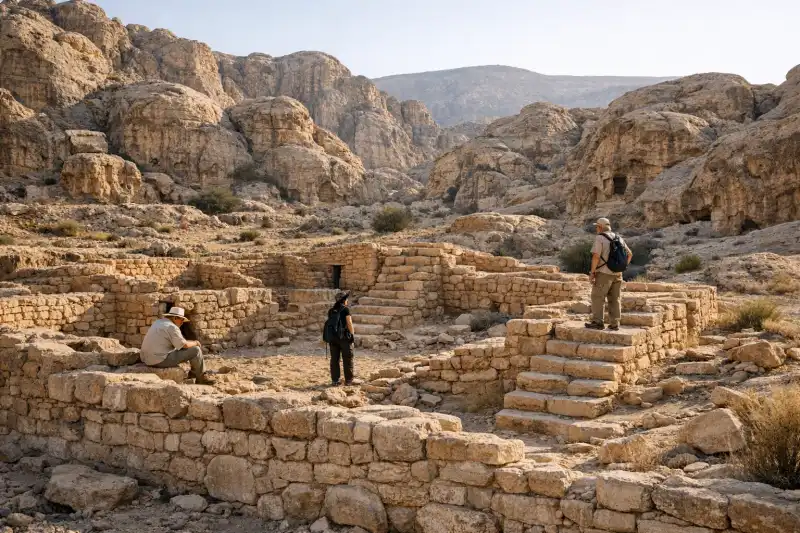
Beidha
Pre-Pottery Neolithic communities of the southern LevantExplore Beidha, a remarkable Neolithic village near Petra in Jordan, known for early farming, stone ...
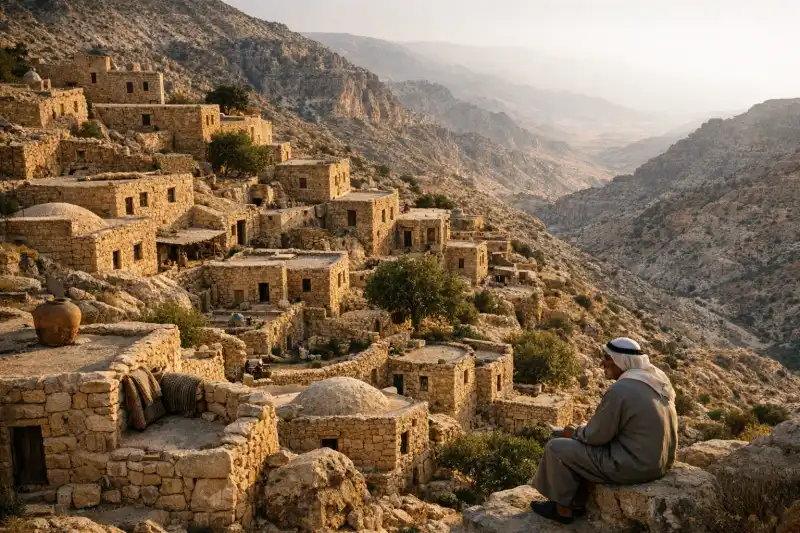
Dana Village
Nabataean, Ottoman, and local Jordanian highland communitiesA timeless stone village in Jordan overlooking Dana Biosphere Reserve, famed for mountain views, tra...
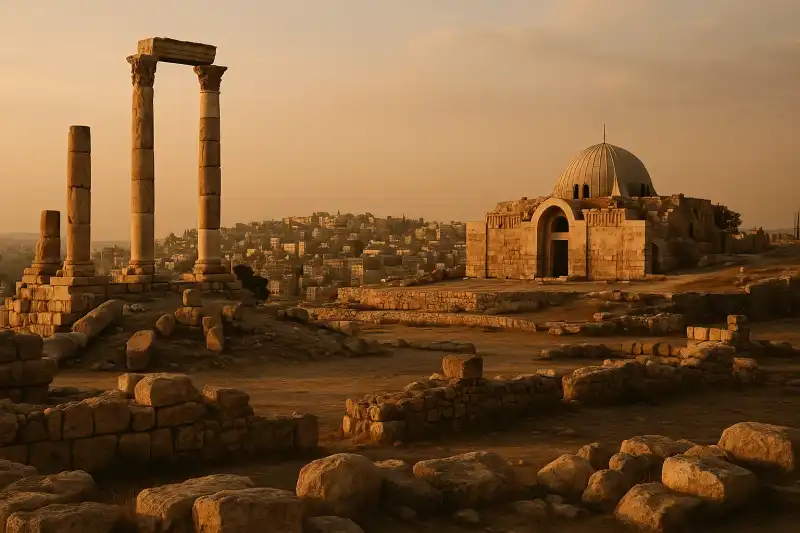
Amman Citadel Jordan Guide 2026: Temple of Hercules & Ancient Rabbah
Ammonite-Roman-UmayyadExplore Jordan's ancient citadel overlooking modern Amman. Discover the Temple of Hercules, Umayyad ...