Quick Info
At a glance
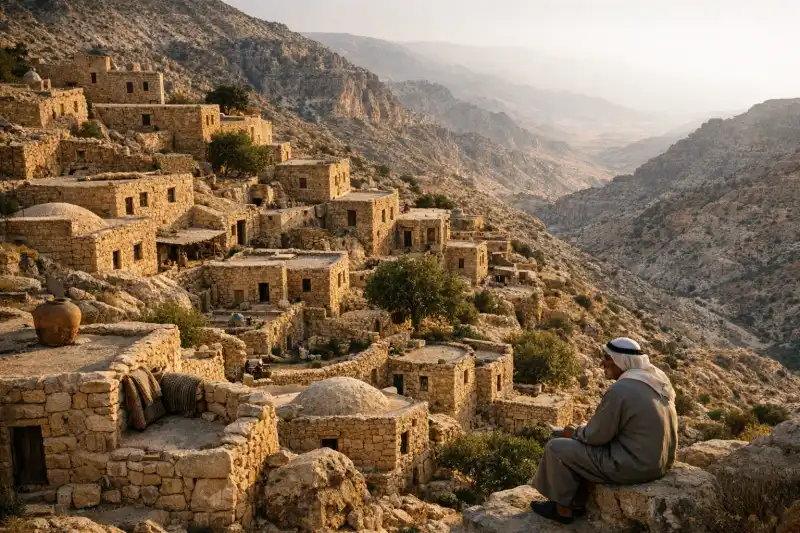
Dana Village in Jordan feels, at first sight, like a place suspended between mountain, desert, and memory. Clinging to the edge of a vast natural amphitheater in southern Jordan, the village looks out over the dramatic canyons and terraces of the Dana Biosphere Reserve, where pale cliffs, winding ravines, and shifting light create one of the country’s most atmospheric landscapes. Long before it became known to hikers and eco-travelers, Dana was a lived-in highland settlement, shaped by caravan routes, seasonal agriculture, and the practical wisdom of building with local stone in a demanding environment. Today its narrow lanes, weathered houses, and broad panoramas make it one of the most distinctive heritage destinations in Jordan.
What sets Dana apart is not monumental scale in the way of Petra or Jerash, but a rare sense of continuity. The village is intimate rather than grand, and its appeal grows slowly: in the rough texture of old masonry, in the silence before sunset, in the sight of swifts circling above ruined rooftops, and in the way the settlement seems to emerge naturally from the surrounding rock. For travelers interested in cultural landscapes rather than only isolated monuments, Dana Village offers a compelling blend of history, architecture, and nature. It is a place where Jordan’s human past and geological drama remain visibly intertwined, rewarding visitors who come not just to see, but to linger.
History
Ancient roots in the Dana highlands
The area around Dana Village has been occupied for millennia, thanks to its strategic highland position and access to varied ecological zones. Southern Jordan has long served as a corridor linking the Arabian interior with the Levant, and the mountains around Dana were part of wider networks of movement, trade, and seasonal settlement. Archaeological evidence from the broader region shows human presence stretching back to prehistoric periods, while later communities took advantage of the altitude, springs, and defensible terrain.
Dana’s location between upland agricultural zones and deeper wadis made it especially valuable. Pastoral groups and farming households could exploit different environments across the year, moving animals, planting small fields, and using the valley systems below for foraging and transit. Though Dana Village itself is most visibly associated with later centuries, the landscape around it belongs to a far older human story. Nabataean influence was strong across southern Jordan, and the wider region connected naturally with the trade world that made Petra famous. Routes crossing the plateau and descending through valleys would have brought merchants, herders, and local communities into repeated contact.
From late antiquity to Islamic eras
During late antiquity and into the early Islamic centuries, settlement in southern Jordan evolved with changing political structures, trade patterns, and agricultural practices. Villages rose and declined according to water availability, taxation, security, and the relative importance of local routes. Dana’s mountain setting likely protected it from total abandonment even when more exposed locations suffered disruption. The broader district retained significance because it linked interior plateaus with lowland routes leading toward the Arabah and beyond.
As power shifted from Byzantine to Islamic rule, many communities in Jordan adapted rather than disappeared outright. Religious identity, language, and administration changed over time, but the practical realities of village life remained rooted in land, water, and kinship. Terracing, orchard management, and seasonal herding would have structured daily existence in places like Dana. Its architecture, though mostly surviving in later forms, reflects this long tradition of adapting built space to climate and topography. Houses were clustered for shelter and social cohesion, and lanes were shaped by slope more than by formal planning.
Ottoman-era village formation
The Dana Village travelers see today is largely associated with the Ottoman period, particularly the later centuries when stone village architecture in southern Jordan took on its most recognizable form. Many of the surviving houses, though repaired or partially ruined, date from this era or reflect building traditions that matured under Ottoman administration. The village developed as a compact settlement of stone dwellings, storage spaces, animal enclosures, and terraces fitted tightly onto the mountainside.
Life in Ottoman Dana was demanding but resourceful. Families cultivated grains, figs, olives, and other crops suited to the uplands, while also raising livestock and participating in local exchange systems. Architecture was practical: thick walls moderated temperature, small openings reduced exposure, and building materials came from the surrounding terrain. Rooftops, courtyards, and stepped passages created a layered village environment in which domestic life unfolded across multiple levels.
Like many rural settlements in Jordan, Dana was never isolated in an absolute sense. It was connected to market towns, pilgrimage routes, and administrative systems, yet its mountainous position preserved a strong local character. The village’s communal life was shaped by shared labor, harvest cycles, and the management of scarce resources. Over generations, this produced the cultural landscape visitors still perceive today, where architecture and terrain appear almost inseparable.
Decline, conservation, and revival through tourism
In the 20th century, social and economic changes led many residents of older Jordanian villages to move toward larger towns and newer housing. Dana was no exception. Modern services, roads, education, and employment opportunities elsewhere gradually reduced the practicality of maintaining life in a remote mountain settlement of traditional stone houses. As a result, parts of the village fell into disrepair, and some structures became semi-abandoned.
Yet this apparent decline also preserved Dana from wholesale redevelopment. By the late 20th century, growing awareness of Jordan’s environmental and cultural heritage brought renewed attention to the area. The establishment of the Dana Biosphere Reserve, overseen by the Royal Society for the Conservation of Nature, transformed the wider landscape into one of Jordan’s leading conservation zones. Dana Village, perched above the reserve, became an important gateway for visitors interested in ecology, birdlife, hiking, and heritage accommodation.
Restoration efforts and tourism initiatives helped revive portions of the village while respecting its historic character. Rather than converting Dana into a polished museum piece, many projects sought to retain its rough authenticity. Today, visitors encounter a place that still feels lived-in and weathered, where restored guesthouses stand alongside old walls and empty structures. That balance is central to Dana’s appeal: it is not merely a scenic overlook, but a highland community whose history remains visible in stone, silence, and survival.
Key Features
Dana Village’s most striking feature is its setting. Built along the lip of a deep valley system, it commands extraordinary views over the Dana Biosphere Reserve, where mountains descend in folds toward lower desert terrain. The scale of the panorama changes throughout the day. Morning light draws out the pale tones of the cliffs, while evening turns the rock faces amber, rose, and violet. Unlike sites defined by a single monument, Dana’s drama is cumulative. The village itself is part of the spectacle, with low stone houses and broken rooflines echoing the textures of the surrounding escarpment.
The architecture deserves close attention. Traditional houses in Dana are built from local stone and arranged to accommodate the steep slope. Their forms are simple but highly adapted, with thick masonry walls, arched doorways in some cases, and modest openings that respond to climate and exposure. Some structures have been restored into guesthouses or communal spaces, while others remain partially ruined, allowing visitors to read the history of abandonment and reuse directly in the built fabric. Walking through the lanes, you notice how the village is organized less by formal streets than by passages, stairs, terraces, and thresholds. It is a settlement made for movement on foot, where each turn reveals a new relationship between house, drop-off, and horizon.
Another defining feature is the atmosphere of the place. Dana offers a kind of quiet that is increasingly rare. Even when travelers are present, the village tends to feel calm, especially outside midday. Wind, birdsong, and distant goat bells often replace urban noise. This sensory quality is part of what makes the village memorable. It encourages slower observation: a carved stone reused in a wall, an old doorway opening onto emptiness, a fig tree rooted near collapsed masonry. Rather than overwhelming the visitor with information panels or spectacle, Dana invites attention through understatement.
The connection to the Dana Biosphere Reserve is equally important. The village serves as one of the reserve’s main cultural gateways, and from here visitors can access short viewpoint walks as well as longer guided treks into the valleys. The reserve is one of Jordan’s richest ecological areas, known for its biodiversity and dramatic variation in altitude and habitat. While many travelers come to Dana for heritage and scenery, the natural context deepens every part of the experience. Raptors circling over the cliffs, rare plants clinging to terraces, and the immense geological layering below the village all reinforce the sense that Dana is a living cultural landscape rather than an isolated historic settlement.
Dana also stands out for the way hospitality and heritage intersect. Several restored properties preserve traditional architectural character while providing places to stay, eat, and watch the sunset over the reserve. This gives visitors the chance to experience the village after day-trippers leave, which is arguably the best time to be there. Twilight settles softly across the stone walls, and the reserve below fades into shadow. At night, especially in clear weather, the sky can be remarkably bright with stars.
For photographers, hikers, architecture enthusiasts, and travelers interested in rural history, Dana offers different rewards. It may not have the instantly iconic profile of Jordan’s most famous ancient sites, but its strength lies in layers: environmental, historical, visual, and emotional. The village embodies a form of heritage in which landscape, vernacular building, and memory are inseparable. That depth is what makes it one of Jordan’s most compelling places to visit.
Getting There
Dana Village is most easily reached by road, and self-driving is the simplest option for most travelers. From Amman, the journey usually takes around 3.5 to 4.5 hours depending on traffic and route, with many visitors using the King’s Highway for a more scenic drive through central Jordan. A rental car gives the greatest flexibility, especially if you plan to combine Dana with Madaba, Kerak, or Petra. In Jordan, standard rental car rates often start around 25–45 JOD per day for a basic vehicle, excluding fuel and insurance.
Public transport exists but is less convenient. There are occasional buses or service taxis to Tafilah or nearby towns, but onward connections to Dana Village itself can be limited and irregular. If traveling without a car, one practical strategy is to take a bus or shared taxi toward Tafilah or the Dana area and then hire a local taxi for the final stretch. Private taxis from larger hubs can be arranged, though prices vary by distance and negotiation. From Petra or Wadi Musa, expect a private transfer to Dana to cost roughly 40–70 JOD; from Amman, a private car may range from about 80–120 JOD.
Many travelers visit Dana as part of a broader southern Jordan itinerary. It pairs especially well with Petra, Little Petra, Kerak Castle, or the Desert Highway route. Roads into the village are generally manageable, but the final approach is winding, and driving after dark requires caution. If you are staying overnight, it is wise to arrive before sunset so you can settle in and enjoy the views.
When to Visit
The best times to visit Dana Village are spring and autumn, when temperatures are moderate and the landscapes are at their most inviting. In spring, usually from March to May, the hills can show patches of green and seasonal flowers, and hiking conditions are often excellent. This is one of the most rewarding periods for visitors interested in the biosphere reserve, birdwatching, or longer walks. Daytime weather is usually pleasant, though mornings and evenings at altitude can still be cool.
Autumn, especially from late September through November, is another ideal season. The summer heat has eased, visibility is often crisp, and the village feels calm and clear under bright skies. For many travelers, autumn offers the best balance between comfort and scenery. It is also a good time for photography, with lower-angle light emphasizing the textures of stone walls and the contours of the valleys.
Summer is possible, but conditions can be hot, especially on exposed trails descending into the reserve. The village itself, thanks to its elevation, may feel more comfortable than lower desert regions, yet midday walking can still be tiring. If visiting in summer, plan hikes early and reserve the hottest hours for rest and meals.
Winter brings a different beauty: sharp air, dramatic clouds, and a quieter atmosphere. However, nights are cold, and occasional rain or strong winds can affect comfort and access. Some accommodations or services may operate on reduced schedules. For travelers who enjoy solitude and do not mind chilly conditions, winter can still be deeply rewarding, but packing warm layers is essential.
| Quick Facts | Details |
|---|---|
| Location | Tafilah Governorate, southern Jordan |
| Setting | Historic mountain village above Dana Biosphere Reserve |
| Best For | Heritage travel, hiking, scenery, photography, eco-tourism |
| Main Appeal | Traditional stone architecture and canyon panoramas |
| Typical Visit Length | Half day to 2 nights |
| Nearest Major Stop on Tourist Route | Petra / Wadi Musa |
| Access | Best by rental car or private transfer |
| Best Seasons | Spring and autumn |
| Elevation Feel | Cooler than lower desert areas, especially at night |
| Combined Itinerary Ideas | Kerak Castle, Madaba, Little Petra, Petra |
Guided tours: worth it?
A guide can be genuinely useful at Dana Village, especially if you want help with transport, timing, tickets, or understanding a large site without losing half the day to logistics.
Best for
- Travelers who want transport, timing, or entry logistics handled
- Short visits where a planned route saves time
When to go self-guided
Go independently if you already have transport and tickets sorted, enjoy moving at your own pace, and are comfortable checking the latest official rules before you arrive.
What I’d avoid
Skip paid tours that bundle unrelated stops you do not actually want. The best option should either save meaningful planning time or add historical context you would miss on your own.
Dana Village and Dana Biosphere Reserve tours
Useful when: you want to compare guided formats before deciding
Jordan nature and hiking tours including Dana
Useful when: you want to compare guided formats before deciding
Petra and Dana combined tours
Useful when: you want to connect a site and museum visit
Some tour links are affiliate links, which may earn Ancient Travel a small commission at no extra cost to you. I try to surface options that make practical sense for the site—not just anything bookable.
Frequently Asked Questions
Where is Dana Village located?
Dana Village is in southern Jordan in Tafilah Governorate, perched above the Dana Biosphere Reserve between the King's Highway and Petra.
Is Dana Village worth visiting?
Yes. Dana Village is one of Jordan’s most atmospheric historic settlements, combining stone architecture, dramatic canyon scenery, and access to some of the country’s best hiking.
How much time do you need in Dana Village?
Most travelers need at least one night and one full day, though two nights are better if you want to hike, enjoy the viewpoints, and experience the village at a slower pace.
Can you visit Dana Village without hiking?
Yes. Many visitors come mainly for the village itself, the panoramic overlooks, birdlife, and the quiet atmosphere, even if they do only short walks.
What is the best time of year to visit Dana Village?
Spring and autumn are generally best, with mild temperatures, greener landscapes, and good walking conditions. Summer can be hot in the reserve, while winter nights are cold.
Is Dana Village close to Petra?
Dana Village is often visited on the same southern Jordan route as Petra. The drive usually takes around 1.5 to 2.5 hours depending on road choice and stops.
Nearby Ancient Sites
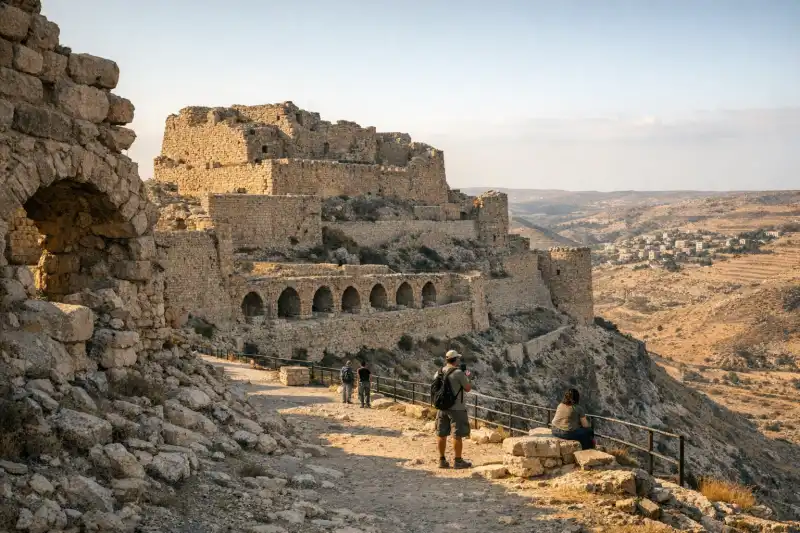
Kerak Castle
Crusader, Ayyubid, Mamluk, OttomanA vast Crusader fortress in Jordan, Kerak Castle crowns a hilltop with tunnels, towers, and sweeping...
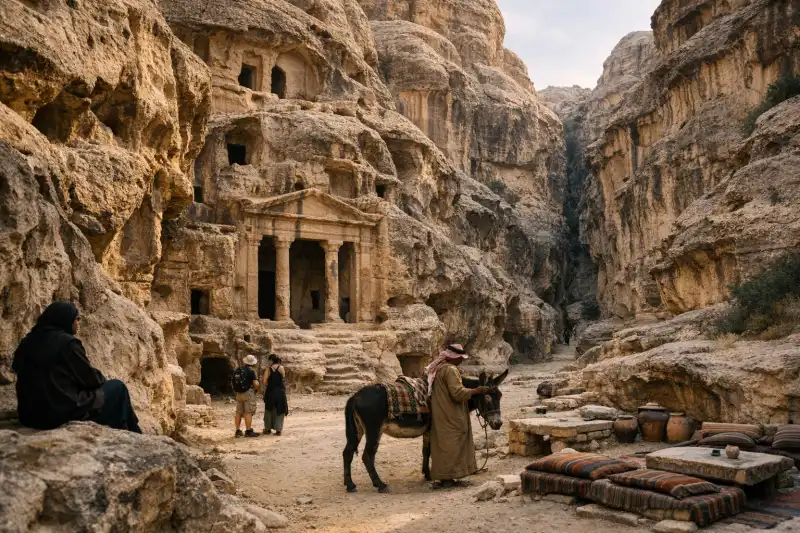
Little Petra (Siq al-Barid)
Discover the Nabataean rock-cut marvel of Little Petra (Siq al-Barid) in Jordan, a hidden archaeolog...
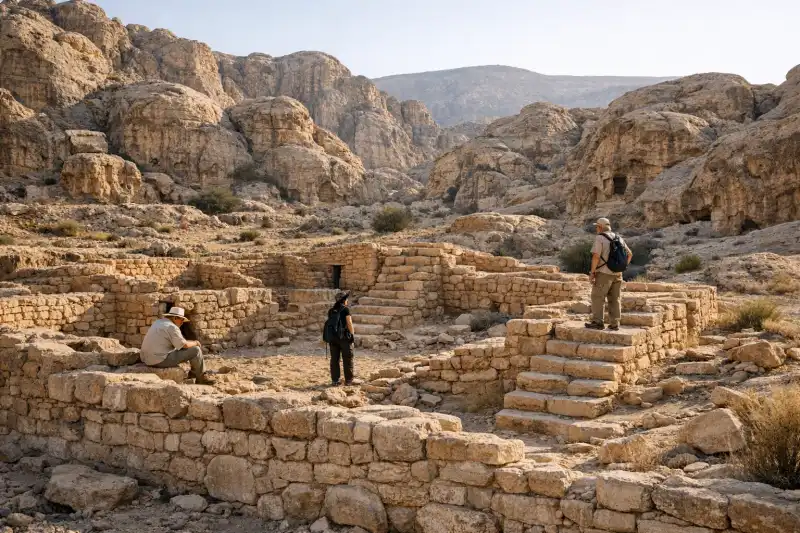
Beidha
Pre-Pottery Neolithic communities of the southern LevantExplore Beidha, a remarkable Neolithic village near Petra in Jordan, known for early farming, stone ...
Madaba
Discover Madaba, Jordan’s ancient mosaic city famed for its spectacular Byzantine art, historical ch...