Quick Info
At a glance
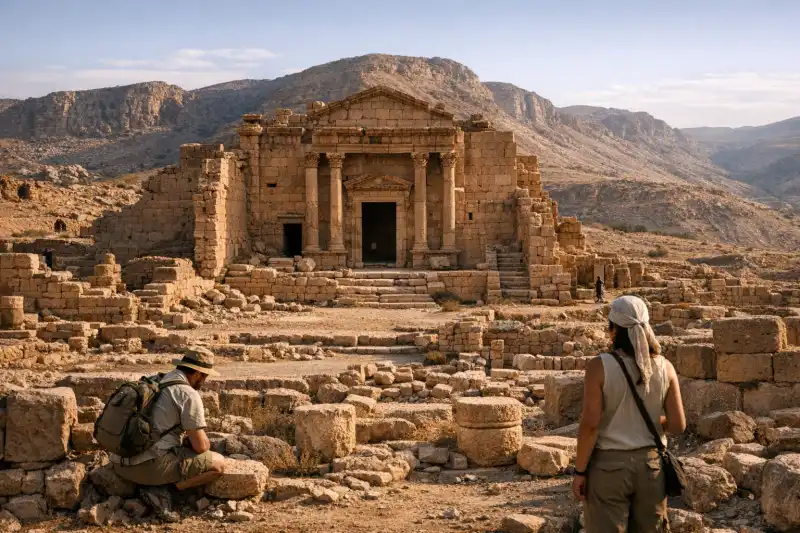
Khirbet ed-Dharih in Jordan is the kind of archaeological place that rewards travelers who are willing to leave the most famous roads behind. Set high in the rugged landscape of southern Jordan, the site occupies a commanding position amid hills, wadis, and cultivated terraces, where shifting light can make carved stone seem to glow against the dry earth. Unlike the theatrical grandeur of Petra, Khirbet ed-Dharih feels intimate and scholarly at the same time: a place where the outlines of ancient ritual, trade, and daily life remain visible in quieter form. Its temple complex, decorated architecture, and associated settlement reveal how the Nabataeans shaped religious space beyond their capital, while later Roman and Byzantine layers show how the site continued to matter across centuries.
For visitors interested in Jordan’s deeper archaeological story, Khirbet ed-Dharih offers an especially appealing balance. It is substantial enough to demonstrate the sophistication of Nabataean building and belief, yet peaceful enough that you can pause and imagine the rhythms of the place without crowds. The surrounding scenery is part of the experience. Roads wind through highland villages and valleys that have supported human movement for millennia, reminding you that this was never an isolated sanctuary. Khirbet ed-Dharih belonged to a living network of routes, communities, and sacred traditions, and that layered identity is exactly what makes a visit here memorable.
History
Hellenistic and early Nabataean roots
The area around Khirbet ed-Dharih was likely significant before the monumental remains now visible were constructed. Southern Jordan’s uplands were crossed by routes linking the Arab interior with the Dead Sea, Petra, and regions farther north. By the late Hellenistic period, communities in this landscape benefited from trade, farming, and the circulation of religious ideas. The Nabataeans, whose kingdom grew powerful through caravan commerce and regional diplomacy, were especially adept at anchoring that power in strategic and sacred places.
Khirbet ed-Dharih seems to have emerged as one of those important local centers. Its location suggests both economic and ritual value. Rather than standing in a major urban core, it occupied a setting that connected settled agricultural life with wider movement through the region. This combination was common in Nabataean territory, where religion, landscape, and trade often overlapped. Pilgrims, merchants, farmers, and local elites may all have contributed to the rise of the sanctuary.
The Nabataean temple and settlement
The site reached its greatest architectural distinction during the Nabataean period, likely between the 1st century BCE and the 1st century CE. During this era, a temple complex was constructed with impressive care and ornament. Archaeological work has revealed decorated façades, columns, sculptural elements, and carefully planned spaces for movement and ritual performance. The architecture shows that Khirbet ed-Dharih was no minor outpost. It was a meaningful cult center with enough resources and status to attract sophisticated design.
The Nabataeans are often associated in popular imagination with Petra’s rock-cut monuments, but Khirbet ed-Dharih helps broaden that image. Here, they built in freestanding masonry, using finely worked stone and a formal layout that reflects both local traditions and wider Mediterranean influences. The result is a site that illustrates how Nabataean identity was expressed through architectural hybridity. Religious practice here was not hidden in a cave or scattered among shrines; it was shaped into a coherent, ceremonial complex.
The surrounding settlement likely supported the sanctuary and benefited from it in return. Priests, pilgrims, laborers, landholders, and traders may all have had reasons to gather here. Storage, housing, water systems, and agricultural installations in the broader area indicate that this was a functioning community rather than a standalone monument. Like many sacred sites in antiquity, the temple probably operated within an economic landscape as much as a spiritual one.
Roman annexation and continuity
In 106 CE, the Roman Empire annexed the Nabataean kingdom, transforming it into the province of Arabia. At many places, this political shift did not mean immediate rupture. Khirbet ed-Dharih appears to have continued in use, with Roman-era occupation and adaptation layered onto the Nabataean foundations. This continuity is important. It suggests that the site’s regional importance outlasted the independence of the kingdom that had made it flourish.
Roman administration brought new networks, taxation structures, and patterns of mobility, but local traditions often persisted. At Khirbet ed-Dharih, sacred and domestic spaces were modified rather than simply abandoned. The site remained part of a living landscape where older identities and newer imperial realities intersected. Architectural changes from this period may reflect repairs, additions, or repurposing, but they also reveal the resilience of local communities.
Byzantine transformation and later decline
By the Byzantine period, southern Jordan saw major religious and social changes as Christianity spread across the region. Many older sites were adapted to new functions, and Khirbet ed-Dharih appears to have remained occupied in some form. As at other long-lived Levantine settlements, continuity and transformation likely coexisted. Structures might be reused, sacred associations reinterpreted, and domestic life reorganized around altered political and religious circumstances.
Eventually, however, the site declined. Changes in settlement patterns, economic routes, environmental conditions, and religious focus probably all contributed. The sanctuary lost its active role, buildings collapsed or were dismantled, and the place became a ruin embedded in the agricultural highlands. Yet decline did not erase memory. Local knowledge of the ruins persisted, and modern archaeology has helped restore Khirbet ed-Dharih to wider historical awareness.
Excavation and study over recent decades have made the site particularly valuable for understanding Nabataean religion outside Petra. Scholars have used its remains to explore ceremonial architecture, regional identity, and long-term occupation in southern Jordan. Today, Khirbet ed-Dharih stands as one of the country’s most informative lesser-known archaeological sites: not spectacular merely because it is old, but because it preserves a nuanced story of continuity, adaptation, and local importance over centuries.
Key Features
The heart of Khirbet ed-Dharih is its temple complex, and this is what most visitors remember first. Even in ruin, the sanctuary communicates order and intention. You can trace the arrangement of walls and courtyards and begin to understand how worshippers once approached the sacred core. The surviving masonry reveals a level of craftsmanship that immediately marks the complex as significant. Blocks are carefully cut, the plan is formal rather than improvised, and decorative fragments hint at the visual richness the building once possessed. Unlike a purely defensive site or anonymous village ruin, Khirbet ed-Dharih was designed to impress and to guide movement through ritual space.
One of the most striking aspects is the quality of the ornament. Carved architectural pieces recovered at the site show the fusion often associated with Nabataean art: local religious expression meeting classical forms. Floral motifs, moldings, and column elements suggest a setting that was both symbolic and highly aesthetic. This matters because it helps visitors see the Nabataeans not just as traders or desert engineers, but as patrons of an accomplished visual culture. At Khirbet ed-Dharih, architecture was part of belief. The design itself conveyed prestige, sacredness, and connection to broader artistic currents.
Equally compelling is the relationship between the temple and the settlement around it. The site is not experienced as a single isolated building. Instead, it unfolds as a wider archaeological landscape in which sacred, domestic, and practical functions blur into one another. Remains of additional structures help visitors imagine a community that lived with the sanctuary rather than merely visiting it occasionally. Storage areas, houses, and infrastructure suggest that ritual life was embedded in everyday economic reality. That pattern is familiar across the ancient world, but here it is especially tangible because the site remains relatively undisturbed by mass tourism.
The setting amplifies everything. Khirbet ed-Dharih sits within a dramatic upland environment where terraces, ridges, and wadis frame the ruins. Looking out from the site, you can appreciate why this place mattered. It controlled sightlines, accessed nearby agricultural land, and sat within a larger corridor linking southern Jordan’s interior landscapes. The views are not incidental background. They are part of the archaeology, helping explain how ancient communities understood sacred geography. A temple in such a location was not simply convenient; it announced presence and meaning in the landscape.
Visitors with an interest in architectural history will appreciate that Khirbet ed-Dharih offers a different perspective from Jordan’s more famous monumental sites. Petra overwhelms through scale and drama; Khirbet ed-Dharih engages through detail, planning, and context. The ruin invites slow observation. Thresholds, alignments, fallen stonework, and fragmentary decorative pieces all reward patience. It is a site where you often find yourself reconstructing the past mentally, which can be more satisfying than simply photographing an iconic façade.
Another important feature is the site’s interpretive value for understanding Nabataean religion. Scholars have long debated the forms and local variations of Nabataean worship, and Khirbet ed-Dharih contributes concrete evidence to that discussion. Its sanctuary architecture indicates formalized ritual activity outside the royal center of Petra, showing that Nabataean religious life was distributed across a network of regional sites. For travelers, this makes a visit more than scenic. It becomes a chance to see how ancient belief functioned in provincial settings, where local devotion and kingdom-wide identity likely reinforced each other.
Finally, Khirbet ed-Dharih’s atmosphere is itself a major feature. Because it remains off the main tourist circuit, the site often feels contemplative. Wind, distance, and silence shape the experience as much as stone. This is especially appealing for visitors who want to engage with archaeology without crowds, barriers, and rushed timelines. The ruins can be read in relation to their terrain, and that sense of space is increasingly rare. Khirbet ed-Dharih may not be Jordan’s most famous ancient destination, but its combination of temple architecture, settlement remains, mountain scenery, and relative tranquility gives it a distinctive power.
Getting There
Khirbet ed-Dharih is easiest to reach by private vehicle, and most visitors approach it as part of a southern Jordan itinerary that also includes Dana, Petra, or Tafila. From Amman, the drive generally takes around 3.5 to 4.5 hours depending on traffic and route. A rental car offers the most flexibility, especially because public transport to the immediate area is limited and schedules can be irregular. Expect to pay roughly 25–45 JOD per day for a standard rental car in Jordan, with fuel extra.
From Tafila or Dana, hiring a local taxi or driver is often the simplest option if you are not self-driving. Fares vary with negotiation, wait time, and road conditions, but a half-day arrangement from nearby towns may cost around 25–50 JOD. From Wadi Musa, prices are usually higher, often in the 40–70 JOD range for a return trip with waiting time. If you are already traveling with a private guide in Jordan, Khirbet ed-Dharih can usually be added as a custom stop.
Public buses and minibuses may get you to larger nearby towns, but they rarely deliver you directly to the site in a convenient way. If using public transport from Amman to Tafila or another southern hub, budget around 5–10 JOD for the bus leg, then arrange a taxi for the final approach. This option is cheaper but can be time-consuming and may not work well on Fridays or holidays.
Roads in the region are scenic but winding. Carry water, download offline maps, and avoid arriving too late in the day if you are unfamiliar with rural mountain driving. A morning or early afternoon arrival is usually best.
When to Visit
Spring and autumn are the best seasons to visit Khirbet ed-Dharih. From March to May, the highland landscape is at its most appealing, with milder temperatures, clearer air, and occasional greenery that softens the surrounding hills. Daytime conditions are usually comfortable for walking among the ruins, and the changing light can be excellent for photography. September through November offers similar advantages, with warm days, cooler mornings, and fewer weather extremes than midsummer.
Summer visits are possible, but midday heat can still be tiring, especially because shade at archaeological sites is usually limited. Even though the elevation helps somewhat compared with lower desert areas, you should plan to arrive early, wear a hat, and carry plenty of water. If you combine Khirbet ed-Dharih with Dana or Petra in summer, build in rest time between stops.
Winter can be rewarding for travelers who prefer quiet conditions and crisp visibility, but temperatures in southern Jordan’s uplands may become chilly, especially in the morning and late afternoon. Rain is possible, and roads can feel less predictable after wet weather. On overcast days, the ruins take on a different mood—less golden, more austere—which some visitors actually prefer.
For the best on-site experience in any season, aim for early morning or late afternoon. The lower sun improves visibility of architectural textures and makes the site feel more atmospheric. Midday is acceptable if that is your only option, but the softer hours reveal Khirbet ed-Dharih at its most evocative and photogenic.
| Quick Facts | Details |
|---|---|
| Location | Tafilah Governorate, southern Jordan |
| Ancient significance | Nabataean sanctuary and settlement with Roman and Byzantine phases |
| Best known for | Temple complex, decorated stone architecture, and quiet archaeological setting |
| Likely peak period | 1st century BCE to 1st century CE |
| Best time to visit | Spring and autumn |
| Recommended visit length | 1.5 to 3 hours |
| Easiest access | Private car or taxi from Tafila, Dana, or Wadi Musa |
| Ideal for | Nabataean history enthusiasts, archaeology travelers, and off-the-beaten-path explorers |
Guided tours: worth it?
A guide can be genuinely useful at Khirbet ed-Dharih, especially if you want help with transport, timing, tickets, or understanding a large site without losing half the day to logistics.
Best for
- First-time visitors who want context, not just photos
- Travelers who want transport, timing, or entry logistics handled
- Short visits where a planned route saves time
When to go self-guided
Go independently if you already have transport and tickets sorted, enjoy moving at your own pace, and are comfortable checking the latest official rules before you arrive.
What I’d avoid
Skip paid tours that bundle unrelated stops you do not actually want. The best option should either save meaningful planning time or add historical context you would miss on your own.
Petra and Little Petra Tours
Useful when: you want to compare guided formats before deciding
Dana Biosphere Reserve Day Trips
Useful when: transport or pickup logistics matter
Jordan Private Multi-Day Tours
Useful when: you want flexible timing or a private guide
Some tour links are affiliate links, which may earn Ancient Travel a small commission at no extra cost to you. I try to surface options that make practical sense for the site—not just anything bookable.
Frequently Asked Questions
What is Khirbet ed-Dharih?
Khirbet ed-Dharih is an archaeological site in southern Jordan best known for its Nabataean temple, settlement remains, and later Roman and Byzantine occupation.
Where is Khirbet ed-Dharih located?
The site lies in Jordan's Tafilah Governorate, in the uplands between the Dana area and Petra, reached most easily by road from Tafila, Dana, or Wadi Musa.
Is Khirbet ed-Dharih worth visiting?
Yes. It is one of Jordan's most rewarding lesser-known ancient sites, especially for travelers interested in Nabataean religion, architecture, and quieter alternatives to major tourist hubs.
How much time should I spend at Khirbet ed-Dharih?
Most visitors spend 1.5 to 3 hours exploring the temple area, settlement remains, and surrounding landscape at a relaxed pace.
Do I need a guide to visit Khirbet ed-Dharih?
A guide is not strictly necessary, but it can greatly improve the visit because many of the site's religious and architectural details are easy to miss without context.
Can Khirbet ed-Dharih be combined with other sites in Jordan?
Yes. It pairs well with Dana Village, Petra-related itineraries, and other southern Jordan routes for travelers exploring Nabataean and Roman history.
Nearby Ancient Sites
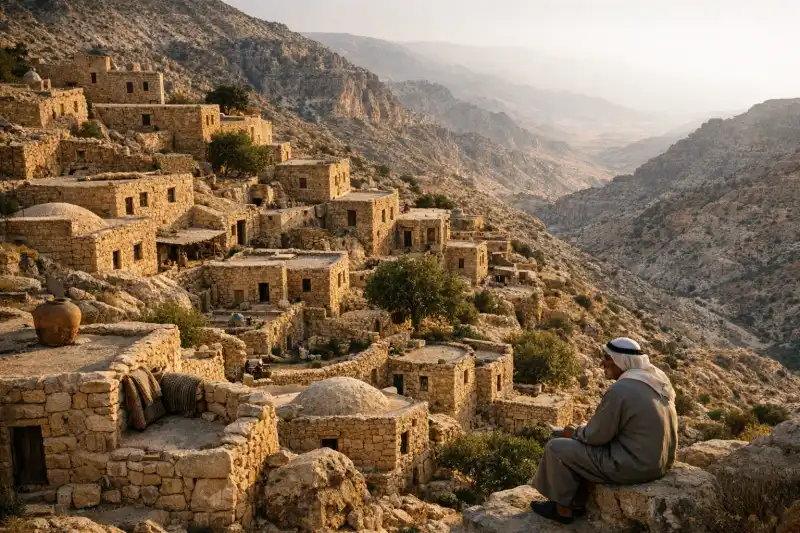
Dana Village
Nabataean, Ottoman, and local Jordanian highland communitiesA timeless stone village in Jordan overlooking Dana Biosphere Reserve, famed for mountain views, tra...
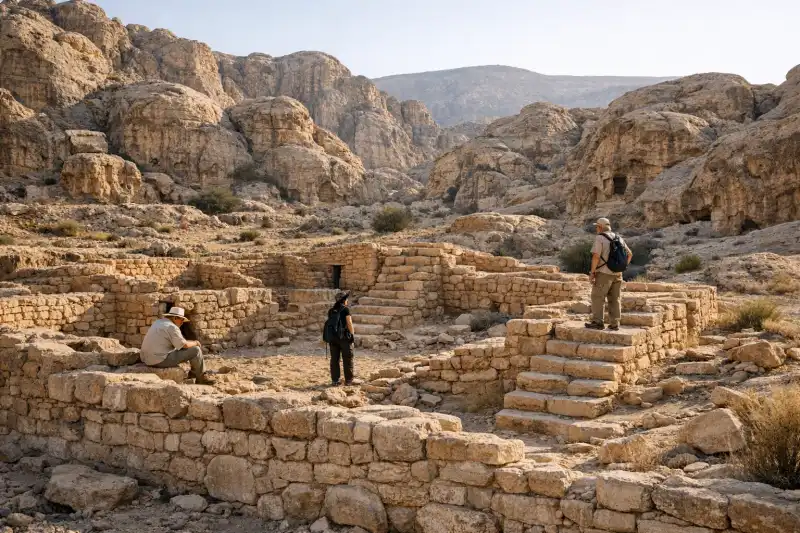
Beidha
Pre-Pottery Neolithic communities of the southern LevantExplore Beidha, a remarkable Neolithic village near Petra in Jordan, known for early farming, stone ...
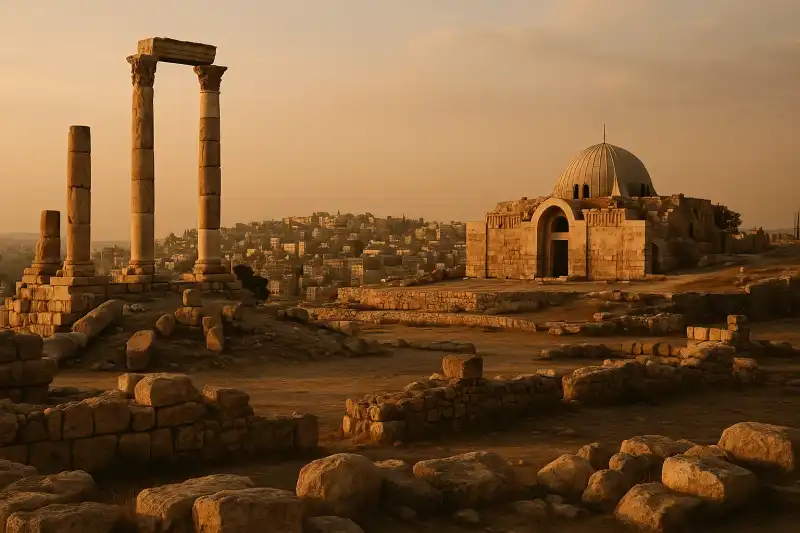
Amman Citadel Jordan Guide 2026: Temple of Hercules & Ancient Rabbah
Ammonite-Roman-UmayyadExplore Jordan's ancient citadel overlooking modern Amman. Discover the Temple of Hercules, Umayyad ...