Quick Info
At a glance
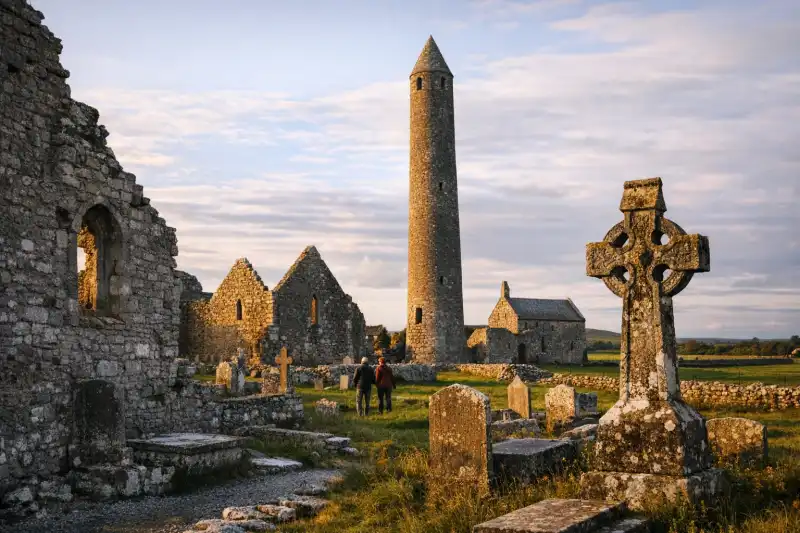
Kilmacduagh in Ireland is one of those places that can feel strangely larger than its footprint. Set amid the green countryside of County Galway, not far from Gort and the limestone landscapes associated with the Burren, this ancient monastic site combines quietness with monumental presence. The first thing many visitors notice is the famous round tower, rising unexpectedly above fields and gravestones and leaning just enough to make you look twice. Then the rest of the complex begins to emerge: roofless churches, the remains of a cathedral, worn stonework, medieval carvings, and the layered atmosphere of a place that remained sacred for centuries.
Unlike some better-known Irish heritage sites crowded by coach groups and heavy interpretation, Kilmacduagh often feels contemplative. Sheep may graze nearby. Wind moves through the grass and broken windows. You can stand beside massive stone walls and imagine the rhythms of monastic prayer, manuscript learning, pilgrimage, diocesan administration, and local burial traditions that shaped this landscape over more than a thousand years. It is a site where architecture and memory are still closely tied to the land around them.
For travelers interested in early Christian Ireland, Kilmacduagh offers a rewarding blend of history and physical presence. It is neither a single building nor a simple ruin, but a small sacred landscape whose surviving structures tell a long story of foundation, growth, reform, and decline. Visiting today means encountering not only stones, but the endurance of a spiritual center that once helped define this part of western Ireland.
History
Origins in the Early Christian Period
Kilmacduagh traces its beginnings to Saint Colman, who is traditionally credited with founding a monastery here in the 7th century. According to local tradition, the location was chosen after a supernatural sign involving a wild boar, a story that reflects the way Irish ecclesiastical foundations often became rooted in both spirituality and landscape. The Irish name, Cill Mhic Dhuach, is generally understood to mean the church of the son of Duach, preserving memories of both lineage and sacred establishment.
In early medieval Ireland, monasteries were not only religious centers but also places of learning, administration, landholding, and regional influence. Kilmacduagh would have functioned within this wider monastic world, one linked by saints’ cults, kinship structures, and local patronage. Though little survives from the very earliest phase in complete form, the site’s later importance strongly suggests that the original foundation quickly gained significance in the district.
As with many Irish monasteries, the earliest buildings were likely more modest than the stone ruins visible today. Timber structures may have preceded the major stone churches, and the complex would have evolved gradually over generations. The shift to substantial masonry signaled both permanence and prestige. By the high medieval period, Kilmacduagh had become more than a local monastery; it was the center of a diocese.
Growth as an Ecclesiastical Center
By the 12th century, church reform across Ireland was reshaping older monastic institutions into diocesan structures more closely aligned with broader European models. Kilmacduagh emerged as the seat of the Diocese of Kilmacduagh, giving the site a new administrative and liturgical importance. This transition helps explain the construction and enlargement of substantial stone churches, including the cathedral remains that dominate the site today.
The cathedral, though now ruined, reflects the ambitions of a church center intended to serve not just monks but a wider ecclesiastical jurisdiction. Romanesque and later Gothic elements point to phases of rebuilding and expansion. Doorways, window tracery, arches, and carved details reveal that Kilmacduagh participated in major architectural developments of medieval Ireland rather than remaining an isolated rural outpost.
The round tower probably belongs to the 10th or 11th century, though exact dating remains debated. Such towers were multipurpose symbols of monastic prestige and practical features for bell-ringing, storage, and refuge. Kilmacduagh’s tower is especially notable for its height and tilt. It stands as one of the most distinctive round towers in Ireland, a landmark that announces the monastic settlement from a distance.
Alongside the cathedral and tower, several smaller churches were built across the grounds. These suggest a complex religious environment in which burial, prayer, pilgrimage, and local devotion all played roles. The density of sacred structures indicates that Kilmacduagh remained active and significant over many centuries.
Later Medieval Change and Post-Medieval Decline
From the late medieval period onward, Kilmacduagh experienced the same pressures that affected many Irish ecclesiastical sites: political upheaval, economic shifts, reform, and changing religious structures. While the diocese remained important, medieval church buildings often suffered from reduced resources, intermittent repair, and the gradual weakening of institutional continuity.
The Reformation transformed the religious landscape of Ireland, though change on the ground could be slow and uneven, especially in rural districts. Over time, however, medieval church complexes such as Kilmacduagh ceased to function in their original way. Roofs were lost, regular maintenance ended, and buildings entered the long phase of picturesque ruin in which many survive today.
Yet decline did not mean abandonment in a total sense. Graveyards preserved continuity of local attachment. Sacred memory endured, and communities continued to value the place even when its ecclesiastical role had changed. Antiquarians, historians, and later heritage visitors were drawn to the site, fascinated by the tower, the cathedral, and the romantic grandeur of the ruins.
Today, Kilmacduagh stands as a rare and compelling survival of Ireland’s layered Christian past: founded in the age of saints, monumentalized in the medieval period, and preserved into modern times as both archaeological site and enduring landmark.
Key Features
What makes Kilmacduagh memorable is not only any single monument, but the relationship between several structures spread across a serene rural setting. The site unfolds gradually. As you approach, the round tower immediately captures attention. Tall, slender, and unmistakably off-vertical, it is among the most dramatic towers in Ireland. Its lean is part of its identity, but so too is its elegant construction. Built of carefully laid stone and tapering as it rises, it demonstrates the technical confidence of medieval masons working within a distinct Irish ecclesiastical tradition. Standing beneath it, you get a sense of how monastic communities used vertical architecture to project spiritual authority into the surrounding landscape.
Near the tower are the remains of the cathedral, the largest structure on the site and the clearest sign of Kilmacduagh’s status as a diocesan center. Though roofless, the building still preserves impressive walls, window openings, and fragments of architectural detailing. You can trace the line of the nave and chancel and imagine how clergy and worshippers once moved through the space. Different phases of construction are visible in the masonry, reminding visitors that medieval churches were often altered rather than built all at once. Romanesque solidity and later Gothic refinement seem to coexist in the ruin, giving the cathedral an architectural richness greater than its ruined state might first suggest.
Around the main complex stand several smaller churches, each with its own character. These are not merely secondary remains; they help communicate how substantial the religious settlement once was. Some preserve simple rectangular forms, while others contain more distinctive openings or carved stone features. Their scale creates intimacy. If the cathedral speaks of diocesan importance, the smaller churches hint at the daily devotional life that once animated the site. Together they create the sense of a sacred precinct built and rebuilt over generations.
The stonework itself deserves close attention. Kilmacduagh rewards slow looking. Doorways, windows, joints in the masonry, and weathered carvings reveal the skill of the builders and the age of the structures. Lichen, moss, and centuries of exposure have softened many surfaces, but this weathering only deepens the atmosphere. The ruins seem fully embedded in the land rather than imposed upon it.
Another notable feature is the graveyard setting. Like many historic Irish monastic sites, Kilmacduagh remains connected to local memory through burial. Headstones from later centuries stand among much older ruins, reinforcing a continuity between medieval sacred space and more recent community life. This layering is important to the site’s emotional effect. You are not simply walking through an abandoned monument; you are moving through a place where sacred use changed but never entirely vanished.
The surrounding landscape adds still another dimension. South Galway is characterized by open fields, shifting skies, and a calm that can feel almost monastic in itself. Kilmacduagh is not dramatically perched on a cliff or mountain. Its power comes from contrast: high medieval architecture rising from quiet lowland countryside. The tower becomes a visual anchor, while the churches and walls create enclosed pockets of reflection. On a misty morning, the site can appear almost dreamlike. In bright weather, the pale stone stands out vividly against green grass and blue sky.
For photographers, historians, and travelers seeking places with atmosphere rather than spectacle, Kilmacduagh offers an unusually complete experience. It combines landmark architecture, archaeological interest, and deep stillness. The result is a site that lingers in memory long after the visit ends.
Getting There
Kilmacduagh is located near Gort in County Galway, making it most convenient to reach by car. From Galway City, the drive typically takes around 45 to 60 minutes depending on traffic and your starting point. From Gort, the journey is short, usually about 10 minutes. Car rental from Galway often starts around €35-€70 per day for a small vehicle, while fuel costs for a return trip are modest. Driving is the simplest option if you want flexibility to combine Kilmacduagh with other heritage stops in south Galway or the Burren region.
Public transport is possible, though less direct. Irish Rail and Bus Éireann services connect Galway City with Gort. A one-way train or bus fare is often in the range of €8-€15, depending on booking time and service type. From Gort, you will generally need a taxi to reach the site, since Kilmacduagh is outside the town center. A local taxi ride may cost roughly €15-€25 each way, so it helps to prearrange return pickup if you are not driving.
Private tours from Galway are another practical choice, especially for visitors who prefer not to manage rural transport. Full-day private excursions around the west of Ireland vary widely in price, but small-group or custom experiences often begin around €100-€200 per person and can include several sites in one itinerary.
The final approach involves walking on uneven ground, so sturdy shoes are advisable. Weather in western Ireland changes quickly, and even a short visit is more comfortable with a waterproof jacket.
When to Visit
Kilmacduagh can be visited year-round, but the experience changes noticeably with the seasons. Late spring through early autumn is the easiest and most popular period. From May to September, longer daylight hours and generally milder conditions make it easier to explore the cathedral ruins, tower, and surrounding grounds at a relaxed pace. Grass is greener, wildflowers may appear around the site, and the broader countryside feels especially inviting. Summer temperatures are usually comfortable rather than hot, often ranging between 15°C and 20°C, though rain remains possible at any time.
Spring is one of the best times for visitors who want a balance of beauty and quiet. The landscape feels fresh, crowds are usually light, and changeable skies can make the ruins especially atmospheric for photography. Autumn is similarly rewarding, with softer light and fewer travelers on the road. The stonework takes on a more subdued character in mist or low-angle sunshine, and the site’s contemplative quality becomes even stronger.
Winter visits can be memorable if you do not mind cold, wet, and windy conditions. You may have the site nearly to yourself, and the starkness of the ruins in bare-season light has its own appeal. However, footing may be slippery, and shorter days mean less flexibility.
If possible, try to visit in the morning or later afternoon rather than at midday. The lower light often brings out more texture in the stone and creates a quieter mood. Whatever the season, dress for sudden changes in weather, because western Ireland rarely stays constant for long.
| Quick Facts | Details |
|---|---|
| Location | Near Gort, County Galway, Connacht, Ireland |
| Historic Role | Early monastic settlement and later diocesan center |
| Founded | Traditionally 7th century CE |
| Best-Known Feature | Leaning round tower |
| Main Remains | Cathedral, round tower, smaller churches, graveyard |
| Ideal Visit Length | 45 minutes to 1.5 hours |
| Nearest Town | Gort |
| Best For | Early Christian history, medieval architecture, quiet heritage visits |
Kilmacduagh is not a site that overwhelms through scale alone. Its appeal is more subtle and, for many travelers, more lasting. Here, the grandeur of medieval faith survives in fragments: a tower that still dominates the skyline, a cathedral open to the weather, and smaller churches that preserve the intimacy of local devotion. The silence of the place is part of its meaning. In that silence, the stones seem to communicate the long continuity of worship, community, and remembrance that shaped this corner of Ireland.
For anyone exploring ancient and medieval Ireland beyond the most famous tourist circuits, Kilmacduagh is an exceptional stop. It offers architectural interest, spiritual depth, and a landscape setting that allows the past to feel close at hand. Whether you come for the famous tower, the history of Saint Colman, or simply the pleasure of discovering a beautiful and less-visited ruin, Kilmacduagh rewards careful attention. It is one of those places where the Irish past is not only visible, but quietly, unmistakably present.
Guided tours: worth it?
Most travelers can visit Kilmacduagh independently. Compare a tour only if you want a tighter history-focused visit, easier logistics, or a guide who can answer questions on the spot.
Best for
- Short visits where a planned route saves time
When to go self-guided
Go independently if you prefer setting your own pace, reading as you go, and checking official hours or ticket rules directly before you arrive.
What I’d avoid
Skip paid tours that bundle unrelated stops you do not actually want. The best option should either save meaningful planning time or add historical context you would miss on your own.
Galway day tours and heritage trips
Useful when: you want to compare guided formats before deciding
County Galway castles and monasteries tours
Useful when: you want to compare guided formats before deciding
West of Ireland private tours from Galway
Useful when: you want flexible timing or a private guide
Some tour links are affiliate links, which may earn Ancient Travel a small commission at no extra cost to you. I try to surface options that make practical sense for the site—not just anything bookable.
Frequently Asked Questions
What is Kilmacduagh known for?
Kilmacduagh is best known for its early medieval monastic ruins in County Galway, especially its remarkably tall and visibly leaning round tower.
Where is Kilmacduagh located?
Kilmacduagh is in south County Galway, Ireland, near the town of Gort in the province of Connacht.
Do you need a ticket to visit Kilmacduagh?
Access arrangements can change, but the site is generally visited as an open historic ruin. Check current local or heritage guidance before traveling.
How much time should I spend at Kilmacduagh?
Most visitors spend 45 minutes to 1.5 hours exploring the cathedral ruins, churches, round tower, and graveyard.
Is Kilmacduagh suitable for families?
Yes, families can enjoy Kilmacduagh, though the ground is uneven and children should be supervised closely around ruins and gravestones.
Can you visit Kilmacduagh from Galway City?
Yes, Kilmacduagh is feasible as a half-day or day trip from Galway City by car, taxi, or as part of a private regional tour.
Nearby Ancient Sites
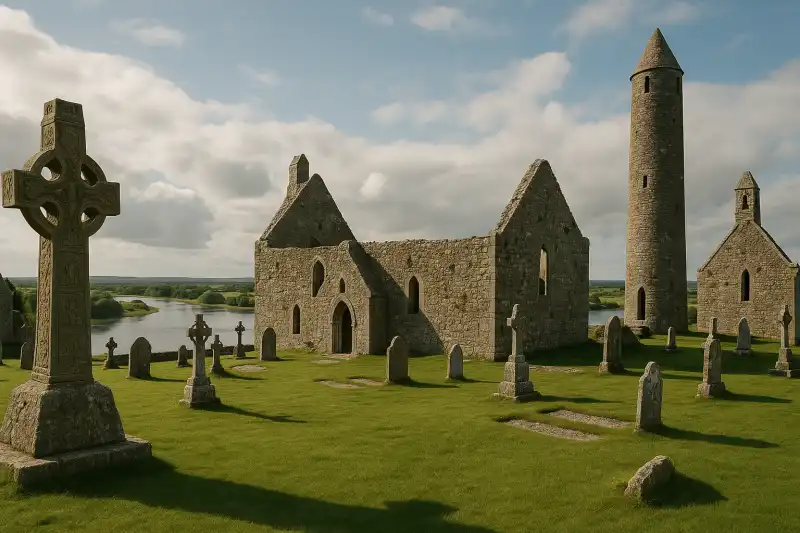
Clonmacnoise Travel Guide 2026: Monastic Ruins, High Crosses, and River Shannon Context
Early Medieval IrelandPlan a first visit to Clonmacnoise with practical timing, monastic-site context, and clear route adv...
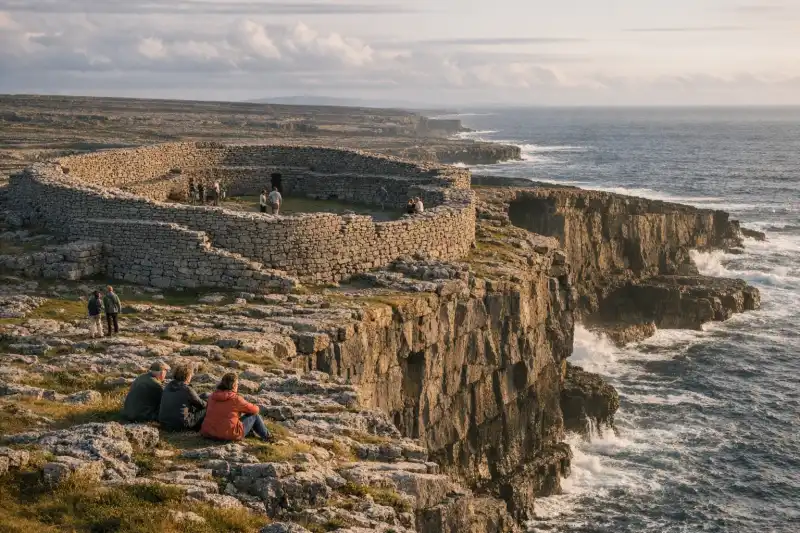
Aran Islands Stone Forts
Prehistoric and early medieval IrishExplore the dramatic prehistoric stone forts of Ireland’s Aran Islands, where Atlantic cliffs and an...
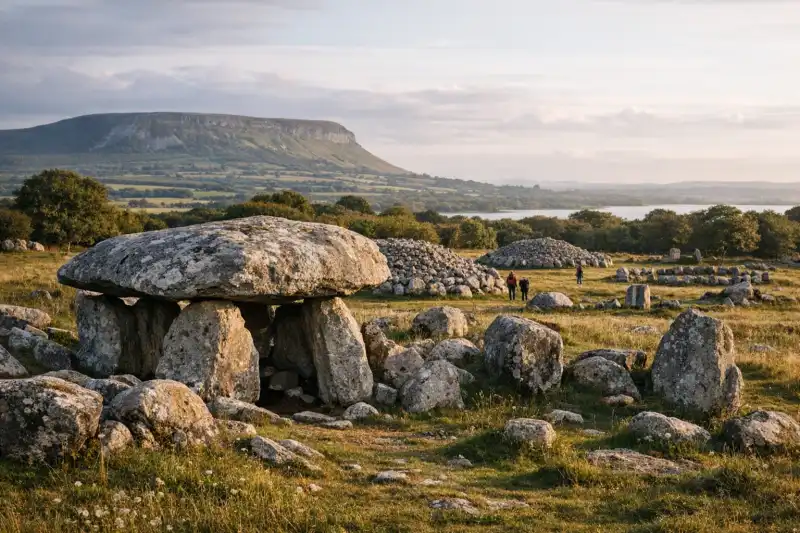
Carrowmore Megalithic Cemetery
Neolithic communities of prehistoric IrelandExplore Carrowmore Megalithic Cemetery, Ireland’s vast Neolithic burial landscape near Sligo, with t...