Quick Info
At a glance
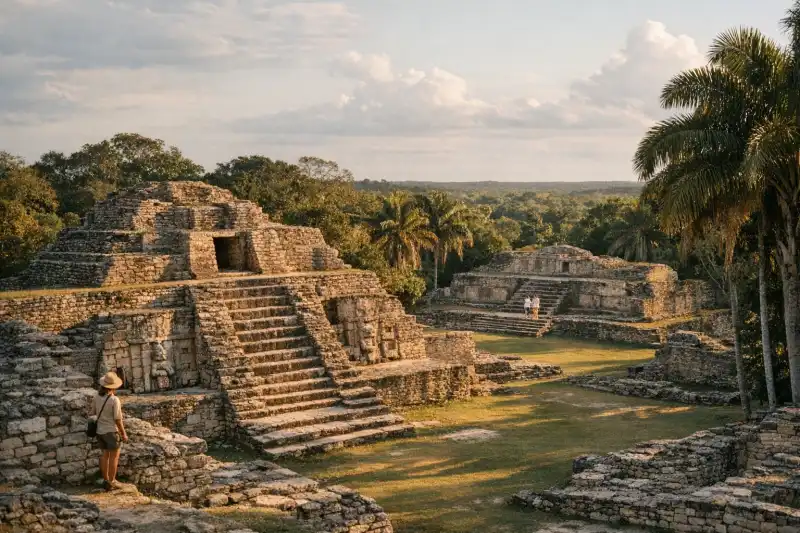
Kohunlich, in Mexico, is one of those ancient Maya sites that feels discovered rather than visited. Reached through the forests of southern Quintana Roo, it rises from a landscape of dense greenery, birdsong, and heavy tropical air, far from the resort imagery that often defines the region. Instead of massive crowds and long queues, travelers usually find broad plazas, stair-stepped pyramids, and shaded pathways that encourage a slower, more attentive kind of exploration. The experience here is not only about seeing ruins; it is about watching stone architecture emerge from the jungle much as archaeologists once did, with each platform and temple seeming to belong naturally to its surroundings.
What gives Kohunlich its special identity is a combination of scale, atmosphere, and art. It was once a significant regional center, shaped by trade and political connections across the Maya world. Today it is best known for the Temple of the Masks, where enormous stucco faces still cling to the sides of a pyramid stairway, offering one of the most memorable sights in ancient Mesoamerica. Yet the site’s appeal goes beyond a single monument. Residential compounds, ceremonial groups, elevated causeways, and open courtyards reveal a city designed for both ritual and daily life. For travelers interested in ancient history without the intensity of Mexico’s most famous ruins, Kohunlich offers something rarer: grandeur in stillness.
History
Early settlement and growth
Kohunlich was first occupied around the Late Preclassic period, likely by about 200 BCE, when communities were spreading through the lowlands of what is now southern Quintana Roo. Its location was strategic. Though it was not a coastal port, it stood within a network of routes linking the Petén region, the Yucatán Peninsula, and areas farther south in present-day Belize and Guatemala. This inland position allowed the settlement to participate in trade while remaining protected within fertile, forested terrain.
In its earliest stages, Kohunlich was probably a modest center made up of residential zones, agricultural support areas, and ceremonial spaces that gradually became more formalized. As with many Maya settlements, development was not instantaneous. Buildings were enlarged over time, earlier platforms were buried beneath new construction, and ritual life became increasingly elaborate. Archaeological evidence suggests that by the Late Preclassic and Early Classic periods, the site had acquired enough influence to support major public works and sustained elite activity.
The Early Classic florescence
Kohunlich reached its greatest prominence during the Early Classic period, roughly from the 3rd to the 7th centuries CE. This was the era in which many of its most important structures were built or expanded, including the famous Temple of the Masks. The city’s rulers likely benefited from links to wider Maya political and economic systems, and there are indications of influence from powerful centers such as Teotihuacan, either directly or through broader cultural exchange. Architectural patterns, iconography, and the style of certain constructions suggest that Kohunlich was not isolated but actively engaged with the dynamic world of Classic-era Mesoamerica.
The Temple of the Masks belongs to this flourishing phase. Its monumental stucco masks, associated with solar imagery and royal symbolism, point to a sophisticated political-religious ideology. Such decoration was not merely ornamental. In Maya architecture, façades communicated sacred power, dynastic legitimacy, and cosmological meaning. The masks at Kohunlich probably framed the ruler’s role within a sacred order tied to celestial cycles, especially the movement and rebirth of the sun.
The city at this time contained elite residences, ceremonial plazas, administrative spaces, and connected groups of buildings arranged with clear planning. Elevated walkways, or sacbeob, linked different sectors. This urban organization reflects a mature center with hierarchy, ceremonial obligations, and a population capable of supporting sustained construction.
Transformation and decline
Like many Maya centers, Kohunlich did not remain dominant forever. During the Late Classic period, political networks shifted across the region. Some cities expanded while others lost influence, and Kohunlich appears to have entered a period of transformation rather than abrupt collapse. Construction continued in some areas, and occupation persisted, but the character of the site changed. Certain ceremonial spaces may have been reused differently, and elite power likely became less centralized.
By the Terminal Classic and into the Postclassic period, Kohunlich was no longer among the region’s major political players. Population declined, monumental construction slowed, and parts of the city were gradually reclaimed by forest. This pattern mirrors broader upheavals in the Maya lowlands, where environmental pressures, warfare, altered trade routes, and political fragmentation contributed to the weakening of many urban centers. Kohunlich was not entirely abandoned at once, but over time it ceased to function as a major ceremonial and administrative capital.
Rediscovery and archaeological study
After centuries of relative obscurity beneath thick vegetation, Kohunlich drew modern archaeological attention in the 20th century. The site name itself derives from an English surname associated with a nearby estate, transformed phonetically into Spanish over time. Formal investigation and conservation revealed the scale of the city and brought its most celebrated features to public awareness.
Excavation work uncovered plazas, palace-like compounds, and the iconic stucco masks that made Kohunlich famous. Conservation has been especially important here because stucco is fragile in humid tropical conditions. Archaeologists and preservation teams have had to balance public access with protection from rain, temperature shifts, and biological growth. Thanks to that work, visitors today can appreciate both the grandeur of the architecture and the delicacy of the surviving art.
Key Features
The defining image of Kohunlich is the Temple of the Masks, and it deserves its reputation. Set on a substantial pyramid platform, the structure features giant stucco masks flanking the central stairway. These faces are powerful even in their worn state. Their broad features, elaborate headdresses, and commanding expressions suggest divine or royal associations, often linked by scholars to solar symbolism. Unlike carved stone reliefs, stucco has a softer, more modeled quality, giving the masks a vivid presence that can feel surprisingly human. Standing before them, you are not just looking at decoration but at a carefully staged statement about sacred kingship and cosmic order.
Beyond this celebrated monument, Kohunlich unfolds as a spacious and varied city. One of its pleasures is that the site does not compress everything into a single ceremonial core. Instead, visitors move through distinct architectural groups that reveal different aspects of Maya urban life. Broad plazas open suddenly after stretches of forest path, and low platforms lead the eye toward taller temples and palatial structures. This layout creates a rhythm of discovery. Rather than encountering one overwhelming vista, you piece together the city sector by sector.
The Acropolis area is especially evocative. Raised above surrounding spaces and associated with elite occupation, it contains courtyards and structures that suggest administrative and residential functions. Here the architecture feels more intimate than monumental, offering a glimpse into the built environment of Maya nobility. Rooms, terraces, and enclosed spaces hint at governance, ritual preparation, and domestic life among the upper ranks of society. These compounds remind visitors that ancient cities were not only places of public ceremony but also lived spaces shaped by status and power.
Another notable sector is the Plaza of the Stelae, where open ceremonial space emphasizes the civic dimension of the site. Even when original carved monuments are weathered or no longer fully legible, the arrangement of platforms and plaza edges conveys a sense of public gathering. These were spaces where rulership was performed, rituals were witnessed, and community identity was reinforced. The scale is large enough to feel important but not so vast that the human proportions disappear.
The site’s relationship with the forest is also a key feature in its own right. At Kohunlich, trees often frame pyramids, roots approach retaining walls, and shade softens the geometry of stone. This setting gives the ruins a particularly atmospheric character, especially early in the day when the air is cooler and wildlife is active. Monkeys are not always seen here, but birds, insects, and the persistent soundscape of the tropical environment make the city feel embedded in a living ecosystem. For many travelers, this is one of the strongest contrasts with larger, more exposed archaeological zones.
Kohunlich is also notable for how accessible its architecture feels. While some stairways are steep and not all structures are open for climbing, many of the pathways are straightforward, and the site invites unhurried walking. You can spend time observing construction details: the proportions of platforms, the layering of masonry, the way ceremonial axes organize movement. Because crowds are usually lighter than at more famous Maya destinations, it is easier to pause, photograph, and absorb the place without feeling rushed along.
What ultimately makes Kohunlich memorable is its balance. It has enough monumentality to impress, enough artistry to stand apart, and enough quiet to preserve a sense of encounter. The ruins do not compete for attention with heavy commercialization. Instead, they ask visitors to notice subtler things: the shape of a stairway emerging from shadow, the texture of old stucco under protective covering, the alignment of plazas beneath a tropical sky. That combination of cultural depth and environmental presence is the site’s true signature.
Getting There
Kohunlich is most commonly visited from Chetumal, the capital of southern Quintana Roo. By road, the journey is usually around 65 to 75 kilometers depending on route, and travel time is roughly 1.5 hours. Renting a car is the simplest option for independent travelers because public transportation to the site is limited and infrequent. Basic rental cars from Chetumal often start around MXN 700 to 1,200 per day, not including fuel, and this gives you flexibility to combine Kohunlich with other nearby sites.
Taxis or private transfers can be arranged from Chetumal, though this is significantly more expensive. Expect a round-trip private taxi fare in the range of MXN 1,800 to 3,000 depending on negotiation, waiting time, and season. For travelers who prefer not to drive, organized tours are often the best value, especially if they include transport, entrance fees, and a guide. Group day tours from Chetumal or the Costa Maya area commonly begin at around USD 70 to 140 per person, depending on inclusions and whether other ruins are visited the same day.
Public buses may get you part of the way along the highway, but they usually do not deliver a simple door-to-door experience. If relying on local transport, you may need to coordinate a shared taxi for the final stretch, which can be inconvenient on the return trip. For most visitors, self-drive or a booked tour is the most practical approach.
When to Visit
The best time to visit Kohunlich is generally during the dry season, from November to April, when roads are easier to navigate, humidity is lower, and walking the site is more comfortable. Morning visits are especially rewarding. Temperatures are cooler, the light is softer for photography, and the forest atmosphere feels freshest before midday heat builds. If you want a quieter, more contemplative experience, arriving early is ideal.
The hotter months, especially April and May, can still be good for travel if you are prepared for strong sun and high humidity. Bring more water than you think you need, wear light clothing, and plan for regular shade breaks. The site’s tree cover helps in places, but open plazas can become very warm by late morning and early afternoon.
The rainy season usually runs from late spring into autumn, with the heaviest rains often between June and October. During this period the surrounding landscape becomes especially lush, which can make the ruins even more beautiful. However, showers can be intense, trails may become slippery, and mosquitoes are more active. Tropical weather can also affect driving conditions on rural roads. If you visit in these months, pack a light rain layer and insect repellent.
Hurricane season overlaps with the late summer and early autumn period, so travelers should monitor forecasts if visiting southern Quintana Roo then. For the most balanced conditions, late winter and early spring tend to offer the best combination of access, comfort, and clear weather.
| Quick Facts | Details |
|---|---|
| Location | Southern Quintana Roo, Mexico |
| Civilization | Maya |
| Main highlight | Temple of the Masks |
| Best base city | Chetumal |
| Typical visit length | 2 to 4 hours |
| Best season | November to April |
| Access | Best by rental car, private transfer, or guided tour |
| Atmosphere | Forested, quiet, and less crowded than many major Maya sites |
Guided tours: worth it?
Self-guided works here, but a guide can add real value if you want the ruins explained as a living place rather than just a sequence of monuments.
Best for
- First-time visitors who want context, not just photos
- Short visits where a planned route saves time
When to go self-guided
Go independently if you prefer setting your own pace, reading as you go, and checking official hours or ticket rules directly before you arrive.
What I’d avoid
Skip paid tours that bundle unrelated stops you do not actually want. The best option should either save meaningful planning time or add historical context you would miss on your own.
Kohunlich tours
Useful when: you want to compare guided formats before deciding
Kohunlich and Chacchoben tours
Useful when: you want to compare guided formats before deciding
Chetumal to Kohunlich day trips
Useful when: transport or pickup logistics matter
Some tour links are affiliate links, which may earn Ancient Travel a small commission at no extra cost to you. I try to surface options that make practical sense for the site—not just anything bookable.
Frequently Asked Questions
Where is Kohunlich located?
Kohunlich is in the state of Quintana Roo in southern Mexico, inland from the Caribbean coast and north of Chetumal.
What is Kohunlich most famous for?
The site is best known for the Temple of the Masks, whose large stucco faces are among the most striking surviving examples of Maya architectural decoration in the region.
How much time should I allow for visiting Kohunlich?
Most travelers spend 2 to 4 hours exploring the main plazas, pyramids, causeways, and surrounding forested grounds.
Can you visit Kohunlich from Chetumal?
Yes. Kohunlich is commonly visited as a day trip from Chetumal by rental car, private transfer, or guided tour.
Is Kohunlich suitable for independent travelers?
Yes. The site is reachable by road, and independent visitors can walk the ruins on clearly defined paths, though having your own transport makes the trip much easier.
What should I bring to Kohunlich?
Bring water, sun protection, insect repellent, sturdy walking shoes, and cash for entrance fees or local transport needs.
Nearby Ancient Sites
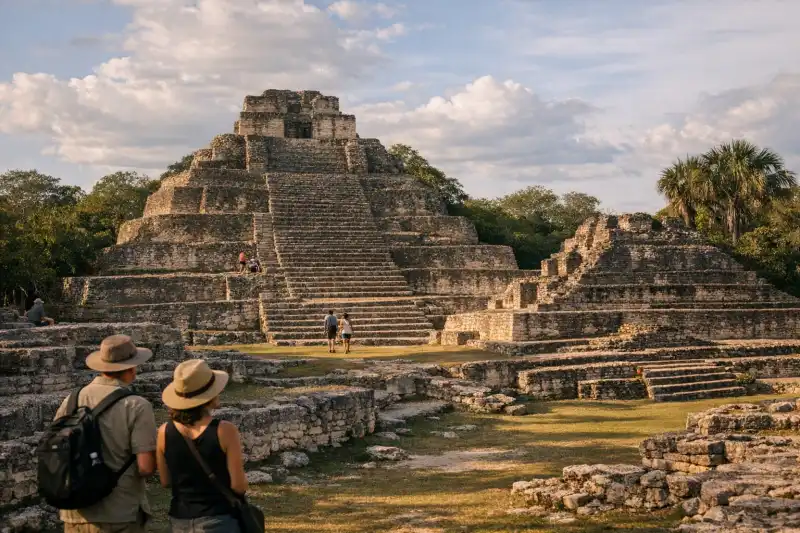
Chacchoben
MayaExplore Chacchoben, a serene Maya archaeological site in Mexico surrounded by jungle, lagoons, and i...
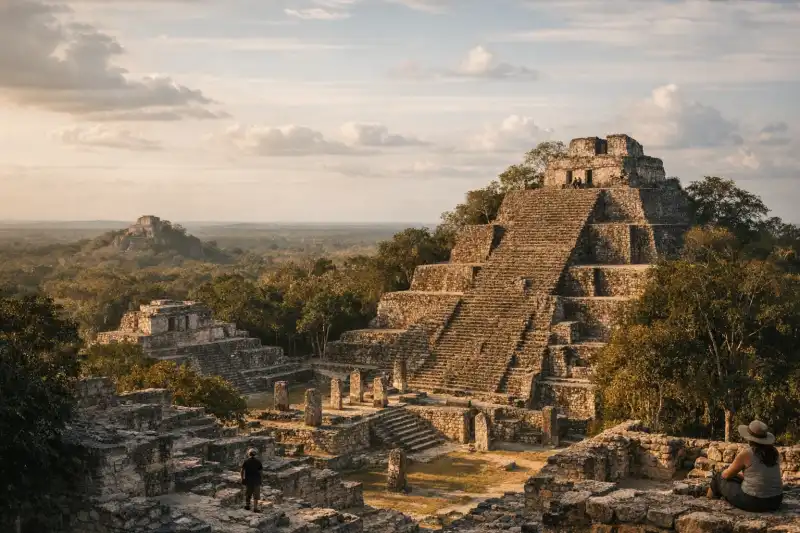
Calakmul
MayaExplore Calakmul, a vast Maya city deep in the forests of Campeche, Mexico, known for towering pyram...
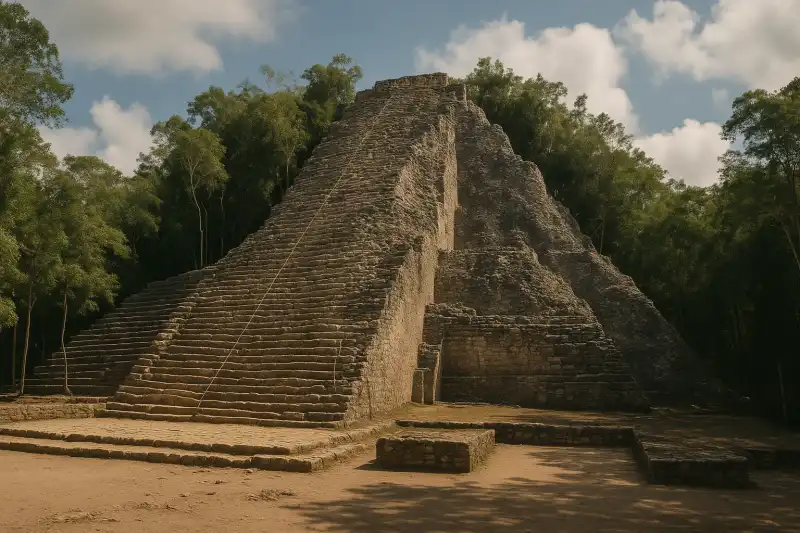
Coba Travel Guide 2026: Ruins Route, Timing, and Practical Day Planning
MayaPlan a better Coba visit with route strategy, realistic timing from Tulum or Cancun, and practical t...