Quick Info
At a glance
Labná, in Mexico, is one of the most graceful ancient sites in the Yucatán Peninsula: smaller than the headline names, quieter than the major tourist circuits, and often more memorable because of that silence. Reached through the low forest of the Puuc hills, the ruins emerge not as a sprawling metropolis but as a finely composed ceremonial and residential center shaped by careful masonry, decorative stonework, and a strong sense of architectural drama. Travelers often come to Labná as part of the Puuc Route, a constellation of Maya sites that includes Kabah, Sayil, and Uxmal, yet Labná rewards far more than a quick stop. It offers an experience that feels intimate and legible, where buildings sit close enough together to encourage slow looking and repeated returns to key details.
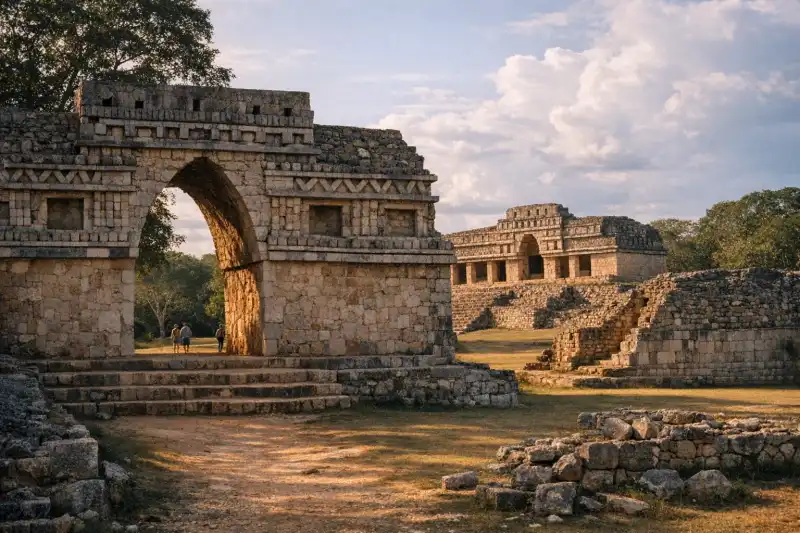
The name Labná is usually translated as “old house” or “old building,” a fitting label for a place whose surviving structures still communicate the prestige of the community that built them. Here, visitors walk among palaces, terraces, and courtyards where elite families and administrators once lived and governed. Most famous of all is the site’s arched gateway, a masterpiece of Puuc architecture whose proportions and carved façade give Labná an instantly recognizable identity. Unlike some heavily reconstructed ruins, Labná retains an atmosphere of discovery. Birds call from the brush, iguanas disappear into stone crevices, and the pale limestone walls glow against green vegetation. It is an archaeological site best appreciated not by rushing through it, but by allowing its elegance, scale, and setting to unfold gradually.
History
Early settlement and the rise of the Puuc region
Labná developed within the Puuc region of the Maya world, an area of low limestone hills in what is now southwestern Yucatán. This zone became one of the most distinctive cultural landscapes of the Late Classic period, especially between about 600 and 900 CE, when a network of prosperous communities emerged across the countryside. Unlike some Maya centers built around permanent rivers or lakes, settlements in the Puuc hills relied on careful management of seasonal rainfall. Water was stored in chultuns, underground cisterns cut into bedrock, and in other collected reservoirs. The ability to support dense populations in this environment required planning, labor, and social organization.
Labná likely began as a modest settlement before growing into an important local center. Its rise was tied to broader regional patterns: agricultural productivity, inter-site exchange, and elite competition expressed through monumental building. During this period, cities of the Puuc zone developed a shared architectural vocabulary marked by smooth lower walls, richly ornamented upper façades, mosaic stone decoration, and repeated depictions of Chaac, the rain deity. Labná participated fully in this tradition, though on a somewhat smaller scale than the greatest nearby centers.
Flourishing in the Late Classic and Terminal Classic periods
The main florescence of Labná appears to have occurred during the Late Classic to Terminal Classic periods, roughly from the 7th to 10th centuries CE. This was the era in which its principal monuments were erected and elaborated. Like other Maya centers, Labná was not simply a ceremonial complex detached from everyday life. It was a living community that likely included nobles, artisans, laborers, priests, and agricultural families connected to the site’s political core.
Its architecture suggests a place of status and refinement. Multi-room palatial buildings indicate elite residence and administration, while the careful arrangement of platforms and courtyards points to staged movement through the site. The great arch, which now defines Labná in photographs and guidebooks, may have marked a formal passage between precincts or functioned as a ceremonial threshold. Whatever its exact purpose, it embodied authority and artistic sophistication.
Labná’s success was tied to the broader prosperity of the Puuc region, which may have benefited from shifting trade routes and changes in political gravity as some southern Maya lowland cities declined. Craft knowledge was clearly advanced here. Stone-cutting was precise, façades were harmoniously proportioned, and decorative programs were carefully integrated into structural design. The site’s builders worked in limestone, creating surfaces that could be both monumental and delicate.
Decline and abandonment
Like many Maya centers, Labná did not remain permanently occupied in its monumental form. By the 10th century, much of the Puuc region experienced demographic and political decline. The causes were likely multiple rather than singular: environmental stress, changing trade networks, internal conflict, regional realignment, and the broader transformations that affected the Maya world during the so-called Terminal Classic collapse.
At Labná, elite construction appears to have ceased, and the ceremonial-administrative center lost its former importance. Some degree of continued occupation in surrounding zones may have persisted, as often happened at Maya sites, but the era of palace building and formal architectural expansion came to an end. Over time, vegetation reclaimed plazas and walls, while roofs and upper elements collapsed. The site survived not as a functioning city, but as a remembered landscape embedded in regional memory.
Rediscovery, study, and conservation
European and North American travelers, explorers, and scholars documented many Yucatán ruins in the 19th century, when Maya archaeology first began to attract broad attention. Labná was among the sites recorded during these exploratory journeys. Early descriptions and illustrations helped introduce the elegance of Puuc architecture to an international audience. As archaeology matured in the 20th century, Labná became part of a more systematic effort to understand regional chronology, construction methods, settlement patterns, and the relationships among the Puuc centers.
Conservation has focused especially on stabilizing standing architecture and making the site accessible to visitors without overwhelming its fragile character. Today Labná remains under the protection of Mexican heritage authorities and forms an important stop on the Ruta Puuc. While it is not among the largest Maya sites in Mexico, it is among the most aesthetically admired, a place where archaeologists and travelers alike can see how much social meaning was carried in stone form, ornament, and movement through space.
Key Features
Labná’s most celebrated feature is the Arch, and it deserves its reputation. Standing apart from the larger masses of the main palace structures, it has a balance and confidence that make it feel almost sculptural. The arch is not a true Roman-style arch but a corbelled Maya form, created by progressively overlapping stones until the sides meet at the top. What makes this one extraordinary is not just engineering but finish. Its façade is decorated with fine geometric stone mosaic, and its proportions are so carefully judged that it seems both monumental and light. Passing through it is one of the most evocative experiences at the site, because it compresses and frames movement in a way that reveals how Maya builders shaped ritual and visual perception.
Another essential structure is the palace often called El Palacio. This elongated building sits on a substantial platform and contains multiple rooms, suggesting elite residential and administrative use. The façade displays classic Puuc qualities: smooth lower surfaces, decorated upper zones, and a disciplined sense of symmetry. Even in partial ruin, the building conveys authority. You can imagine plastered walls, painted details, and a social life organized around audiences, hospitality, and control of local affairs. Labná may be smaller than Uxmal, but in structures like this it demonstrates the same cultivated architectural language.
A notable pyramid or temple platform rises elsewhere in the complex, giving visitors a sense of vertical contrast within the site. While not towering on the scale of the best-known Maya pyramids, it shows that Labná’s builders used elevation to mark sacred and civic importance. Looking across the ruins, you begin to understand how the site was choreographed: broad horizontal palace ranges, raised temples, controlled entries, and open spaces for gathering or circulation.
What also distinguishes Labná is the detail work. Puuc architecture is often admired for its ornament, and here the surviving carvings reveal a visual culture deeply invested in pattern and sacred imagery. Masks associated with Chaac, the rain god, are characteristic of the region. Their hooked noses and emphatic features appear in façades elsewhere along the Puuc Route and reflect the immense importance of rainfall in a landscape without major surface water. At Labná, even where carvings are weathered, the decorative intent remains obvious. Builders wanted their structures to communicate sacred protection, lineage prestige, and aesthetic control.
The site’s setting is another key feature, though it is not a built one. Labná lies within low tropical forest rather than in a dense urban environment, and that context changes the emotional tone of a visit. The ruins are encountered through birdsong, heat, filtered light, and the scent of vegetation. Because the site is relatively compact, the jungle feels close at all times, softening the edges of the architecture and reminding visitors how temporary human dominance can be. This nearness of nature and masonry is part of Labná’s charm.
Finally, Labná stands out because it is comprehensible. Some great archaeological zones can feel overwhelming, their histories difficult to read without deep preparation. Labná, by contrast, offers enough complexity to reward attention while remaining small enough that visitors can form a clear mental map. You can move from palace to arch to raised structures and begin to imagine processions, elite households, craft activity, and ceremonial passage. In that sense, its scale is an advantage. The site teaches visitors how Puuc architecture worked by presenting its principles in a distilled, elegant form.
Getting There
Most travelers reach Labná from Mérida, the capital of Yucatán, or as part of a circuit through the Puuc region. By car, the journey from Mérida generally takes around 2 to 2.5 hours depending on traffic and route. A rental car is the easiest option if you want flexibility to combine Labná with Uxmal, Kabah, Sayil, or nearby villages. Daily car rental in Mérida often starts around MXN 700 to 1,400 before insurance, while fuel costs for a day trip are usually moderate.
Guided tours are another practical choice. Full-day archaeological excursions from Mérida that include Uxmal and one or more Puuc sites commonly range from about MXN 1,500 to 3,500 per person, depending on group size, transport comfort, and whether lunch and entrance fees are included. Private tours cost more but are useful if Labná is a priority rather than a brief add-on.
Public transport to Labná is possible but less straightforward. Buses and colectivos generally serve larger hubs rather than the site directly, so independent travelers using public transit may need to ride to a nearby town and then continue by taxi. A regional bus from Mérida toward the southern Yucatán route may cost roughly MXN 100 to 250, and a connecting taxi can add MXN 200 to 500 depending on distance and negotiation. Because schedules can be limited, this method requires patience and advance planning.
If you are staying near Uxmal, Labná is much easier to reach. Taxi fares from the Uxmal area can vary widely, often around MXN 400 to 900 round trip with waiting time. However you arrive, bring water, sun protection, and some cash, as services near the site may be minimal.
When to Visit
The best time to visit Labná is during Yucatán’s dry season, generally from November through April. These months usually bring lower humidity, clearer skies, and more comfortable conditions for walking among exposed stone structures. Morning visits are especially rewarding. The light is softer, wildlife is more active, and temperatures are significantly gentler than in the middle of the day. If you want to photograph the arch and façades, early hours often provide the best combination of angle, shadow, and manageable visitor numbers.
The hot season intensifies from about March through May, when midday heat can be draining even without rain. During this period, arriving right when the site opens is strongly recommended. Lightweight clothing, a hat, and plenty of water become essential. Because Labná is a relatively compact site, a heat-conscious traveler can still have an excellent visit by keeping the schedule short and early.
The rainy season, typically from May or June into October, brings greener landscapes and a dramatic atmosphere, but also more humidity, passing storms, and occasional muddy paths. Rain can make the forest feel lush and alive, which suits the site’s intimate setting, but heavy showers may disrupt travel plans or reduce the amount of time you want to spend outdoors. Mosquitoes can also be more noticeable.
If your priority is comfort and convenience, aim for December to February. If your priority is fewer visitors and a greener landscape, the shoulder months can be appealing. Whenever you go, avoid the peak afternoon heat when possible. Labná is a site that rewards calm observation, and that is easiest when the climate allows you to linger.
| Quick Facts | Details |
|---|---|
| Location | Puuc region, Yucatán, Mexico |
| Civilization | Maya |
| Main period | Late Classic to Terminal Classic, c. 600-1000 CE |
| Famous for | The elegant ceremonial arch and refined Puuc architecture |
| Best base city | Mérida |
| Typical visit length | 1-2 hours |
| Best time to go | November to April, especially in the morning |
| Combined itinerary | Often visited with Uxmal, Kabah, and Sayil |
| Terrain | Uneven archaeological paths in low tropical forest |
| What to bring | Water, hat, sunscreen, comfortable shoes, cash |
Labná is the kind of place that often exceeds expectations precisely because it is not the most famous ruin in Mexico. It does not depend on scale alone. Instead, it impresses through proportion, setting, and craftsmanship. For travelers interested in the Maya world beyond the biggest names, it offers a close encounter with the sophistication of Puuc architecture and the environmental intelligence of the communities who built in this dry, hilly landscape. Its arch is one of the great works of ancient Mesoamerican design, but the wider site matters just as much: the palaces, raised platforms, and quiet passages that reveal an elite center once fully integrated into regional life.
A visit here also helps place the Yucatán Peninsula in richer context. Chichén Itzá may draw global attention, and Uxmal may dominate the Puuc route, but Labná shows how much beauty and historical value survive in smaller centers. It is a site for travelers willing to slow down, look closely, and imagine social worlds from fragments of stone. In the stillness of the forest, with limestone walls catching the sun, Labná feels less like a remote ruin and more like a carefully composed memory of Maya urban life in Mexico.
Guided tours: worth it?
A guide can be genuinely useful at Labná, especially if you want help with transport, timing, tickets, or understanding a large site without losing half the day to logistics.
Best for
- First-time visitors who want context, not just photos
- Travelers who want transport, timing, or entry logistics handled
- Short visits where a planned route saves time
When to go self-guided
Go independently if you already have transport and tickets sorted, enjoy moving at your own pace, and are comfortable checking the latest official rules before you arrive.
What I’d avoid
Skip paid tours that bundle unrelated stops you do not actually want. The best option should either save meaningful planning time or add historical context you would miss on your own.
Labná and Puuc Route tours
Useful when: you want to compare guided formats before deciding
Uxmal and nearby Maya sites tours
Useful when: you want to compare guided formats before deciding
Yucatán archaeological day trips
Useful when: transport or pickup logistics matter
Some tour links are affiliate links, which may earn Ancient Travel a small commission at no extra cost to you. I try to surface options that make practical sense for the site—not just anything bookable.
Frequently Asked Questions
Where is Labná located?
Labná is in the Puuc region of Yucatán state in southern Mexico, south of Mérida and not far from Uxmal along the well-known Puuc Route.
What is Labná best known for?
Labná is best known for its beautifully preserved ceremonial arch, one of the most elegant examples of Puuc Maya stonework in the Yucatán Peninsula.
How much time do you need to visit Labná?
Most travelers spend 1 to 2 hours at Labná, though history enthusiasts often combine it with other Puuc sites for a full day.
Can you visit Labná independently?
Yes. Labná can be visited independently by rental car or taxi, and it is also commonly included in guided tours from Mérida or Uxmal-area hotels.
Is Labná suitable for families?
Yes. The site is relatively compact and manageable for families, though paths can be uneven and hot during midday.
What is the best time of year to visit Labná?
The best time to visit is generally during the dry season from November to April, when temperatures are more comfortable and rain is less frequent.
Nearby Ancient Sites
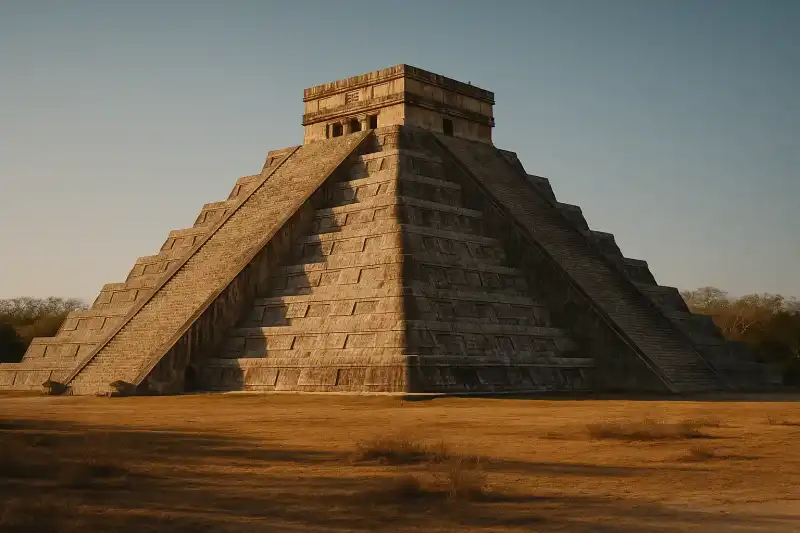
Chichen Itza Travel Guide 2026: Maya Secrets, Sacred Cenote, and Smart Timing
MayaChichen Itza stands as the most visited ancient site in Mexico, showcasing the architectural genius ...
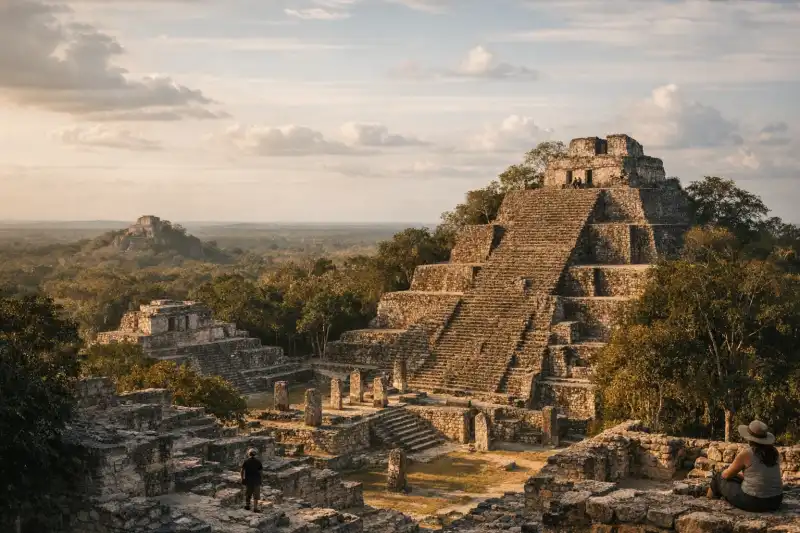
Calakmul
MayaExplore Calakmul, a vast Maya city deep in the forests of Campeche, Mexico, known for towering pyram...
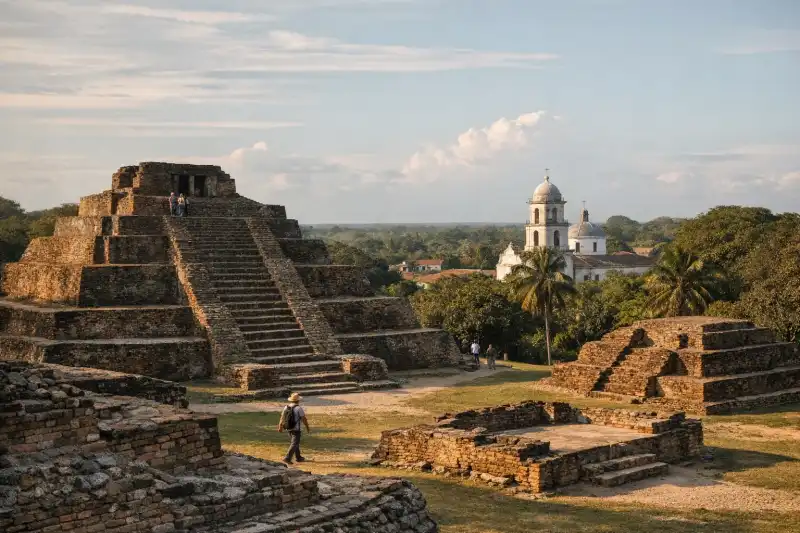
Comalcalco
MayaExplore Comalcalco, Mexico's distinctive Maya city built with brick, carved stucco, and rich Gulf Co...