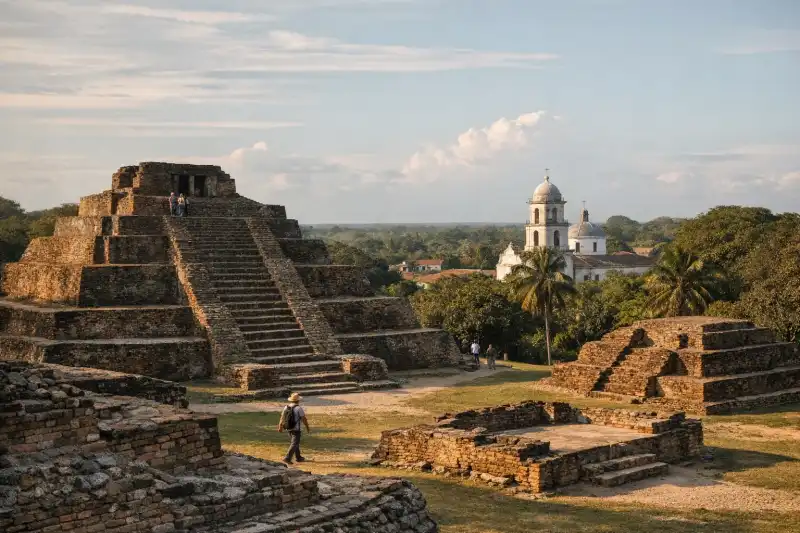
Quick Info
At a glance
Comalcalco in Mexico feels different from many other Maya sites almost from the first moment you arrive. The lowland heat hangs over the fields of Tabasco, birds move through the humid air, and then the ruins appear: temple platforms and palace remains not of the expected pale limestone, but of warm-toned fired brick. That single detail changes the whole atmosphere. Comalcalco is ancient and recognizably Maya, yet its materials, textures, and setting give it an identity all its own.
Set in a fertile region once shaped by rivers, trade, and cacao cultivation, Comalcalco offers a striking reminder that the Maya world was never culturally uniform. Here, architecture adapted to the landscape. Builders worked with what was available, creating monumental structures with brick and shell-lime mortar, then finishing them with stucco and paint. For travelers used to thinking of Maya ruins as stone cities emerging from dry forests, Comalcalco offers a broader story—one linked to the Gulf Coast, to commerce, and to local ingenuity.
A visit today combines visual appeal with historical depth. The site is compact enough to explore in a few hours, but layered enough to reward close attention. From temple mounds and ceremonial plazas to carved bricks and reconstructed decorative elements, Comalcalco invites you to look carefully. It is not simply an unusual ruin in Tabasco; it is one of the most distinctive archaeological sites in Mexico, a place where material scarcity inspired architectural creativity and where regional identity became part of monumental design.
History
Early settlement and regional context
The area around Comalcalco was occupied long before the site reached its architectural peak. Tabasco’s riverine plains supported agriculture, fishing, and exchange, making the region a natural corridor between the Maya interior and the Gulf Coast. Communities in this zone were part of wider interaction networks that connected highland and lowland peoples, and over time local elites emerged who could organize labor, control trade, and sponsor ceremonial construction.
Comalcalco developed in an environment very different from the limestone-rich Yucatán or parts of Chiapas. Its builders did not have easy access to the large cut stone blocks used at many famous Maya centers. Instead, they responded to local conditions by developing a building tradition based on fired bricks, shell-derived lime, and thick stucco coatings. This practical solution eventually became a defining feature of the city.
By the first centuries of the Common Era, settlements in the wider region were already participating in Mesoamerican economic and political life. Agricultural productivity, especially in a humid tropical environment, likely supported population growth. Access to waterways also would have helped Comalcalco connect with coastal and inland routes, allowing goods, ideas, and artistic influences to circulate.
Rise during the Late Classic period
Comalcalco flourished most strongly during the Late Classic period, roughly between the 6th and 9th centuries CE. This was the era when many Maya cities reached high levels of political complexity, artistic production, and monumental construction. At Comalcalco, elite groups commissioned ceremonial architecture, temple complexes, and civic spaces that announced their authority in a style adapted to local resources.
The city appears to have been integrated into broader Maya political dynamics rather than existing in isolation. Epigraphic and stylistic evidence suggests ties, rivalries, and exchanges with other centers, including powerful cities farther east and south. Though Comalcalco was never as vast as Tikal or Calakmul, it occupied a strategic position in a region valuable for trade. Scholars have often linked Tabasco’s lowlands with the movement of cacao, marine products, and other prestige goods, and Comalcalco may have benefited from that economic role.
Its major construction projects from this period include temple platforms, palatial compounds, and acropolis-like elevated groups. The city’s leaders invested heavily in visual impact. Buildings were covered in stucco and ornamented with modeled imagery, giving them a more elaborate appearance than the surviving brick cores alone might suggest today. Some bricks also bear marks, designs, or inscriptions, creating an additional level of interest for archaeologists.
Architecture, identity, and outside influence
One of the most fascinating aspects of Comalcalco’s history is how it combined unmistakably Maya planning and symbolism with construction methods that appear highly localized. The use of fired brick is exceptional in the Maya world, and it may reflect both environmental necessity and regional experimentation. The resulting architecture was not crude substitution; it was sophisticated engineering designed to produce durable monumental buildings in a wet climate.
Comalcalco’s artistic and architectural forms also suggest cultural contact beyond the immediate region. Certain motifs and construction ideas have prompted comparisons with sites influenced by wider Mesoamerican trends. While scholars differ on the degree and direction of these interactions, there is little doubt that Comalcalco was plugged into a dynamic world of exchange. It was a city aware of broader styles but confident in its own building traditions.
This combination of connectivity and local innovation helps explain why the site attracts such interest today. It demonstrates that Maya civilization could be both deeply shared and strongly regional at the same time.
Decline and abandonment
Like many Maya centers, Comalcalco entered a phase of decline toward the end of the Classic era, around the 9th century CE. Monumental building slowed, political systems weakened, and populations likely shifted. The causes were probably multiple: changes in trade routes, environmental pressures, political instability, and broader transformations affecting many parts of the Maya world.
Comalcalco may have retained some occupation after its principal florescence, but the period of major ceremonial and elite activity came to an end. Over time, vegetation reclaimed the structures, and the city passed into archaeological silence. Local memory persisted in the landscape, yet the full significance of the ruins only became clearer through modern investigation.
Rediscovery and archaeology
In the modern era, explorers, scholars, and Mexican archaeologists documented Comalcalco and began to uncover its unusual construction history. Excavation and conservation revealed temple groups, decorative stucco remains, tombs, and the now-famous bricks marked with symbols and designs. The site became increasingly recognized as one of Mexico’s most distinctive ancient cities.
Today Comalcalco is protected as an archaeological zone and includes an on-site museum that helps visitors understand its layout, chronology, and material culture. Conservation is ongoing, especially because tropical humidity and heavy rainfall create constant challenges. Even so, enough survives to make the city legible and memorable. What was once a regional Maya center has become an essential stop for travelers interested in seeing how diverse ancient Mexico truly was.
Key Features
What makes Comalcalco immediately memorable is the material itself. Instead of broad façades of neatly cut limestone, you see courses of fired brick laid into platforms, temples, and supporting walls. This gives the ruins a texture unlike almost any other major Maya site. In the slanting light of morning or late afternoon, the brick surfaces can seem almost intimate compared with the hard glare of stone architecture elsewhere. They remind you that ancient builders were problem-solvers as much as ritual specialists, adapting engineering to environment.
The ceremonial core includes elevated groups and plazas that would once have structured public and sacred life. As you move through the site, the arrangement still communicates hierarchy: raised platforms for important buildings, open spaces for gatherings, and temples positioned to dominate movement and sightlines. Even in partial ruin, the architecture conveys a carefully ordered city where religion, status, and performance were inseparable.
One of the most important areas is often referred to as the North Plaza, where several of the principal structures stand. Here, visitors gain the clearest sense of Comalcalco’s civic and ceremonial planning. Nearby mounds and building remnants reveal repeated phases of construction, expansion, and rebuilding. The city did not emerge all at once; it grew over generations, with each new layer embedding political ambition into architecture.
The so-called Great Acropolis is another highlight. This elevated complex functioned as an elite and ceremonial zone, and it remains one of the best places to appreciate the scale of the site. Climbing or walking around these raised sectors allows you to imagine how rulers and priests may have separated themselves physically and symbolically from ordinary residents below. The Acropolis also shows how Comalcalco balanced monumentality with practical adaptation. Brick cores, mortar, and stucco finish worked together to create imposing forms suited to local conditions.
Decorative stucco is central to understanding the site, even though much of it has not survived intact. Buildings that now look plain would once have been visually rich, coated with plaster and modeled ornament, likely painted in vivid colors. Reconstructed fragments and museum displays help restore that lost dimension. They reveal a city that was far more colorful and theatrical than its weathered remains suggest. This matters because Maya architecture was never just structural; it was symbolic display, turning buildings into statements of cosmology and power.
Another especially intriguing feature is the carved and marked brick corpus. Some bricks at Comalcalco bear signs, images, or maker’s marks that have fascinated researchers for decades. These markings offer rare glimpses into construction processes, identity, or perhaps ritual symbolism. For visitors, they add an almost human scale to the site. Behind the temples and plazas were individual hands—craftspeople shaping, firing, carrying, and setting each brick into place.
The tombs and burial finds associated with the site further underline its ceremonial importance. Elite interments, offerings, and associated objects show that Comalcalco was not merely an administrative center but a sacred landscape where ancestors, rulers, and ritual practice were closely linked. As at other Maya cities, death and authority were woven into architecture. Temple platforms could serve as stages for both public devotion and dynastic memory.
The museum is an essential part of the experience rather than an optional add-on. It provides context for the layout, displays artifacts from excavations, and explains why Comalcalco’s construction methods matter. If you visit the ruins without the museum, you may appreciate the atmosphere; with the museum, you understand the innovation. It is especially useful for seeing stucco fragments, ceramics, and interpretive material that connect the weathered ruins to the living city they once were.
Finally, the landscape around Comalcalco is itself a feature. This is not a dry, isolated ruin set against bare horizon. It belongs to humid Tabasco, a world of green vegetation, moisture, fertile ground, and agricultural abundance. That environment shaped everything from the city’s economy to its engineering. Visiting Comalcalco means seeing Maya civilization through a Gulf Coast lens, where climate, trade, and local resources created a city both fully Maya and unmistakably regional.
Getting There
Comalcalco is most easily reached from Villahermosa, the capital of Tabasco, which serves as the main gateway for travelers arriving by air or long-distance bus. From Villahermosa, the archaeological zone is roughly 60 to 70 kilometers away depending on your route, and the drive usually takes around 1.5 hours. Renting a car is the simplest option because it gives you flexibility to combine the site with museums, cacao haciendas, or other stops in the region. Daily rental rates in Villahermosa commonly start around MXN 700 to 1,200, with higher prices in peak travel periods.
Taxis and private transfers are also possible. A one-way taxi from Villahermosa to Comalcalco may cost roughly MXN 900 to 1,500, depending on negotiation, vehicle type, and whether the driver waits and returns with you. For small groups, a private driver can be convenient and not dramatically more expensive per person than other options.
Budget travelers can use public transport in stages. Buses or colectivos from Villahermosa toward Comalcalco are generally affordable, often in the MXN 80 to 180 range one way depending on service class and route. From the town of Comalcalco, you may need a short taxi ride to the archaeological zone, usually around MXN 80 to 150. This is the cheapest approach, though it takes more time and requires more coordination.
Entrance fees can change, but visitors should budget a modest archaeological site admission charge, often around MXN 75 to 100 for foreign visitors, with possible discounts for eligible residents, students, teachers, or nationals on designated days. Bring cash just in case, along with water and sun protection, as services at the site itself may be limited.
When to Visit
Comalcalco can be visited year-round, but seasonal conditions in Tabasco make timing important. The best months for many travelers are from roughly November through February, when temperatures are somewhat milder and the humidity can feel more manageable. Even then, the climate remains tropical, so early morning is usually the most comfortable time to explore. Softer light also brings out the textures of the brick architecture beautifully.
March through May tends to be hotter, with stronger sun and heavier, more draining humidity. If you travel during these months, try to arrive as close to opening time as possible. Midday visits can be tiring, especially because exposed areas of the site offer limited shade. A hat, sunscreen, insect repellent, and plenty of water are essential.
The rainy season, generally from late spring into autumn, transforms the landscape into deep green and can make the surroundings especially atmospheric. Showers are often intermittent rather than constant, so visiting is still possible and can be rewarding if you do not mind wet weather. The trade-off is muddier ground, slick surfaces, and a greater chance of heat combined with rainfall. Lightweight rain gear and sturdy footwear are useful.
If your priority is photography, the drier and cooler months are usually the easiest. If your priority is seeing the site framed by lush vegetation, the wetter season has clear appeal. Weekdays are often quieter than weekends or Mexican holiday periods. Whatever the month, aim for an early start and avoid building your schedule around the hottest part of the afternoon.
| Quick Facts | Details |
|---|---|
| Location | Comalcalco, Tabasco, Mexico |
| Civilization | Maya |
| Main florescence | Late Classic to Terminal Classic, c. 500-900 CE |
| Distinctive feature | Monumental architecture built largely with fired brick and shell-lime mortar |
| Best base | Villahermosa |
| Typical visit length | 2-4 hours |
| Good for | Archaeology enthusiasts, Maya history travelers, architecture lovers, regional Mexico itineraries |
| Bring | Water, hat, sunscreen, insect repellent, cash, light rain protection in wet season |
| Access style | Best by car, taxi, private transfer, or combined bus/colectivo plus local taxi |
| Why it stands out | One of the most unusual Maya sites in Mexico because of its brick construction and Gulf Coast setting |
Comalcalco rewards travelers who appreciate differences within the ancient world. It does not rely on overwhelming scale or celebrity status. Instead, it impresses through character: brick where you expect stone, tropical Tabasco where many imagine only the dry Maya lowlands, and a city that tells a story of adaptation as much as power. For anyone interested in how ancient civilizations responded creatively to local environments, Comalcalco is not a detour—it is the point.
Guided tours: worth it?
Self-guided works here, but a guide can add real value if you want the ruins explained as a living place rather than just a sequence of monuments.
Best for
- First-time visitors who want context, not just photos
- Short visits where a planned route saves time
When to go self-guided
Go independently if you prefer setting your own pace, reading as you go, and checking official hours or ticket rules directly before you arrive.
What I’d avoid
Skip paid tours that bundle unrelated stops you do not actually want. The best option should either save meaningful planning time or add historical context you would miss on your own.
Comalcalco and Tabasco archaeological tours
Useful when: you want to compare guided formats before deciding
Villahermosa to Comalcalco day tours
Useful when: you want to compare guided formats before deciding
Tabasco Maya ruins and cacao experiences
Useful when: you want to compare guided formats before deciding
Some tour links are affiliate links, which may earn Ancient Travel a small commission at no extra cost to you. I try to surface options that make practical sense for the site—not just anything bookable.
Frequently Asked Questions
What is Comalcalco known for?
Comalcalco is famous for being one of the few major Maya sites built largely with fired brick rather than cut limestone, along with its stucco decoration and Gulf Coast setting.
Where is Comalcalco located?
Comalcalco is in the state of Tabasco in southeastern Mexico, near the modern town of Comalcalco and within reach of Villahermosa.
How much time do you need to visit Comalcalco?
Most visitors spend 2 to 4 hours exploring the archaeological zone and its museum, though history enthusiasts may want longer.
Can you visit Comalcalco as a day trip from Villahermosa?
Yes, Comalcalco is commonly visited as a day trip from Villahermosa by rental car, taxi, or organized tour.
Why was Comalcalco built with brick?
The region lacks abundant building stone, so ancient builders used fired bricks and shell-based mortar, creating an architectural style that is unusual in the Maya world.
Is Comalcalco suitable for families?
Yes, the site is manageable for families, though shade can be limited and the tropical heat makes water, hats, and sunscreen important.
Nearby Ancient Sites
Chiapa de Corzo
Zoque and earlier Mesoamerican culturesExplore Chiapa de Corzo, Mexico, a major early Mesoamerican site beside the Grijalva River in Chiapa...
Edzná
MayaExplore Edzná, a striking ancient Maya city in Campeche, Mexico, known for its grand plazas, elevate...
Dzibilchaltún
MayaExplore Dzibilchaltún, an ancient Maya city in Mexico known for its Temple of the Seven Dolls, sacbe...