Quick Info
Curated Experiences
Private Tour to Pamukkale and Laodikeia from Marmaris
Pamukkale and Laodicea Day Tour from Denizli
Private Pamukkale, Hierapolis and Laodikeia Tour
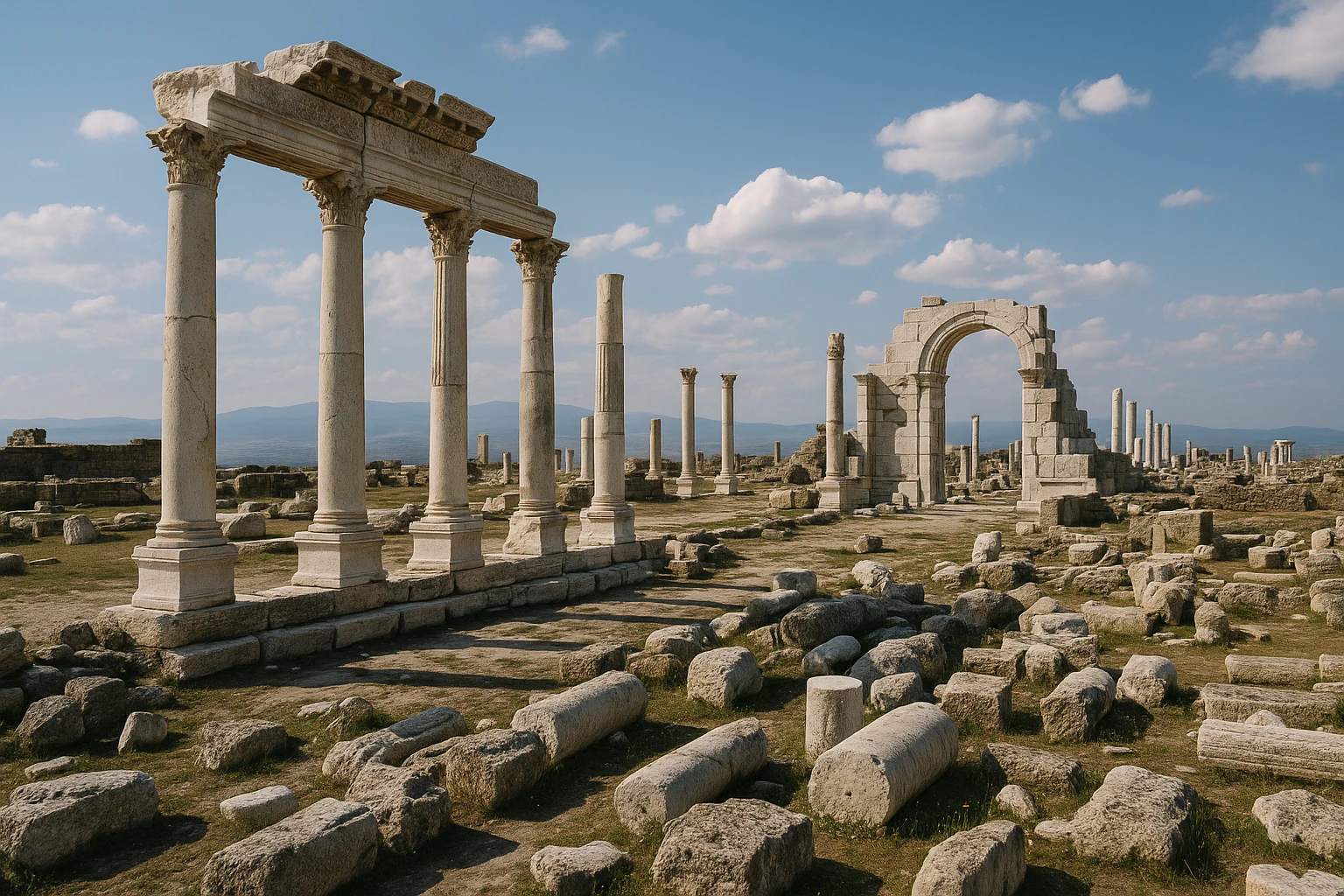
At Laodikeia in Turkey, you do not arrive at a single iconic postcard ruin. You arrive at an entire city grid spread across a high Anatolian plain, where avenues stretch out, churches rise from Roman foundations, and restoration work makes old urban geometry feel unexpectedly alive. In practice, this Laodikeia Turkey travel guide starts with one core truth: the first impression is scale, and the second is continuity. You can read Hellenistic ambition, Roman wealth, late antique Christianity, and medieval adaptation in one long walk under big Denizli skies.
Laodikeia-on-the-Lycus was once one of the richest cities in western Anatolia, famous for banking, black wool textiles, and medicine. It later became equally famous in Christian history through its mention in the Book of Revelation. At Ancient Travels, we recommend Laodikeia as the intellectual counterpart to nearby Pamukkale-Hierapolis: less thermal spectacle, more urban archaeology. This guide covers the city’s layered history, the monuments and streets that matter most, transport and ticket planning from Denizli and Pamukkale, seasonal strategy, and how to combine Laodikeia with neighboring classics in a single well-paced route.
History: Wealth, Faith, and Rebuilding on the Lycus
Hellenistic foundation on a strategic plain (c. 3rd century BCE)
Laodikeia was founded in the Seleucid period, usually dated to the 3rd century BCE and associated with Antiochus II, who named the city for Queen Laodice. The location was deliberate: a fertile corridor near major inland routes connecting the Aegean world with inner Anatolia. From the beginning, the city was positioned less as a fortified hilltop and more as a commercial and administrative node. That orientation shaped everything that followed. Laodikeia’s prosperity came from movement, exchange, and regional integration, not isolation behind walls.
Roman prosperity and urban expansion (1st century BCE-3rd century CE)
Under Roman rule, Laodikeia became one of Asia Minor’s wealthiest cities. Ancient sources describe extensive banking activity, textile production, and medical trade, including eye salves exported across the region. Monumental building followed: colonnaded streets, theaters, bath complexes, nymphaea, and civic institutions that projected Roman order through architecture. The city also developed notable water infrastructure, bringing and distributing supplies across a broad urban footprint. Repeated earthquakes damaged parts of Laodikeia, but elite wealth enabled rapid rebuilding, reinforcing its status as a resilient metropolitan center rather than a fragile provincial outpost.
A major early Christian center (1st century-6th century CE)
Laodikeia holds a special place in Christian memory because it appears in Revelation as one of the Seven Churches of Asia. That textual moment often overshadows the wider historical reality: the city became an important episcopal center with multiple church constructions and evolving liturgical spaces over centuries. Pagan and Christian traditions overlapped during transition periods, visible in reused materials and adapted urban zones. By late antiquity, Laodikeia was not simply a Roman city with a church; it was a Christian city that still carried Roman urban DNA in its streets, infrastructure, and public architecture.
Byzantine contraction and medieval transition (7th-13th centuries CE)
From the 7th century onward, warfare, changing trade patterns, seismic activity, and regional instability contributed to demographic decline. Settlement did not vanish overnight, but urban life contracted and shifted. Administrative weight gradually moved toward nearby centers in the Lycus valley, while parts of Laodikeia were quarried, reused, or abandoned. In this period, the city moved from active metropolis to layered ruin landscape. Later Seljuk and early Turkic phases in the region did not erase Laodikeia’s presence; they reframed it as inherited material within a transformed political and cultural map.
Modern rediscovery and major restoration campaigns (19th century-present)
Travelers documented Laodikeia in the modern era, but sustained archaeological work accelerated in the late 20th and early 21st centuries under Turkish leadership. Recent decades have emphasized not only excavation but high-visibility anastylosis and conservation, especially along monumental avenues and select civic buildings. That is why Laodikeia feels unusually legible compared with many large ruins: restorations help visitors read street lines, façade rhythm, and spatial sequencing. The site today functions as both research zone and public historical landscape, where new findings continue to reshape how scholars understand urban religion, commerce, and resilience in Roman and late antique Anatolia.
The Key Monuments: What to See at Laodikeia
Syrian Street and the colonnaded urban axis
The Syrian Street is Laodikeia’s most photogenic and conceptually important space: a long restored avenue where colonnades, paving, and architectural fragments reveal how movement was choreographed through the city. This was not a decorative promenade alone. It organized commerce, processions, social display, and access to adjoining civic structures. Walking it gives you a rare sense of ancient urban tempo, especially in early morning when shadows carve depth between columns. Look for differences in block finish and reconstruction joints; they quietly document the site’s modern conservation philosophy.
The West Theatre
Laodikeia’s West Theatre anchors the city’s entertainment and assembly culture. Built into a slope and expanded in Roman phases, it once seated thousands and framed performances against the wider Lycus landscape. Even in partial preservation, the cavea’s curve and the stage zone’s remaining architecture communicate the social mechanics of Roman spectacle: collective viewing, elite patronage, and political messaging folded into public leisure. Climb partway up the seating to understand proportions, then pause on descent for oblique views of the orchestra. Late-day light often gives the masonry more texture and reduces harsh contrast.
The stadium and gymnasium complex
The stadium-gymnasium zone speaks to civic identity through athletic and educational life. What survives is more fragmentary than the theater, but the scale is still evident in long foundations, spatial alignments, and monumental traces across the eastern sector. In Roman Anatolia, these complexes were not only about sport; they were training grounds for citizenship, rhetoric, status, and social networking. At Laodikeia, the breadth of this zone helps you imagine a city that invested heavily in public institutions beyond religion and trade. Give yourself time to walk the perimeter rather than viewing it from one static point.
The church complexes of Laodikeia
For many travelers, the most meaningful monuments are the church complexes linked to Laodikeia’s early Christian role. Multiple ecclesiastical structures reveal changing liturgical plans, later repairs, and adaptations to seismic damage. The famous association with Revelation draws attention, but the architecture tells a broader story about continuity: Roman construction traditions, late antique worship needs, and local craftsmanship all intersect here. These ruins reward quiet observation more than speed. Watch how apses, aisle lines, and reused blocks map belief onto inherited urban fabric.
The central church and sacred topography
One of the best-known sacred areas is often called the Central Church, where restoration has made plan geometry easier to read from ground level. Columns, floor zones, and structural outlines show how ceremonial routes once moved congregations through space. The building’s position inside the larger city plan matters as much as its walls: this was Christianity embedded in a functioning urban environment, not an isolated shrine. If you are interested in early church history, pair this stop with a second pass along nearby civic ruins to see how secular and sacred infrastructures coexisted.
Nymphaeum, fountains, and water engineering traces
Laodikeia’s ruined nymphaea and fountain systems are easy to underestimate, yet they are critical to understanding why the city could sustain wealth and population on an exposed plateau. Aqueduct-fed distribution, storage, and monumental presentation of water were status markers as much as utilities. Even where superstructures are incomplete, channels and basin remains indicate a sophisticated hydraulic network integrated with streets and public spaces. In practical terms, this is the invisible backbone of urban life. In interpretive terms, it explains how Laodikeia maintained metropolitan scale despite recurring environmental stress.
Getting There: Transportation and Access
Laodikeia is straightforward by road and works well as a half-day or full-day stop from Denizli or Pamukkale.
From Denizli city center
From central Denizli, Laodikeia is close enough for a direct taxi, short self-drive, or guided transfer, and this is the easiest independent base.
- Taxi: Usually 500-900 TRY ($16-28 USD) one way depending on time, waiting agreement, and pickup area; travel time about 20-30 minutes.
- Public transport: Local bus routes toward the outskirts plus a short taxi for the final leg can work, generally 50-140 TRY ($2-5 USD) total, but schedules are less tourist-friendly.
- Rental car: Typically 1,200-2,200 TRY ($37-68 USD) per day plus fuel; best if combining Laodikeia with multiple Lycus Valley sites.
From Pamukkale village and Hierapolis
Many visitors pair Laodikeia with Pamukkale-Hierapolis on the same day because transfer times are manageable.
- Taxi/private transfer: Commonly 700-1,300 TRY ($22-40 USD) one way; travel time around 25-35 minutes.
- Guided day tour: Combined archaeology packages often run 2,500-4,500 TRY ($78-140 USD) per person with transport and guide inclusions.
- Rental car: Fastest independent option, especially if you want sunrise at one site and sunset at another.
Admission and Hours
Entry is ticketed separately in Turkish lira, and pricing can change by season, so confirm rates shortly before your visit. As a practical baseline, expect a mid-range archaeological ticket in the hundreds of TRY, with card payment commonly available but backup cash still smart. Opening windows are usually longer in summer and shorter in winter. Arriving near opening time gives better temperatures and cleaner photo conditions on the main avenues, while late afternoon is often best for warm, directional light on restored columns.
When to Visit: Seasonal Considerations
Spring (March-May)
Spring is the most balanced season for Laodikeia. Daytime temperatures generally range from 14-27°C (57-81°F), with cooler mornings ideal for long walks across exposed sectors. Crowd levels are moderate, and restoration zones are easier to photograph before bus groups arrive. If you want the best overall comfort-to-visibility ratio, late April and May are excellent.
Summer (June-August)
Summer brings serious heat, often 30-38°C (86-100°F) by afternoon, with reflected glare off pale stone. The site is still very visitable, but timing becomes everything. Enter as early as possible, carry at least 1.5 liters of water per person, and use hat plus sunscreen consistently. Midday circuits can feel draining because shade is limited in the wider city sectors.
Autumn (September-November)
Autumn is arguably the ideal shoulder season, especially September and October, when temperatures commonly settle around 17-31°C (63-88°F). Visitor pressure is lighter than peak summer, and side light improves texture on colonnades and theater masonry. For photographers and slower-paced walkers, this is often the sweet spot for both climate and atmosphere.
Winter (December-February)
Winter is quiet and atmospheric, typically around 6-15°C (43-59°F) in daytime, with occasional rain and brisk wind over open terrain. Crowds drop sharply, making the city feel spacious and contemplative. Bring waterproof layers and shoes with traction, and verify seasonal hours before departure. On clear days, winter visibility across the plain can be superb.
Combining Laodikeia with Pamukkale and the Lycus Valley
The most rewarding one-day sequence starts at Laodikeia by 8:00 AM, when avenues are cooler and the Syrian Street is still soft in low-angle light. Spend the first two hours moving from colonnaded zones to the theater and church complexes, then use a short break around 10:30 AM before heat builds. By 11:00 AM, depart for Pamukkale-Hierapolis, arriving in time to explore core ruins and travertine viewpoints through early afternoon.
A practical lunch window is around 1:30 PM in Pamukkale village or along the Denizli corridor, where lokantas and kebab houses are easier and better value than rushing on-site snacks. After lunch, return to Hierapolis sectors you missed earlier, then shift to travertine viewpoints near 4:30 PM as the light turns warmer. This rhythm gives you urban archaeology in the morning and geological spectacle in late day, a far stronger contrast than reversing the order.
If you have two days, slow down: dedicate half a day or more to Laodikeia alone, then split Pamukkale-Hierapolis and Aphrodisias across the second day depending on stamina and transport. Laodikeia rewards patience because its logic is spatial, not singular. You are reading a city plan, not collecting one hero monument. Total active sightseeing time for a one-day Laodikeia-Pamukkale pairing usually lands around 9-11 hours including transfers and meals.
Practical Information
Bring sun protection, water, and sturdy shoes; Laodikeia’s scale means more walking than many travelers expect. A lightweight long-sleeve layer helps in both intense summer sun and cool shoulder-season mornings. Toilets and services are typically concentrated near entry zones, so plan hydration and breaks before committing to outer sectors.
Dress is generally casual for archaeological touring, but respectful coverage is still wise if you combine the day with active religious sites elsewhere in Denizli Province. Mobility conditions are mixed: some restored paths are easier to navigate, while older sectors remain uneven with loose stone and gentle grade changes. If mobility is limited, focus on central restored zones and theater viewpoints rather than full perimeter loops.
Why Laodikeia Matters
Laodikeia matters because it corrects a common misunderstanding about ancient travel: great sites are not always single monuments. Sometimes greatness is urban intelligence spread across streets, utilities, sacred spaces, and institutions that once made daily life possible for tens of thousands of people. Here, wealth did not just commission decorative façades; it built systems that held a city together through earthquakes, political change, and religious transformation.
It also matters because the site keeps two histories in conversation. One is Roman and civic, measured in avenues, theaters, fountains, and markets. The other is spiritual and late antique, measured in churches, letters, and evolving religious identity. At Laodikeia, neither story cancels the other. They overlap in stone.
When you stand on the avenue and look across the plain toward modern Denizli, the feeling is not ruin as absence. It is structure as memory: a city still teaching you how people organized ambition, belief, and survival in a difficult landscape.
Quick Facts
| Attribute | Details |
|---|---|
| Location | Near Denizli, Denizli Province, Turkey |
| Ancient Name | Laodikeia on the Lycus (Laodicea ad Lycum) |
| UNESCO Status | On Turkey’s UNESCO Tentative List |
| Established | c. 3rd century BCE Seleucid foundation |
| Distance from nearest hub | ~10 km from central Denizli; ~20-30 minutes by road |
| Entry Fee | Mid-range TRY ticket (check current rate), card + cash recommended |
| Hours | Seasonal schedule; generally longer summer, shorter winter |
| Best Time | Spring and autumn, especially early morning |
| Suggested Stay | 2.5-4 hours (longer with detailed church and theater circuit) |
| Signature Highlight | Restored Syrian Street and layered Roman-Christian urban plan |
Explore More Turkey
- Hierapolis: Thermal Roman-Byzantine city above Pamukkale’s white terraces.
- Aphrodisias: Masterpiece of Roman sculpture, stadium architecture, and urban planning.
- Ephesus: Monumental Aegean metropolis with iconic imperial-era streets and façades.
- Miletus: Ionian and Roman city with major theater remains and layered harbor history.
Plan your complete journey with our Turkey Ancient Sites Guide. For route strategy, read our Turkey itinerary planning guide.
Frequently Asked Questions
How much time should I plan for Laodikeia?
Most travelers need at least 2.5 to 3.5 hours to see the Syrian Street, churches, stadium area, and main civic ruins without rushing. If you enjoy architecture or photography, plan closer to 4 hours. Add extra time in summer because heat slows walking on the exposed plateau.
Is Laodikeia included with Pamukkale-Hierapolis tickets?
Ticketing policies can change, but Laodikeia is commonly managed as a separate archaeological entry from Pamukkale-Hierapolis. If you are doing both sites in one day, verify current prices and combo options at official counters or Ministry channels before arrival. Carry both card and some cash in case of network issues.
What is the best time of day to visit Laodikeia?
Early morning is best for comfort, softer light, and fewer tour groups, especially from May through September. Late afternoon can also be excellent for photos along the colonnaded avenues. Midday is workable in cooler months but harsh in summer due to limited shade.
How do I get to Laodikeia from Denizli or Pamukkale?
From central Denizli, the site is typically a 20-30 minute drive by taxi or rental car, depending on traffic. From Pamukkale village, driving usually takes around 25-35 minutes. Public transport options exist via local buses plus taxi for the last stretch, but schedules are less convenient for tight itineraries.
What are the key highlights at Laodikeia?
Do not miss the restored Syrian Street, the monumental West Theatre, the church complexes tied to early Christianity, and the broad stadium-gymnasium zone. The site's scale is part of the experience, so wide-angle viewpoints and elevated spots are worth your time. It feels more like an entire ancient city map than a single ruin cluster.
Is Laodikeia suitable for families and older travelers?
Yes, many major paths are broad and manageable, and you can tailor the route to shorter loops. That said, surfaces are still uneven in places and shade is limited in warmer months. Comfortable shoes, water, and paced breaks make the visit easier for all ages.
Nearby Ancient Sites
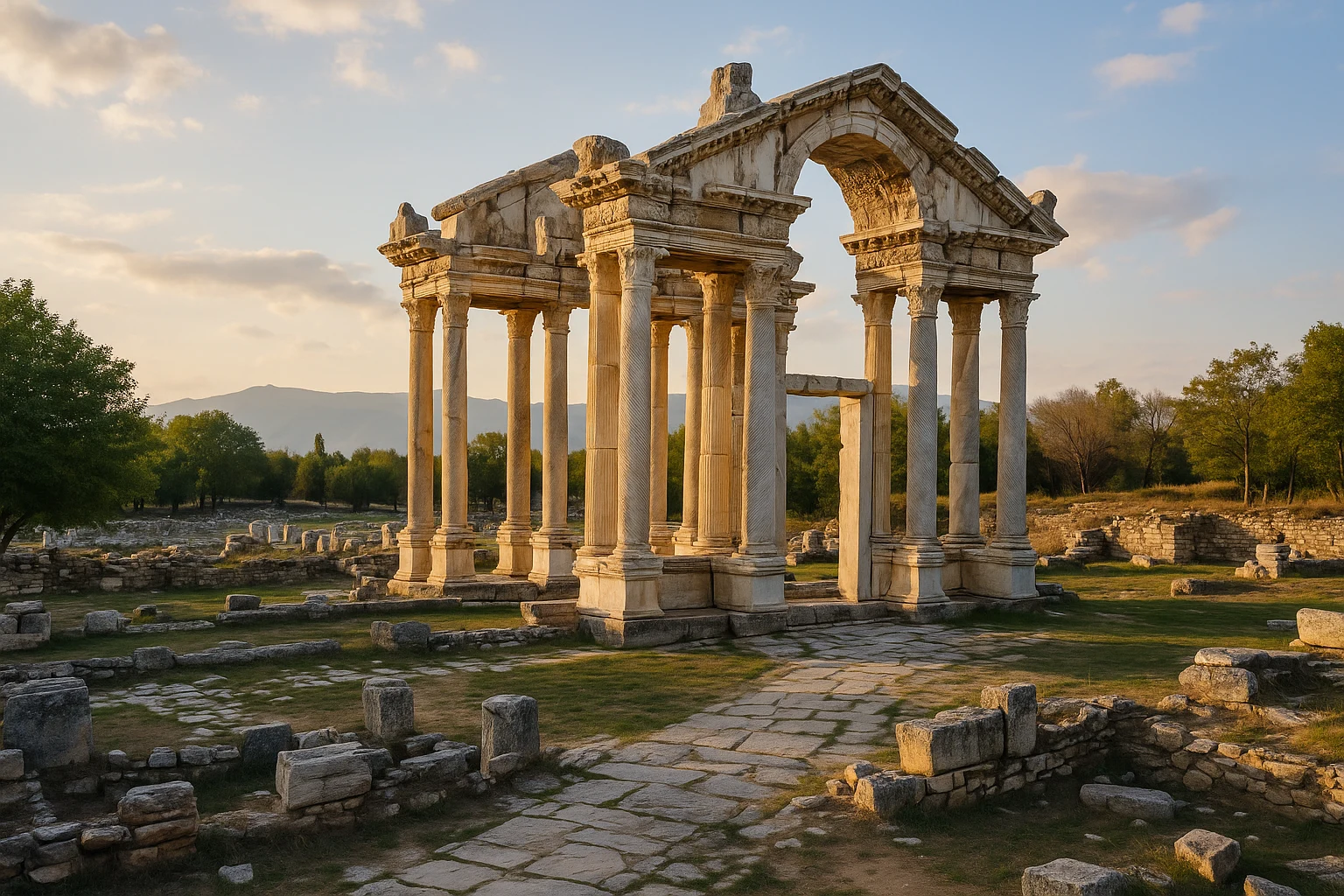
Aphrodisias Turkey Guide 2026: Stadium & Temple of Aphrodite
Carian-Hellenistic-Roman-ByzantinePlan Aphrodisias in Turkey: Roman stadium, Aphrodite temple, museum, transport from Izmir or Pamukka...
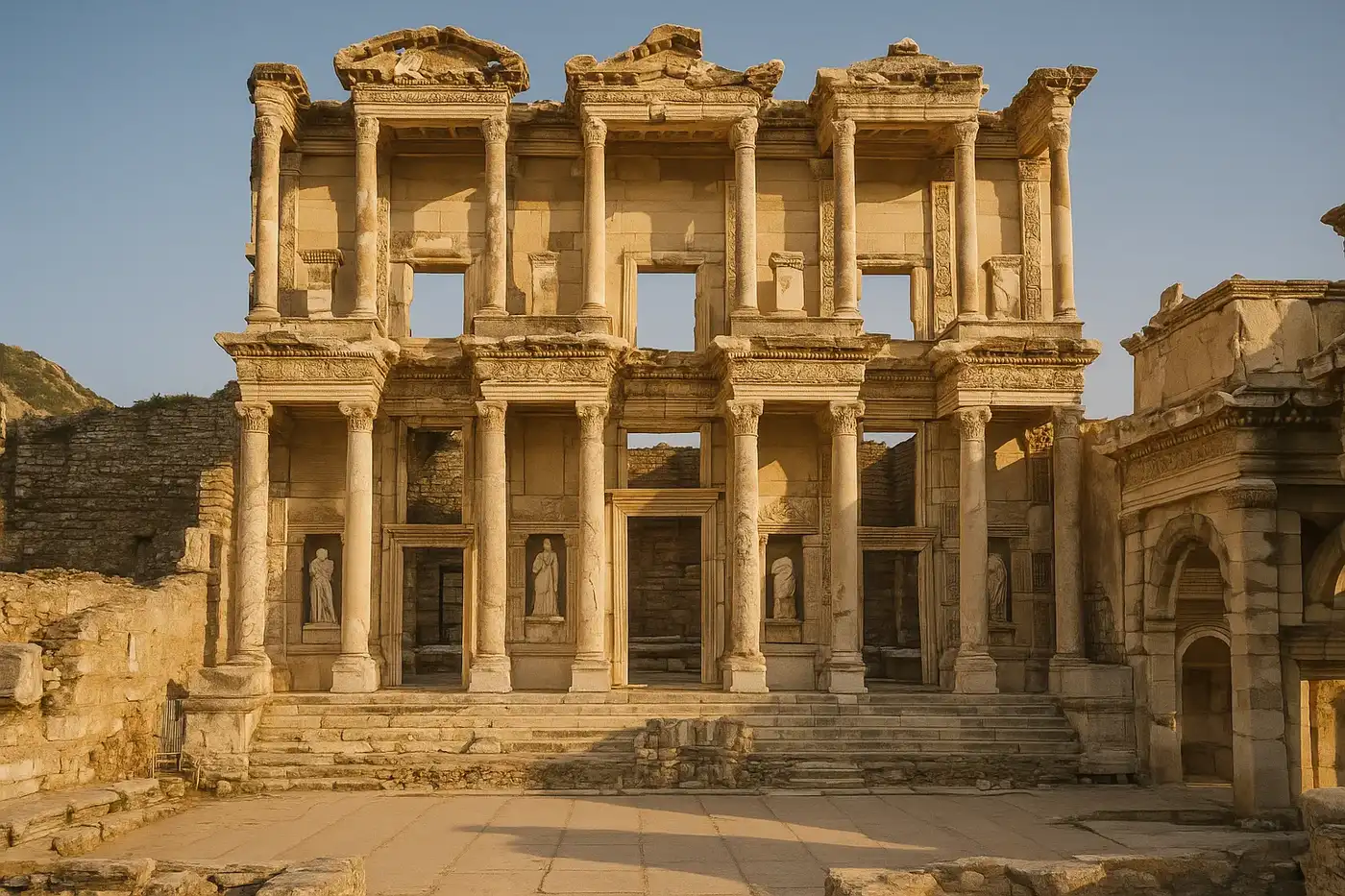
Ephesus Turkey Travel Guide: Library of Celsus & Terrace Houses
Greco-RomanDiscover Ephesus, the best-preserved ancient city in the Mediterranean. Our complete guide covers th...
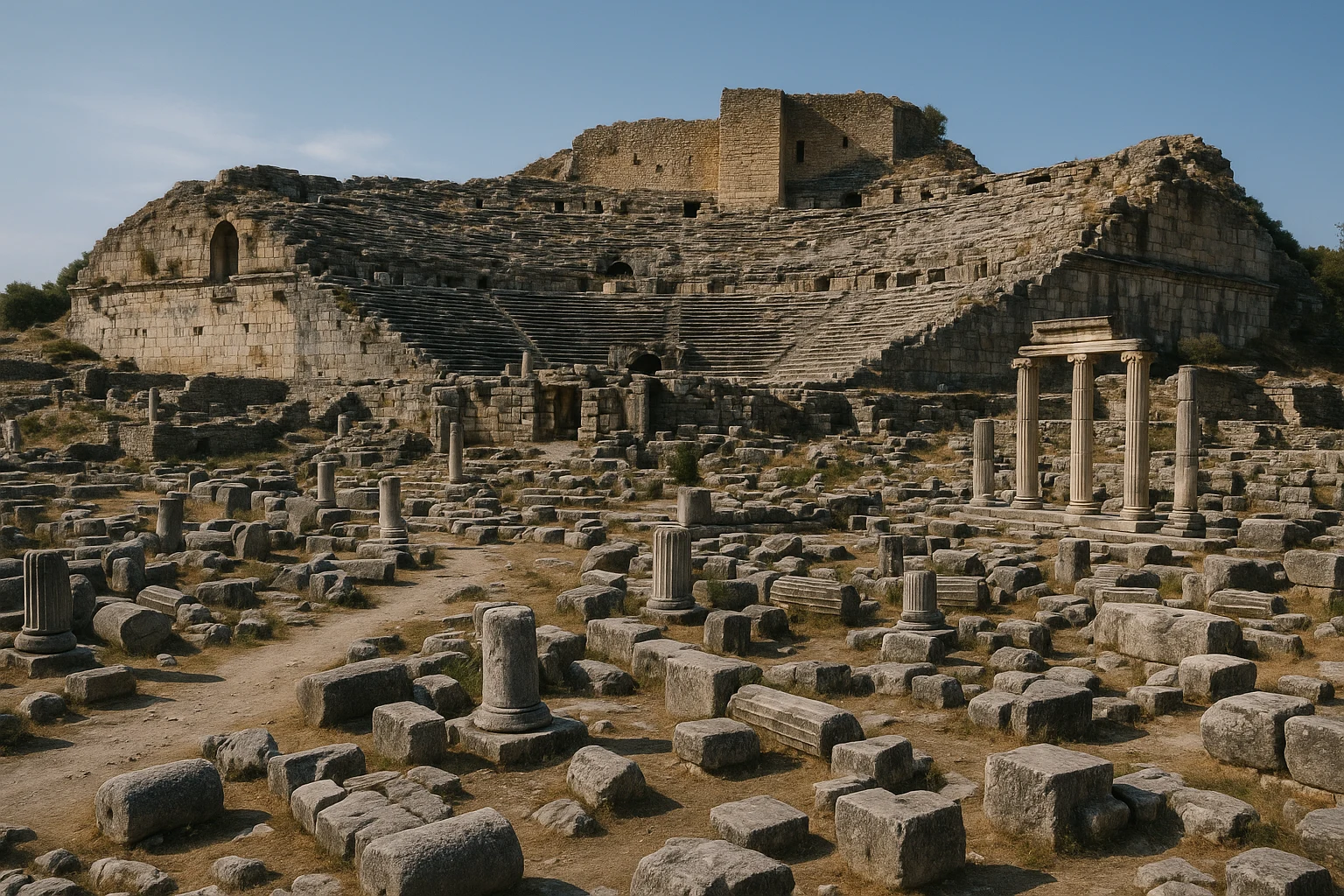
Miletus Turkey Guide 2026: Great Theater & Faustina Baths
Carian-Ionian-Persian-Hellenistic-Roman-ByzantineUse this Miletus, Turkey guide to explore its great theater, Roman baths, history, tickets, and tran...