Quick Info
Curated Experiences
Maras Salt Mines and Moray Circular Terraces Half-Day from Cusco
Sacred Valley VIP: Moray, Maras & Ollantaytambo Full Day from Cusco
Sacred Valley Full Day: Pisac, Ollantaytambo & Chinchero from Cusco
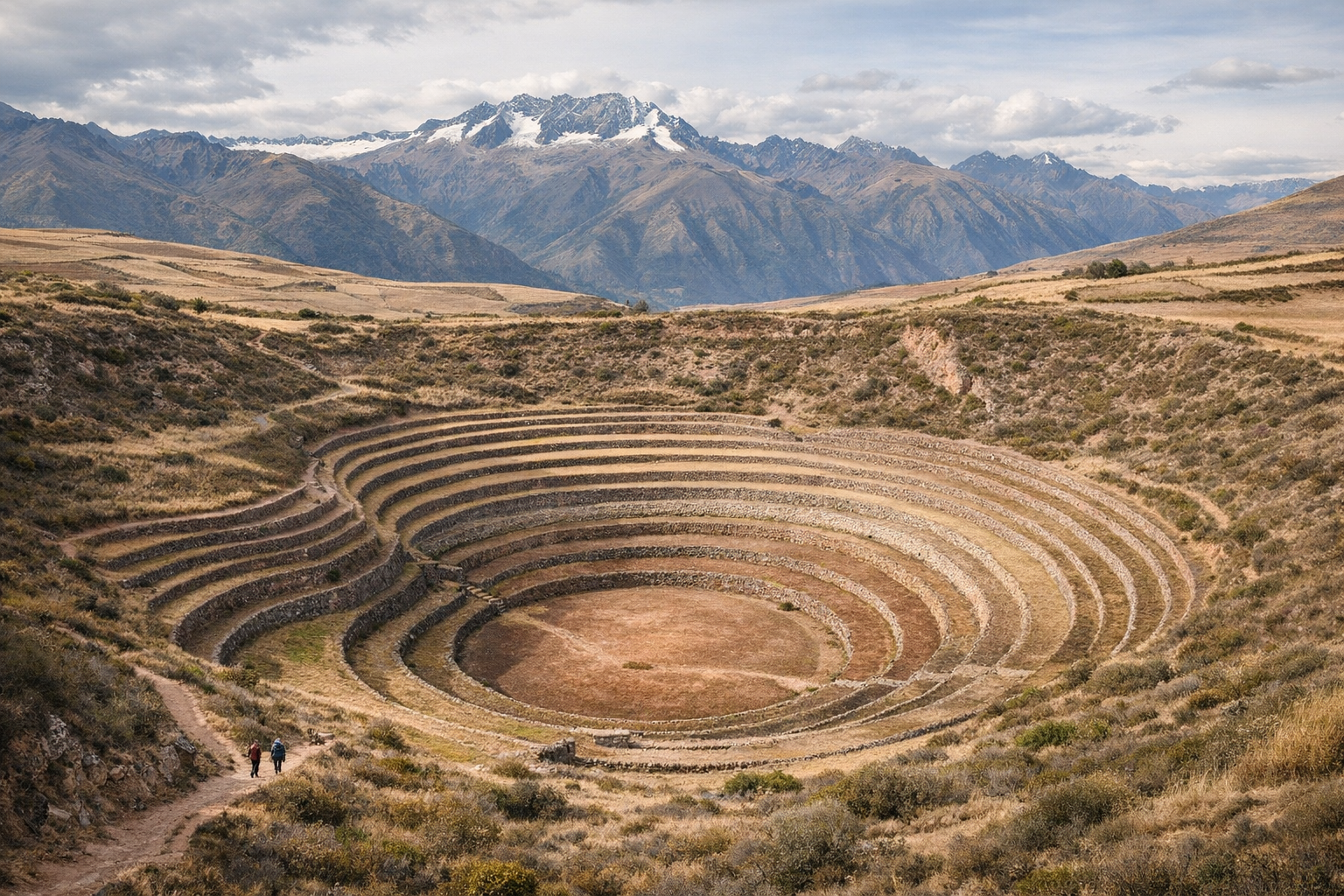
No ancient site in Peru is more immediately baffling — or more photographically spectacular — than Moray. Fifty kilometers northwest of Cusco, in a landscape of high plateau interrupted by deep natural sinkholes, the Incas created something that looks, from the rim, less like an agricultural installation than a great earthwork art project: concentric circles of stone-faced terraces descending to the floor of a circular depression, each ring smaller and lower than the one above, forming a precise spiraling amphitheater that measures 30 meters from rim to center floor at its deepest point. The main depression — the Qechuyoq hollow — contains seven concentric terrace rings. Two smaller depressions nearby hold similar structures. The effect from above is of a series of prehistoric bull’s-eyes pressed into the plateau surface by some patient and deliberate hand.
The Incas built this extraordinary structure and left no written record explaining its purpose — they had no writing system. What archaeologists have established is a microclimate gradient: the temperature difference between the rim and the floor of the main depression averages 15°C (27°F), effectively creating a controlled range of growing environments stacked within one location. The leading interpretation is that Moray served as an Inca agricultural research center — a laboratory where the empire tested crop varieties from across its vast altitude range in conditions replicating different elevations simultaneously. Whether this fully explains the investment in precise terrace engineering, or whether ceremonial and cosmological meanings also drove the project, remains an open archaeological question. This guide covers the terraces, the Maras salt ponds that make this a compelling half-day circuit, transport from Cusco, and practical logistics for a visit.
History: The Circular Architecture of the Inca Plateau
Pre-Inca Landscape and Early Use (Before 1440 CE)
The plateau between Cusco and the Sacred Valley was not empty before the Inca expansion. Local Quechua-speaking communities farmed the high-altitude grasslands and used the natural sinkholes — formed by the collapse of underlying limestone formations — as features of their agricultural landscape. Some evidence of pre-Inca activity exists at Moray, though the precise circular terrace system as it survives today is a product of the Imperial Inca period. The region had been productive agricultural territory for centuries before the Incas arrived, providing the human organization and landscape knowledge on which the Inca state would build its more ambitious intervention.
Inca Imperial Construction (c. 1440–1532 CE)
The Inca state constructed the Moray terrace system during the height of Imperial expansion in the 15th century, most likely during or after the reign of Pachacuti (1438–1471). The project involved precise engineering: the natural sinkhole depressions were terraced with stone-faced walls following the circular contour of each hollow, drainage channels were cut through the terrace walls to prevent waterlogging, and irrigation channels (acequias) brought water from plateau springs above. The symmetry of the finished installation — each terrace ring a precise concentric circle — required systematic surveying and planning beyond what simple agricultural terrace-cutting would demand. This deliberate geometry suggests a purposefully designed experimental or ceremonial space rather than opportunistic terrace construction into a convenient hollow.
The Microclimate Theory and Modern Research
Research conducted in the 20th and 21st centuries established the temperature gradient that forms the basis of the agricultural laboratory theory. Measurements recorded by archaeologists show that the temperature at the base of the Qechuyoq depression is consistently 5–15°C warmer than at the rim — a consequence of the bowl shape trapping warmer air and reducing wind exposure. This range effectively replicates the climate conditions found between approximately 2,800 and 3,500 meters of altitude in the Andes. The theory that the Incas used these conditions to test crops from across their empire’s altitude range is compelling, though not definitively proven. Alternative interpretations include religious and cosmological functions, or that the circular form itself carried symbolic meaning in Inca spatial cosmology.
Decline and Archaeological Recovery
Moray was abandoned after the Spanish conquest in the 1530s and fell into relative obscurity. The site became widely known outside Peru after aerial surveys and photographic publications in the mid-20th century highlighted the dramatic visual impact of the circular terraces from above. Systematic archaeological excavation began in earnest in the 1980s and 1990s, and the site was incorporated into the Boleto Turístico del Cusco network as Peruvian tourism expanded. Today the terraces are partially restored — stabilized walls and cleared drainage channels — while the vegetation and atmospheric quality of the hollow remain close to their natural state.
The Key Monuments: What to See at Moray
The Qechuyoq Depression
The main circular depression, Qechuyoq (also called the Principal Hollow), is the site’s primary attraction and one of the most visually striking landscape features in the Andes. At the rim, the diameter measures approximately 220 meters. The concentric terrace rings descend in seven steps to the flat circular floor approximately 30 meters below. The scale from the rim is deceptive — walk the full perimeter before descending to appreciate the site’s geometry. From above, the concentric pattern is clearest in the early morning when light rakes across the terrace faces from the east, casting each ring into sharp relief. The trail to the floor begins on the south side of the rim and descends via a stone stairway cut into the terrace faces; the descent takes about 10 minutes and reveals how precisely each wall was constructed to the same height and curvature around the full circle.
The Smaller Depressions: Cheqoq and Mulluyoq
Two smaller circular depressions adjoin the main Qechuyoq hollow to the north: Cheqoq and Mulluyoq. These are shallower and less elaborately terraced than the main hollow but extend the complex’s area and suggest the experimental program operated at multiple scales simultaneously. From the main rim, the smaller depressions are visible across the plateau grass. A circuit trail connects all three hollows, adding approximately 20–30 minutes to the main site visit. Seen together, the three-hollow complex emphasizes the deliberateness of the Inca intervention — three natural sinkholes transformed by the same engineering logic into a unified installation at a remote plateau site.
The Inca Water Management System
Often overlooked by visitors focused on the visual drama of the circular rings, the hydraulic infrastructure at Moray is a significant technical achievement. The natural drainage tendency of the sinkhole hollows would cause water to accumulate at the bowl’s center, waterlogging the lowest terraces. The Incas cut a drainage channel from the base of the main hollow, allowing excess water to escape while retaining controlled moisture levels. A separate network of surface channels (acequias) carries water from plateau springs to the upper terrace rim, distributing it through channels cut into the terrace walls at controlled rates. This dual system — drainage out and irrigation in — allowed the growing conditions in each ring to be independently managed. The channels are visible along the terrace faces as you descend to the floor, their stone-lined edges still intact after five centuries.
Views from the Plateau Rim
The plateau setting of Moray creates a landscape experience distinct from the canyon-cut sites of the lower Sacred Valley. From the rim of the main hollow, the view extends across high puna grassland dotted with Andean wildflowers to the snow-capped summits of Nevado Chicón (5,530 m) to the northeast and the broader Urubamba mountain range to the southwest. The undisturbed horizon and the silence of the plateau contrast dramatically with the visual complexity of the terrace architecture immediately below. On clear mornings — arriving before 09:00 in dry season — the combination of sharp Andean air, golden light on the stone rings, and distant snow peaks makes this one of the most photogenic viewpoints in the Sacred Valley region. A wide-angle lens captures the full circular geometry from the rim; telephoto compression emphasizes the depth of the descent.
Getting There: Transportation and Access
Moray is accessible from Cusco by road across the high plateau — a journey of approximately 50 kilometers.
From Cusco
- Organized tour: The most convenient approach; half-day tours combining Moray and Maras salt ponds depart daily from Cusco hotels (45–89 USD / 165–330 PEN all-inclusive with guide and transport).
- Private taxi: 60–90 PEN ($16–25 USD) round trip from Cusco, allowing flexible time at the site. Negotiate a waiting fee or agree on a specific return time. The plateau road is paved to the site entrance.
- Public transport plus mototaxi: Take a shared colectivo from Cusco toward Chinchero/Urubamba, alight at the Maras turnoff, then hire a mototaxi to Moray (8–12 PEN / $2.20–3.30 USD, 10 minutes). This is the cheapest option but adds logistical complexity.
From Maras or Chinchero
Moray is 8 km by road from Maras town and 25 km from Chinchero. Mototaxis connect Maras to both the Moray site and the Maras salt ponds, making it practical to combine both attractions from a Maras base or directly from Cusco.
Admission and Hours
Moray is covered by the Boleto Turístico del Cusco (BTC) partial circuit (70 PEN / $19 USD). Tickets must be purchased at the BTC office in Cusco (Avenida del Sol 103) or at designated ticket windows — not at the site entrance. The Maras salt ponds are not part of the BTC; their separate entrance fee is approximately 10 PEN ($2.75 USD). The site is open 07:00–17:30 daily. The plateau is fully exposed with no shade — bring sun protection, a warm layer for morning visits, and water. Cash is required for the mototaxi from Maras; card acceptance at Moray itself is limited.
When to Visit: Seasonal Considerations
Spring (September–November)
September and October provide ideal conditions for Moray. The rainy season has ended, the plateau grassland is green and flowering, and visibility to the surrounding peaks is excellent. Temperatures at 3,500 m run 5–15°C (41–59°F) with cool mornings and mild afternoons. The early-morning light on the terrace rings is at its most dramatic in October — warm Andean sun and crisp air combining for outstanding photography.
Summer (June–August)
The dry season brings cloudless skies and the clearest long-range views of the Andes from the plateau. Temperatures range from near-freezing at dawn to 12–18°C (54–64°F) by midday. This is peak tourist season; arrive before 09:00 to have the site to yourself before tour groups arrive from Cusco. June and July are the coldest months — bring a substantial jacket for early arrivals.
Autumn (March–May)
April and May transition from the rainy season with lush vegetation and manageable crowds. Some morning cloud is possible, occasionally obscuring the peaks, but the terraces remain visible. Light rain is possible in March and early April; waterproof outer layers are advisable, and note that wet stone on the terrace descent can become slippery.
Winter (December–February)
The wet season makes the plateau cold and frequently cloudy, with afternoon showers that can turn the approach road muddy. The terrace descent becomes genuinely slippery in rain. Visitor numbers are lowest in December through February, and the landscape is dramatically green. Clear mornings do occur; check forecasts and arrive early if conditions look favorable.
Combining Moray with the Maras Salt Ponds
Moray’s greatest practical advantage is its proximity to the Maras salt evaporation ponds — a landscape equally spectacular and geologically distinct, just 8 kilometers east along the plateau road. Combining the two creates the Sacred Valley’s most unusual half-day circuit.
Begin at Moray by 09:00, arriving at the rim of the main depression for the best morning light on the circular terraces. Spend 1–1.5 hours walking the perimeter, descending to the floor of the main hollow via the stone stairway, and exploring the smaller depressions to the north. By 10:30, drive or take a mototaxi the 8 kilometers to Salineras de Maras — the salt ponds that cascade down a hillside in thousands of small, individually worked pools, each fed by a naturally saline spring and managed by a local family cooperative. The colors shift from white to pink to amber depending on the season and evaporation state of each pool. Allow 1–1.5 hours to walk the upper paths overlooking the full extent of the salt fields. By 12:30, return to the town of Maras for lunch at one of the simple restaurants on the plaza before transferring back to Cusco by 14:00–14:30.
Adding Chinchero to this circuit is practical with an early Cusco departure: visit Chinchero from 08:00–10:00, then proceed directly to Moray and Maras for the rest of the morning, returning to Cusco by early afternoon. This three-site combination covers a full cross-section of Inca highland landscape — palace estate, agricultural laboratory, and salt production — in a single efficient day.
Why Moray Matters
Moray challenges the assumption that ancient agriculture was purely practical. Whatever the Inca architects intended — laboratory, temple, theater of land, or all three simultaneously — the execution demanded the same precision they brought to their finest ceremonial stonework. The circular terraces are geometrically exact: each ring follows its prescribed radius to within a tolerance suggesting systematic measurement. The drainage and irrigation systems reveal sophisticated hydro-engineering at a remote high-plateau site. The scale of labor required to construct three circular terrace complexes here, far from any major population center, argues for a project of genuine importance to the Inca state — something worth the extraordinary investment.
Standing at the rim of the main hollow and looking down into the concentric rings, something about the geometry produces a sensation difficult to name — a kind of visual vertigo mixed with recognition, as if the pattern triggers something deeper than learned aesthetic preference. The Incas may have felt this too. They built here not because it was convenient but because this particular landscape, these particular sinkholes in the plateau grass 50 kilometers from Cusco, offered something that nowhere else in their empire could: the right shape, the right depth, the right convergence of elevation and microclimate. What they made of it is still worth coming to see.
Quick Facts
| Attribute | Details |
|---|---|
| Location | Near Maras, Cusco Region, Peru |
| UNESCO Status | Part of Cusco Historic Area (1983) |
| Established | c. 1440 CE (Inca agricultural complex) |
| Civilization | Inca Empire |
| Distance from Cusco | ~50 km / ~1–1.25 hrs by road |
| Entry Fee | BTC Parcial: 70 PEN (~$19 USD) |
| Hours | 07:00–17:30 daily |
| Best Time | May–October; arrive by 09:00 |
| Altitude | ~3,500 m (11,480 ft) |
| Suggested Stay | 1–1.5 hours (Moray) + 1.5 hours (Maras salt ponds) |
Explore More Peru
- Chinchero: Inca royal estate with terraces and colonial church, 25 km southeast on the plateau
- Ollantaytambo: Living Inca town and fortress at the Sacred Valley’s western entrance
- Pisac: Inca citadel, cemetery, and artisan market at the valley’s eastern end
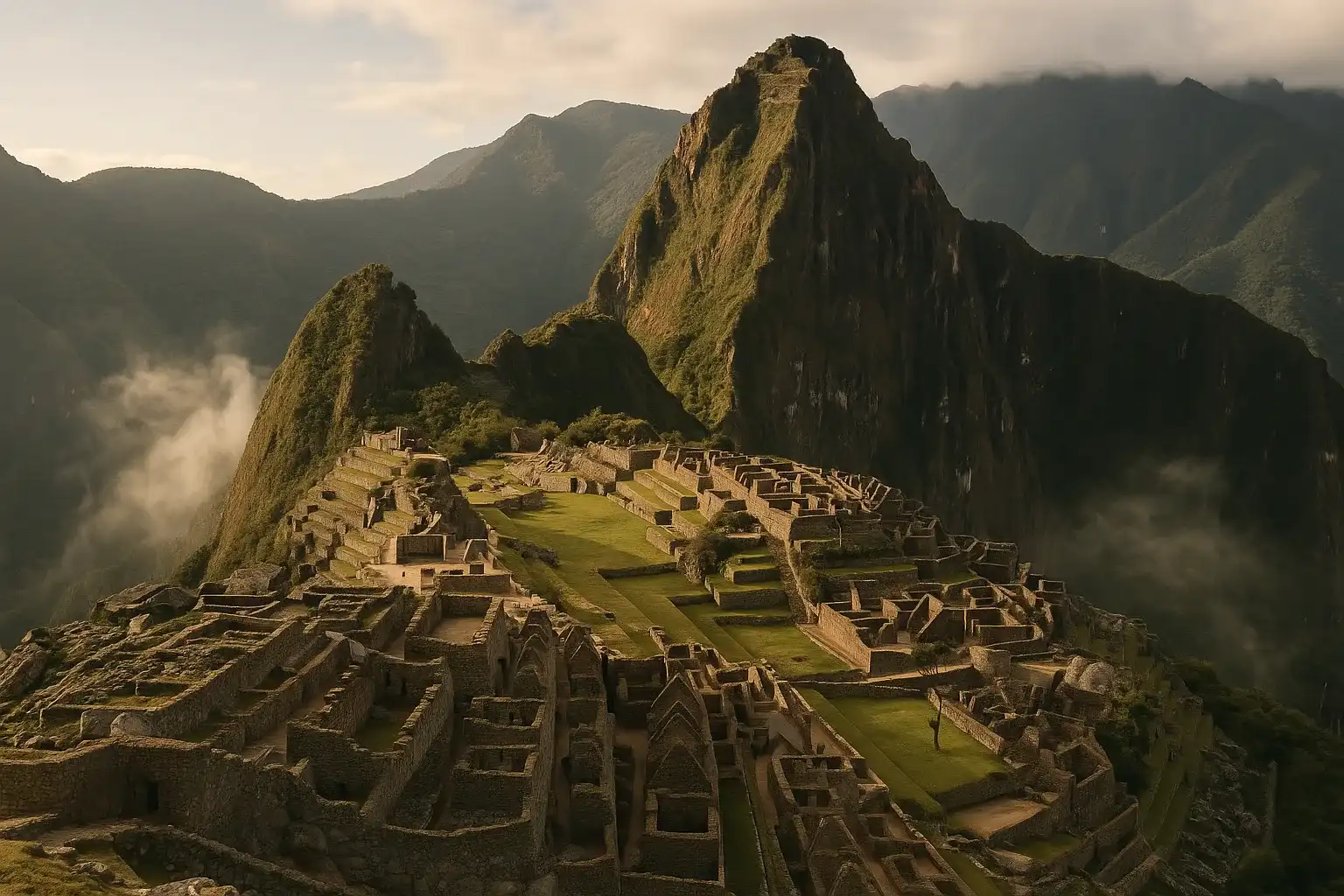
- Machu Picchu: The Lost City of the Incas — the Sacred Valley’s ultimate destination
Plan your complete Sacred Valley journey with our Peru Ancient Sites Guide.
Frequently Asked Questions
How much time do I need at Moray?
Allow 1–1.5 hours to walk the perimeter of the circular terraces, descend to the basin floor, and appreciate the site from multiple vantage points. Most visitors combine Moray with the Maras salt mines (30 minutes away) in a half-day excursion, adding 1–1.5 hours at the salt ponds for a total of 3–4 hours.
What were the circular terraces at Moray used for?
The leading theory is that Moray served as an Inca agricultural research station. The concentric circular terraces create distinct microclimatic zones — the temperature difference between the top and bottom of the main depression averages 15°C (27°F). The Incas may have used these zones to test crop varieties from across their empire's altitude range in a single controlled location.
Is Moray included in the Boleto Turístico?
Yes. Moray is included in the Boleto Turístico del Cusco (BTC) partial circuit. The partial BTC costs 70 PEN (~$19 USD) and covers Moray and other Sacred Valley sites. The Maras salt mines are NOT included in the BTC and charge a separate entrance fee of approximately 10 PEN (~$2.75 USD).
How do I get from Cusco to Moray?
Most visitors take an organized tour or hire a private taxi from Cusco (60–90 PEN / $16–25 USD round trip, approximately 1–1.25 hours). Moray is 50 km from Cusco. Shared transport to Maras town is available from Cusco for about 5 PEN ($1.40 USD), followed by a 10-minute mototaxi to the site.
What else is near Moray?
The Maras salt evaporation ponds (Salineras de Maras) are 8 km from Moray — a landscape of thousands of small terraced salt pools actively worked by local families. Combine these two sites for the most rewarding half-day in the Sacred Valley. Chinchero is 25 km southeast, and Ollantaytambo is 30 km west.
Can I reach the bottom of the circular terraces at Moray?
Yes — a stone stairway descends to the floor of the main circular depression. The descent takes about 10 minutes and is steep but manageable for most visitors. The view from the bottom, looking up at the concentric rings rising to the plateau rim, is dramatically different from the aerial perspective above. Wear closed shoes; the path becomes slippery when wet.
Nearby Ancient Sites
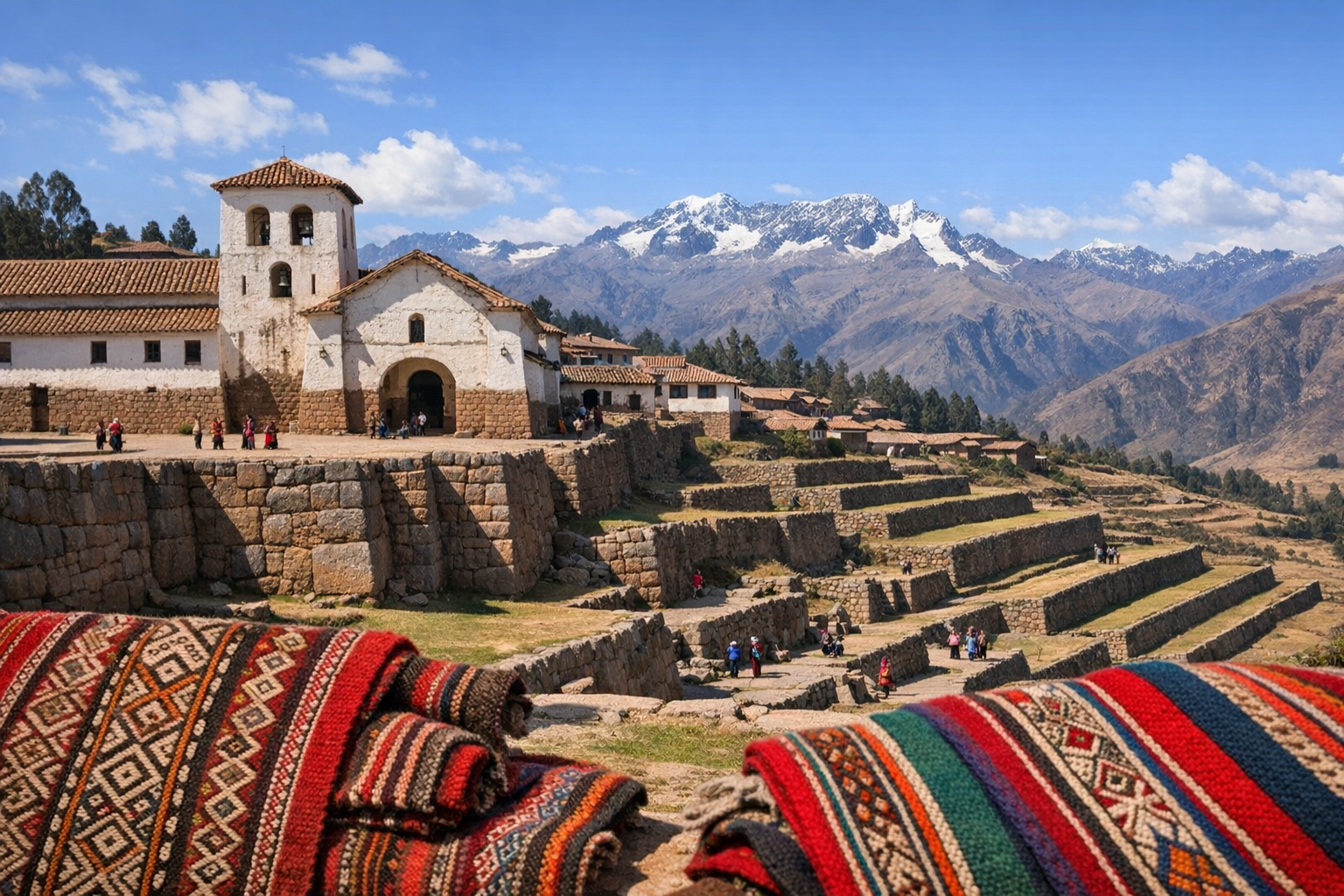
Chinchero Peru Guide 2026: Inca Terraces & Andean Weaving Village
IncaVisit Chinchero on Peru's high plateau above Cusco: Inca royal estate terraces, colonial church buil...
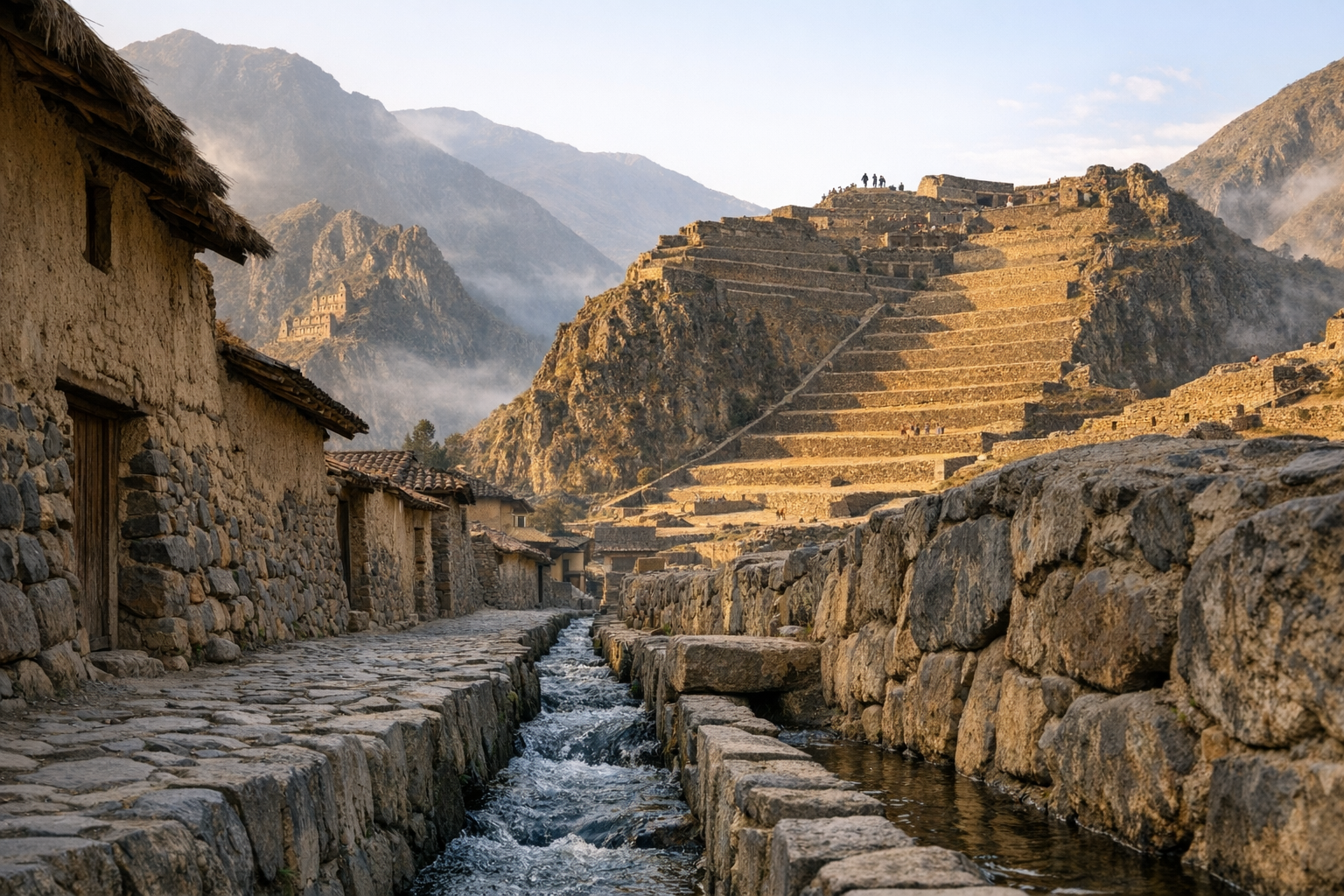
Ollantaytambo Peru Guide 2026: Inca Fortress & Sacred Valley Town
IncaVisit Ollantaytambo in Peru's Sacred Valley: explore the Inca fortress terraces, the Sun Temple, and...
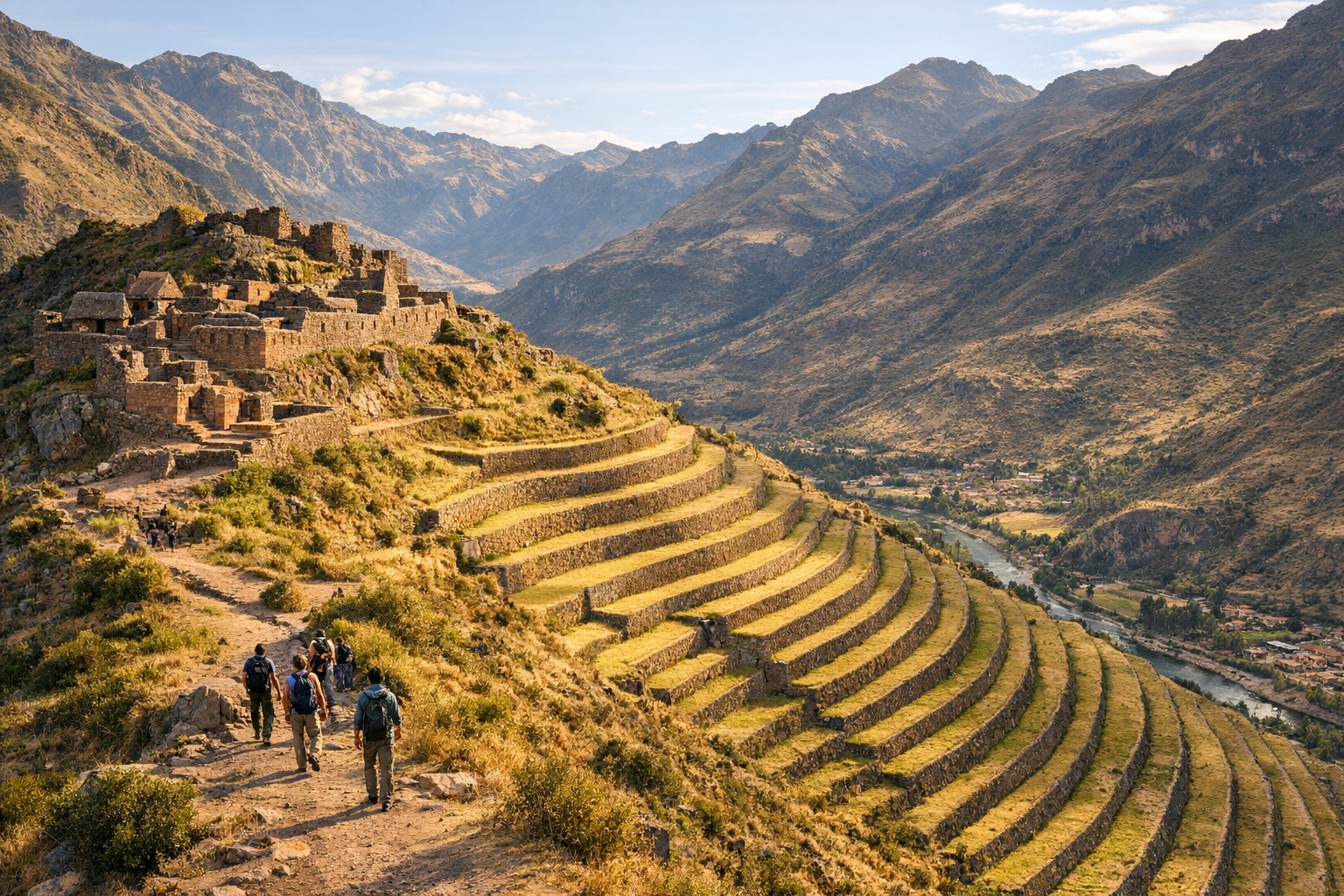
Pisac Peru Guide 2026: Inca Citadel, Market & Sacred Valley
IncaExplore Pisac in Peru's Sacred Valley: hike the Inca citadel terraces above town, visit the famous a...
Machu Picchu Peru Travel Guide 2026: Circuits, Tickets & Entry Tips
Inca EmpireNavigate Machu Picchu's 2026 circuit system with our definitive guide. Learn how to choose your rout...