Quick Info
Curated Experiences
Mount Qingcheng and Dujiangyan Day Tour from Chengdu
Private Mount Qingcheng Temples Hiking Tour
Chengdu UNESCO Sites Tour: Dujiangyan and Qingcheng Mountain
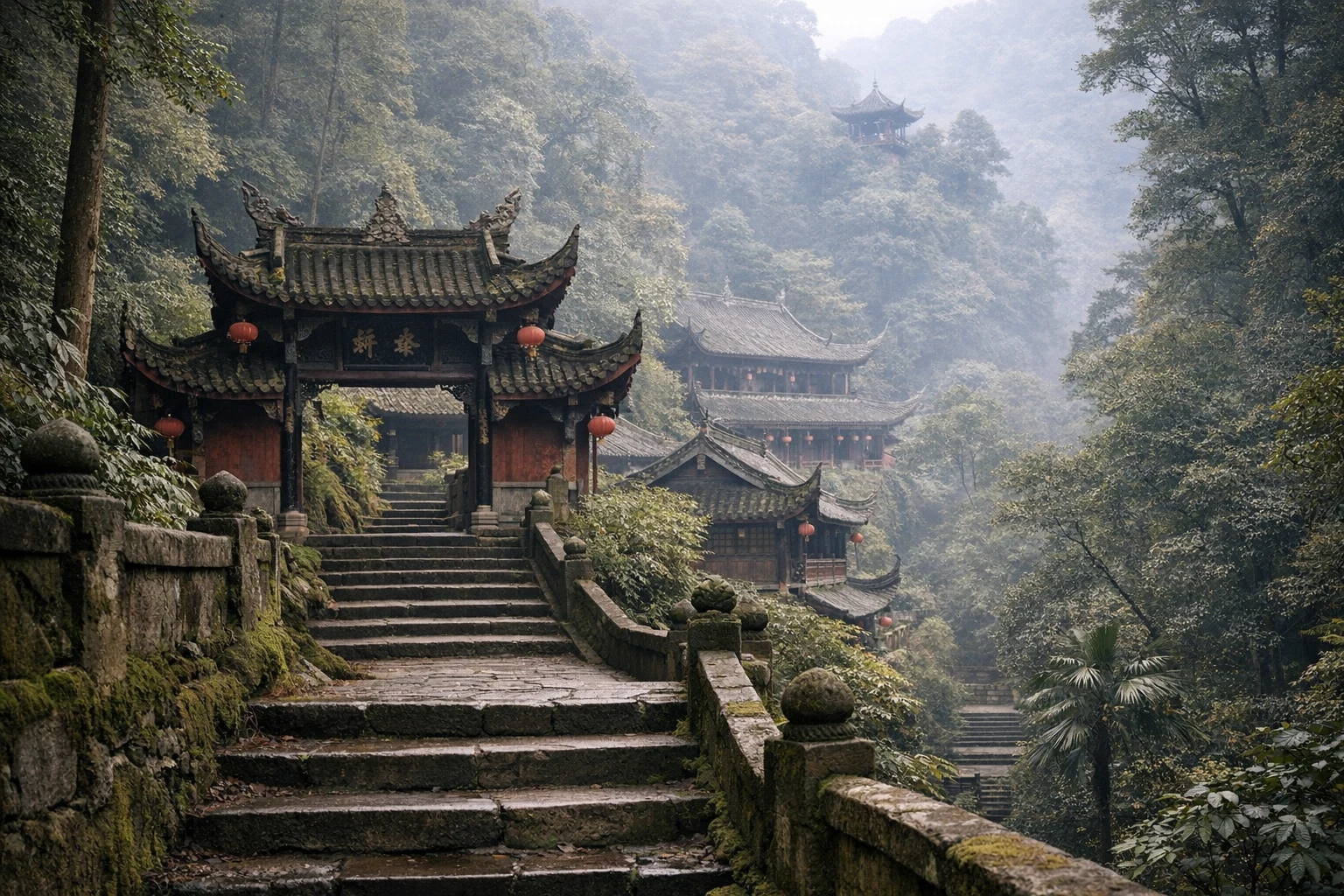
High on the forested flanks of western Sichuan, where subtropical plains dissolve into the first folds of the Tibetan Plateau, the Mount Qingcheng Temples preserve one of China’s oldest living religious traditions. Tucked inside a UNESCO World Heritage landscape less than 70 kilometres from the sprawl of Chengdu, Mount Qingcheng has sheltered Taoist hermits, abbots, and pilgrims for nearly two thousand years. The mountain’s name translates roughly as “Green City Peak,” a reference to the way its ring of forested ridges closes around a central valley like the walls of a city, sealing the interior in perpetual cool shadow and drifting mist. Ancient pines, ginkgos, and camphor trees crowd every path, and the scent of incense drifts outward from temple courtyards long before the buildings themselves come into view. Visitors arrive expecting historical monuments and discover instead a place that functions exactly as it always has: monks chanting in pre-dawn darkness, devotees burning paper offerings at stone altars, and solitary hikers pausing at cliff-edge pavilions to watch clouds pour through the valley below. The mountain divides into two distinct zones — the heavily visited Front Mountain with its succession of temples and cable car, and the quieter, wilder Rear Mountain, where trails thin out and overnight guesthouses replace day-trippers. Together they form one of the most atmospheric sacred landscapes in East Asia.
History
The Founding of Taoism
The story of Mount Qingcheng as a religious site begins in 142 CE, when the Taoist master Zhang Daoling — also called Zhang Ling — is said to have received a divine revelation on the mountain and used that inspiration to codify what became the Tianshi (Celestial Masters) school of Taoism, the oldest organised form of the religion. Zhang Daoling had already spent years studying in Sichuan, and the mountain’s isolation and natural power made it a fitting location for a foundational event in Chinese religious history. His descendants carried the tradition forward, and the mountain became the symbolic home of the Celestial Masters lineage for generations. By the Eastern Han period the site already had a network of hermitages and gathering points scattered across the slopes.
Tang and Song Expansion
Imperial patronage transformed scattered hermitages into formal temple complexes during the Tang dynasty (618–907 CE). Emperor Xuanzong, who had a particular regard for Taoism, ordered the construction and renovation of several structures on the mountain, and the site’s reputation spread across the empire. The Song dynasty (960–1279 CE) saw further growth, with wealthy merchant families from Chengdu funding new buildings and donating bronze statues and bell towers. By this period the broad outlines of the mountain’s temple geography — Jianfu Temple near the base, Tianshi Cave at mid-elevation, and Shangqing Temple near the summit — were established and would persist, through damage and restoration, to the present day.
Destruction and Rebuilding
Like almost every ancient site in China, Mount Qingcheng suffered repeated cycles of destruction and reconstruction. Warfare, dynastic upheaval, and the particular violence of the twentieth century all left their mark. Many of the structures visible today date from Qing dynasty (1644–1912) restorations or from rebuilding efforts carried out after damage during the Republican period and the Cultural Revolution (1966–1976), when religious sites across China were attacked or repurposed. The 2008 Wenchuan earthquake, whose epicentre lay less than 20 kilometres away, caused significant structural damage to several temples and surrounding infrastructure. Intensive restoration followed, and the mountain reopened to visitors within a year. That resilience is itself part of the site’s character: the community of practice persisted through every rupture, ensuring that when buildings were repaired the traditions they housed had never fully stopped.
UNESCO Recognition
In 2000, Mount Qingcheng was inscribed on the UNESCO World Heritage List as part of a joint nomination with the Dujiangyan Irrigation System, the extraordinary hydraulic engineering project that has watered the Chengdu Plain for more than two thousand years. The dual inscription acknowledges that the two sites are products of the same civilisation and complement each other: Dujiangyan represents the mastery of physical nature through engineering, while Mount Qingcheng represents engagement with the spiritual dimensions of the same landscape. The nomination documentation cited the mountain’s exceptional cultural significance as a cradle of Taoism and the outstanding universal value of its preserved religious landscape.
Key Features
Jianfu Temple
Jianfu Temple stands near the main entrance to the Front Mountain, making it the first major structure most visitors encounter. Built originally during the Tang dynasty and rebuilt several times since, the present complex dates largely from the Qing period with modern repairs following the 2008 earthquake. Its courtyard sequence follows the classic Taoist temple plan: a succession of gates and halls oriented along a central axis, with side buildings accommodating monks’ quarters, scripture halls, and shrine rooms dedicated to specific deities. The temple maintains an active community and operates a well-regarded vegetarian restaurant serving dishes based on traditional mountain recipes — a meal here before the ascent is a local tradition for pilgrims and tourists alike. The surrounding tea plantations that drape the lower slopes in geometric rows are visible from the temple forecourt, their orderly geometry contrasting pleasantly with the wild forest above.
Tianshi Cave
Approximately halfway up the Front Mountain, Tianshi Cave (Tianshi Dong) is the most spiritually charged site on the mountain and the one most directly associated with Zhang Daoling’s founding revelation. The name refers to a natural rock hollow beside which Zhang is said to have meditated, though the cave itself is now surrounded by an extensive temple complex that has grown around it over centuries. A large camphor tree, believed to be over 1,800 years old, dominates the main courtyard and is venerated as a living witness to the site’s entire history. The tree’s vast gnarled trunk, braced with wooden supports and wrapped in devotional ribbons, is one of the most photographed subjects on the mountain. The halls surrounding the courtyard contain fine examples of Taoist devotional art, including carved stone stelae and gilded altar figures.
Shangqing Temple and the Summit Ridge
The Shangqing Temple near the summit ridge rewards those who complete the full ascent on foot or take the cable car from its upper station. At this elevation the forest thins slightly and views open across ridges descending toward the Chengdu Plain. On clear days — which are relatively rare in perpetually misty Sichuan — the distant snowfields of the Min Mountains are visible on the western horizon. The temple itself is more austere than Jianfu or Tianshi Cave, in keeping with its high altitude and the contemplative character expected of a summit sanctuary. A small guesthouse adjacent to the temple allows visitors to stay overnight and experience the mountain after the day-trippers have descended, when the silence is broken only by wind, bell chimes, and the chanting of the resident community.
The Rear Mountain
The Rear Mountain (Houshan) receives far fewer visitors and offers a fundamentally different experience. Trails here are longer, steeper, and less maintained, passing waterfalls, bamboo groves, and small isolated shrines that see few visitors in any given week. The area around Shuanghe Valley is particularly scenic, with a series of pools and cataracts threading between moss-covered boulders. Several simple guesthouses and farmstays operate along the Rear Mountain trails, catering to hikers who want to spend a night on the mountain and experience the early-morning atmosphere before crowds arrive. The Rear Mountain connects to the Front Mountain via a ridge trail, allowing experienced hikers to traverse the entire mountain over two days.
Getting There
The most convenient approach from Chengdu uses the high-speed rail line that links Chengdu’s main stations — Chengdu East and Chengdu — to Qingchengshan station. Trains depart roughly every thirty minutes throughout the day, with the journey taking between 35 and 50 minutes depending on the service. Fares are approximately 14–16 CNY in second class. From Qingchengshan station, taxis cover the few kilometres to the Front Mountain entrance in around ten minutes for 15–20 CNY; local buses run the same route for about 2 CNY. The trip can also be done by private car or booked as a guided day tour from Chengdu, which typically combines the mountain with Dujiangyan Irrigation System and includes hotel pickup.
If arriving by long-distance bus, Chengdu’s Chadianzi bus station runs services to Dujiangyan city, from which local transport connects to the mountain. This route is slower but cheaper and passes through pleasant agricultural countryside.
Once at the base, the entry ticket covers walking access to all Front Mountain temples. The cable car, which runs from near Jianfu Temple to a station just below the Shangqing Temple, requires a separate ticket and eliminates roughly 400 metres of elevation gain. Cable car wait times can be significant on weekends and public holidays, so arriving early or planning to walk both ways reduces frustration. There is no vehicle access beyond the ticketed entrance plaza.
When to Visit
Spring — roughly mid-March through May — is widely considered the best season for Mount Qingcheng. Temperatures on the mountain range from pleasantly cool to mild, the forest is intensely green following winter rain, and rhododendrons and wildflowers colour the upper slopes. Crowds are present but manageable on weekdays.
Autumn (September through November) offers crisp air and the spectacle of turning foliage among the ginkgo and maple trees that line many of the temple approaches. October is a peak domestic travel month in China due to the Golden Week holiday, and the mountain can be extremely crowded during those first seven days of the month. Arriving on the second or third week of October gives you the autumn colour without the crowds.
Summer (June through August) is humid and warm even at elevation, and the mountain sees its highest visitor numbers, particularly on weekends. Morning arrival is essential in summer, both to beat the crowds and to experience the mountain before afternoon mist thickens into the low cloud that frequently blankets the upper sections by early afternoon. Rain is common throughout summer and actually enhances the atmosphere, though trails become slippery.
Winter (December through February) brings occasional snow to the upper temple zones and a dramatic reduction in visitors. Some facilities close or reduce hours, and icy trails require appropriate footwear. The misty, monochrome winter landscape has its own austere beauty and appeals to photographers and visitors who prefer solitude over comfort.
Quick Facts
| Detail | Information |
|---|---|
| Location | Dujiangyan, Sichuan Province, China |
| Coordinates | 30.90°N, 103.57°E |
| UNESCO Status | World Heritage Site (2000, with Dujiangyan) |
| Religious tradition | Taoism (Celestial Masters school) |
| Founded | c. 142 CE (Zhang Daoling’s revelation) |
| Elevation | Summit ridge approx. 1,260 m (4,134 ft) |
| Front Mountain entry fee | ~150 CNY |
| Cable car (round trip) | ~70 CNY |
| Nearest city | Chengdu (~65 km, ~40 min by high-speed rail) |
| Best seasons | Spring (Mar–May) and Autumn (Sep–Nov) |
| Typical visit duration | 3–5 hours (Front Mountain); full day (Rear Mountain) |
Mount Qingcheng occupies a singular place in Chinese civilisation — not merely as a collection of beautiful old buildings in a scenic landscape, but as a continuously inhabited spiritual community whose founding tradition has shaped Chinese religion, philosophy, medicine, and art for nearly two millennia. The temples are not ruins or museums but working institutions, and the chanting, incense, and slow processions of devotees that animate them daily are not performances for tourists but the ordinary life of a tradition that has outlasted dynasties, earthquakes, and revolutions. To walk the forested paths between these sanctuaries is to move through a landscape where the boundary between the historical and the living has never been drawn very clearly — and that ambiguity, as much as any individual monument, is what makes the mountain worth the journey.
Frequently Asked Questions
What is Mount Qingcheng famous for?
Mount Qingcheng is regarded as one of the birthplaces of Taoism and shelters more than thirty ancient temples and monasteries beneath its dense forest canopy. Together with the Dujiangyan Irrigation System it was inscribed as a UNESCO World Heritage Site in 2000.
How do I get to Mount Qingcheng from Chengdu?
High-speed trains depart Chengdu's main stations for Qingchengshan station roughly every half-hour and cover the 65 km in about 40 minutes for around 15 CNY. From the station, taxis reach the Front Mountain gate in under ten minutes for approximately 15–20 CNY.
How long does it take to visit Mount Qingcheng?
The Front Mountain loop takes three to five hours on foot, or about two hours if you use the cable car for the steepest section. The wilder Rear Mountain requires a full day or an overnight stay at a mountain guesthouse.
Is Mount Qingcheng still an active religious site?
Yes. Taoist clergy continue to live and practise in several temples, including Tianshi Cave and Shangqing Temple at the summit ridge. Visitors are welcome to observe ceremonies but are expected to dress modestly and move quietly through ritual spaces.
What does it cost to enter Mount Qingcheng?
Front Mountain admission is approximately 150 CNY per person. The round-trip cable car costs an additional 70 CNY. The Rear Mountain has a separate ticket of around 30 CNY. Prices are subject to change, so verify current rates before your visit.
Can I combine Mount Qingcheng with Dujiangyan on the same day?
Many visitors do exactly this. Dujiangyan Irrigation System lies only a few kilometres from Qingchengshan station. Spending the morning at Dujiangyan and the afternoon on the Front Mountain of Qingcheng makes a full but manageable day trip from Chengdu.
Nearby Ancient Sites
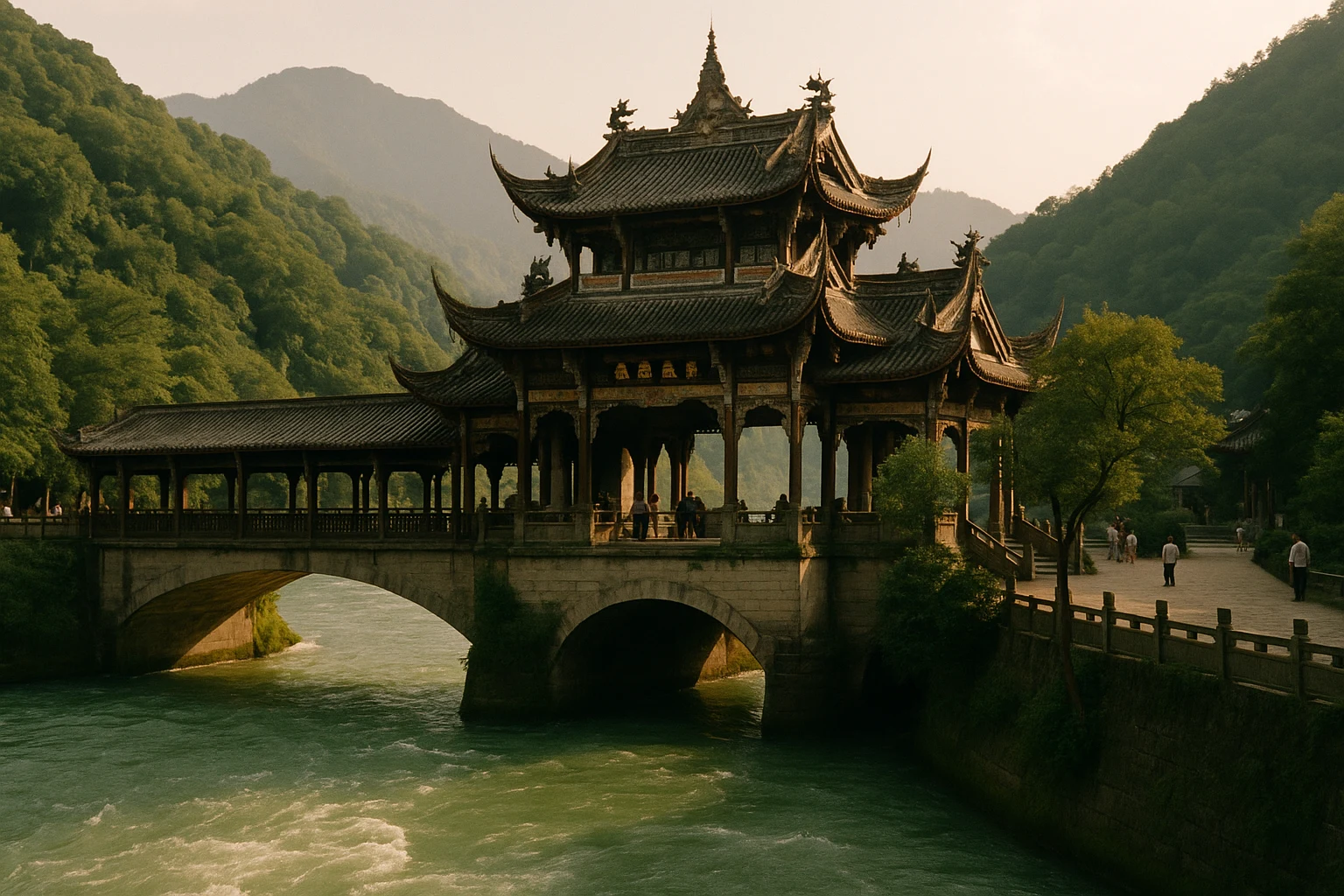
Dujiangyan Irrigation System
Explore Dujiangyan, the world's oldest functioning irrigation system, built in 256 BCE by engineer L...
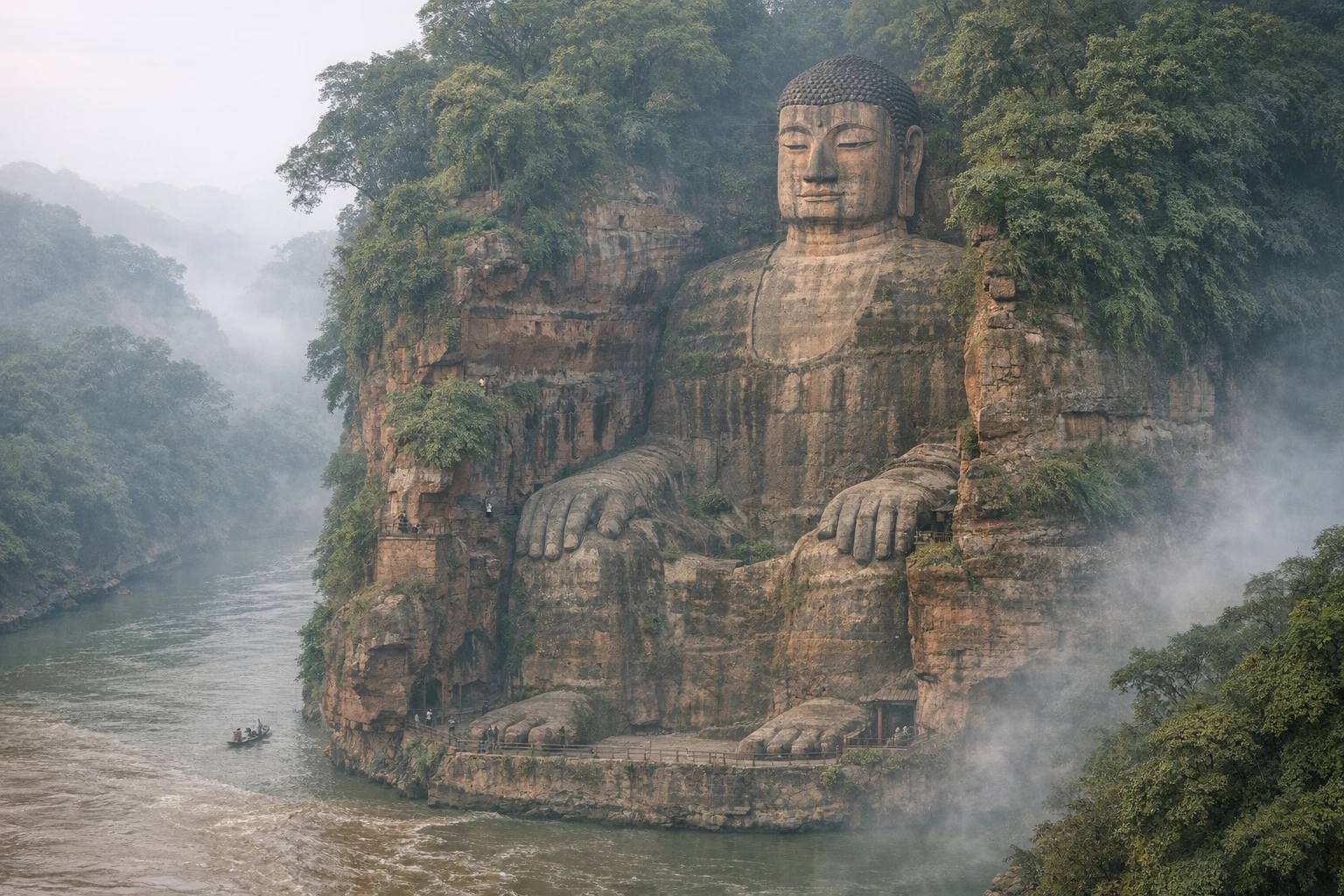
Leshan Giant Buddha
Tang Dynasty ChinaThe world's tallest pre-modern stone Buddha, carved into a clifftop in Sichuan, China, overlooking t...
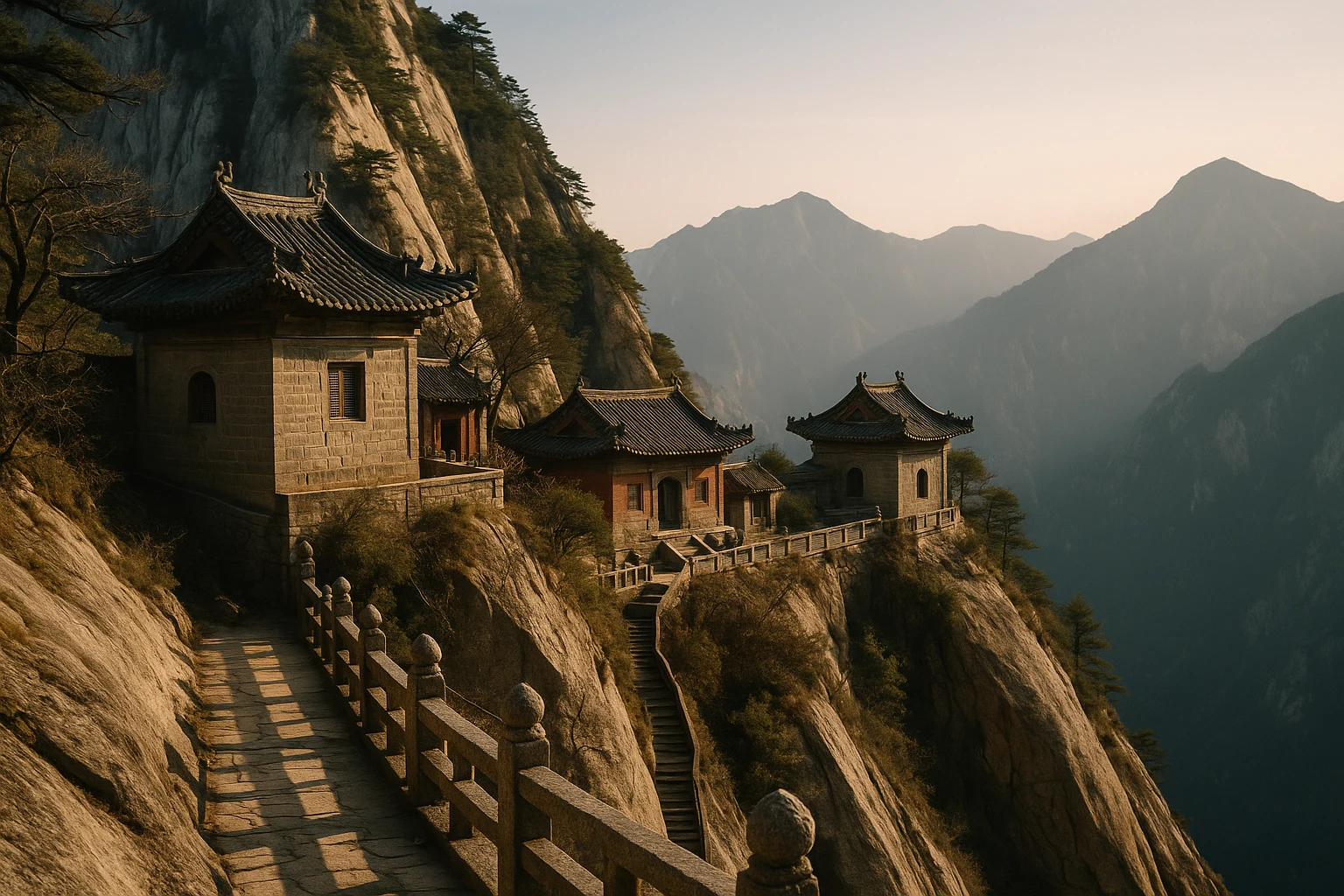
Mount Huashan Ancient Temples
Discover the sacred Daoist temples clinging to the sheer granite cliffs of Mount Huashan, one of Chi...