Quick Info
Curated Experiences
Mycenae, Epidaurus & Nafplion Full-Day Tour from Athens
Small-Group Mycenae, Epidaurus & Nafplio Trip from Athens
The Citadel of Legend
High in the rugged hills of Greece’s Argolid peninsula, surrounded by dramatic mountains and commanding views of the Aegean Sea, stands Mycenae—the citadel that launched a thousand ships and burned the topless towers of Ilium. Or so Homer tells us.
This is the home of Agamemnon, the legendary king who commanded the Greek forces in the Trojan War. It’s the seat of the House of Atreus, a dynasty cursed with betrayal, murder, and revenge that inspired Greek tragedies for centuries. When Heinrich Schliemann excavated these hills in the 1870s, he was searching not just for archaeology but for proof that Homer’s epics were more than myth. What he found changed our understanding of the ancient world.
Where Myth Meets Bronze Age Reality
Mycenae represents a fascinating intersection of legend and history. The stories Homer told—of Agamemnon and Menelaus, of Clytemnestra’s treachery and Orestes’ revenge—were already ancient when the Iliad was composed around 750 BCE, some 400 years after Mycenae’s fall. Whether Agamemnon himself ever walked these streets is impossible to prove. But someone did. Someone built these massive walls, forged the gold treasures Schliemann discovered, and ruled a kingdom powerful enough to dominate the Aegean for centuries.
Archaeology has revealed a sophisticated Bronze Age civilization—the Mycenaeans—who flourished from approximately 1600 to 1100 BCE. They developed writing (Linear B, an early form of Greek), built fortified palaces across mainland Greece, traded from Egypt to Sicily, and eventually collapsed in the mysterious Bronze Age Age catastrophe that ended ancient Mediterranean civilizations.
Today, Mycenae is a UNESCO World Heritage Site (shared with nearby Tiryns) and one of Greece’s most compelling archaeological destinations. Walking through the Lion Gate, standing atop the citadel, and descending into the Treasury of Atreus, you tread where legend and history intertwine—where the mask of Agamemnon (or whoever wore it) was unearthed, and where one of Europe’s first great civilizations rose and fell.
Getting to Mycenae: The Argolis Heartland
From Athens: 90-Minute Drive via Corinth Canal
Most visitors reach Mycenae from Athens, Greece’s capital and primary entry point for international travelers. The 120-kilometer journey takes approximately 90 minutes by car, following the modern highway westward across the Isthmus of Corinth and into the Peloponnese.
The route is straightforward and scenic, passing the Corinth Canal (worth a brief stop for photos) and climbing into the Argolid hills. Rental cars are readily available in Athens, and the roads are excellent. For a fuller experience, combine Mycenae with a stop at Ancient Corinth and lunch in charming Nafplio.
Public Bus: KTEL buses run from Athens’ Kifissos Bus Terminal to Nafplio (2 hours, €12-15), with stops near Mycenae. From the highway stop, it’s a 1-kilometer walk or short taxi ride to the site entrance. While economical, this option limits your flexibility for visiting multiple sites.
Organized Tours: Countless operators offer day trips from Athens combining Mycenae with Epidaurus and sometimes Corinth or Nafplio (€60-120). This is the easiest option for travelers without cars, though you’ll sacrifice some independence for convenience.
From Nafplio: The Ideal Base (30 minutes)
Nafplio, Greece’s first capital and one of its most picturesque towns, makes the ideal base for exploring Mycenae and the Argolid region. Located just 24 kilometers from Mycenae (25 minutes by car), Nafplio offers excellent restaurants, charming old town streets, seafront promenades, and accommodations ranging from boutique hotels to budget guesthouses.
Staying in Nafplio allows you to visit Mycenae early in the morning before tour buses arrive from Athens, then return to Nafplio for afternoon exploration or beach time. Many visitors find this approach more relaxing than the rushed day-trip from Athens.
Public Bus and Tour Options
From Nafplio, you can reach Mycenae by:
- Rental car: Most flexible option; allows combining with Tiryns and other sites
- Taxi: Approximately €40-50 each way; negotiate for the driver to wait
- Organized tour: Many Nafplio hotels and agencies offer half-day tours
- Bus: Limited service; check current schedules at the Nafplio KTEL office
The Citadel: Walking the Mycenaean Defenses
The Lion Gate: Icon of Ancient Greece
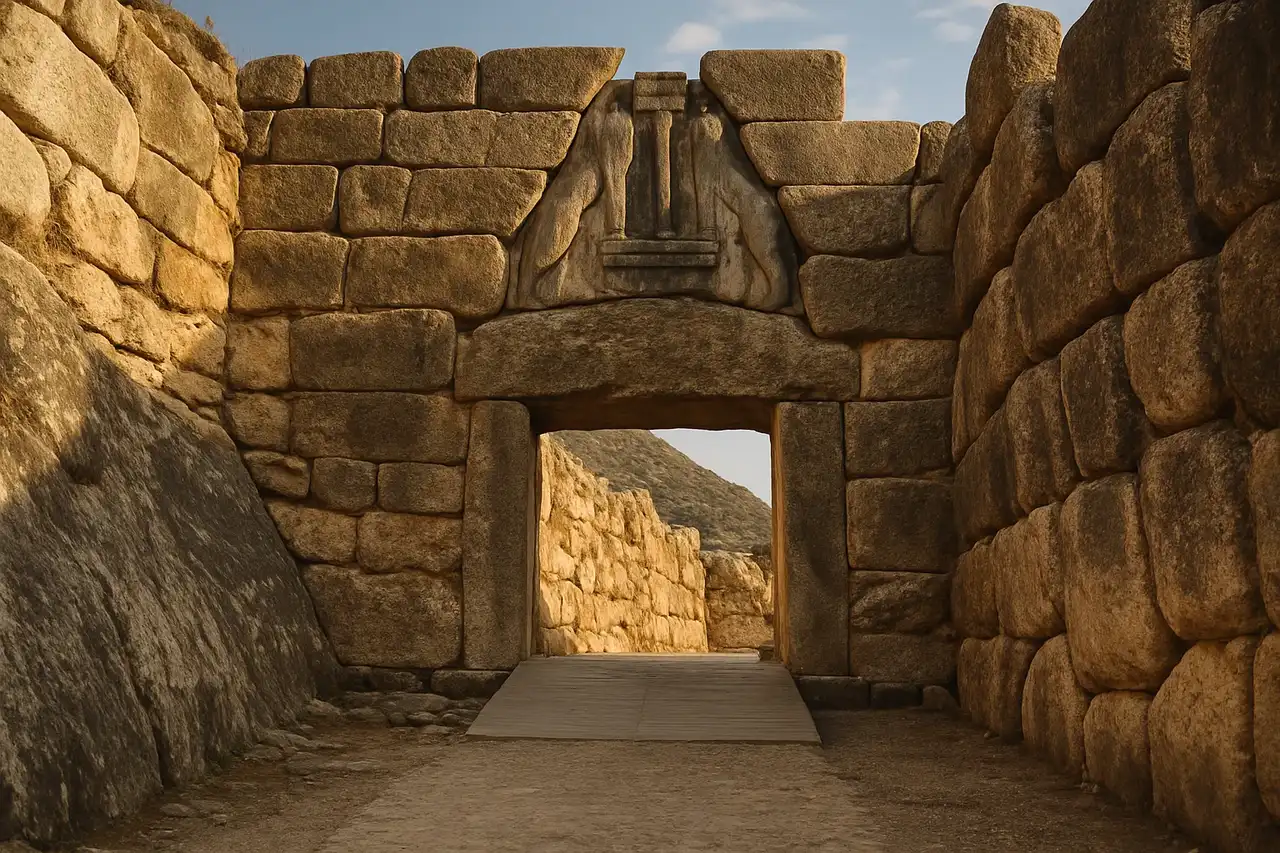
Your approach to Mycenae follows the same path travelers have used for 3,400 years—a winding road that climbs through the hills until suddenly, the citadel appears, its massive walls looming overhead. And there, guarding the entrance, stands the Lion Gate.
This is the only surviving monumental sculpture from the Mycenaean civilization, and it doesn’t disappoint. Two lionesses (or possibly lions—the heads, which would have identified the gender, are lost) rise on their hind legs, their forepaws resting on a central pillar atop an altar-like structure. They face outward, protecting the city while projecting royal power to all who approach.
The gate itself is ingeniously constructed—a massive limestone lintel, estimated to weigh 20 tons, spans the opening. Above it, a relieving triangle reduces weight on the lintel; the lions are carved into a stone slab filling this space. The engineering is impressive; the symbolism is unmistakable.
Passing through the Lion Gate, you’re walking where Agamemnon (perhaps) walked, where Schliemann stood in 1876 and declared, “I have gazed upon the face of Agamemnon.” The atmosphere is electric with history.
Grave Circle A: Royal Shaft Graves
Just inside the Lion Gate lies Grave Circle A, the burial ground that yielded Schliemann’s most spectacular discoveries. Six large shaft graves here contained the remains of 19 individuals—men, women, and children—buried with staggering wealth between 1600 and 1500 BCE.
The treasures Schliemann unearthed transformed understanding of the Greek Bronze Age: gold death masks, bronze weapons, silver vessels, intricate jewelry, carved ivory, and ceremonial objects demonstrating connections to Egypt, Crete, and the Near East. The most famous discovery, the gold “Mask of Agamemnon,” is actually too old to belong to the legendary king—it’s now dated to around 1550 BCE, centuries before the Trojan War. But Schliemann’s romantic identification captured the world’s imagination.
Today, Grave Circle A is marked by stone circles and informative displays. The original treasures are in the National Archaeological Museum in Athens (replicas and some grave goods are displayed at Mycenae). Standing here, you can imagine the funeral processions, the sacrifices, and the interment of a warrior aristocracy that ruled the Aegean world.
The Palace and Megaron
Ascending through the citadel, you follow the ancient processional way to the palace complex on the summit. While only foundations remain, the layout reveals sophisticated Mycenaean architecture centered on the megaron—the throne room that was the heart of Mycenaean political and religious life.
The megaron followed a standard design repeated across Mycenaean Greece: a porch (prodomos) leading to a central hall with a raised hearth and four columns supporting the roof. The king received visitors here, conducted religious ceremonies, and administered his kingdom. The ritual and political functions were inseparable—kingship was sacred authority.
Look for the indentations where columns once stood, the outline of the central hearth, and the drainage channels that carried water away. The views from the palace area encompass the surrounding territory—olive groves, hills, and the distant sea—demonstrating why this location was strategically valuable.
Nearby structures include workshops, storage rooms, and residential quarters. The citadel was more than a royal residence; it was a functioning administrative center with a permanent population of scribes, artisans, guards, and servants.
The Secret Cistern and Postern Gate
For adventurous visitors, the Postern Gate on the northern side of the citadel leads to Mycenae’s most atmospheric feature: the secret cistern. A tunnel descends into the bedrock, leading to an underground spring that provided water during sieges.
The descent is not for the claustrophobic. Steep, narrow, and lit only by artificial lights installed for visitors, the tunnel leads 18 meters down to a chamber where water still collects. The engineering is remarkable—Mycenaean builders carved this passage over 3,000 years ago, ensuring the citadel could withstand prolonged blockade.
Bring a flashlight (or use your phone) and wear sturdy shoes. The experience offers a visceral connection to the siege warfare that characterized the late Bronze Age Mediterranean.
The Treasury of Atreus: Engineering Marvel
The Corbelled Dome Technique
Five hundred meters outside the citadel stands the Treasury of Atreus—neither a treasury nor associated with Atreus, but one of the finest surviving examples of Mycenaean tholos tomb architecture. This is where Mycenaean engineering reaches its pinnacle.
Approach through the long, stone-lined passage (dromos) and stand before the massive doorway, framed by enormous monoliths. The lintel above the door weighs an estimated 120 tons—among the largest single stones used in ancient Greek architecture.
Step inside, and you’re in a beehive-shaped chamber constructed using the corbelling technique: each course of stone projects slightly inward from the one below, creating a self-supporting dome that reaches 13.5 meters in height. No mortar holds these stones together; precision cutting and gravity do the work. The effect is cathedral-like—acoustically resonant, spiritually evocative, and architecturally breathtaking.
The tomb was originally covered by an earthen mound, invisible from outside. Grave goods would have been placed in a side chamber (now collapsed) or directly on the floor. When it was discovered in modern times, the Treasury of Atreus had long since been looted, but the structure itself remains miraculously intact after 3,400 years.
Not Actually Agamemnon’s Tomb
Schliemann and early archaeologists identified this as the tomb of Agamemnon, hence the name “Treasury of Atreus.” Modern dating places its construction around 1250 BCE—still before the traditional date of the Trojan War but probably too late for Agamemnon himself, if he existed.
The tomb likely belonged to an unknown king or high noble of the final Mycenaean flowering. Other tholos tombs dot the Argolid landscape—some collapsed, some excavated—but none match the Treasury of Atreus for preservation and scale. This was clearly a burial place for someone of extraordinary status, possibly the last great ruler of Mycenae before the Bronze Age collapse.
When to Visit: Peloponnese Climate
Spring (April-May): Wildflowers and Mild Temps
April and May offer ideal conditions for exploring Mycenae. Temperatures range from 15-25°C (59-77°F), wildflowers carpet the hillsides, and the harsh summer sun hasn’t yet arrived. This is also when the site is relatively uncrowded before peak tourist season begins.
Easter week can be busy with domestic Greek visitors, but otherwise spring provides the perfect balance of pleasant weather and manageable crowds. Photographers will love the soft light and colorful landscapes.
Summer: Brutal Heat; Visit Early Morning
June through August brings Mediterranean summer—brilliant sunshine, cloudless skies, and temperatures regularly exceeding 35°C (95°F). Mycenae’s exposed position on a rocky hillside makes it particularly brutal in midday heat.
If visiting in summer, arrive at the 8:00 AM opening and plan to finish by 11:00 AM. Carry at least 1 liter of water per person; dehydration comes quickly on the unshaded citadel. The afternoon hours are better spent at Nafplio’s beaches or in air-conditioned museums.
Fall: Ideal Conditions
September and October provide a second sweet spot for visiting Mycenae. Temperatures moderate, crowds thin, and the light takes on a golden quality photographers love. This is when many experienced Greece travelers prefer to visit archaeological sites—good weather without the peak-season crush.
November brings cooler temperatures and occasional rain, but the site remains open and atmospheric. Winter visits (December-March) are possible but expect shorter hours, possible closures during severe weather, and definitely bring warm clothing—the wind on the citadel can be biting.
Practical Essentials: Tickets and Combined Sites
Combined Ticket with Tiryns
Mycenae and nearby Tiryns share a combined entrance ticket (€12 for adults as of 2024), valid for both sites on the same day or consecutive days. This is excellent value, as Tiryns features some of the best-preserved Mycenaean walls anywhere.
Tiryns is located just 20 kilometers from Mycenae (20 minutes by car) and makes a natural addition to your itinerary. The walls here are even more impressive than Mycenae’s in places—thicker, better preserved, and demonstrating the same Cyclopean masonry techniques. While Tiryns lacks Mycenae’s dramatic setting and famous Lion Gate, it’s well worth visiting, especially with the combined ticket.
Current Pricing and EU Discounts
- Full admission: €12 (includes Mycenae, Tiryns, and on-site museums)
- Reduced admission: €6 (EU seniors 65+, students outside EU)
- Free admission: EU students, EU visitors under 25, all visitors on select cultural heritage days (check current calendar)
The ticket includes admission to the small but excellent archaeological museum at Mycenae, which displays finds from the site including pottery, tools, and fragments of frescoes.
Understanding Mycenaean Civilization
The Linear B Script
One of Mycenae’s most significant contributions to history was the development of Linear B, Europe’s earliest known writing system. Clay tablets inscribed with Linear B were discovered at Mycenae and other palace sites, revealing a sophisticated administrative system tracking everything from agricultural production to military equipment.
In 1952, architect Michael Ventris (with help from John Chadwick) proved that Linear B recorded an early form of Greek—the language of the Mycenaeans. This was revolutionary: it meant the Greek language had continuous documentation from the 15th century BCE to the present, the longest recorded linguistic lineage in Europe.
The tablets reveal a world of palace bureaucracies, specialized craftsmen, slave labor, and careful record-keeping. They mention gods recognizable from later Greek mythology (Zeus, Hera, Poseidon, Athena), suggesting religious continuity across the Bronze Age Dark Age. While the tablets are mostly administrative rather than literary, they prove the Mycenaeans were far from the illiterate barbarians some scholars once imagined.
Relationship to Minoan Crete
No discussion of Mycenae is complete without acknowledging Crete. The Minoan civilization, centered at Knossos and other Cretan palaces, predated and influenced the Mycenaeans. For centuries, Minoan culture set the standard for Aegean art, architecture, and trade.
Around 1450 BCE, Mycenaeans appear to have taken control of Crete—whether through conquest, alliance, or gradual infiltration remains debated. Linear B tablets from this period appear at Knossos, written in Mycenaean Greek rather than the earlier Linear A. The Mycenaeans absorbed Minoan artistic techniques, religious concepts, and administrative practices while developing their own distinctive culture.
The relationship was complex: admiration and imitation mixed with competition and eventual domination. When the Minoan palaces were destroyed (probably by the volcanic eruption on Thera and subsequent tsunami, combined with Mycenaean takeover), Mycenae emerged as the dominant power in the Aegean, a position it held until the Bronze Age collapse around 1200 BCE.
Frequently Asked Questions
Is the Mask of Agamemnon at Mycenae?
No, the original Mask of Agamemnon and other treasures from Grave Circle A are housed in the National Archaeological Museum in Athens. Mycenae displays high-quality replicas and some original grave goods of lesser value. The museum in Athens is essential viewing for anyone interested in Mycenae—plan a visit either before or after seeing the archaeological site.
How long do I need at Mycenae?
Plan 2-3 hours for the citadel itself, including the museum. Add 45 minutes for the Treasury of Atreus (a separate site 500 meters away). A thorough half-day allows you to see everything at a reasonable pace without rushing. Combine with Tiryns for a full day of Mycenaean archaeology.
Can I combine Mycenae with Epidaurus in one day?
Yes, combining Mycenae and Epidaurus is a standard day trip from Athens or Nafplio. The ancient theater at Epidaurus (45 minutes from Mycenae) is the best-preserved Greek theater and a UNESCO site. Many organized tours include both, plus a stop at Nafplio. Self-drivers can easily manage Mycenae in the morning, lunch in Nafplio, and Epidaurus in the afternoon.
What’s the difference between Mycenae and Tiryns?
Tiryns is smaller than Mycenae but features better-preserved walls and a more compact layout. Both are Mycenaean citadels using Cyclopean masonry; both are included in the same UNESCO World Heritage listing and combined ticket. Tiryns is 20 km from Mycenae and takes 45 minutes to an hour to explore. If you have time, visit both—they’re complementary. If you must choose, Mycenae offers more famous features (Lion Gate, Treasury of Atreus) while Tiryns offers superior wall preservation.
Is Mycenae accessible for mobility-impaired visitors?
Partially. The approach to the Lion Gate and the area immediately inside are relatively accessible, though the terrain is uneven gravel and stone. The path to the palace megaron involves significant uphill walking on rough surfaces with steps. The Treasury of Atreus is more accessible, with a flat approach and only one step at the entrance. Visitors with limited mobility can see the most famous features but won’t be able to explore the entire citadel.
The Mask and the Myth
Standing in Grave Circle A, where Schliemann found his golden masks, or walking through the Lion Gate as countless visitors have done for three millennia, you confront the fascinating tension that defines Mycenae. This is a place where myth and history intertwine, where archaeological fact is often more astonishing than legendary fiction, and where the questions are sometimes more compelling than the answers.
Did Agamemnon exist? Probably not as Homer described him—king of kings, commander of the Greeks, murdered by his wife upon his return from Troy. But someone ruled Mycenae, commanded its armies, and was buried with the golden mask that Schliemann so romantically attributed to the legendary king. The reality of the Mycenaean civilization—its writing, its engineering, its far-reaching trade—exceeds what the myths preserved.
Mycenae matters because it represents a beginning. This was the first major civilization on the European mainland, the first Greeks, the first Europeans to leave written records. Their Linear B tablets trace the Greek language back 3,400 years. Their architecture influenced everything that followed. Their collapse in the Bronze Age catastrophe created the Dark Ages from which classical Greece eventually emerged.
When you visit Mycenae, you’re not just seeing ruins. You’re witnessing the foundations of Western civilization—the first steps toward the classical world that gave us democracy, philosophy, theater, and the enduring questions of what it means to be human. Agamemnon may be legend, but the people who built these walls, forged these treasures, and wrote these tablets were real. Their achievements speak across the centuries.
That is the true gold of Mycenae. Not Schliemann’s mask, however beautiful, but the knowledge that here, on this windswept hill in the Argolid, something extraordinary began. And you can still walk where they walked, touch what they built, and wonder at what they achieved before the darkness fell.
Continue Your Journey Through Ancient Greece
- Acropolis of Athens: The pinnacle of classical Greek architecture
- Delphi: The mystical oracle sanctuary
- Knossos: The Minoan palace that influenced Mycenaean culture
- Ephesus: The magnificent Roman city across the Aegean
Plan your complete Greek archaeological adventure with our Greece Ancient Sites Guide and 10-Day Greece Itinerary.
Quick Facts
| Attribute | Details |
|---|---|
| Location | Argolis, Greece |
| Country | Greece |
| Region | Argolis |
| Civilization | Mycenaean Greece |
| Historical Period | c. 1600–1100 BCE |
| Established | c. 1600 BCE |
| Coordinates | 37.7306, 22.7561 |
Frequently Asked Questions
What is the connection between Mycenae and Homer?
Mycenae is traditionally identified as the kingdom of Agamemnon, who led the Greek expedition to Troy in Homer's Iliad. When Heinrich Schliemann excavated the site in 1876, he discovered Shaft Grave Circle A with its golden burial masks, famously (and wrongly) declaring one to be the 'Mask of Agamemnon.' While Homer's Agamemnon is almost certainly legendary, Mycenae was undeniably the most powerful city in the Bronze Age Aegean.
How do I get to Mycenae from Athens?
Mycenae is 120 km southwest of Athens (1.5-2 hours by car). Take the Athens-Corinth motorway (E94) then south via Nafplio. Buses run from Athens' KTEL Peloponnese station to Nafplio or Argos, from which local buses or taxis complete the journey. Most visitors do Mycenae as a day trip from Athens or as part of a Peloponnese circuit including Nafplio, Epidaurus, and Corinth.
What is the Treasury of Atreus?
Also called the 'Tomb of Agamemnon,' the Treasury of Atreus is a massive tholos (beehive) tomb from around 1250 BCE—one of the largest single-room spaces in the ancient world. The corbelled dome rises 13.5 meters and spans 14.5 meters across, constructed from precisely cut stones without mortar. The engineering precision equals anything in classical Greece. It stands separate from the main citadel, a 10-minute walk down the road.
How long does it take to visit Mycenae?
The citadel site takes 1.5-2 hours to explore, including the Lion Gate, Grave Circle A, Royal Palace, and the Secret Cistern. The Archaeological Museum on site deserves another 30-45 minutes. Add 30 minutes for the Treasury of Atreus (separate). A full Mycenae visit takes 2.5-3.5 hours.
Is Mycenae combined well with other Peloponnese sites?
Mycenae, Epidaurus (ancient theater, 30km away), and Nafplio (charming harbor town) form the classic Argolid circuit and are easily done in 1-2 days from Athens. Corinth (ancient ruins and canal, 1 hour away) rounds out a great Peloponnese day trip. Add Tiryns (Bronze Age citadel, 3km from Nafplio) for another Mycenaean site comparable to Mycenae itself.
Nearby Ancient Sites
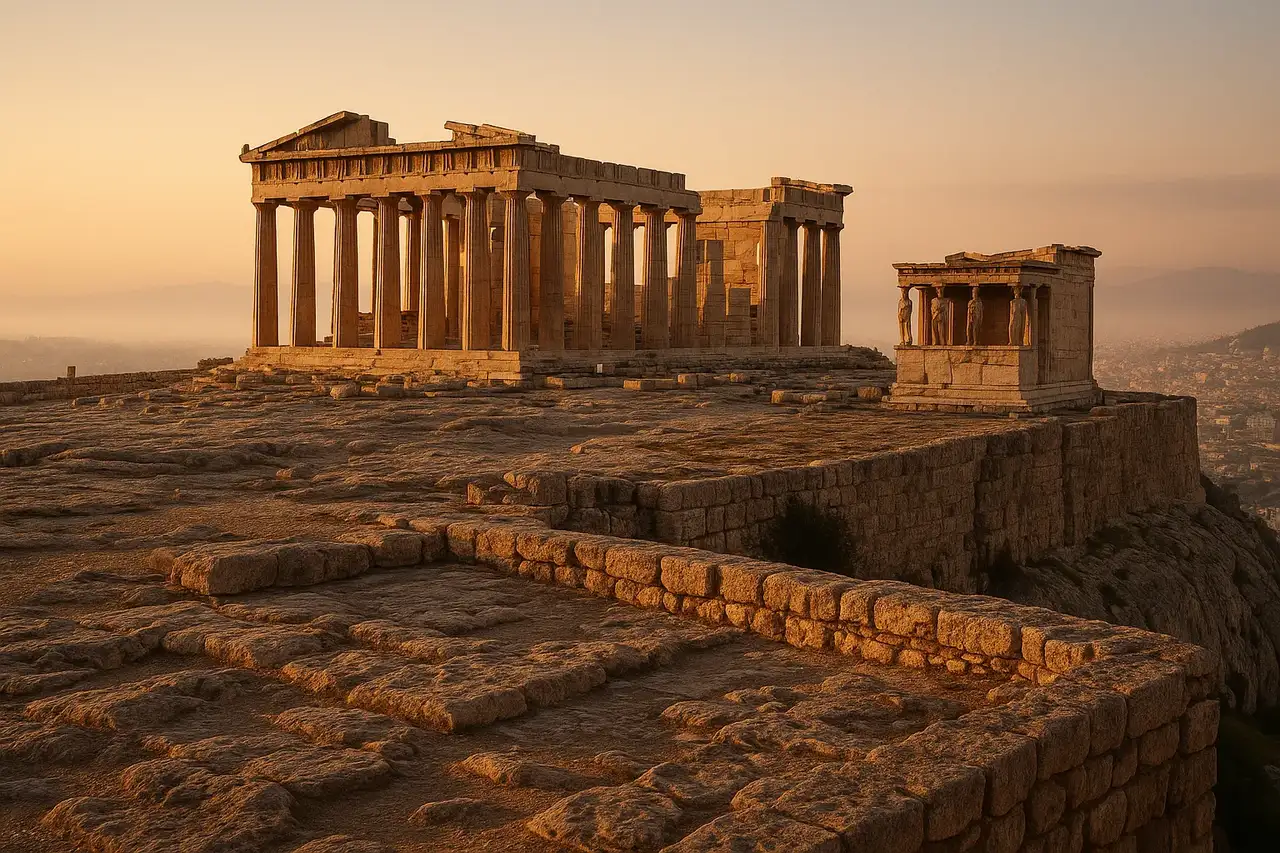
The Complete Acropolis Athens Travel Guide: Temples
Ancient GreecePlan the perfect visit to the Acropolis of Athens with our 2026 guide. Discover the Parthenon, best ...
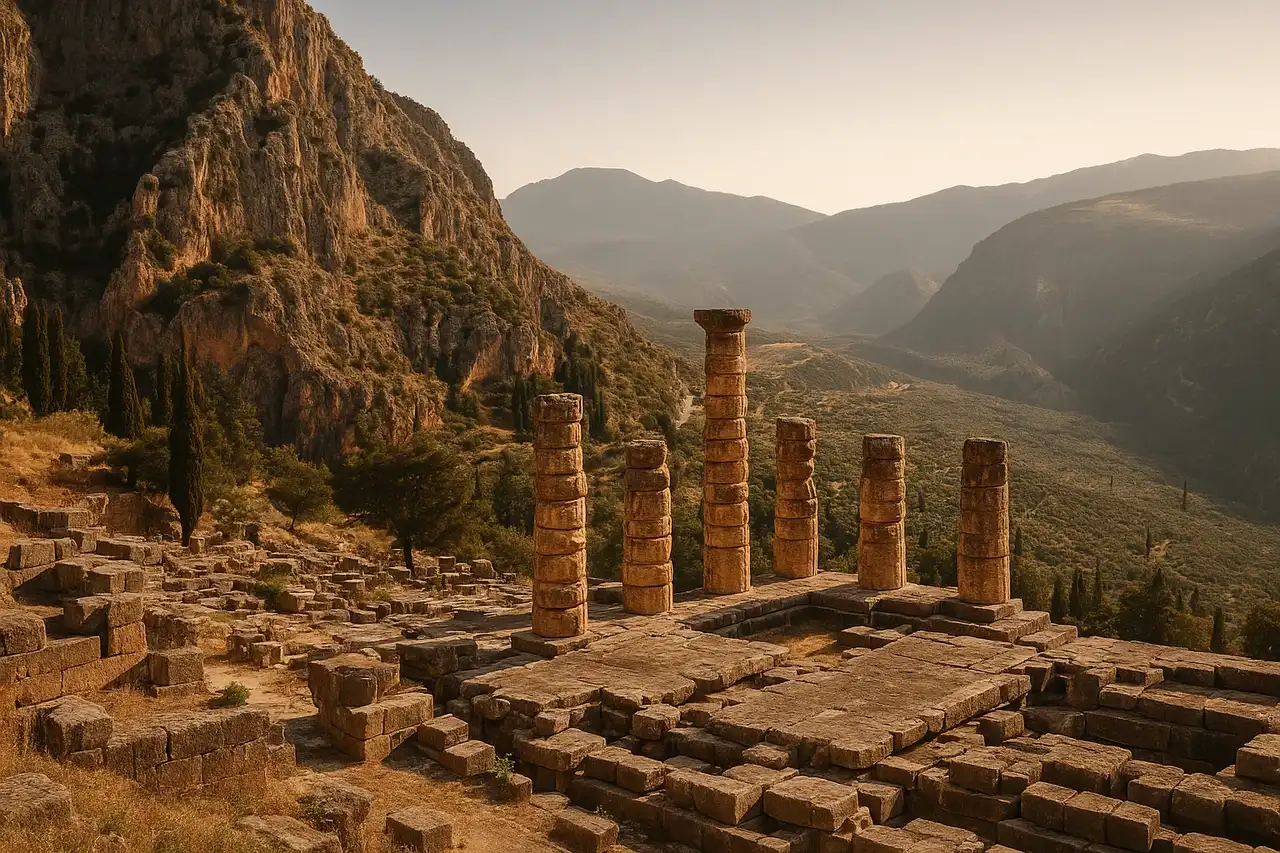
Delphi: The Navel of the Ancient World and Greece's Most
Ancient GreeceExplore Delphi, Greece's most mystical archaeological site. Walk the Sacred Way, discover the Oracle...
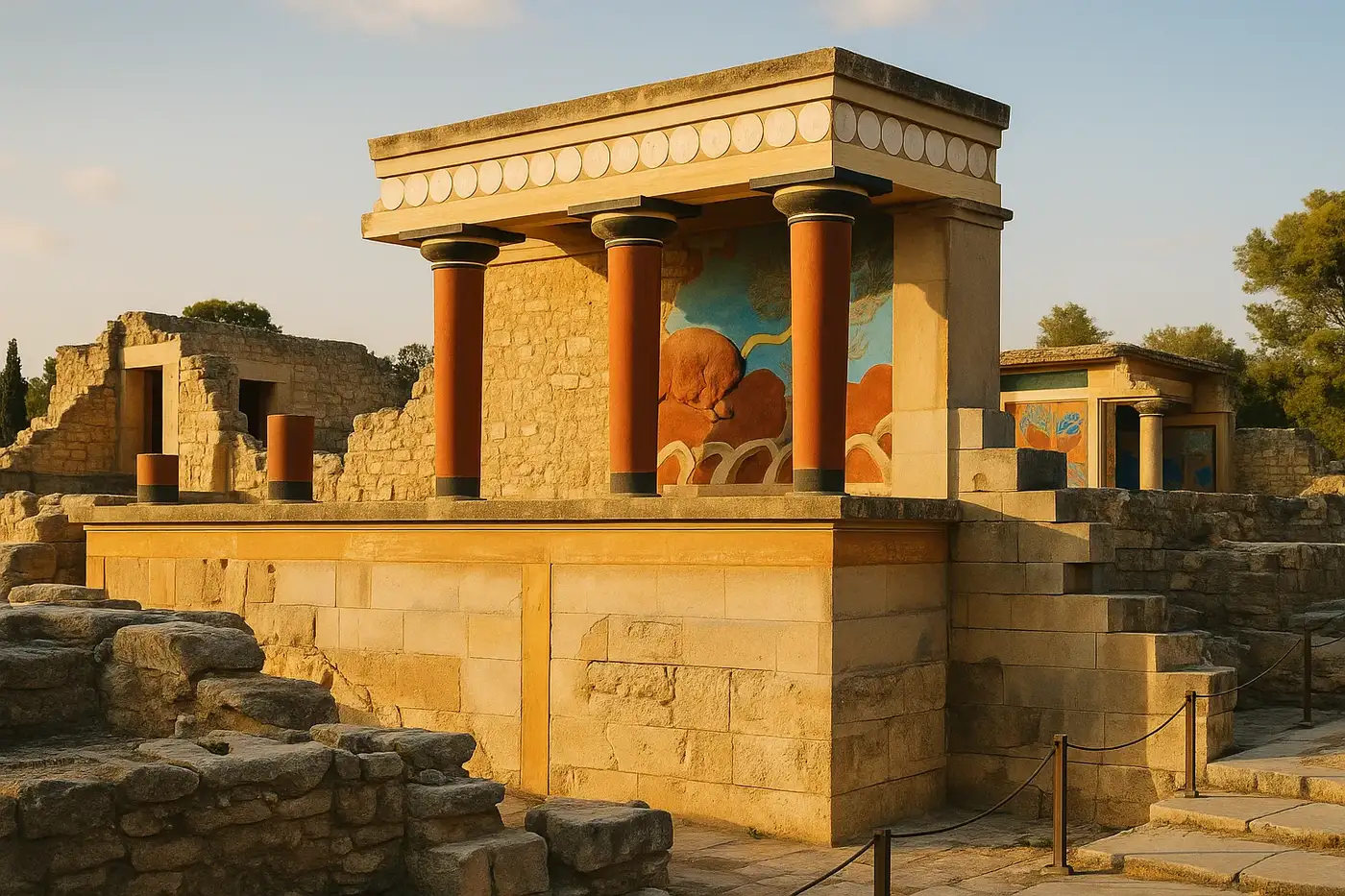
Knossos: Europe's Oldest Palace and the Birthplace of
MinoanExplore the legendary Palace of Knossos, center of Minoan civilization. Discover the Labyrinth myth,...