Quick Info
At a glance
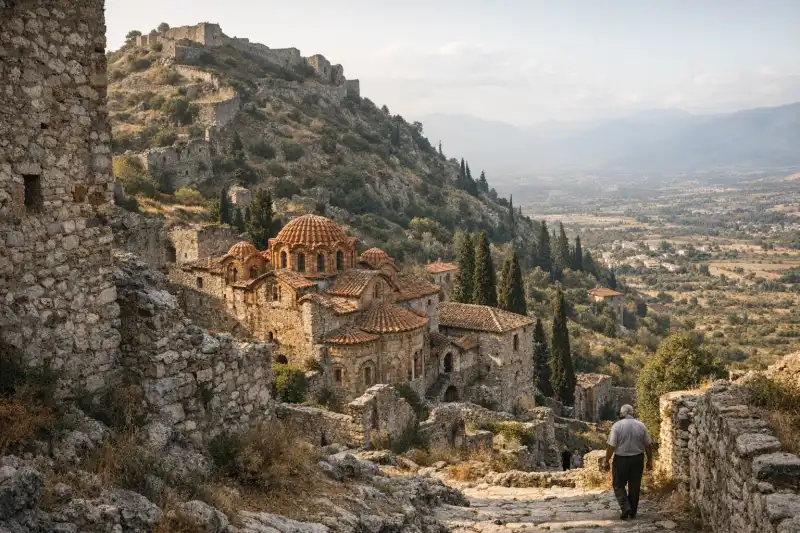
Mystras in Greece is one of those rare places that feels less like a ruin and more like a city paused in mid-breath. Spread across the slopes of Mount Taygetos above the plain of Sparta, it rises in terraces of stone walls, monasteries, chapels, and palatial remains, all watched over by a fortress on the summit. The setting is immediately dramatic: cypress trees frame broken archways, distant olive groves shimmer in the heat, and the valley below opens wide toward Lakonia. Even before you know its story, Mystras suggests ambition, power, and retreat all at once.
Unlike the classical sanctuaries and temples that dominate many itineraries in Greece, Mystras belongs to the Byzantine and late medieval world. Here the visitor encounters domed churches with fading frescoes, convents that still preserve religious life, and the remains of an administrative center that once rivaled other important cities of the eastern Mediterranean. It was a seat of culture, a center of political authority, and, in its final centuries, one of the last great strongholds of a declining Byzantine Empire. Today, walking through Mystras means moving through layers of Frankish conquest, Byzantine revival, Ottoman occupation, and eventual abandonment. The site is large enough to reward a slow visit, yet intimate enough that details linger: carved stonework, mountain light on tiled roofs, and the silence inside a frescoed chapel. For travelers interested in history beyond the ancient Greek world, Mystras is among the most memorable destinations in the Peloponnese.
History
Frankish foundation and the castle
The story of Mystras begins in the aftermath of the Fourth Crusade, when crusaders and western lords carved former Byzantine territory into new feudal states. In 1249, William II of Villehardouin, prince of Achaea, built a strong castle on a steep hill near ancient Sparta. The location was strategic. It commanded routes through Lakonia and offered natural defensive advantages, while also projecting Frankish authority into a region with deep Byzantine traditions.
Around this fortress, a settlement began to take shape. What started as a military stronghold soon attracted inhabitants from surrounding areas, including people from nearby Lacedaemon, the settlement associated with ancient Sparta. The hill offered security in an age of shifting alliances and frontier warfare. Yet the Frankish phase of Mystras was relatively brief. The castle they established remained crucial, but the city’s identity would soon become overwhelmingly Byzantine.
Byzantine takeover and urban growth
In 1259, William II was defeated by Byzantine forces at the Battle of Pelagonia. As part of the settlement for his release, he surrendered several key fortresses, including Mystras, to the Byzantines in 1262. This transfer transformed the site. Under Byzantine rule, Mystras developed rapidly into the administrative and political center of the Despotate of the Morea, the semi-autonomous Byzantine province that governed much of the Peloponnese.
During the late 13th and 14th centuries, the city expanded down the hillside from the original fortress. Fortification walls enclosed an upper and lower town. Noble residences, monasteries, workshops, and churches multiplied. The city became a seat of governors, aristocrats, military officials, and churchmen. Its position made it both defensible and connected: close to fertile plains, but safely elevated above them.
This was the period when many of the site’s most important buildings appeared. Churches such as the Metropolis of Saint Demetrios, the Pantanassa, the Peribleptos, and the Hodegetria display the artistic and architectural richness of late Byzantine culture. Their wall paintings, though damaged, still reveal the sophistication of the era. Mystras became not just a provincial center but one of the brightest urban communities in the later Byzantine world.
A cultural capital of the late empire
By the 14th and 15th centuries, Mystras had become a center of learning as well as government. It attracted intellectuals, artists, and theologians during a time when the Byzantine Empire was politically weakened but culturally resilient. Among the most famous figures associated with the city was the philosopher Gemistos Plethon, whose revival of Platonic thought influenced scholars in both Byzantium and Renaissance Italy.
The despot’s palace complex, still one of the site’s most striking remains, symbolizes this era of prestige. The rulers of the Morea governed from here, and Mystras functioned almost as a secondary capital of the empire. Diplomatic exchanges, ecclesiastical debates, and elite patronage all passed through the city. In 1449, Constantine XI Palaiologos, the last Byzantine emperor, was crowned at Mystras before departing for Constantinople, where he would later die defending the city in 1453.
This connection gives Mystras a special place in Greek and Byzantine memory. It was one of the final flourishing centers of an empire approaching its end, preserving high culture and political ceremony in a period of looming collapse.
Ottoman conquest, decline, and abandonment
After the fall of Constantinople, Mystras survived for a time as a regional center, but the balance of power had decisively shifted. The Ottomans took the city in 1460, though it would briefly pass through other hands, including Venice, before returning to Ottoman control. Despite conquest, the city did not vanish overnight. It remained inhabited and retained religious and local administrative importance.
Over the following centuries, however, Mystras gradually declined. New political realities, changing trade patterns, and regional instability reduced its importance. The foundation of modern Sparta in the 19th century drew population and activity into the plain below. By then, many of the city’s structures had fallen into ruin, though some monastic communities continued to function.
In the modern era, Mystras came to be valued as an archaeological and historical treasure rather than a living urban center. Conservation work and scholarly attention helped reveal the importance of its churches, frescoes, fortifications, and palace complex. Today it is recognized as a UNESCO World Heritage Site and stands as one of the clearest surviving windows into the world of late Byzantium.
Key Features
What makes Mystras remarkable is not a single monument but the way an entire hillside city survives in layered form. The visitor enters a landscape where military architecture, courtly buildings, religious institutions, and domestic remains still relate to one another in space. You do not simply see isolated ruins; you read the outline of a functioning medieval city.
The uppermost feature is the castle, the original Frankish nucleus of the settlement. Reaching it requires a steady climb, but the reward is one of the best panoramas in the Peloponnese. From the summit, the plain of Sparta spreads below in a patchwork of fields and olive groves, while the slopes of Taygetos rise behind. The fortress itself, though fragmentary, preserves the strategic logic of the site. Walls trace the crest of the hill, and the position makes clear why rulers of different empires valued Mystras so highly.
Descending from the castle, visitors encounter the Palace of the Despots, the most imposing secular structure on the site. Its remains include halls, façades, and residential sections built and altered over several centuries. Even in ruin, the complex conveys status and ceremony. This was not merely a defensive outpost but a center of administration and elite life. Restoration has helped make some of the palace easier to interpret, and its scale offers a useful counterpoint to the more intimate church interiors elsewhere in Mystras.
The churches are the site’s true artistic heart. The Metropolis of Saint Demetrios, one of the oldest major churches in the city, combines religious importance with political memory: tradition associates it with the coronation of Constantine XI. Inside, surviving frescoes and sculptural details hint at the richness of its decoration. Other churches offer different atmospheres. The Hodegetria, often called Aphentiko, has a broad and stately presence, reflecting monastic patronage and elite ambition. The Peribleptos, dramatically set into the hillside, feels more secluded and contemplative, and its frescoes are among the most admired at the site. The Pantanassa, still linked to monastic life, is especially elegant, with refined architecture and a sense of continuity between past and present.
These churches matter not only because they are beautiful, but because they show the final flowering of Byzantine art. Their wall paintings belong to a period when artists continued to experiment with emotional expression, movement, and color, even as the empire itself was shrinking. In Mystras, this late Byzantine aesthetic is preserved in unusual concentration.
Another important feature is the urban fabric itself. Stone streets, terraces, stairways, cisterns, and house remains create a strong sense of daily life. Although many domestic buildings survive only as shells, they help the visitor imagine neighborhoods below the palaces and monasteries. Gates and walls define how movement through the city was controlled. The split between upper and lower town also becomes tangible as you walk, reminding you that status, security, and function all shaped the medieval settlement.
Nature is part of the experience as well. Cypress, pines, wildflowers in spring, and mountain air soften the austerity of the stone ruins. Because Mystras climbs a hillside, each turn offers a changing view. In one moment you are looking through a ruined arch at distant farmland; in the next you are standing in the cool dimness of a chapel where painted saints still emerge from the plaster. This mixture of openness and enclosure is one of the site’s defining pleasures.
Getting There
Mystras is located just outside modern Sparta in the Peloponnese, making Sparta the main transport base for most visitors. If you are traveling from Athens by car, the drive usually takes around 2.5 to 3 hours depending on traffic and your route. The journey is straightforward and often the most convenient option, especially if you want flexibility for exploring both Mystras and Sparta in a single day. Rental cars in Greece vary by season, but daily rates often start around €35-€60, with fuel and tolls extra.
Public transport is possible, though slower. Intercity KTEL buses connect Athens to Sparta, with one-way fares commonly in the range of €20-€25. Travel time is usually around 3 to 4 hours. From Sparta, local taxis can take you to the archaeological site entrance in about 10 minutes; expect roughly €10-€15 each way, depending on time of day and exact pickup point. Some local buses or hotel-arranged transfers may also be available in season, but schedules can be limited.
Many travelers choose an organized day trip from Athens or the Peloponnese, especially if they prefer not to manage transfers. Guided tours may combine Mystras with Sparta or other regional landmarks. Prices vary widely, but shared excursions often begin around €80-€150 per person, while private tours can be much higher.
The site itself has more than one entrance, and because it is steep, your route matters. Some visitors enter from the upper gate and walk downhill, arranging transport between entrances. Wear sturdy shoes, carry water, and allow extra time, as moving through Mystras is more demanding than visiting a flat archaeological site.
When to Visit
Spring is the most rewarding season for many travelers. From March to May, the slopes around Mystras are greener, temperatures are usually comfortable, and wildflowers can soften the ruins with color. This is ideal weather for climbing between the upper and lower town without the intensity of high summer heat. Light, especially in the morning and late afternoon, also tends to be excellent for photography.
Autumn, especially September through early November, is another strong choice. The summer crowds thin out, daytime conditions become easier for walking, and the surrounding landscape takes on a warmer, drier beauty. If your main interest is exploring churches, frescoes, and panoramic viewpoints at a measured pace, autumn often offers the best balance of comfort and atmosphere.
Summer can still be enjoyable, but it requires planning. Temperatures in Lakonia can become very high, and much of the site is exposed. If visiting in June, July, or August, aim to arrive early in the morning, bring plenty of water, wear a hat, and expect the uphill sections to feel tiring. Midday visits are far less pleasant in peak heat.
Winter has a quiet charm and can be good for travelers who prefer solitude. Cooler air makes climbing easier, and the mood of the ruined city can feel especially dramatic under gray skies or low cloud. However, weather may be unsettled, opening hours can vary, and slippery paths are more of a concern after rain.
Whenever you go, give yourself time rather than rushing. Mystras is best appreciated slowly, with pauses in churches, viewpoints, and shaded corners. Early morning and late afternoon are especially rewarding, when the mountain light brings out the textures of stone, brick, and faded fresco.
| Quick Facts | Details |
|---|---|
| Location | Near Sparta, Laconia, Peloponnese, Greece |
| Main period | 13th-15th century CE |
| Founded | 1249 CE as a Frankish fortress |
| Later importance | Capital of the Byzantine Despotate of the Morea |
| UNESCO status | World Heritage Site |
| Best known for | Byzantine churches, frescoes, monasteries, palace, and castle |
| Typical visit length | 3-5 hours |
| Terrain | Steep hillside paths, steps, and uneven stone surfaces |
| Nearest city | Sparta |
| Best seasons | Spring and autumn |
Guided tours: worth it?
Self-guided works here, but a guide can add real value if you want the ruins explained as a living place rather than just a sequence of monuments.
Best for
- First-time visitors who want context, not just photos
- Short visits where a planned route saves time
When to go self-guided
Go independently if you prefer setting your own pace, reading as you go, and checking official hours or ticket rules directly before you arrive.
What I’d avoid
Skip paid tours that bundle unrelated stops you do not actually want. The best option should either save meaningful planning time or add historical context you would miss on your own.
Mystras Greece tours
Useful when: you want to compare guided formats before deciding
Sparta and Mystras day trip
Useful when: transport or pickup logistics matter
Peloponnese Byzantine sites tour
Useful when: you want to compare guided formats before deciding
Some tour links are affiliate links, which may earn Ancient Travel a small commission at no extra cost to you. I try to surface options that make practical sense for the site—not just anything bookable.
Frequently Asked Questions
What is Mystras famous for?
Mystras is famous for its remarkably preserved Byzantine city, with churches, monasteries, palaces, frescoes, and a hilltop castle overlooking the plain of Sparta.
Is Mystras worth visiting from Athens?
Yes. Mystras is one of Greece’s most important medieval and Byzantine archaeological sites and rewards visitors with architecture, history, and beautiful mountain scenery.
How much time do you need at Mystras?
Most visitors need at least 3 to 4 hours to explore the main upper and lower town, but a full day is better if you want to visit museums, churches, and walking paths at a relaxed pace.
Do you need to walk a lot at Mystras?
Yes. Visiting Mystras involves significant walking on uneven stone paths, slopes, and steps, so sturdy shoes, water, and sun protection are strongly recommended.
Can you visit Mystras and Sparta on the same day?
Yes. The archaeological site of Mystras and modern Sparta are very close to each other, making it easy to combine them in a single day trip.
When is the best time to visit Mystras?
Spring and autumn are usually the best times, with milder temperatures, greener landscapes, and more comfortable conditions for walking the large hillside site.
Nearby Ancient Sites
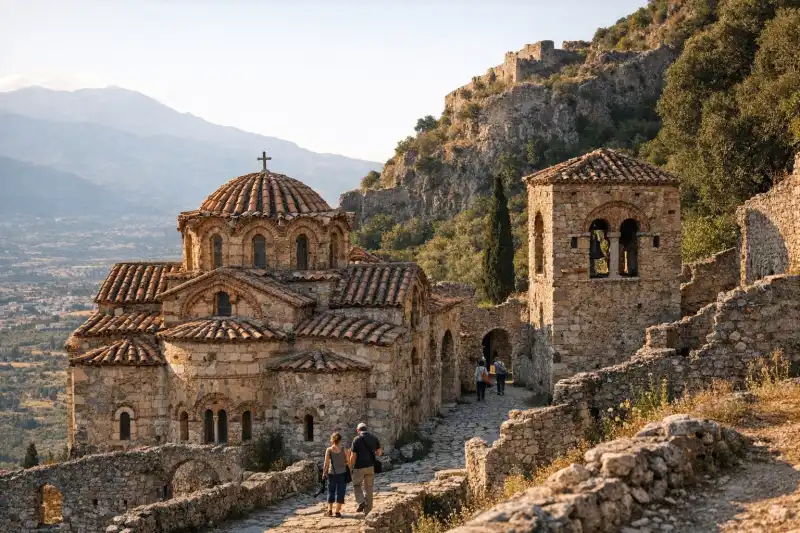
Byzantine Mystras
ByzantineExplore Byzantine Mystras in Greece, a haunting hilltop city of palaces, monasteries, frescoed churc...
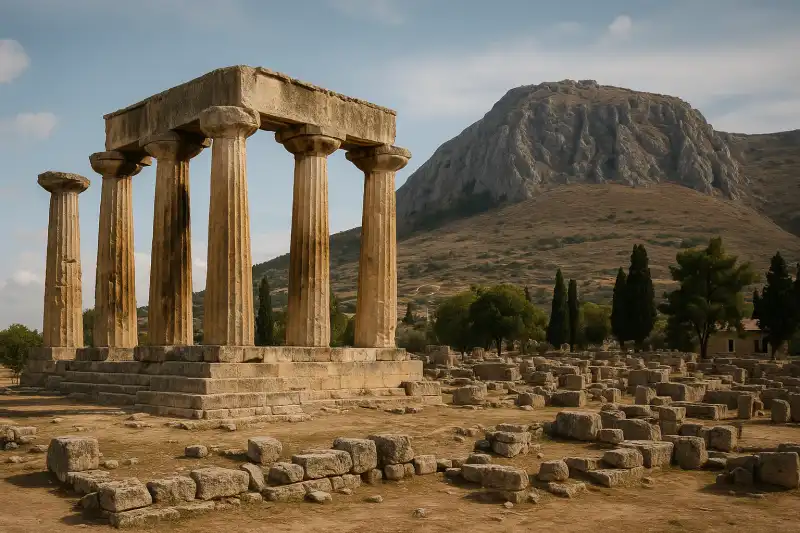
Ancient Corinth Travel Guide 2026: Ruins, Museum, and Visit Strategy
Classical GreekPlan a focused Ancient Corinth visit with practical timing, monument priorities, and route context f...
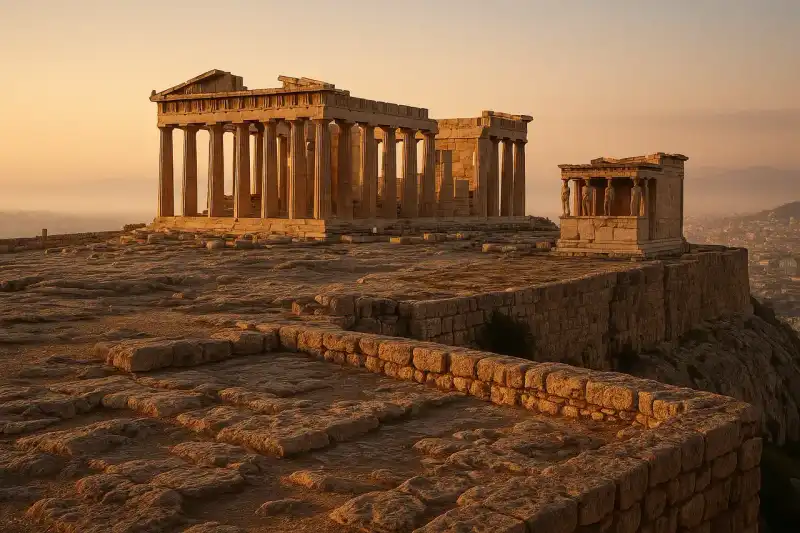
The Complete Acropolis Athens Travel Guide: Temples
Ancient GreecePlan the perfect visit to the Acropolis of Athens with our 2026 guide. Discover the Parthenon, best ...