Quick Info
At a glance
Nemea, Greece, sits in a quiet valley of the northeastern Peloponnese, where vineyards spread across low hills and the remains of one of ancient Greece’s great sacred athletic centers lie in open countryside. At first glance, the site can feel modest compared with the Acropolis or Delphi, but that is exactly part of its power. Nemea is not a ruin swallowed by a modern city. It is a landscape site, one where temple columns rise from fields, a stadium rests beyond cypress and olive trees, and the memory of ritual, sport, and myth remains closely tied to the land itself.
Travelers often arrive in Nemea expecting a brief stop on a Peloponnese road trip and leave surprised by how complete the experience feels. The Sanctuary of Zeus, the museum, the hero cult associated with Opheltes, and the remarkably atmospheric stadium together tell a story larger than the scale of the ruins might suggest. Nemea was one of the homes of the Panhellenic games, and that alone placed it in the same cultural world as Olympia, Delphi, and Isthmia. Yet it also belongs to another layer of Greek memory: the realm of Heracles, whose slaying of the Nemean Lion gave the valley a permanent place in myth. Today, with its calm setting and manageable size, Nemea offers one of the clearest ways to imagine how sacred geography, athletic competition, and regional identity once came together in ancient Greece.
History
Early cult and the sacred valley
The valley of Nemea was already significant in the early archaic period, though its development into a major Panhellenic sanctuary appears to have taken shape in the 6th century BCE. The area seems to have first functioned as a religious center before it became a major athletic one. Ancient sources and archaeological evidence connect the site above all with Zeus, whose sanctuary eventually drew visitors from across the Greek world.
Nemea’s mythic associations likely helped elevate its importance. The best-known story is the first labor of Heracles, in which he killed the invulnerable Nemean Lion and later wore its skin as his emblem. Another local tradition involved the infant Opheltes, whose death was commemorated with funeral games. In mythic terms, Nemea was therefore a place of both heroic violence and sacred mourning, and these traditions helped shape the identity of the games held there.
The earliest sanctuary was probably simpler than the monumental remains visible today. As with many Greek sacred sites, repeated use, offerings, and rebuilding gradually transformed an open cult place into an organized religious complex with temple buildings, altars, and supporting structures.
The rise of the Nemean Games
By the later 6th century BCE, the Nemean Games had become one of the four great Panhellenic festivals, alongside those at Olympia, Delphi, and Isthmia. They were usually celebrated every two years and attracted athletes, officials, and spectators from many Greek regions. This status made Nemea far more than a local shrine. It became a meeting point where prestige, piety, and political display intersected.
The games were dedicated to Zeus and included the athletic competitions expected at a major Greek festival: running events, combat sports, and other contests that emphasized strength, endurance, and honor. Victors gained symbolic rewards rather than material prizes, but the reputational value of success was immense. To win at Nemea was to join a circuit of elite achievement recognized across the Greek world.
This growth required infrastructure. Sanctuaries used for Panhellenic games needed roads, accommodations, water systems, ceremonial spaces, and athletic facilities. Nemea’s stadium and associated buildings reflect that development, though much of what visitors see today belongs to a later rebuilding phase rather than the earliest period of the festival.
Classical rebuilding and monumental architecture
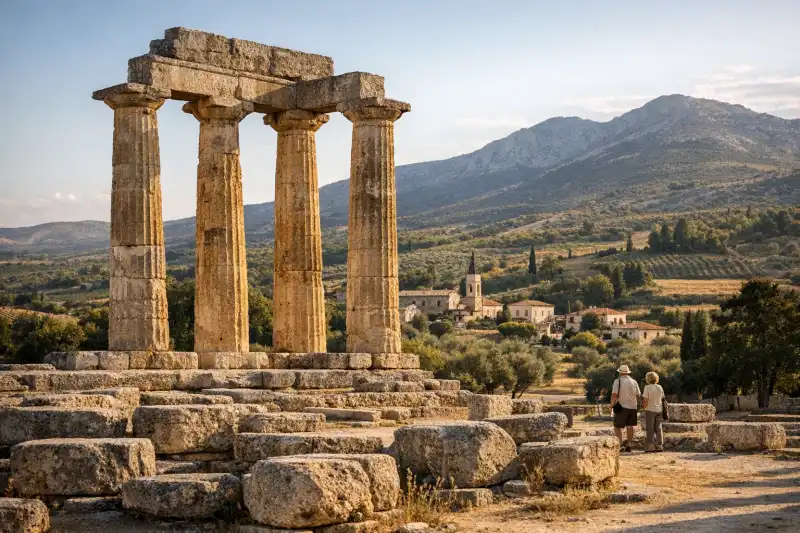
A major transformation occurred in the late 4th century BCE, when much of the sanctuary was rebuilt in more monumental form. The Temple of Zeus visible today belongs to this phase. Constructed in the Doric order, it replaced an earlier temple and expressed both religious devotion and the prestige of the sanctuary. The surviving columns, though only part of the original structure, still convey the balance and force associated with late Classical Greek architecture.
Other buildings in the sanctuary also date to this intensive rebuilding effort. The bath complex, xenon or guest facilities, and improved athletic installations suggest a coordinated attempt to renew Nemea’s place in the Panhellenic world. The stadium, located some distance from the temple area, likely belongs to this broader program. Its distinctive vaulted entrance tunnel is among the site’s most memorable features and remains exceptionally evocative.
This period also reflects the broader dynamics of the Peloponnese in the aftermath of shifting alliances and wars. Sanctuaries often benefited from regional political ambitions, and investment in monumental architecture could assert legitimacy, prestige, and continuity with Greek tradition.
Hellenistic, Roman, and later decline
Nemea continued to function into the Hellenistic period, though control of the games and the sanctuary shifted over time. Nearby city-states, especially Argos, had influence over the festival, and in some periods the games may have been moved or administered elsewhere. This changing relationship affected the site’s long-term vitality.
Under Roman rule, Nemea did not entirely disappear, but its importance declined compared with its classical height. Roman visitors and patrons often admired Greek sanctuaries, yet many older festival centers experienced uneven continuity. Some buildings fell into disrepair, while others were adapted or stripped for materials. Gradually, the sacred and athletic functions that had once defined Nemea faded.
In later centuries, the valley returned largely to agricultural use. The ruins remained in the landscape, but the great sanctuary ceased to operate as a major active center. As happened at many ancient sites, stone blocks shifted, collapsed, or were reused in later construction.
Rediscovery and archaeology
Modern archaeological work brought ancient Nemea back into view. Systematic excavations in the 19th and especially 20th centuries revealed the layout of the sanctuary, clarified its chronology, and recovered inscriptions, pottery, architectural fragments, and athletic installations. Restoration work on parts of the Temple of Zeus helped visitors better appreciate its original scale.
The museum now plays an essential role in interpreting the site, displaying finds from the sanctuary and surrounding valley. Nemea has also gained renewed symbolic life through modern revivals of the Nemean Games, in which participants sometimes run in the ancient stadium. These events do not recreate antiquity exactly, but they restore something of the site’s original spirit: movement, ceremony, and shared presence in a landscape built for gathering.
Key Features
The most striking element of Nemea is the Temple of Zeus, whose surviving columns rise cleanly from the valley floor. Even in its incomplete state, the temple has a commanding serenity. Unlike monuments crowded by urban surroundings, this one is framed by open air and cultivated land, which helps visitors understand how Greek sanctuaries were often experienced in relation to nature as much as architecture. The Doric design expresses power without ornament-heavy distraction, and the partial restoration makes it easier to read the building’s original height and rhythm.
Close to the temple, the archaeological museum gives shape to what might otherwise remain abstract. Sculptural fragments, pottery, architectural elements, inscriptions, and everyday finds reveal that Nemea was not only a place of myth and ceremonial spectacle but also a functioning sanctuary with workers, visitors, athletes, priests, and officials. The museum helps connect the visible stones outside to the living systems that sustained the festival. For many travelers, it also clarifies how the sanctuary evolved through time, especially since not all buildings survive equally well.
One of the site’s most compelling dimensions is its layered sacred topography. Nemea was not simply a temple with a nearby sports field. It was a ritual landscape in which religion, myth, and athletics were closely linked. The area associated with Opheltes and heroic commemoration reminds visitors that Greek games often had funerary or cultic origins. Athletic competition was never just entertainment. At Nemea, it formed part of a deeply symbolic world in which memory, divine favor, and public identity all intersected.
The stadium is perhaps the emotional highlight of a visit. Reached from the main sanctuary area, it lies in a natural hollow and preserves the long, narrow shape characteristic of Greek athletic grounds. Walking through the vaulted entrance tunnel is an unforgettable experience. The passage acts almost like a stage device, moving you from the ordinary world into the ceremonial arena. Ancient athletes would have entered here before competitions, and the tunnel still carries a sense of anticipation.
Inside the stadium, the scale feels human rather than overwhelming. You can imagine runners taking their marks, officials overseeing the contests, and spectators assembled along the embankments. The starting line mechanisms no longer function, of course, but traces of the formal organization of Greek sport remain visible. This is one of the rare places where the relationship between architecture and athletic ritual is immediately graspable without needing much imagination.
Nemea’s landscape setting is also one of its key features. The surrounding plain is now famous for wine production, especially the Agiorgitiko grape, and that agricultural continuity adds depth to the visit. Ancient sanctuaries often depended on fertile valleys, road networks, and regional economies. Here, the setting still feels productive and inhabited rather than isolated in a museum-like void. Depending on the season, the light across the fields can be as memorable as the masonry itself.
Another important feature is the site’s manageability. Nemea does not require the physical exertion of a mountainous sanctuary or the time commitment of a sprawling archaeological park. That makes it particularly rewarding for travelers who want a substantial historical experience within a half day. Yet its compactness should not be mistaken for slightness. The integrity of its story is unusually strong. Temple, museum, heroic cult, and stadium all work together, allowing visitors to understand not just what ancient Greeks built here, but why.
Finally, Nemea stands out because it preserves a less commercialized atmosphere than many better-known sites. There is room to pause, listen to the wind, and consider the way ancient festivals once transformed this quiet valley into a place of intense competition and devotion. That contrast between present calm and former activity is one of the site’s greatest strengths.
Getting There
Nemea is most easily reached by car from Athens, Corinth, or Nafplio. From Athens, the drive is usually around 1.5 to 2 hours, covering roughly 120 to 130 kilometers. The most common route uses the motorway toward Corinth and then continues into the northeastern Peloponnese. Expect tolls on the main highway, usually in the range of €7 to €10 total depending on the route and exact entry points, plus fuel costs. Renting a car is the simplest option for most travelers because public transport to the archaeological site itself is limited.
If you are staying in Corinth or Loutraki, Nemea makes an easy day trip by road in about 35 to 50 minutes. From Nafplio, allow around 1 hour to 1 hour 15 minutes. Organized tours sometimes combine Nemea with Ancient Corinth, Mycenae, or regional wineries, which can be a good choice if you prefer not to drive.
Public transportation is possible but requires planning. Intercity KTEL buses may connect Athens with modern Nemea or nearby towns, but schedules can be infrequent and may not align neatly with site opening hours. A one-way bus fare from Athens to the region is often around €10 to €16, after which you may need a taxi for the final stretch to the archaeological area. Local taxi fares from Corinth or nearby transport hubs to the site can range from roughly €25 to €45 depending on distance and waiting time.
If you want flexibility, especially to visit both the sanctuary and a winery or another Peloponnese site on the same day, a rental car offers the best value.
When to Visit
Spring is one of the best times to visit Nemea. From March through May, the valley is green, temperatures are comfortable, and the open setting of the sanctuary feels especially attractive. Wildflowers and soft light can make the site feel more vivid, and walking between the temple and stadium is pleasant even in the middle of the day. This season is ideal for travelers who enjoy photography and longer stays outdoors.
Early autumn, especially September and October, is another excellent period. The heat of high summer begins to ease, vineyards in the region become part of the experience, and the countryside has a warm golden tone. If you plan to combine archaeology with wine tourism, this can be an especially rewarding season. The air is often clear, and roads are generally less busy than in peak island-hopping months.
Summer is fully possible, but it comes with challenges. Temperatures in the Peloponnese can be high, and there is limited natural shade across parts of the site. If you visit in June, July, or August, aim for early morning or late afternoon where possible, bring water, and wear sun protection. Midday can feel exposed, especially around the stadium.
Winter visits have their own appeal. The site is quieter, and the landscape can feel dramatic under changing skies. However, cooler temperatures, occasional rain, and shorter daylight hours may affect your experience. Some travelers find winter perfect for a peaceful cultural stop, especially if they are already touring the mainland by car.
For the best balance of comfort, atmosphere, and manageable crowds, spring and early autumn are the strongest choices.
| Quick Facts | Details |
|---|---|
| Location | Northeastern Peloponnese, Greece |
| Main significance | Sanctuary of Zeus and site of the Nemean Games |
| Best known for | Temple of Zeus, ancient stadium, Heracles myth |
| Closest major base | Corinth |
| Ideal visit length | 1.5 to 3 hours |
| Best seasons | Spring and early autumn |
| Access | Best reached by rental car or organized tour |
| Combined day trip options | Ancient Corinth, regional wineries, Argolid sites |
| Site atmosphere | Rural, peaceful, and highly evocative |
| Traveler profile | Excellent for history lovers, road trippers, and archaeology-focused visitors |
Nemea rewards travelers who value context over spectacle. Its beauty lies not in sheer scale but in coherence: a sacred valley where myth, ritual, athletics, and architecture still belong to one another. Standing before the Temple of Zeus, then walking the path toward the stadium tunnel, you begin to understand how ancient Greeks organized space around ideas of honor, divine presence, and public gathering. This is a place where memory feels unusually intact.
For visitors exploring the Peloponnese, Nemea also offers a welcome shift in tempo. It is less crowded than many headline sites, easier to absorb in a single visit, and enriched by the agricultural landscape that surrounds it. You can come for the history of the Nemean Games, for the legend of Heracles, for the architecture, or simply for the chance to spend time in a landscape that still carries the logic of the ancient world. However you arrive, Nemea tends to linger in the mind as one of Greece’s most quietly rewarding archaeological destinations.
Guided tours: worth it?
Most travelers can visit Nemea independently. Compare a tour only if you want a tighter history-focused visit, easier logistics, or a guide who can answer questions on the spot.
Best for
- Short visits where a planned route saves time
When to go self-guided
Go independently if you prefer setting your own pace, reading as you go, and checking official hours or ticket rules directly before you arrive.
What I’d avoid
Skip paid tours that bundle unrelated stops you do not actually want. The best option should either save meaningful planning time or add historical context you would miss on your own.
Nemea Greece Tours
Useful when: you want to compare guided formats before deciding
Corinth and Nemea Day Trips
Useful when: transport or pickup logistics matter
Peloponnese Archaeology Tours
Useful when: you want to compare guided formats before deciding
Some tour links are affiliate links, which may earn Ancient Travel a small commission at no extra cost to you. I try to surface options that make practical sense for the site—not just anything bookable.
Frequently Asked Questions
What is Nemea famous for?
Nemea is best known for the Sanctuary of Zeus, the ancient stadium, and the Nemean Games, one of the four major Panhellenic athletic festivals of ancient Greece.
How far is Nemea from Athens?
Ancient Nemea is roughly 120 to 130 kilometers southwest of Athens, and the drive usually takes about 1.5 to 2 hours depending on traffic and your route.
Can you visit the stadium at Nemea?
Yes. Visitors can explore the ancient stadium, including the vaulted entrance tunnel and the track area, usually as part of the archaeological site and museum visit.
Is there a museum at Nemea?
Yes. The Archaeological Museum of Nemea displays finds from the sanctuary, stadium, and surrounding area, and helps explain the history of the site and the Nemean Games.
How much time do you need at Nemea?
Most travelers should allow 1.5 to 3 hours to see the temple, museum, stadium, and surrounding ruins at a comfortable pace.
Is Nemea worth visiting with Corinth?
Yes. Nemea pairs very well with Ancient Corinth because both are in the northeastern Peloponnese and together offer a strong introduction to mythology, religion, and ancient Greek politics.
Nearby Ancient Sites
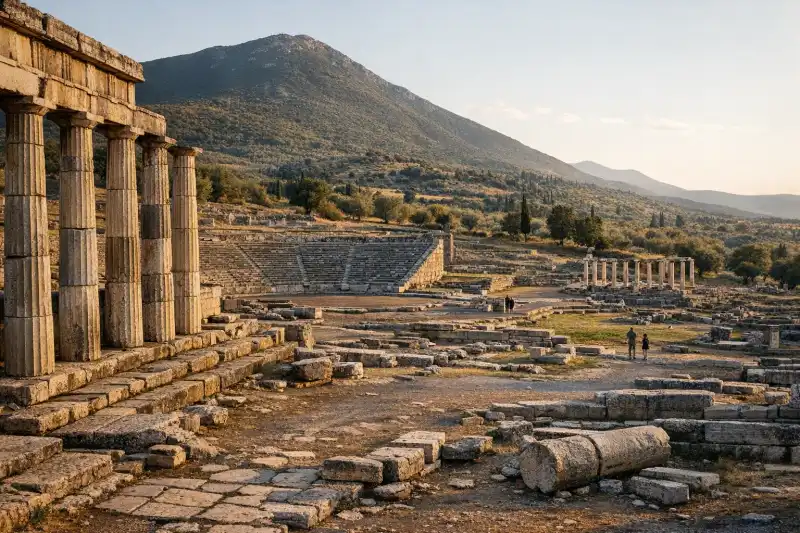
Ancient Messene
Ancient GreekExplore Ancient Messene, a remarkably preserved Greek city with grand stadium, theater, and fortific...
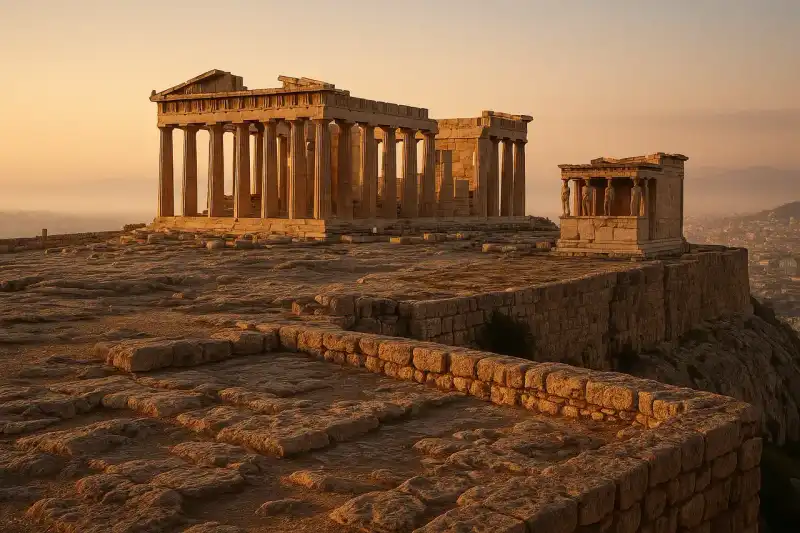
Acropolis Travel Guide 2026: Parthenon, Tickets, and Best Time
Ancient GreecePlan an efficient Acropolis visit with practical ticket timing, key monuments, and museum pairing ti...
The Complete Acropolis Athens Travel Guide: Temples
Ancient GreecePlan the perfect visit to the Acropolis of Athens with our 2026 guide. Discover the Parthenon, best ...