Quick Info
At a glance
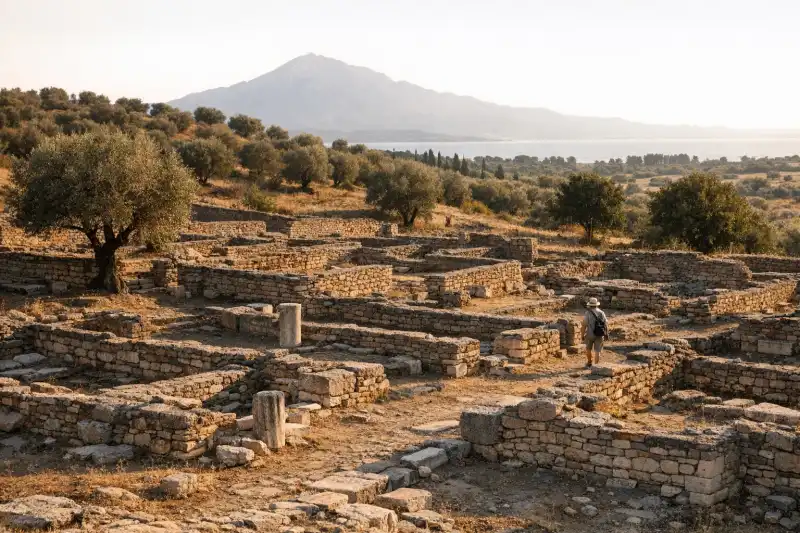
Olynthos, in Greece, is one of those ancient places that quietly overturn expectations. Travelers often arrive imagining a scatter of ruins on a hill in Halkidiki and leave with something much more vivid in mind: the shape of a city, the rhythm of its streets, and the outline of ordinary lives interrupted by war. Unlike famous Greek sanctuaries or acropoleis built around great temples, Olynthos offers a different kind of encounter with the ancient world. Here, what survives most memorably is not only public architecture but the urban fabric itself—houses, courtyards, streets, drainage lines, and traces of decoration that bring domestic life close.
Set in Central Macedonia, not far from the blue coasts and resort towns of modern Chalkidiki, Olynthos rises gently above the surrounding plain. The landscape feels open, agricultural, and sunlit, and that setting matters. This was once a strategic city between inland Macedonia and the peninsulas leading toward the Aegean. Today, the site is spacious and atmospheric rather than theatrical. Visitors walk through stone foundations that map neighborhoods with surprising clarity, discovering how carefully the city was laid out. Olynthos rewards patience: the longer you look, the more coherent it becomes. Walls begin to suggest rooms, streets connect into a plan, and fragments of mosaic floors hint at households with taste, wealth, and ambition. For anyone curious about how ancient Greeks actually lived beyond the monumental centers, Olynthos is one of the most revealing archaeological sites in Greece.
History
Early settlement and regional importance
The origins of Olynthos reach back to the Archaic period, with settlement in the area likely established by the 7th century BCE. The city stood in a strategically valuable part of northern Greece, in a fertile region with access to both inland routes and maritime networks through the Gulf of Torone. Ancient sources suggest that Olynthos changed hands more than once in its early history, reflecting the contested nature of Macedonia and Chalkidiki in this era. Greeks, local populations, and expanding powers all had an interest in controlling this crossroads.
By the 5th century BCE, Olynthos had begun to emerge as a city of wider political significance. Its fortunes were tied to the Chalcidian League, a federation of cities in the Chalkidiki peninsula. Olynthos became the leading center of this league, turning it from a local settlement into an influential urban and political hub. This rise was part of a broader Greek pattern in which regional alliances developed in response to pressure from larger states such as Athens, Sparta, and Macedon.
The rise of the Chalcidian League
Olynthos reached its peak during the Classical period, especially in the late 5th and early 4th centuries BCE. As head of the Chalcidian League, it coordinated military, political, and economic activity among neighboring communities. This period appears to have been the age in which much of the city’s planned expansion took shape. Archaeology reveals an unusually regular urban design, indicating both organized civic planning and confidence in future growth.
The city’s “North Hill,” where many of the excavated residential blocks lie, is especially important for understanding this stage. Rather than growing in an irregular pattern over centuries, large parts of Olynthos were laid out according to a grid. Streets intersected at right angles, and housing blocks were divided into relatively standardized plots. This tells us that Olynthos was not merely prospering; it was planning. It invested in a civic order that reflected both practical needs and a vision of communal identity.
At this time, Olynthos also enjoyed material prosperity. Trade, agriculture, and regional influence brought wealth into the city, visible today in the size of houses and the decorative quality of some mosaic floors. The archaeological record suggests a community with considerable social variation—some homes were modest, others spacious and refined—but all existed within an intelligently organized urban setting.
Conflict with Sparta and shifting power in Greece
Success made Olynthos important, and importance brought danger. In the early 4th century BCE, the city came into conflict with Sparta, which sought to check the strength of regional federations. The Spartan campaign against Olynthos formed part of a broader struggle over control in mainland Greece after the Peloponnesian War. Although Sparta eventually forced the dissolution of the Chalcidian League, Olynthos survived and later regained a measure of influence.
This phase of its history shows how exposed northern Greek cities were to wider geopolitical shifts. Olynthos was neither isolated nor provincial. It was fully entangled in the power politics of the Greek world, affected by alliances, rivalries, and military interventions that reached far beyond Halkidiki.
Destruction by Philip II
The defining catastrophe in Olynthos’ history came in 348 BCE, when Philip II of Macedon destroyed the city. Philip, father of Alexander the Great, had initially cultivated relations with Olynthos, but the alliance deteriorated as Macedonian power expanded. Once Olynthos became politically inconvenient and potentially disloyal, Philip moved decisively. Ancient accounts describe betrayal, siege, and eventual devastation.
The archaeological remains powerfully confirm this abrupt end. Olynthos was not gradually abandoned over centuries; large parts of the city were violently destroyed and never substantially rebuilt. This is one reason the site is so valuable to historians and archaeologists. The destruction effectively froze a Classical Greek city in time. Instead of layers of Roman, Byzantine, and later occupation obscuring the earlier phases, much of Olynthos preserves the layout and material culture of a 4th-century BCE urban center with unusual clarity.
Rediscovery and excavation
Modern archaeological interest in Olynthos grew in the 20th century, with major excavations—especially those led by David M. Robinson and his team—bringing the city into scholarly prominence. Their work uncovered houses, streets, public areas, pottery, inscriptions, and mosaics, creating one of the most important datasets for the study of ancient Greek domestic life. Although excavation methods from that era do not always match modern standards, the overall contribution was immense.
Today, Olynthos is valued not only as a historical site but as a key reference point in the study of urban planning, household archaeology, and the social life of Classical Greece. Its destruction was a tragedy for the ancient city, but for modern understanding it preserved a remarkable window into an entire urban world.
Key Features
What makes Olynthos so compelling is the way the site communicates city life at ground level. Visitors do not come here primarily for towering columns or one iconic monument. They come for the coherence of the whole. As you walk across the excavated sectors, the ancient street plan appears with unusual legibility. The grid is among the clearest surviving examples of planned urbanism in the Greek world. Straight roads divide the settlement into regular blocks, making it possible to imagine movement, traffic, drainage, and neighborhood life.
The houses are the heart of Olynthos. Their stone foundations reveal a wide range of domestic arrangements, yet many follow a recognizable pattern centered around courtyards. Rooms opened inward, creating private spaces protected from the street. Some houses had androns, formal dining rooms associated with male banquets, often distinguished by more elaborate floors. Others included work areas, storage spaces, and service rooms that hint at the full complexity of household economies. In Olynthos, architecture tells social history. You can see where hospitality was staged, where labor happened, and where family life likely unfolded.
The mosaics are another defining feature. Though time and weather have taken their toll, enough survives to show the artistic ambitions of the city’s residents. Pebble mosaics in particular, among the earlier forms of Greek mosaic art, decorate certain domestic interiors with patterns and mythological themes. These floors are not simply ornaments. They signal wealth, cultural aspirations, and participation in a wider Greek visual language. Standing above one of these rooms, even in fragmentary condition, you sense how private houses in Olynthos could be elegant and carefully curated environments.
The site’s two main hills also help explain its historical development. The South Hill represents the earlier settlement, while the North Hill reflects the city’s planned Classical expansion. This spatial relationship allows visitors to read Olynthos almost like a diagram of urban growth. The older and newer sections illustrate how a city adapted as its political and economic role changed.
There are also traces of public and infrastructural life that deserve attention. Streets were not rough tracks but elements of a designed environment. Drainage systems indicate practical engineering and concern for sanitation. The spacing of blocks implies official oversight and civic organization. Even where major public buildings are less immediately dramatic than at other ancient sites, the urban framework itself stands in for the administrative intelligence of the city.
An on-site museum enriches the experience by placing the visible ruins in context. Pottery, household objects, figurines, architectural fragments, and interpretive displays help visitors understand what the bare stone plans once contained. This is especially important at Olynthos, where imagination is rewarded by information. A simple room outline can become a kitchen, a storeroom, or a reception space once you know what archaeologists found there.
The surrounding landscape is part of the experience as well. From the site, the broad Macedonian light and agricultural plain create a sense of openness that contrasts with the density of the ancient blocks underfoot. It becomes easier to understand why this place mattered strategically: it watched routes, commanded land, and stood within reach of both coastal and inland worlds. Olynthos is not a ruin detached from geography. Its layout, prosperity, and downfall all make more sense once you stand within that larger setting.
Getting There
Olynthos is most easily reached from Thessaloniki, the major city of northern Greece. By car, the journey usually takes around 60 to 75 minutes, depending on traffic and your starting point. Driving is the most practical option because public transport in this part of Halkidiki can be limited and schedules may not align neatly with site opening hours. A rental car from Thessaloniki often starts around €30-€60 per day in low or shoulder season, with higher rates in summer.
If you prefer public transport, you can usually take an intercity KTEL bus from Thessaloniki toward Nea Moudania or routes serving the Halkidiki region, then continue by local taxi to the archaeological site. Bus fares are commonly in the €8-€15 range depending on the route and connection, while the final taxi leg may cost roughly €10-€20. Because routes and frequencies change, it is wise to verify timetables in advance rather than relying on assumptions.
Organized day tours are another good option, especially if you want historical commentary or wish to combine Olynthos with other Halkidiki stops. Prices vary widely, but expect roughly €60-€140 per person depending on whether the tour is private, small-group, or bundled with coastal visits.
For travelers already staying in Halkidiki, Olynthos is an easy inland excursion from resort areas. Parking is generally simpler than at major Greek archaeological sites, making independent visits pleasantly straightforward. Comfortable walking shoes, water, and sun protection are essential, since the site is open and can feel hot even outside peak summer.
When to Visit
The best times to visit Olynthos are spring and autumn, when the weather in northern Greece is mild, the light is clear, and walking among the ruins is much more comfortable than in peak summer. April to early June is especially appealing: wildflowers may still be visible in the landscape, temperatures are pleasant, and the site feels calm and spacious. September and October are equally good, with warm days but less intense sun than in July or August.
Summer is certainly possible, and many travelers combine Olynthos with holidays in Halkidiki, but midday heat can be severe. The site has limited shade, and because much of the pleasure comes from slow observation, high temperatures can shorten your visit. If you come in summer, aim for early morning or later afternoon and carry plenty of water. July and August also bring more traffic on regional roads because of beach tourism.
Winter visits can be rewarding for travelers who prefer quiet and cooler air, though opening hours may be more limited and weather can occasionally be wet or windy. The lower sun can actually help with photography and with reading the texture of the ruins, since oblique light makes foundations and street lines stand out more clearly.
Whenever you go, try to pair the site visit with the museum if it is open. Olynthos is one of those places where context significantly deepens appreciation. A rushed stop in the hottest part of the day can make the ruins seem abstract, but in good weather and with a little time, the city’s plan becomes unusually alive.
| Quick Facts | Details |
|---|---|
| Location | Central Macedonia, Greece |
| Nearest major city | Thessaloniki |
| Nearby town | Nea Moudania |
| Ancient role | Leading city of the Chalcidian League |
| Best known for | Grid-planned streets, house remains, pebble mosaics |
| Main period visible today | 5th-4th century BCE |
| Major destruction | 348 BCE by Philip II of Macedon |
| Ideal visit length | 1.5-3 hours |
| Best season | Spring and autumn |
| Visitor profile | Best for archaeology, history, and urban-planning enthusiasts |
Olynthos is one of the most intellectually satisfying archaeological sites in Greece because it tells a story larger than itself. It is the story of a city that prospered through planning, alliance, and regional power; a city whose citizens invested in houses, streets, and decorative living spaces; and a city that was abruptly erased by the rise of Macedon. What survives is not grandeur in the usual sense but something arguably rarer: a readable map of ancient urban life. To walk here is to move through a Classical Greek city at the scale of everyday experience. You see where people gathered, dined, stored goods, and decorated their homes. You understand that history was not lived only in temples, theaters, and palaces, but in neighborhoods.
For travelers willing to look closely, Olynthos offers exactly that closeness. It is quieter than Greece’s marquee destinations, but it rewards curiosity with depth. In an hour, you can appreciate its layout; in two or three, you can begin to imagine its people. That is the quiet power of Olynthos: it transforms ruins into a city again.
Guided tours: worth it?
Self-guided works here, but a guide can add real value if you want the ruins explained as a living place rather than just a sequence of monuments.
Best for
- First-time visitors who want context, not just photos
- Short visits where a planned route saves time
When to go self-guided
Go independently if you prefer setting your own pace, reading as you go, and checking official hours or ticket rules directly before you arrive.
What I’d avoid
Skip paid tours that bundle unrelated stops you do not actually want. The best option should either save meaningful planning time or add historical context you would miss on your own.
Olynthos and Halkidiki archaeology tours
Useful when: you want to compare guided formats before deciding
Day trips from Thessaloniki to Olynthos
Useful when: transport or pickup logistics matter
Ancient Macedonia history tours
Useful when: you want to compare guided formats before deciding
Some tour links are affiliate links, which may earn Ancient Travel a small commission at no extra cost to you. I try to surface options that make practical sense for the site—not just anything bookable.
Frequently Asked Questions
What is Olynthos known for?
Olynthos is best known for its well-preserved urban grid, domestic architecture, and floor mosaics that reveal daily life in a Classical Greek city.
Where is Olynthos located?
Olynthos is in Halkidiki, in the region of Central Macedonia in northern Greece, not far from Thessaloniki.
How much time do you need at Olynthos?
Most visitors spend 1.5 to 3 hours exploring the ruins and the on-site museum, though history enthusiasts may want longer.
Can you visit Olynthos on a day trip from Thessaloniki?
Yes, Olynthos is commonly visited as a half-day or full-day trip from Thessaloniki by rental car, taxi, or organized tour.
Are the mosaics at Olynthos still visible?
Some mosaics and house plans remain visible on site, though preservation conditions vary and some of the finest finds are better understood with museum context.
Is Olynthos suitable for casual visitors?
Yes, but it is especially rewarding for travelers interested in archaeology, city planning, and ancient domestic life rather than monumental temples alone.
Nearby Ancient Sites
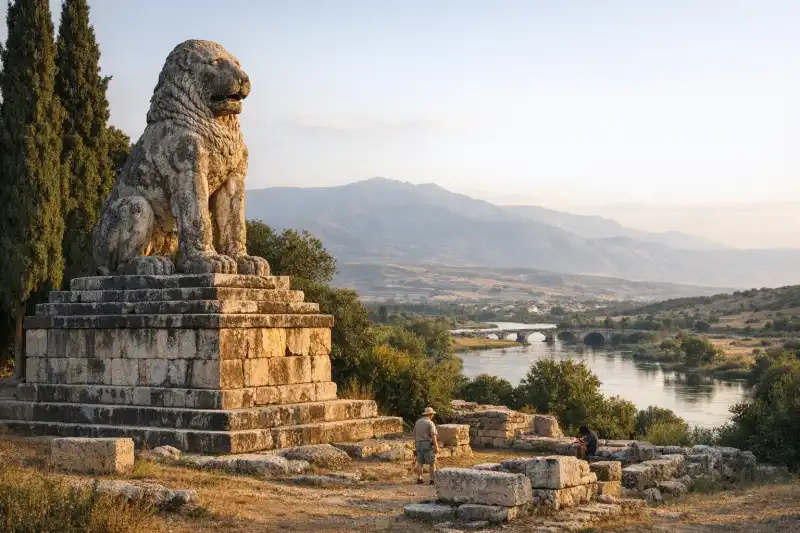
Amphipolis
Ancient Greek, Macedonian, Roman, ByzantineExplore Amphipolis in Greece, an important ancient Macedonian city famed for its walls, lion monumen...
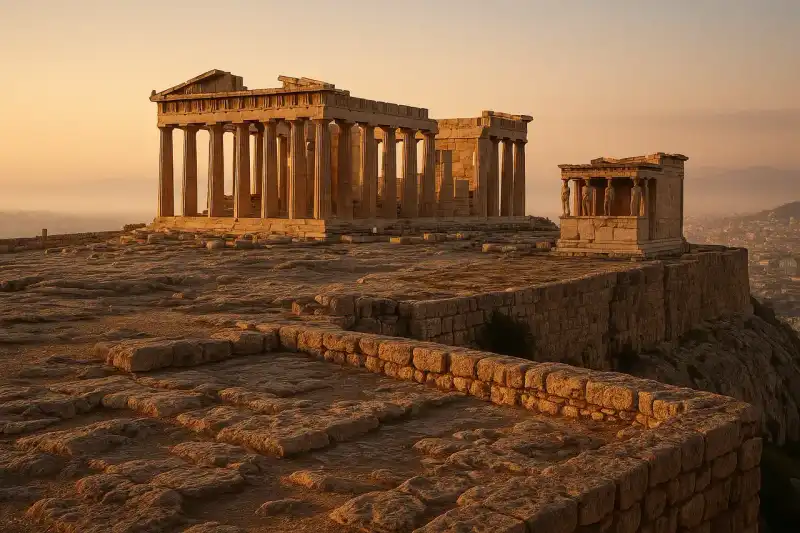
Acropolis Travel Guide 2026: Parthenon, Tickets, and Best Time
Ancient GreecePlan an efficient Acropolis visit with practical ticket timing, key monuments, and museum pairing ti...
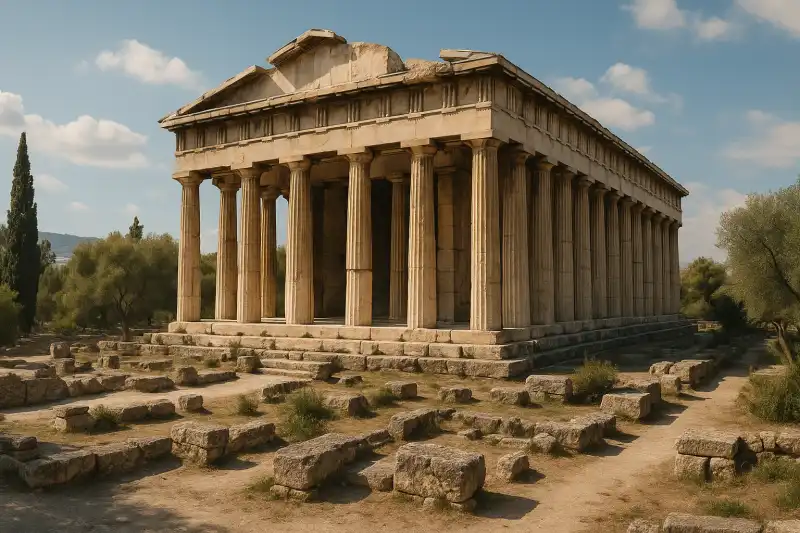
Ancient Agora of Athens Travel Guide 2026: Route, Tickets, and Context
Classical GreekPlan a better Ancient Agora visit with practical timing, monument priorities, and clear historical c...