Quick Info
At a glance
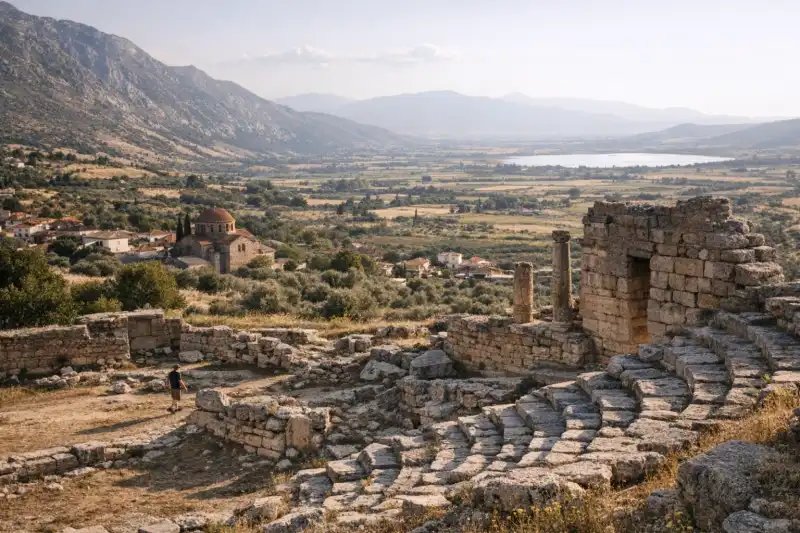
Orchomenos, Greece, sits quietly in the Boeotian plain, but its silence is deceptive. This is a place with an outsized past: a city once counted among the most powerful centers of Bronze Age Greece, later woven into the political struggles of classical Boeotia, and still marked by monuments that hint at former wealth and ambition. For travelers accustomed to the headline sites of Athens or Delphi, Orchomenos offers a different experience—less crowded, more reflective, and in some ways more evocative because the remains are embedded in a living landscape of fields, hills, and small-town Greece.
Arriving here, you sense how geography helped shape history. The surrounding plains were fertile, the routes through central Greece strategic, and nearby Lake Copais—before its modern drainage—was both a resource and a challenge that demanded engineering and organization. Ancient authors connected Orchomenos with mythic kings and immense riches, and archaeology has shown that these stories were not entirely fanciful. The great tholos tomb associated with Minyas, the theater, fragments of fortifications, and traces of long habitation all point to a community that mattered for centuries. Today, Orchomenos rewards visitors who enjoy connecting myth, archaeology, and landscape. It is not only a stop on a map of central Greece, but a place where the layered story of the Greek world becomes unusually tangible.
History
Bronze Age power and the world of Minyas
The earliest fame of Orchomenos belongs to the Bronze Age, when it emerged as one of the leading centers of Mycenaean Greece. In later tradition, the city was linked with Minyas, a legendary ruler whose name became shorthand for wealth, maritime enterprise, and political power. While myth cannot be read as straightforward history, the archaeology of the region supports the image of Orchomenos as a major center in the 2nd millennium BCE.
Its importance came in part from control of the fertile lands around Lake Copais. In antiquity, this huge lake dominated the local environment, and the communities around it developed sophisticated drainage and water-management systems. Such large-scale works imply wealth, labor organization, and political authority. Orchomenos appears to have been one of the beneficiaries—perhaps one of the directors—of this productive agricultural landscape. The prosperity of the city is most dramatically expressed in the monumental tholos tomb known as the Treasury of Minyas. Built in the late Mycenaean era, it ranks among the most impressive beehive tombs in Greece and suggests a ruling elite with both technical resources and strong ideological ambitions.
Like many Mycenaean centers, Orchomenos was affected by the upheavals that transformed the eastern Mediterranean at the end of the Bronze Age. The palace-centered world collapsed or fragmented, and political structures shifted across Greece. Yet Orchomenos did not vanish from memory or from regional life.
Archaic and Classical Orchomenos
In the centuries that followed, Orchomenos became part of the complex political and cultural fabric of Boeotia. The region was home to several significant cities, most famously Thebes, and local rivalries shaped much of its history. Orchomenos retained prestige, partly because of its ancient lineage and partly because of its strategic position on routes across central Greece.
During the Archaic and Classical periods, the city was often involved in broader Boeotian politics. It was associated at times with anti-Theban positions and could align with powers outside Boeotia, depending on the balance of regional interests. This political flexibility was less a sign of instability than of the difficult realities faced by a city caught between larger ambitions. Control of productive land and communications kept Orchomenos relevant even when it was not dominant.
The Persian Wars and the later conflicts of the Greek city-states affected the region deeply. Boeotia’s cities did not always move in unison, and Orchomenos, like its neighbors, had to navigate changing alliances. During the 4th century BCE, when Thebes rose to major power under leaders such as Epaminondas, Orchomenos’ fate became especially precarious. The city suffered destruction in the context of Theban expansion, a reminder that ancient prestige did not guarantee security.
Hellenistic and Roman continuity
Despite episodes of devastation, Orchomenos continued into the Hellenistic age. As across much of Greece, local civic identity survived even as larger kingdoms and later Roman authority redefined the political order. The city’s theater belongs to this later life of Orchomenos and shows that it remained a functioning urban center with cultural and civic institutions.
Under Roman rule, many Greek cities experienced both continuity and adaptation. Ancient sites were reused, repaired, or repurposed; memory itself became part of the landscape. Orchomenos no longer held the power it may have enjoyed in the Bronze Age, but its historical depth helped preserve its importance. Travelers, local communities, and imperial administrators all encountered a place already ancient by their standards.
Byzantine transformation and long memory
The Byzantine period added another visible layer to Orchomenos. The most notable monument from this era is the Church of the Dormition of the Virgin, a significant medieval structure built near the ancient remains. Its presence illustrates a common Mediterranean pattern: sacred and civic landscapes evolving rather than disappearing. Stones from earlier phases might be reused, while older places retained local significance even as religion and political structures changed.
This continuity matters for visitors today. Orchomenos is not only a Bronze Age or classical site frozen in time. It is a long-lived settlement landscape where different eras overlap. Mythic kings, Mycenaean elites, Boeotian rivalries, Hellenistic civic life, and Byzantine devotion all left traces. That layered endurance is one of the strongest reasons to visit.
Key Features
The centerpiece of Orchomenos is unquestionably the so-called Treasury of Minyas. Even among Greece’s notable tholos tombs, it stands out for scale and craftsmanship. Approaching it, you are immediately aware of the engineering confidence behind the monument. The long entrance passage, or dromos, creates a ceremonial movement inward, while the circular chamber evokes both burial and display. This was not a modest resting place, but an architectural statement about status, ancestry, and power. Though time has stripped away many of its decorative elements, enough remains to convey the sophistication of late Bronze Age elite culture. For many visitors, this tomb is the emotional high point of the site because it compresses myth and archaeology into one dramatic space.
The archaeological area also includes the ancient theater, a reminder that Orchomenos was not only a place of prehistoric splendor but a functioning city in later Greek antiquity. Compared with the theatrical monuments of major tourist centers, it may feel more intimate, yet that is part of its appeal. The theater speaks to civic life—to assembly, performance, ritual, and communal identity. Standing here, you can imagine a later Orchomenos still engaged in the shared cultural forms of the Greek world, even after the political fortunes of the city had shifted.
Another important dimension of the site is less monumental but equally meaningful: the landscape itself. Orchomenos cannot be understood apart from Boeotia’s plains and the former basin of Lake Copais. Modern visitors see fields and roads where ancient communities saw both opportunity and environmental complexity. The engineering traditions associated with the region’s drainage systems underline how closely human power was tied to water control and agricultural productivity. Even if the visible remains of these systems are not the first thing a traveler notices, knowing this background changes the experience of the site. The wealth of Orchomenos was not abstract; it grew out of the successful management of land.
The Byzantine Church of the Dormition of the Virgin adds another texture to the visit. Its presence broadens Orchomenos beyond a narrowly “classical” itinerary and reminds travelers that Greek sacred landscapes did not stop evolving after antiquity. Medieval architecture here provides visual and historical contrast with the Mycenaean tomb and Greek civic remains. In one relatively compact area, you can encounter centuries of cultural change.
Perhaps the most striking feature of Orchomenos, though, is its atmosphere. Unlike heavily visited landmark destinations, this site often feels quiet and spacious. That quiet makes it easier to notice details: the texture of stone, the shape of the terrain, the relationship between built remains and open plain. You are not only seeing monuments; you are seeing why a community flourished here. For travelers interested in the deeper geography of ancient Greece, Orchomenos offers a more interpretive and less theatrical experience than the country’s busiest sites.
The site also rewards those who know a little mythology. The Minyans appear in ancient traditions as a wealthy and sometimes far-ranging people. While modern archaeology handles such stories cautiously, the myths enrich the visit by showing how strongly later Greeks associated Orchomenos with age, prestige, and power. This fusion of literary memory and physical remains is one of the site’s greatest strengths.
Getting There
Orchomenos is most easily reached by car, and for most travelers this is the best option. From Athens, the drive typically takes around 1 hour 45 minutes to 2 hours depending on traffic and your starting point. A rental car offers the greatest flexibility, especially if you want to combine Orchomenos with Livadeia, Chaeronea, or Delphi. Expect fuel and toll costs from Athens to come to roughly €20-€35 each way in total, depending on vehicle type and route.
Public transport is possible but less direct. Intercity KTEL buses from Athens to Livadeia are usually the first step, with fares commonly in the €10-€15 range one way. From Livadeia, you may need a local bus or taxi onward to Orchomenos. Taxi fares for the final segment can vary, but budgeting around €15-€25 is sensible. Because schedules can change, it is wise to confirm times locally or through current KTEL information before traveling.
Some travelers include Orchomenos as part of a guided day tour through central Greece, though it is less commonly featured than Delphi. If using a private driver from Athens for a custom itinerary, expect a significantly higher cost—often from €180 upward for a full-day arrangement—but this can be worthwhile if you prefer convenience and historical commentary.
Parking in or near the site is generally easier than at Greece’s most visited monuments. Bring water, especially if arriving by car in warm weather, since local services may be limited compared with larger tourist hubs.
When to Visit
Spring and autumn are the best seasons to visit Orchomenos. From April to early June, the Boeotian landscape is greener, temperatures are milder, and walking around exposed archaeological remains is far more comfortable than in midsummer. Autumn, especially September through October, also offers pleasant light, clearer air, and manageable temperatures. These seasons are ideal if you want time to linger at the tomb and theater without rushing back to shade.
Summer is certainly possible, but central Greece can be intensely hot, particularly from late June through August. Orchomenos does not have the constant sea breeze of coastal destinations, and much of the site can feel exposed at midday. If visiting in summer, arrive early in the morning or later in the afternoon, wear a hat, and carry plenty of water. The advantage of summer is predictably dry weather and long daylight hours, but comfort may be reduced.
Winter brings a quieter, more atmospheric mood. Cooler temperatures make walking easier, and the site can feel especially contemplative under softer skies. However, rain is more likely, and opening hours may be shorter or occasionally subject to change. Winter is best for travelers who prioritize atmosphere over ideal photographic conditions.
If your itinerary includes multiple mainland sites, consider pairing Orchomenos with nearby destinations in spring or autumn for the best overall experience. The combination of moderate weather, easier driving conditions, and reduced heat makes those seasons particularly rewarding. Whenever you go, checking local opening times in advance is a smart step, since smaller archaeological sites may not always follow the patterns of Greece’s major attractions.
| Quick Facts | Details |
|---|---|
| Location | Orchomenos, Boeotia, central Greece |
| Best known for | Treasury of Minyas, ancient theater, Mycenaean heritage |
| Main historical periods | Mycenaean, Archaic, Classical, Hellenistic, Byzantine |
| Ideal visit length | 1-2 hours |
| Best season | Spring and autumn |
| Nearest city | Livadeia |
| Best way to arrive | Rental car from Athens or via Livadeia |
| Atmosphere | Quiet, uncrowded, historically layered |
Orchomenos is one of those places that rewards curiosity more than checklist tourism. It does not overwhelm with endless ruins, but what survives has unusual depth: a tomb of extraordinary ambition, a city with roots in myth and Bronze Age power, a later civic life marked by theater and regional politics, and a Byzantine presence that continued the story. In a country filled with celebrated ancient destinations, Orchomenos stands apart by offering something calmer and more interpretive. You come here not only to see monuments, but to understand how environment, memory, and power interacted across millennia in central Greece. For travelers willing to step slightly off the standard route, that makes Orchomenos exceptionally worthwhile.
Guided tours: worth it?
Most travelers can visit Orchomenos independently. Compare a tour only if you want a tighter history-focused visit, easier logistics, or a guide who can answer questions on the spot.
Best for
- Short visits where a planned route saves time
When to go self-guided
Go independently if you prefer setting your own pace, reading as you go, and checking official hours or ticket rules directly before you arrive.
What I’d avoid
Skip paid tours that bundle unrelated stops you do not actually want. The best option should either save meaningful planning time or add historical context you would miss on your own.
Boeotia and Northern Attica Archaeology Tours
Useful when: you want to compare guided formats before deciding
Day Trips from Athens to Ancient Greek Sites
Useful when: transport or pickup logistics matter
Delphi and Central Greece Historical Tours
Useful when: you want to compare guided formats before deciding
Some tour links are affiliate links, which may earn Ancient Travel a small commission at no extra cost to you. I try to surface options that make practical sense for the site—not just anything bookable.
Frequently Asked Questions
Where is Orchomenos located?
Orchomenos is in Boeotia in central Greece, northwest of Athens and not far from Livadeia and Delphi routes.
What is Orchomenos best known for?
The site is best known for its rich Mycenaean past, especially the monumental tholos tomb often called the Treasury of Minyas, as well as its theater and Byzantine church.
Can you visit Orchomenos on a day trip from Athens?
Yes. Orchomenos can be visited as a day trip from Athens by rental car or as part of a broader central Greece itinerary that may also include Livadeia or Delphi.
How much time should I spend at Orchomenos?
Most visitors spend 1 to 2 hours at the archaeological area, though history enthusiasts may stay longer to appreciate the tomb, theater, and surrounding landscape.
Is Orchomenos suitable for casual travelers or only specialists?
It works for both. Specialists value its Mycenaean and Boeotian significance, while casual travelers enjoy the dramatic tomb architecture and quieter atmosphere.
What should I wear when visiting Orchomenos?
Wear sturdy walking shoes, sun protection, and carry water, especially from late spring to early autumn when central Greece can be hot and exposed.
Nearby Ancient Sites
Acropolis Travel Guide 2026: Parthenon, Tickets, and Best Time
Ancient GreecePlan an efficient Acropolis visit with practical ticket timing, key monuments, and museum pairing ti...
The Complete Acropolis Athens Travel Guide: Temples
Ancient GreecePlan the perfect visit to the Acropolis of Athens with our 2026 guide. Discover the Parthenon, best ...
Ancient Agora of Athens Travel Guide 2026: Route, Tickets, and Context
Classical GreekPlan a better Ancient Agora visit with practical timing, monument priorities, and clear historical c...
Amphiareion of Oropos
Ancient GreekAncient healing sanctuary near Athens where pilgrims sought dream oracles at the Amphiareion of Orop...