Quick Info
At a glance
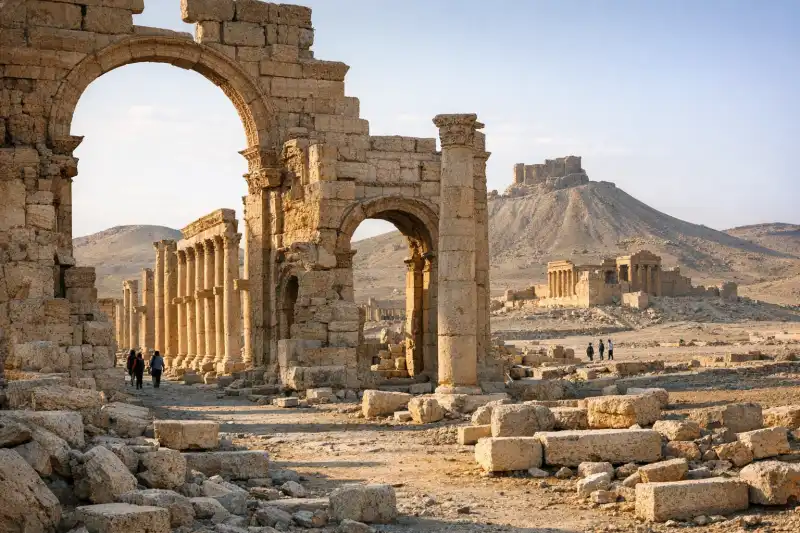
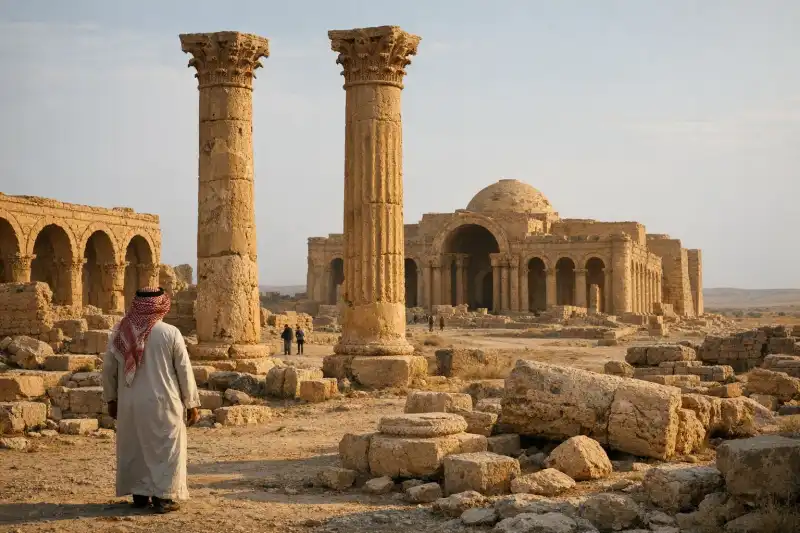
Palmyra, Syria rises from the desert with a kind of improbable grandeur, a city of honey-colored stone where columns, temples, and funerary monuments still suggest the wealth of caravans that once crossed this harsh interior landscape. Known locally as Tadmur, the site sits in an oasis in central Syria, and its setting is essential to understanding its power: this was never simply a provincial town, but a meeting point between worlds. Traders moving silk, spices, pearls, glass, perfumes, and textiles passed through here on routes connecting the Mediterranean, Mesopotamia, Arabia, and Persia. What survives today is both majestic and fragile, a vast archaeological field that preserves the memory of a city that became one of antiquity’s most distinctive urban centers.
For travelers interested in the ancient Near East, Palmyra has long held a special place in the imagination. It is Roman, but never only Roman. It is Semitic, but deeply cosmopolitan. Its inscriptions reveal multiple languages, its art blends local and imperial forms, and its architecture reflects an identity shaped by exchange rather than isolation. Even after severe destruction and damage in recent years, Palmyra remains one of the most important ancient sites in the Middle East. To walk among its surviving columns and tombs, if travel conditions permit, is to encounter not just a ruined city but the memory of a borderland civilization that flourished by linking distant regions through trade, diplomacy, and ambition.
History
Early origins and oasis settlement
Palmyra’s roots go far deeper than the great Roman ruins that define its modern image. The oasis was occupied in very early periods, and references to a place identified with Tadmur appear in ancient Near Eastern sources from the 2nd millennium BCE. Its significance came from geography. In a dry and difficult environment, reliable water turned this location into a natural stopping point. That alone would have made it valuable, but Palmyra’s position between western Syria and the lands farther east gave it a larger destiny.
The earliest community here was shaped by Semitic cultural traditions, and over time the oasis developed into a settled center with temples, social institutions, and a local elite tied to long-distance commerce. Palmyra was never cut off from surrounding powers. It stood within spheres influenced by Assyrians, Babylonians, Persians, Hellenistic rulers, and eventually Rome. Yet throughout these changes, the city retained a distinctive local identity, visible later in its language, religion, and funerary customs.
Hellenistic and Roman expansion
After the campaigns of Alexander and the division of his empire, the region entered the Hellenistic age. Greek influence spread through urban culture and administration, but Palmyra remained somewhat different from the more heavily Hellenized cities of western Syria. Its major transformation came under Roman influence, especially from the 1st century CE onward. Rome valued Palmyra not because it sat at the empire’s center, but because it connected the empire to eastern markets and political frontiers.
During the 1st and 2nd centuries CE, Palmyra grew rich and monumental. Merchant families accumulated wealth through caravan trade, while civic benefactors funded temples, porticoes, streets, baths, and public buildings. The city’s famous Great Colonnade, one of the defining urban axes of the ancient world, belongs to this period of confidence and prosperity. Religious life also flourished. Temples dedicated to Bel, Baalshamin, Nabu, and other deities reveal a blend of local traditions with broader Near Eastern and Greco-Roman forms.
Palmyra was incorporated into the Roman imperial system, but with considerable autonomy. Its leading citizens could be Romanized in status and style while still presenting themselves as distinctly Palmyrene. Inscriptions in both Greek and Palmyrene Aramaic capture this dual identity clearly. Rather than being absorbed into a single imperial culture, the city turned imperial connections into an advantage while preserving its own traditions.
Zenobia and the Palmyrene Empire
Palmyra’s most famous historical moment came in the 3rd century CE, when instability shook the Roman world. External pressure from the Sasanian Persian Empire and internal crises weakened imperial control across the east. In this context, the Palmyrene elite assumed a military and political role larger than before. Odaenathus, a leading figure of the city, defended Roman interests against Persia and gained exceptional influence.
After his death, his widow Zenobia emerged as one of antiquity’s most celebrated rulers. Acting in the name of her son Vaballathus, she expanded Palmyrene power dramatically. For a brief but remarkable period, Palmyra controlled much of Syria, Egypt, and parts of Anatolia, effectively creating an eastern empire under local leadership. Zenobia’s court projected sophistication, legitimacy, and ambition, drawing on Roman, Hellenistic, and eastern political traditions alike.
This ascent was short-lived. The Roman emperor Aurelian moved against Palmyra in the early 270s CE, defeating Zenobia and reasserting imperial authority. The city rebelled again and faced harsh suppression. Although Palmyra survived, it never fully recovered its former prominence. The age of caravan wealth and political ascendancy had passed.
Late antiquity, Islamic eras, and modern rediscovery
In late antiquity, Palmyra continued as a smaller settlement. Some pagan temples were adapted for Christian use, and the city remained inhabited into the Byzantine and Islamic periods. Under Islamic rule, the settlement contracted further, with occupation concentrating around the fortified hilltop castle area and within portions of the ancient city.
European travelers, scholars, and artists in the 17th and 18th centuries helped bring Palmyra to international attention. Its ruins inspired engravings, architectural studies, and romantic descriptions that made it one of the emblematic cities of classical antiquity. Systematic archaeology in the 19th and 20th centuries revealed more of its urban layout, inscriptions, sculpture, and funerary architecture, deepening understanding of Palmyra as a unique crossroads civilization rather than simply a remote Roman outpost.
In the 21st century, Palmyra suffered devastating destruction during the Syrian conflict. Several major monuments were damaged or destroyed, and the site became a symbol of the vulnerability of global heritage in wartime. Even so, many remains endure. Palmyra today carries not only the memory of ancient trade and empire, but also the modern burden of loss, survival, and the difficult work of preservation.
Key Features
The most memorable approach to Palmyra is often the long view across the desert plain, where rows of columns emerge in pale bands against the open horizon. The Great Colonnade is the city’s best-known feature, and for good reason. More than a ceremonial street, it was the connective spine of urban life, linking districts, monuments, and civic spaces. Even in fragmented form, the avenue conveys order, wealth, and scale. You can still sense how merchants, officials, priests, and visiting caravans once moved through a carefully planned city that wanted to impress.
Among Palmyra’s most important monuments was the Temple of Bel, once the religious heart of the city. Though badly damaged, the precinct remains essential for understanding Palmyra’s sacred landscape. The temple blended Near Eastern and Greco-Roman architectural ideas in a way that feels entirely characteristic of the site. It was not a copy of western Roman building styles; it was a local expression of power and devotion, built at monumental scale. Even its surviving enclosure and architectural fragments suggest how central religion was to civic identity in a city where commerce and belief were closely tied.
The Temple of Baalshamin, another major sanctuary, also reflected Palmyra’s layered religious world. Though more modest in scale than Bel’s temple complex, it was architecturally refined and historically significant. Nearby sacred spaces, altars, and processional routes show that the city’s ritual life unfolded across multiple monuments rather than around a single center alone.
Palmyra’s theater offers a different face of the city. With its semicircular seating and stage architecture, it signals the influence of Roman civic culture. Yet here too the site resists simple labels. The theater belongs to an urban environment where public performance, politics, and ceremony were adapted to local conditions. When seen in relation to the colonnaded streets and nearby public buildings, it helps reveal Palmyra as a full city, not just a cluster of isolated ruins.
One of Palmyra’s most distinctive features lies beyond the central avenues: the funerary landscape. The Valley of the Tombs and surrounding necropolises preserve tower tombs, underground burial chambers, and temple tombs unlike anything in most Roman provinces. These structures reflected the status of elite families whose wealth came from trade. Inside them, sculpted portrait busts once sealed burial loculi, presenting the dead in richly adorned local dress with striking individuality. These portraits are among the most important survivals of Palmyrene art, capturing a society that was elegant, prosperous, and deeply conscious of lineage.
The Tetrapylon, though also damaged, remains symbolically important as one of the site’s iconic crossroads monuments. It once marked a ceremonial intersection along the colonnaded street and emphasized the planned grandeur of the urban core. In Palmyra, these architectural punctuation points mattered: arches, tetrapyla, and monumental gateways transformed movement through the city into an experience of prestige and order.
Above the ruins stands the hilltop fortress often called Fakhr al-Din al-Ma’ani Castle, a later stronghold commanding broad views across the oasis and archaeological zone. While not part of the classical city, it helps visitors grasp the scale of Palmyra’s setting. From above, the relationship between the settlement, tomb fields, palm groves, and open desert becomes much clearer. The landscape was never incidental. Palmyra existed because this oasis made life and long-distance movement possible.
What makes Palmyra especially compelling is that its features do not fit neatly into a single cultural frame. Its columns may look Roman, but its gods, inscriptions, funerary customs, and social structures remain strongly local. This tension between imperial form and oasis identity is the essence of the site. Palmyra’s monuments are impressive as architecture, but their deeper value lies in what they reveal about cultural exchange at the edge of empires.
Getting There
Travel to Palmyra requires careful planning, and current access is heavily dependent on security conditions inside Syria. Before considering any journey, travelers should consult official government advisories, local authorities, and reliable on-the-ground contacts. Conditions can change quickly, and some routes may be restricted or unsafe.
In normal logistical terms, Palmyra lies near the modern town of Tadmur in Homs Governorate, roughly northeast of Damascus and east of Homs. When routes are open, the most practical way to reach the site is by private car or arranged driver. From Damascus, the road journey has historically taken around 3 to 4 hours depending on checkpoints and road conditions. Private car hire within Syria can vary widely, but a full-day or intercity arrangement may cost roughly $60 to $150 USD equivalent, depending on fuel prices, permissions, and whether a guide is included. From Homs, the trip is shorter and has often taken about 2 to 2.5 hours, with fares similarly negotiated.
Shared transport and buses have historically connected major Syrian cities to Tadmur, often at low local prices, sometimes in the range of a few US dollars equivalent for standard service. However, schedules, reliability, and availability can be highly inconsistent, especially under present conditions. For most international travelers, an organized local arrangement is the only realistic option if access is permitted.
There is no practical tourist rail connection to Palmyra, and commercial air access to the immediate area is not generally relevant for visitors. Bring water, cash, sun protection, identification, and any required permits, as services in the area may be limited and infrastructure may be disrupted.
When to Visit
The best time to visit Palmyra, if travel is possible, is generally in spring or autumn, when the desert climate is more forgiving and light conditions are excellent for walking and photography. March to early May can bring warm days, cooler mornings, and clearer skies, making the immense site easier to explore on foot. This is often the season when the contrast between stone ruins, palms, and desert horizon feels most vivid.
Autumn, especially October and November, is another strong option. Summer heat has begun to fade, but days remain bright and generally dry. For many travelers, this is the most comfortable balance between manageable temperatures and stable weather. Early morning and late afternoon are especially rewarding, when low-angle light emphasizes carved details and the columns cast long shadows across the site.
Summer, from roughly June through September, can be extremely hot. Midday temperatures may become dangerous, especially for visitors spending hours in exposed areas with little shade. If you must go during the hotter months, plan to enter early, rest in the middle of the day, and carry more water than you think you need. Light clothing, a wide-brimmed hat, and strong sun protection are essential.
Winter is cooler and sometimes surprisingly pleasant for walking, but nights can be cold and occasional weather shifts may affect comfort. The bigger issue in any season is not climate alone but access. Because travel to Palmyra depends on political and security realities, the ideal month on paper matters less than whether conditions on the ground are genuinely safe and authorized.
| Quick Facts | Details |
|---|---|
| Location | Near Tadmur, Homs Governorate, Syria |
| Ancient significance | Oasis caravan city linking the Mediterranean, Mesopotamia, Arabia, and Persia |
| Best known for | Great Colonnade, Temple of Bel, funerary towers, theater, Queen Zenobia |
| Main historical periods | Early Semitic settlement, Roman florescence, 3rd-century Palmyrene Empire, late antique and Islamic occupation |
| UNESCO status | World Heritage Site |
| Time needed | Half day minimum; full day recommended if access allows |
| Terrain | Open desert plain with extensive ruins and little shade |
| Best seasons | Spring and autumn |
| Nearest modern town | Tadmur |
| Practical tip | Check security conditions and permissions before planning any visit |
Guided tours: worth it?
A guide can be genuinely useful at Palmyra, especially if you want help with transport, timing, tickets, or understanding a large site without losing half the day to logistics.
Best for
- First-time visitors who want context, not just photos
- Travelers who want transport, timing, or entry logistics handled
- Short visits where a planned route saves time
When to go self-guided
Go independently if you already have transport and tickets sorted, enjoy moving at your own pace, and are comfortable checking the latest official rules before you arrive.
What I’d avoid
Skip paid tours that bundle unrelated stops you do not actually want. The best option should either save meaningful planning time or add historical context you would miss on your own.
Palmyra Syria history tours
Useful when: you want to compare guided formats before deciding
Syria archaeological sites tours
Useful when: you want to compare guided formats before deciding
Ancient Roman ruins in Syria tours
Useful when: you want to compare guided formats before deciding
Some tour links are affiliate links, which may earn Ancient Travel a small commission at no extra cost to you. I try to surface options that make practical sense for the site—not just anything bookable.
Frequently Asked Questions
Where is Palmyra located?
Palmyra is in central Syria, in Homs Governorate, near the modern town of Tadmur in the Syrian desert.
What is Palmyra famous for?
Palmyra is famous for its monumental colonnaded avenue, Temple of Bel, funerary towers, Roman-era theater, and its role as a wealthy caravan city linking the Mediterranean with Mesopotamia and beyond.
Is Palmyra a UNESCO World Heritage Site?
Yes. Palmyra was inscribed on the UNESCO World Heritage List for its exceptional ruins and cultural importance, though the site has also suffered major damage in recent decades.
Can tourists visit Palmyra right now?
Access depends on the current security situation, government regulations, and local conditions in Syria. Travelers should check official travel advisories and obtain up-to-date local guidance before making plans.
How much time do you need at Palmyra?
A half day is the minimum for the main ruins, but a full day is better if conditions allow, especially to appreciate the colonnade, theater, temple precincts, valley tombs, and the wider desert setting.
What should I wear when visiting Palmyra?
Wear light but modest clothing, sturdy walking shoes, sun protection, and carry plenty of water, as the site is exposed, dry, and often very hot.
Nearby Ancient Sites
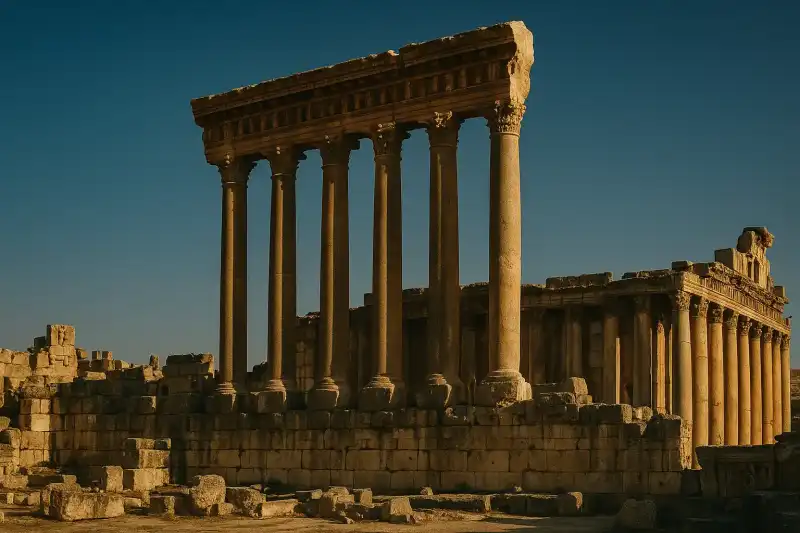
Baalbek: Rome's Mightiest Temple Complex in Lebanon's Beqaa
Roman / PhoenicianExplore Baalbek's colossal Roman temples, including the best-preserved Temple of Bacchus. Discover t...
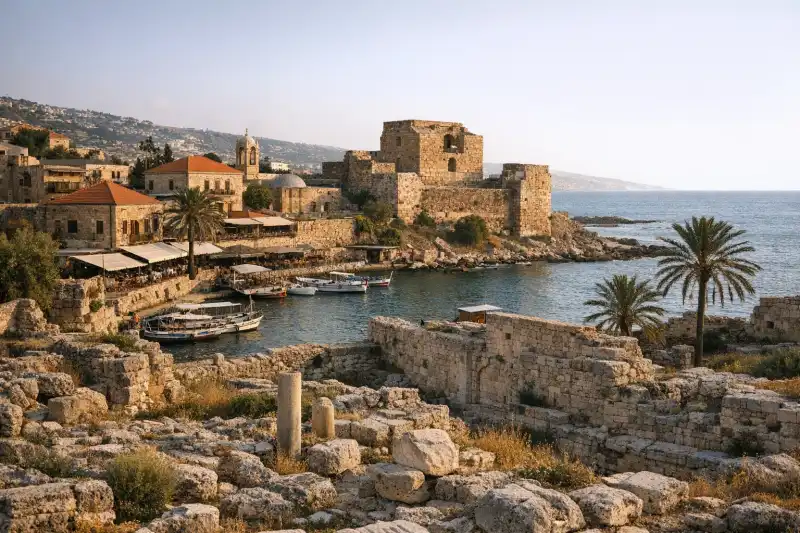
Byblos
Byblos, in Lebanon's Mount Lebanon Governorate, is a UNESCO World Heritage site and one of the world...
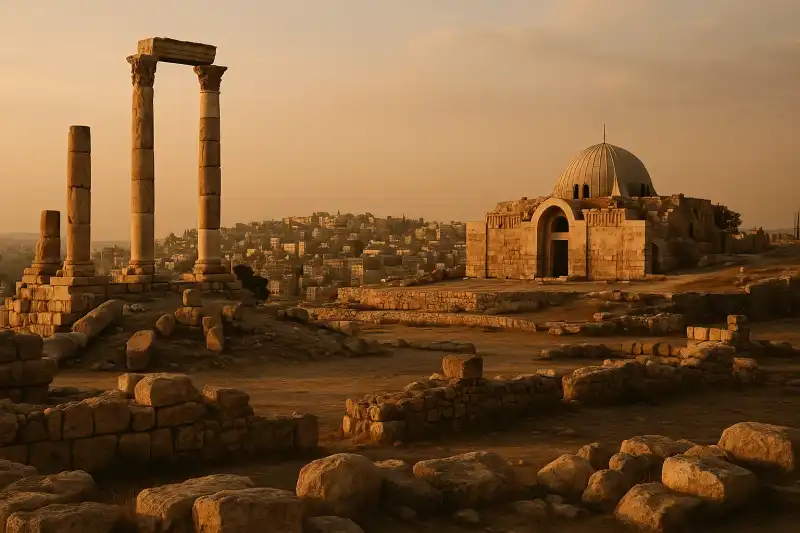
Amman Citadel Jordan Guide 2026: Temple of Hercules & Ancient Rabbah
Ammonite-Roman-UmayyadExplore Jordan's ancient citadel overlooking modern Amman. Discover the Temple of Hercules, Umayyad ...
Hatra
Parthian with Mesopotamian and Arab influencesExplore Hatra in Iraq, a fortified desert city famed for its temples, walls, and blend of Parthian a...