Quick Info
At a glance
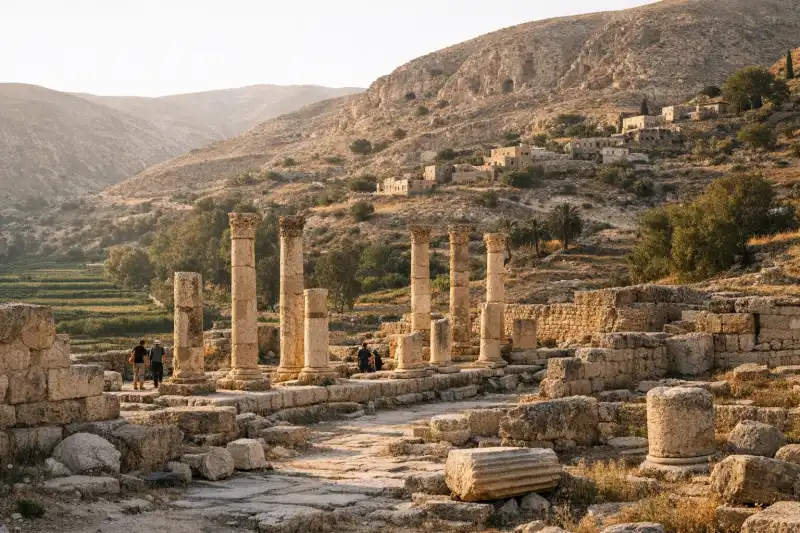
Pella (Tabaqat Fahl) in Jordan is one of those rare archaeological landscapes where the shape of history is still visible in the folds of the land. Set above the Jordan Valley in a basin of springs, low hills, and fertile ground, the site feels different from the grand desert monuments that dominate many travelers’ images of Jordan. Instead of a single dramatic façade or towering temple, Pella offers something subtler and, for many visitors, more rewarding: a city revealed layer by layer across thousands of years. You walk through a place where prehistoric settlement, Bronze Age fortification, Hellenistic planning, Roman urban life, Byzantine worship, and early Islamic change all occupy the same terrain.
The setting is a large part of its appeal. Even before you begin reading walls and foundations, the landscape explains why people kept coming back. Water, arable land, and routes connecting the Jordan Valley to the uplands made this a strategic and livable location. Today, that geography gives the ruins an unusually green and expansive atmosphere, especially in cooler months, when the valley sides soften and the stones sit against a backdrop of fields and brush rather than bare desert. Pella is not always the first stop on a Jordan itinerary, but that is part of its charm. It rewards travelers who want context rather than crowds, and who enjoy seeing how a city can evolve from one era into the next without ever quite losing its original place in the landscape.
History
Prehistoric and Bronze Age Origins
Pella’s story begins far earlier than the classical ruins visible on the surface. Archaeological work has shown that the site and its surrounding basin were occupied from very early periods, with evidence of settlement in prehistoric times. This long continuity was no accident. The springs and agricultural potential of the area made it one of the most favorable locations in northern Jordan. By the Bronze Age, Pella had developed into an important urban center, integrated into the wider world of the southern Levant.
During the Early and Middle Bronze Ages, fortified settlement and organized civic life emerged here. Excavations have revealed substantial architecture, defensive works, and traces of long-distance exchange. Pella was part of a regional network of Canaanite cities, and its prosperity depended on both local agriculture and its position near movement corridors linking the Jordan Valley, the Gilead uplands, and territories farther north and west. Like many Levantine cities, it likely experienced cycles of expansion, destruction, and rebuilding, but the site’s occupation remained resilient.
Iron Age to Hellenistic Transformation
After the Bronze Age, Pella continued to be inhabited, though the scale and character of occupation changed over time. The Iron Age remains at the site contribute to the picture of a settlement adapting to new political realities in the southern Levant. As empires rose and fell across the region, local communities adjusted, reused older spaces, and reshaped the city’s fabric. Pella’s enduring value lay not in one single imperial connection but in its practical geography.
The Hellenistic period marked a major phase of transformation. Following the conquests of Alexander and the establishment of successor kingdoms, cities across the Near East saw new forms of urban identity, architecture, and administration. Pella became more firmly integrated into the Hellenistic world, and its classical name reflects this process. Though its exact development in this era is still reconstructed through archaeology rather than continuous written records, the city clearly took on the profile of a regional center whose cultural life was increasingly linked to Greek-speaking political systems.
Roman Pella and the Decapolis
Under Roman influence, Pella became associated with the Decapolis, the league of cities in the eastern Roman provinces known for their Greco-Roman urban culture. This did not erase earlier layers; rather, it overlaid them with colonnaded streets, civic structures, and a more formalized urban plan in certain sectors. Roman Pella was a town of roads, administration, commerce, and religious diversity. Its location gave it a useful role in regional movement between the valley and the plateau.
The Roman centuries likely brought periods of prosperity, though Pella was never monumental on the scale of Jerash. That difference can actually be helpful for modern visitors. At Pella, one can more easily trace the practical life of a regional city rather than only its display architecture. The site also has historical associations with early Christianity. Later traditions connected Pella with a flight of Christians from Jerusalem before the destruction of the city in 70 CE, though historians continue to debate the exact details and significance of that tradition.
Byzantine and Early Islamic Continuity
In the Byzantine period, Pella remained active and gained churches and religious buildings that still shape the visible ruins. Mosaics, ecclesiastical architecture, and adapted urban spaces point to a city participating in the Christian life of the eastern Mediterranean while remaining anchored in its local economy. The Byzantine layers are among the most accessible for visitors because church remains and associated structures are easier to identify on the ground than some earlier phases.
The early Islamic period did not mean immediate abandonment. Instead, as at many Levantine sites, there was continuity alongside change. New political authorities governed the region, but settlement persisted. The city likely remained inhabited into the Umayyad period. A major turning point came with the earthquake of 749 CE, which damaged many towns across the Jordan Valley and beyond. Pella was affected, and although occupation continued in some form in the area, the city’s role as a major urban center diminished. Over time, ruins, earth, and vegetation accumulated over the old city, preserving much of its history for archaeologists to uncover centuries later.
Key Features
What makes Pella distinctive is not one isolated monument but the breadth of the archaeological landscape. The site spreads across a basin and adjoining slopes, so visiting it feels less like entering a compact ruin field and more like moving through the remains of an entire urban environment. There are tells, lower city areas, religious buildings, domestic zones, and open spaces that together suggest how people used the terrain over many generations.
One of the most striking features is the relationship between the ruins and the natural setting. Springs and fertile land were central to Pella’s life, and even now the greener environment helps explain its long occupation. The topography creates a sense of enclosure, with surrounding hills framing the basin and directing movement through the site. That means the archaeology is never separated from the land itself. The city’s history is legible not only in walls and foundations but also in the shape of the valley.
Among the visible remains, the Byzantine churches are especially important. Their plans can still be followed on the ground, and some preserve traces of floors, apses, and architectural fragments that reveal the Christian character of the later city. These structures are not as visually polished as fully restored churches elsewhere, but they are evocative precisely because they remain embedded in the broader archaeological field. You encounter them as parts of a living city once adapted again and again, not as isolated museum pieces.
Roman and Hellenistic urban features also stand out, though often in a more fragmentary way than at better-known classical sites. Street alignments, civic zones, and architectural remains suggest a town shaped by the urban conventions of the eastern Mediterranean while still responding to local conditions. You may not find endless standing columns, but you do find the logic of the city: routes, terraces, structural platforms, reused stone, and the layering of building phases over one another. For travelers interested in how archaeology works, Pella is especially satisfying because interpretation here depends on reading patterns, not just admiring spectacle.
The tells and higher areas preserve evidence of much earlier occupation. These mounded zones are reminders that classical Pella sits atop a far deeper past. Excavation areas have revealed Bronze Age and earlier remains, and even where those layers are not fully visible to the casual eye, their presence changes the way you understand the site. You are not simply in a Roman town with older foundations; you are in one of Jordan’s long-lived settlement landscapes.
Another key feature is the atmosphere of relative quiet. Pella is often less visited than Jerash, Petra, or Umm Qais, which allows for a slower experience. You can stand back from the ruins and take in the full setting without the pressure of dense visitor traffic. For photographers and travelers who enjoy texture—weathered masonry, grasses between stones, distant slopes, open sky—this makes a real difference. The visual appeal of Pella is cumulative. It comes from wide views, subtle ruins, and the awareness that nearly every patch of ground has a deeper story beneath it.
Finally, Pella rewards those who appreciate continuity. At some sites, one period dominates so completely that the rest fades into the background. At Pella, no single era fully erases the others. The result is a layered historical experience in which prehistoric settlement, Bronze Age city life, Roman administration, Byzantine religion, and early Islamic transition all remain part of the same place. That complexity is the site’s greatest feature.
Getting There
Pella (Tabaqat Fahl) is usually reached by road, and the simplest base for most travelers is Amman or, for those already exploring northern Jordan, Irbid. From Amman, the drive typically takes around 1.5 to 2 hours depending on traffic and your exact route. A private taxi for a full-day excursion in northern Jordan often costs roughly 60 to 100 JOD, depending on negotiation, waiting time, and whether you combine Pella with Jerash or Umm Qais. Car rental is also practical and often the most flexible option, especially if you want to visit multiple sites in one day; daily rental rates in Jordan commonly begin around 25 to 40 JOD before fuel and insurance.
Public transport is possible in a limited way but is not the most convenient for international visitors. You may be able to take buses or service taxis toward nearby towns in the north and then continue by local taxi, but schedules can be irregular and connections are not designed around archaeological tourism. If you are set on public transit, build in extra time and confirm routes locally in Amman or Irbid before departure.
Many travelers visit Pella as part of a custom northern Jordan circuit. Pairing it with Umm Qais works well for those interested in the Decapolis, while combining it with Jerash creates a fuller contrast between a quieter layered site and a more monumental Roman city. Bring water, a hat, and sturdy shoes, as on-site services may be limited and walking surfaces are uneven.
When to Visit
The best times to visit Pella are generally spring and autumn, when temperatures are milder and the landscape is at its most appealing. In spring, usually from March to early May, the basin and surrounding slopes can be greener, and the softer light makes the ruins particularly photogenic. This is an excellent season for walking the site at a relaxed pace, especially in the morning.
Autumn, from around October to November, is another strong choice. The worst summer heat has usually passed, and conditions are often comfortable for exploring exposed archaeological areas. Visibility is often good, and the more moderate temperatures make it easier to appreciate the site’s larger landscape rather than rushing between shaded spots.
Summer visits are possible, but the heat can be intense, especially around midday. Because much of the site is open and shade is limited, it is best to arrive early in the morning if you are visiting between June and September. Carry plenty of water and take sun protection seriously. Winter can be pleasant on clearer days, but conditions vary. Rain can make paths slippery and may reduce the appeal of a longer outdoor visit, though the greener valley setting after rains can be beautiful.
Whenever you go, morning is usually the best time of day. The light is gentler, temperatures are lower, and the site feels especially calm. If you are planning a day with multiple northern Jordan sites, start at Pella early, then continue onward as the day warms.
| Quick Facts | Details |
|---|---|
| Location | Tabaqat Fahl area, Irbid Governorate, northwestern Jordan |
| Ancient significance | Multi-period city occupied from prehistoric times through the early Islamic era |
| Best known for | Bronze Age remains, Roman-Decapolis connections, and Byzantine churches |
| Best visit length | 1.5 to 3 hours |
| Best seasons | Spring and autumn |
| Access | Most easily reached by rental car, taxi, or private driver |
| From Amman | About 1.5 to 2 hours by road |
| Terrain | Uneven archaeological ground with exposed walking areas |
| What to bring | Water, hat, sunscreen, sturdy shoes, and camera |
| Good to combine with | Umm Qais, Jerash, or other northern Jordan historical sites |
Pella is ideal for travelers who want more than a checklist of famous monuments. It asks you to slow down, read the land, and think in centuries rather than snapshots. In return, it offers one of Jordan’s richest archaeological experiences: a city whose history was never confined to one empire, one faith, or one architectural style. At Pella, the story is accumulation, and that is exactly what makes it memorable.
Guided tours: worth it?
Self-guided works here, but a guide can add real value if you want the ruins explained as a living place rather than just a sequence of monuments.
Best for
- First-time visitors who want context, not just photos
- Short visits where a planned route saves time
When to go self-guided
Go independently if you prefer setting your own pace, reading as you go, and checking official hours or ticket rules directly before you arrive.
What I’d avoid
Skip paid tours that bundle unrelated stops you do not actually want. The best option should either save meaningful planning time or add historical context you would miss on your own.
Jordan archaeology tours from Amman
Useful when: transport or pickup logistics matter
North Jordan day trips
Useful when: transport or pickup logistics matter
Jerash and Umm Qais tours
Useful when: you want to compare guided formats before deciding
Some tour links are affiliate links, which may earn Ancient Travel a small commission at no extra cost to you. I try to surface options that make practical sense for the site—not just anything bookable.
Frequently Asked Questions
Where is Pella (Tabaqat Fahl) located?
Pella lies in northwestern Jordan in the Jordan Valley foothills, within Irbid Governorate, not far from the town of Tabaqat Fahl and reachable from Amman by road.
What is Pella (Tabaqat Fahl) known for?
It is known for its unusually long occupation sequence, with remains from the Neolithic and Bronze Age through Hellenistic, Roman, Byzantine, and early Islamic periods.
How much time should I plan for a visit?
Most visitors should allow 1.5 to 3 hours to walk the main ruins, explore the valley setting, and pause at key structures such as churches, civic remains, and excavation areas.
Is Pella suitable as a day trip from Amman?
Yes. Pella can be visited on a long day trip from Amman, especially when combined with Umm Qais, Jerash, or other sites in northern Jordan.
What should I bring to Pella?
Bring water, sun protection, sturdy walking shoes, and cash for any local expenses. Shade can be limited, and the terrain includes uneven paths and exposed ruins.
When is the best time of year to visit Pella?
Spring and autumn are generally the best times, with milder temperatures and clearer walking conditions than the hotter summer months.
Nearby Ancient Sites
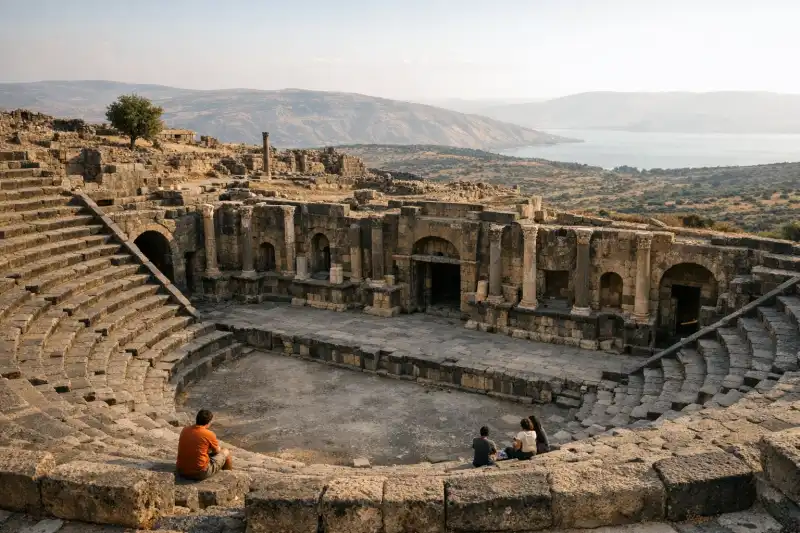
Gadara Theater (Umm Qais)
Greco-Roman, Byzantine, Early IslamicExplore Gadara Theater at Umm Qais in Jordan, a black-basalt Roman theater with sweeping views over ...
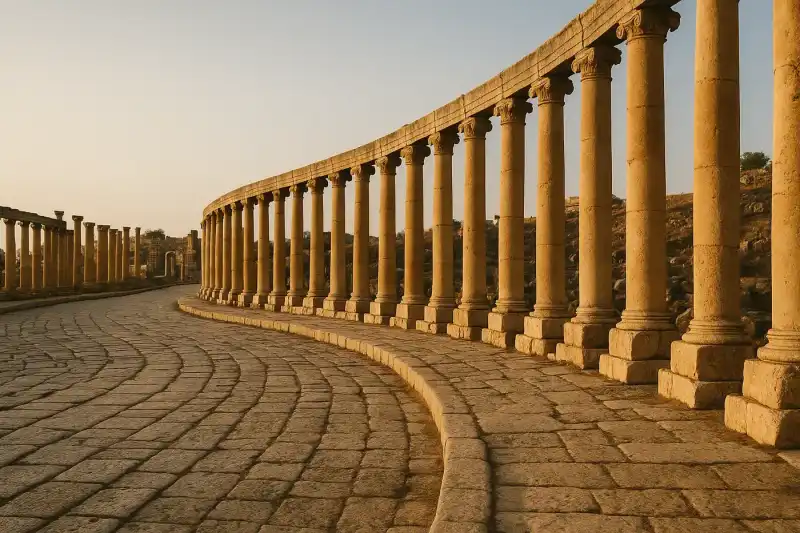
Jerash: The Pompeii of the East and Jordan's Best-Preserved
Roman / NabataeanDiscover Jerash, Jordan's remarkable Roman ruins. Walk the colonnaded streets of ancient Gerasa, exp...
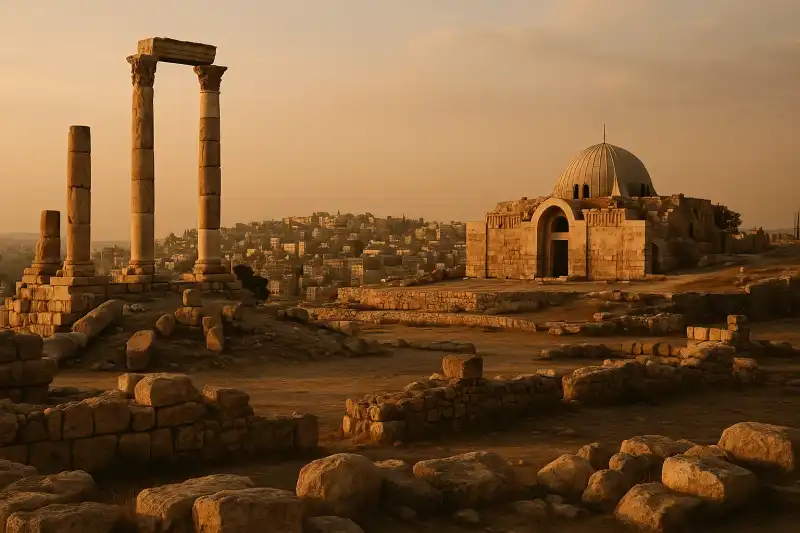
Amman Citadel Jordan Guide 2026: Temple of Hercules & Ancient Rabbah
Ammonite-Roman-UmayyadExplore Jordan's ancient citadel overlooking modern Amman. Discover the Temple of Hercules, Umayyad ...
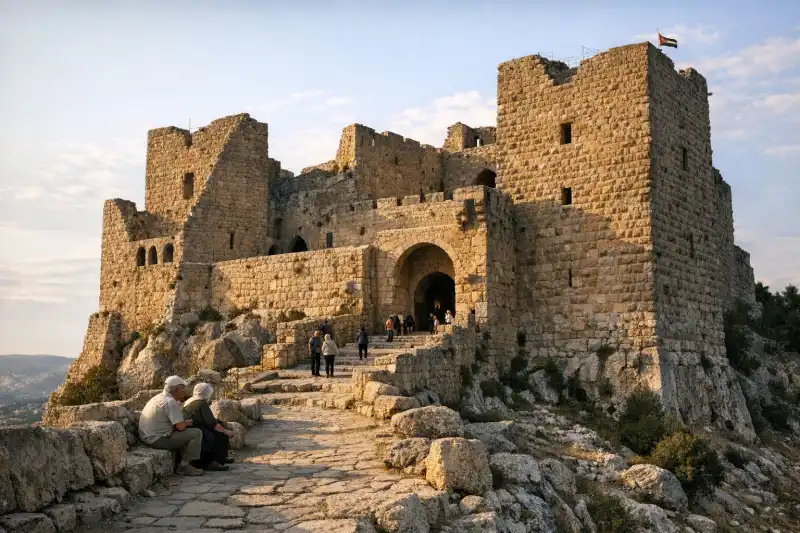
Ajloun Castle
Ajloun Castle in Jordan is a 12th-century Muslim fortress renowned for its strategic hilltop locatio...