Quick Info
At a glance
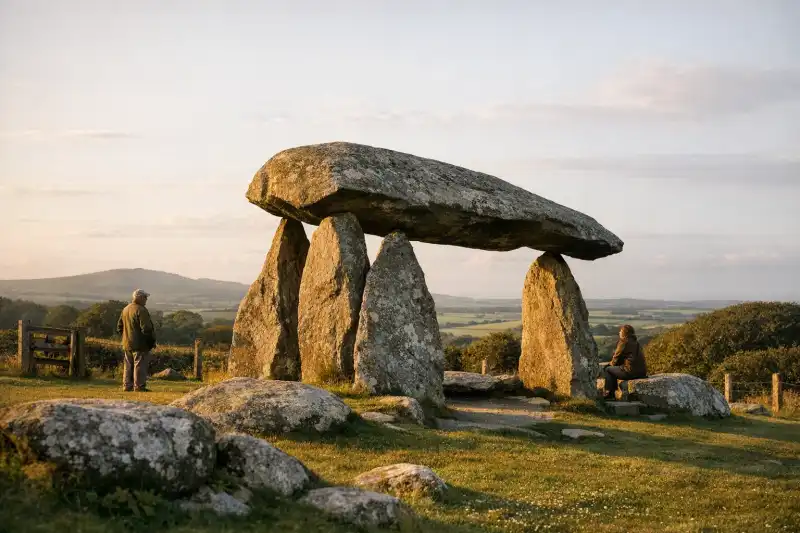
Pentre Ifan in the United Kingdom is one of those prehistoric places that feels larger than its physical size. Set on a hillside in north Pembrokeshire, this elegant Neolithic monument rises from open pasture with an almost theatrical sense of balance. The great capstone, improbably poised on slender uprights, seems at once engineered and mysterious, the product of practical knowledge and ritual imagination. Even before you reach it, the site has a presence. The surrounding landscape opens toward the Preseli Hills and the coast beyond, and the changing Welsh light gives the stones a different mood from hour to hour.
For many visitors, the first surprise is how refined Pentre Ifan looks. Some megalithic tombs feel massive and rough; this one appears carefully composed. Though what survives today is only part of a larger chambered tomb, the remaining stones are so striking that they have become an icon of prehistoric Wales. There are no elaborate visitor facilities competing for attention, no enclosed museum to mediate the experience. Instead, you arrive, walk a short path, and stand face to face with architecture built more than five millennia ago. That simplicity is part of the appeal. Pentre Ifan offers a direct encounter with the deep past, one shaped by weather, open sky, and the quiet drama of stone against the Pembrokeshire horizon.
History
Neolithic origins
Pentre Ifan was built during the Neolithic period, probably around 3500 BCE, at a time when communities in western Britain were undergoing major changes in how they lived and organized their landscapes. Farming had spread widely, woodland was being cleared, and people were creating more permanent marks on the land through monuments, tombs, and ceremonial structures. Pentre Ifan belongs to this world of early farmers and monument builders.
Although today it appears as a freestanding dolmen, archaeologists generally understand it as the surviving entrance or chamber area of a much larger burial mound. The visible uprights and capstone once formed part of a chambered tomb that would likely have been covered by a long cairn or earthen mound. In other words, the dramatic stone arrangement now seen in the open was originally integrated into a broader funerary monument. This was not simply a grave in the modern sense but a communal and ceremonial place, linked to burial, ancestry, and perhaps social identity.
Excavations have suggested that the mound may once have extended significantly beyond the remaining stones. Small finds have been relatively limited, but the monument’s form fits well within wider traditions of Neolithic tomb building in Wales and Atlantic Europe. Its construction would have required planning, labor, and shared purpose, implying a community able to mobilize people and knowledge over time.
Use, memory, and transformation
Like many prehistoric monuments, Pentre Ifan did not remain fixed in meaning after its construction. Tombs of this kind were often used and reused over generations. Human remains, offerings, and ceremonies may have connected the living with the dead in recurring acts of remembrance. Even after active burial practices ceased, the monument would have remained in the landscape as a visible and meaningful marker.
Over centuries, the cairn that once enclosed or framed the chamber gradually disappeared, probably through natural erosion, agricultural activity, and stone robbing. What survived was the most durable and visually dramatic part of the monument: the giant capstone and its supporting uprights. As later communities inherited the site, its original Neolithic purpose may have faded from memory, but the stones themselves continued to invite stories. Across Britain, megaliths were often woven into folklore involving giants, heroes, supernatural beings, or lost peoples. Pentre Ifan likely inspired similar local traditions, especially because of the seemingly impossible balance of its upper slab.
The very name “Pentre Ifan” is associated with a nearby farm and reflects the long relationship between monument and settlement. Like many ancient sites in rural Britain, it became part of a lived agricultural landscape rather than a remote ruin abandoned from human use.
Antiquarian interest and archaeological study
By the eighteenth and nineteenth centuries, Pentre Ifan had begun attracting antiquarians and early scholars interested in Britain’s prehistoric past. Their drawings and descriptions helped establish the monument as one of the most celebrated megalithic sites in Wales. Even when interpretations were speculative, these records preserved valuable evidence of the monument’s appearance and condition.
More systematic archaeological work in the twentieth century clarified that Pentre Ifan had once formed part of a larger burial structure. Excavations around the site uncovered traces of the former cairn and added support to the idea that the monument seen today is only a fragment of a more complex original design. This was an important shift in understanding. Rather than seeing it as an isolated arrangement of stones, researchers placed it within the wider tradition of Neolithic chambered tombs.
The site is now protected as a scheduled ancient monument and cared for as an important part of Welsh heritage. Modern conservation aims to balance accessibility with preservation. Visitors can approach closely enough to appreciate the monument’s scale and craftsmanship while the broader setting remains relatively uncluttered, allowing the site to retain something of its ancient relationship with the landscape.
Key Features
The most unforgettable feature of Pentre Ifan is its capstone. Measuring several meters in length and weighing many tons, it appears to hover above the ground, supported by a cluster of slender upright stones. The engineering effect is astonishing. Unlike some prehistoric monuments that impress through sheer bulk, Pentre Ifan impresses through tension and grace. The capstone narrows toward one end and tilts in a way that gives the whole structure a sense of movement, almost as if the stone had been carefully placed to challenge assumptions about gravity.
Those supporting uprights are equally important to the monument’s character. They are not identical, and their subtle differences create an asymmetrical but harmonious composition. Standing beneath or beside them, visitors quickly notice that the structure has a deliberate shape rather than a random arrangement. This is architecture, not mere accumulation. The builders understood stone, leverage, and visual effect. The monument frames space, guiding the eye upward to the capstone and outward to the surrounding countryside.
Another key feature is the setting itself. Pentre Ifan occupies elevated ground with wide views across north Pembrokeshire. This location is unlikely to have been accidental. In prehistoric monument building, visibility and landscape relationships mattered. The tomb’s position connects it to distant hills, open sky, and the routes people may have traveled across the region. Today that setting remains one of the site’s greatest assets. Even on a short visit, the combination of monument and panorama creates a strong sense of place.
Archaeologically, one of the most significant features is what is no longer fully visible: the remains of the former cairn and mound. While casual visitors may focus on the standing stones, the broader ground plan reveals that Pentre Ifan was once a more extensive structure. Earthworks and excavation evidence indicate a tomb larger and more enclosed than the present silhouette suggests. Understanding this missing architecture helps explain why the surviving chamber has such a carefully organized form. It was once part of a ceremonial whole, approached and experienced in relation to a mound that amplified its presence.
The monument’s weathered surface is also worth attention. The stones bear the marks of thousands of years outdoors in a maritime climate. Lichen, color variation, and subtle erosion soften the edges without diminishing the monument’s authority. In changing light, these surfaces become especially expressive. Early morning can make the capstone glow pale silver; late afternoon may bring out warmer tones. On misty days, the dolmen can feel secluded and almost mythic, while bright conditions emphasize its structural precision.
Pentre Ifan’s relative simplicity is another of its defining qualities. There is no labyrinth of walls, no reconstructed facade, and no large complex to interpret. What remains is compact, legible, and powerful. This makes the site unusually accessible to visitors without specialist knowledge. Within moments of arrival, you understand why it matters. Yet the more closely you look, the more questions emerge: how was the capstone raised, how many people gathered here, what rituals took place, and how did the monument’s meaning change over centuries? The site’s visual clarity is therefore paired with intellectual depth, which is one reason it continues to fascinate archaeologists, photographers, and travelers alike.
Getting There
Pentre Ifan is easiest to reach by car. It lies in north Pembrokeshire, not far from Newport and within practical driving distance of Cardigan and Fishguard. From Newport, the drive usually takes around 15 minutes; from Cardigan, about 20 to 25 minutes depending on traffic and route. There is a small parking area near the site, followed by a short walk along a path to the monument. Parking is typically free, but spaces are limited, so arriving early helps in busy months.
If you are coming from farther away, train travel can get you part of the way. Fishguard & Goodwick is the nearest major rail point for many visitors, with connections from Swansea and Cardiff. From the station, a taxi to Pentre Ifan may cost roughly £20 to £35 depending on distance and time of day. Buses in rural Pembrokeshire can be useful for reaching nearby towns, but direct public transport to the monument itself is limited and schedules may be infrequent, especially on Sundays or outside summer.
A practical low-car option is to stay in Newport or Cardigan and arrange a local taxi for a half-day outing. Travelers already exploring Pembrokeshire by car often pair Pentre Ifan with coastal walks, nearby villages, or trips toward the Preseli Hills. Roads are generally scenic but narrow in places, so allow extra time and drive carefully. Wear suitable shoes, as the approach path and surrounding ground can be uneven, wet, or muddy after rain.
When to Visit
Late spring through early autumn is the most comfortable time to visit Pentre Ifan. From May to September, longer daylight hours make it easier to combine the site with other stops in Pembrokeshire, and the surrounding countryside is usually at its greenest. Summer often brings the best chance of clear views, but it can also mean more visitors and a fuller parking area, especially during school holidays.
Spring is an especially rewarding season if you prefer quieter conditions. The fields are fresh, the air is crisp, and changing weather can create dramatic skies behind the monument. Early autumn is another excellent choice, with softer light and fewer crowds than midsummer. Photographers often favor these shoulder seasons because the low sun angle gives the capstone and uprights stronger definition.
Winter visits can be memorable too, but they require more preparation. Wind, rain, and muddy ground are common, and the exposed location can feel much colder than nearby towns. On the other hand, the site can be wonderfully atmospheric in mist or under shifting storm light, and you may have it almost entirely to yourself.
For the best experience on any day, aim for early morning or late afternoon. Midday light can flatten the stones, while lower sun creates contrast and enhances the monument’s sculptural quality. Sunrise and sunset are particularly beautiful when conditions are clear, though you should plan carefully for parking, changing weather, and limited daylight in colder months.
| Quick Facts | Details |
|---|---|
| Location | Near Newport, Pembrokeshire, Wales, United Kingdom |
| Type | Neolithic chambered tomb / dolmen |
| Date | c. 3500 BCE |
| Cultural context | Neolithic Britain |
| Best known for | Its enormous balanced capstone |
| Time needed | 20–45 minutes |
| Entry fee | Free |
| Access | Short walk from roadside parking area |
| Best season | Late spring to early autumn |
| Good for | Archaeology, photography, scenic stops, short heritage visits |
Pentre Ifan rewards slow looking. It is not a site of spectacle in the modern sense, yet it leaves a strong impression because everything about it feels distilled: a few stones, a high ridge, open weather, immense age. In a region rich with landscape and legend, it stands out for its balance of beauty and mystery. The monument is easy to reach, free to enjoy, and memorable whether you spend twenty minutes there or return repeatedly in different seasons. For anyone interested in the ancient past of the United Kingdom, Pentre Ifan offers one of the clearest and most haunting encounters with Neolithic monument building in Britain.
Guided tours: worth it?
Most travelers can visit Pentre Ifan independently. Compare a tour only if you want a tighter history-focused visit, easier logistics, or a guide who can answer questions on the spot.
Best for
- Short visits where a planned route saves time
When to go self-guided
Go independently if you prefer setting your own pace, reading as you go, and checking official hours or ticket rules directly before you arrive.
What I’d avoid
Skip paid tours that bundle unrelated stops you do not actually want. The best option should either save meaningful planning time or add historical context you would miss on your own.
Pembrokeshire day tours
Useful when: you want to compare guided formats before deciding
West Wales historical tours
Useful when: you want to compare guided formats before deciding
Cardiff to Pembrokeshire tours
Useful when: you want to compare guided formats before deciding
Some tour links are affiliate links, which may earn Ancient Travel a small commission at no extra cost to you. I try to surface options that make practical sense for the site—not just anything bookable.
Frequently Asked Questions
What is Pentre Ifan?
Pentre Ifan is a Neolithic chambered tomb in Pembrokeshire, Wales, dating to around 3500 BCE and famous for its huge balanced capstone.
Do you need to pay to enter Pentre Ifan?
No, the monument is generally free to visit, with access from a small roadside parking area and a short walk to the site.
How long do you need at Pentre Ifan?
Most visitors spend 20 to 45 minutes at Pentre Ifan, though photographers, walkers, and archaeology enthusiasts may stay longer.
Can you reach Pentre Ifan by public transport?
Public transport options are limited, so most travelers visit by car or taxi from nearby towns such as Cardigan, Newport, or Fishguard.
When is the best time to visit Pentre Ifan?
Late spring through early autumn offers the best weather and clearest views, while sunrise and sunset are especially atmospheric for photography.
Is Pentre Ifan suitable for families?
Yes, the walk from the parking area is short and manageable for many families, though the ground can be uneven and muddy after rain.
Nearby Ancient Sites
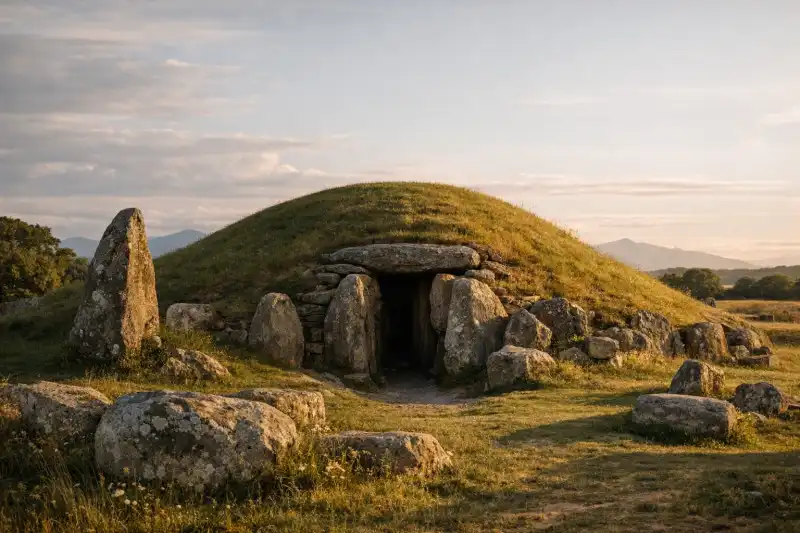
Bryn Celli Ddu
Neolithic BritainAtmospheric Neolithic burial chamber and henge on Anglesey, United Kingdom, famed for ritual alignme...
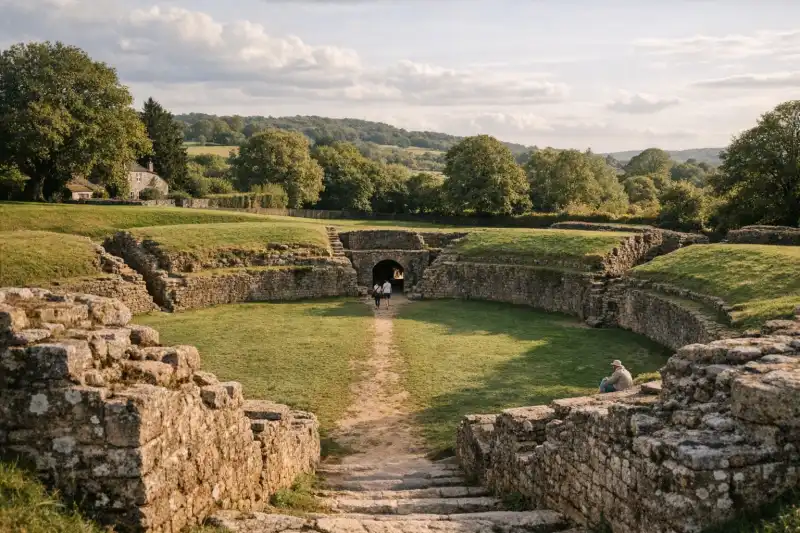
Caerleon Roman Fortress
RomanExplore Caerleon Roman Fortress in the United Kingdom, one of Roman Britain's best-preserved legiona...
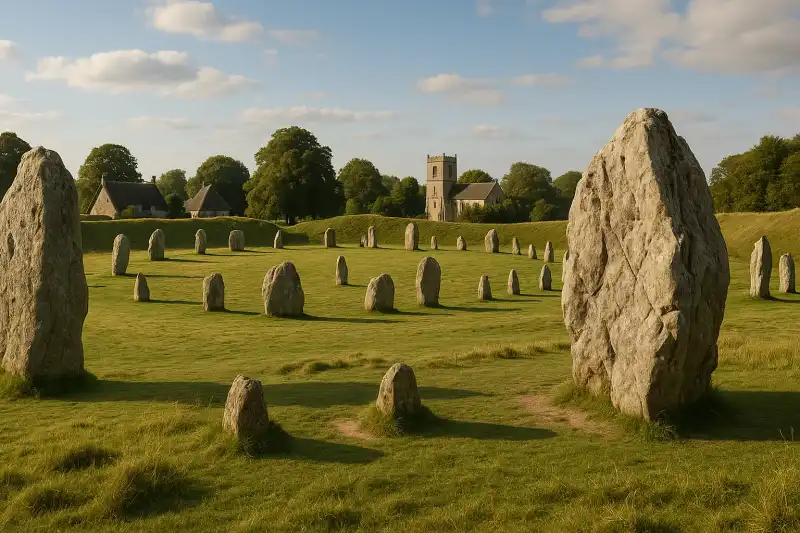
Avebury Stone Circle Travel Guide 2026: Best Walk Routes, History, and Visit Planning
Neolithic BritainPlan a stronger visit to Avebury Stone Circle with practical walking routes, landscape context, and ...