Quick Info
At a glance
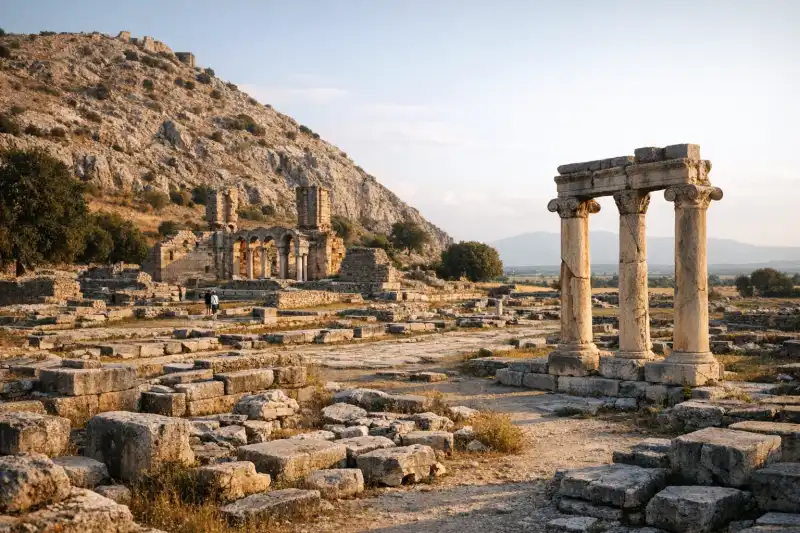
Philippi in Greece is one of those ancient places where several worlds seem to overlap at once. Set on the plain below low hills in northeastern Greece, near modern Kavala, the site does not overwhelm visitors with a single colossal monument. Instead, it reveals itself gradually: a theater cut into the slope, broad Roman spaces, early Christian basilicas, stout city walls, and roads that once linked the Aegean to the wider Balkans. The landscape feels open and luminous, with mountain forms in the distance and farmland stretching around the ruins, a reminder that ancient cities were never isolated museums but part of living terrain.
For travelers interested in Greek history, Roman politics, and the spread of Christianity, Philippi offers a rare combination. It began as a strategic foundation in the age of Macedonian kings, became famous after one of the decisive battles of the Roman world, and later emerged as a major Christian center tied to Saint Paul and the early church. Today, the archaeological site is spacious enough to encourage slow exploration. You can walk from Hellenistic defenses to Roman public buildings and then to monumental basilicas from Late Antiquity, all within a single visit. That layered experience is what makes Philippi memorable: not just a ruin, but a long story preserved in stone.
History
Hellenistic foundations
Philippi’s origins are closely tied to the power politics of the 4th century BCE. The city was founded in 356 BCE by Philip II of Macedon, the father of Alexander the Great. Before that, the area had been associated with a Thasian settlement called Crenides. Philip recognized the importance of the location immediately. The surrounding region offered access to fertile land, strategic mountain passes, and valuable natural resources, especially gold mines in the wider area. By fortifying and enlarging the settlement, he transformed it into a strong Macedonian city that could secure the eastern approaches to his kingdom.
The new city took his name, signaling both royal authority and long-term ambition. Philippi was laid out as a fortified urban center, and its walls reflected the military concerns of the age. Yet it was not just a garrison. Its position on the route between the Aegean and the inland Balkans made it a useful point of exchange and control. In the Hellenistic period, Philippi stood as part of the expanding Macedonian world, participating in the political and military networks that helped shape the eastern Mediterranean.
Roman conquest and the Battle of Philippi
After the Roman expansion into Greece and Macedonia, Philippi entered a new phase. Its most famous moment came in 42 BCE, when the plain near the city became the setting for the Battle of Philippi. This was one of the turning points of Roman history. On one side stood the forces of Mark Antony and Octavian, the future Augustus; on the other were Brutus and Cassius, leaders associated with the assassination of Julius Caesar.
The battle was not a single simple clash but a campaign with multiple engagements across the marshy and difficult terrain around the city. In the end, Antony and Octavian prevailed. The defeat and deaths of Brutus and Cassius marked the collapse of major Republican resistance and helped clear the path toward the Roman imperial system. Philippi thus entered historical memory not just as a provincial city, but as a place where the fate of Rome shifted dramatically.
In the aftermath, Philippi was refounded as a Roman colony. Veterans were settled there, and the city acquired the legal and civic features of Roman colonial life. Latin gained importance, public architecture took on Roman forms, and the city’s status increased further because it sat on the Via Egnatia, the great Roman road connecting the Adriatic with Byzantium. That route made Philippi a natural crossroads for soldiers, traders, officials, and travelers moving through the empire.
Early Christianity and the age of Saint Paul
Philippi also holds an important place in Christian history. According to the New Testament, Saint Paul visited the city during his missionary journeys in the 1st century CE. Philippi is often identified as the first place in Europe where Paul established a Christian community. The episode of Lydia’s conversion, traditionally associated with the nearby river area, remains central to the site’s spiritual significance for many visitors.
Paul’s Letter to the Philippians later gave the city a lasting place in Christian scripture. As a result, Philippi became more than a Roman colony on an imperial road; it also entered the memory of the early church. Over the centuries, this religious importance deepened. As Christianity spread and gained imperial support, Philippi developed into a regional Christian center, with churches and ecclesiastical structures reflecting the city’s elevated role.
Late Antiquity and Byzantine decline
By Late Antiquity, Philippi had become a prosperous city marked by impressive Christian monuments. Large basilicas were constructed, and the urban landscape was reshaped around ecclesiastical institutions. The forum remained important, but the city’s identity increasingly included its churches, bishopric, and role in the Christianized eastern empire.
This flourishing, however, did not last unchanged. Earthquakes, shifting trade patterns, and broader regional instability affected Philippi over time. In the Byzantine period, the city diminished gradually, although fortifications continued to matter and some occupation persisted. As nearby centers rose or changed, Philippi lost the prominence it had once enjoyed under Macedonian kings, Roman colonists, and early Christian bishops.
Eventually, much of the city fell into ruin, preserved by relative abandonment rather than continuous rebuilding. That long decline is one reason the site is so valuable today. Visitors can read the layers of urban life across centuries, from Hellenistic foundations to Roman public space and Christian monumental architecture, all in one archaeological landscape.
Key Features
Philippi is best appreciated as a complete ancient cityscape rather than a place of isolated masterpieces. The theater is often where visitors begin, and it makes an immediate impression. Originally established in the Hellenistic period and later adapted under the Romans, it sits against the hillside in a way that links architecture directly to the land. You can still sense how performances, civic events, and later entertainments would have unfolded there. The seating, stage area, and surrounding contours help visitors imagine the theater as both cultural venue and political gathering place.
Moving deeper into the site, the Roman forum opens a very different chapter. This broad civic center reflects Philippi’s life as a Roman colony, with formal public space, administrative buildings, and the remains of commercial and ceremonial areas. Walking through it gives a stronger understanding of how Roman urbanism worked in a provincial setting. The space feels ordered and public in a distinctly Roman way, emphasizing citizenship, power, movement, and display. Even in ruin, its layout remains legible enough to convey the rhythms of ancient city life.
Among the most striking remains are the early Christian basilicas. These are not minor additions but some of the site’s defining monuments. Their scale suggests a city with considerable ambition and religious significance in Late Antiquity. Fragments of columns, floor plans, apses, and architectural decoration reveal communities that invested heavily in worship spaces and ecclesiastical prestige. Basilica A and Basilica B are especially important for understanding how Philippi evolved from a Roman colony into a Christian center. Their ruins carry a different atmosphere from the forum or theater: less civic, more spiritual, yet equally monumental.
The city walls also deserve attention. They speak to Philippi’s original strategic purpose and to the persistent need for defense across many centuries. Some stretches preserve the sense of enclosure that once defined the city, while gates and lines of fortification show how movement was controlled. These walls are a reminder that Philippi was founded not merely for beauty or trade, but for command over territory and routes.
Another frequently visited point is the so-called Prison of Saint Paul, traditionally associated with the apostle’s stay in Philippi. While the exact historical interpretation has been debated, the location remains deeply meaningful for Christian pilgrims. More broadly, the traditions linked to Paul and Lydia give the site an added dimension that goes beyond archaeology. Philippi is not only studied; it is also remembered devotionally.
The on-site museum complements the ruins well, helping visitors place architectural fragments, inscriptions, and sculptures into context. For anyone unfamiliar with the site’s long chronology, spending time in the museum can make the outdoor remains far easier to understand. It highlights the continuity and change that define Philippi: Macedonian beginnings, Roman status, and Christian transformation.
What makes these features especially rewarding is their setting. Philippi is not hemmed in by dense urban development. The open plain, the nearby hills, and the broader northern Greek landscape all contribute to the experience. On a clear day, the setting itself explains why this place mattered. It controlled routes, gathered people, and connected worlds. The monuments only make full sense when seen against that strategic and natural backdrop.
Getting There
Philippi is easiest to reach from Kavala, which lies about 15 to 20 kilometers away depending on your starting point. By car, the journey usually takes around 20 to 25 minutes, and this is the most convenient option for independent travelers. Rental cars are widely available in Kavala and at Thessaloniki Airport. Fuel costs for the short drive from Kavala are modest, and parking near the site is generally straightforward.
Public transport is possible but requires a bit more planning. Local buses from Kavala toward Krinides or nearby villages may stop within reach of the archaeological area, though schedules can be limited and change seasonally. A one-way bus fare is typically only a few euros, often in the €2 to €4 range, making it the cheapest option. If you prefer simplicity, a taxi from central Kavala usually costs around €20 to €30 one way, depending on time of day and exact pickup point.
From Thessaloniki, Philippi is feasible as a day trip, though it is a longer journey. Driving takes roughly 2 to 2.5 hours each way. Intercity buses to Kavala are available, with fares commonly around €15 to €20 one way, after which you would continue by taxi or local bus to the site. Organized guided tours from Thessaloniki can be a practical choice if you want transport and historical interpretation included together. These vary widely in price, but full-day excursions often begin around €60 to €120 per person depending on group size and inclusions.
When to Visit
Spring and autumn are the best seasons to visit Philippi. From April to early June, the weather is usually mild, the surrounding landscape is greener, and walking the large site is comfortable for most travelers. September and October offer similar advantages, with warm light, fewer peak-season crowds, and generally pleasant temperatures for extended exploration. These shoulder seasons are ideal if you want time to move slowly through the theater, forum, basilicas, and museum without the fatigue that intense summer heat can bring.
Summer is the busiest period, especially from late June through August. The long daylight hours are excellent for photography, and cultural events in the wider region can add appeal, but midday temperatures can become very hot. If you visit then, aim for early morning or late afternoon and carry water, sun protection, and a hat. The open areas of the site provide limited shade in some sections, so comfort depends a lot on timing.
Winter visits can be rewarding for travelers who prefer quiet archaeological sites and cooler conditions. Northeastern Greece is not as mild in winter as some southern islands, so expect colder days, occasional rain, and shorter opening hours. The atmosphere can be especially evocative, however, with fewer visitors and a clearer sense of the site’s vastness. If your trip is focused on history rather than beach weather, winter remains a perfectly viable option.
Whenever you go, check current opening times in advance, especially around public holidays. Combining Philippi with Kavala works well in any season, and staying nearby lets you visit at the calmest hours rather than rushing through in the middle of the day.
| Quick Facts | Details |
|---|---|
| Location | Near Krinides, close to Kavala, northeastern Greece |
| Region | Eastern Macedonia and Thrace |
| Founded | 356 BCE by Philip II of Macedon |
| UNESCO Status | Inscribed in 2016 |
| Famous For | Macedonian foundation, Battle of Philippi, early Christian heritage |
| Main Highlights | Theater, Roman forum, basilicas, city walls, museum |
| Nearest City | Kavala |
| Best Time to Visit | April-June and September-October |
| Typical Visit Length | 2-4 hours |
| Ideal For | History travelers, biblical tours, archaeology enthusiasts |
A visit to Philippi rewards patience and curiosity. It is not a site built around a single iconic postcard view, but around the cumulative power of centuries layered in one place. Macedonian kings, Roman armies, colonial settlers, bishops, pilgrims, and modern archaeologists have all left their mark here. That means every path through the ruins can tell a slightly different story depending on what interests you most. Some visitors come for the Battle of Philippi and the final struggles of the Roman Republic. Others arrive because of Saint Paul and the early church. Many simply find themselves drawn into the quieter pleasures of walking among substantial ruins in a landscape that still explains the ancient city’s purpose.
Philippi’s great strength is that it remains readable. You can stand in the theater and think about Hellenistic Macedon, cross the forum and imagine Roman civic life, then pause among the basilicas and sense the transformation of the late antique world. Few sites in Greece offer that narrative arc so clearly. For travelers exploring northern Greece, Philippi is not just a worthwhile stop; it is one of the country’s most compelling places to understand how classical, Roman, and Christian histories meet.
Guided tours: worth it?
Self-guided works here, but a guide can add real value if you want the ruins explained as a living place rather than just a sequence of monuments.
Best for
- First-time visitors who want context, not just photos
- Short visits where a planned route saves time
When to go self-guided
Go independently if you prefer setting your own pace, reading as you go, and checking official hours or ticket rules directly before you arrive.
What I’d avoid
Skip paid tours that bundle unrelated stops you do not actually want. The best option should either save meaningful planning time or add historical context you would miss on your own.
Philippi and Kavala Tours
Useful when: you want to compare guided formats before deciding
Northern Greece Biblical Tours
Useful when: you want to compare guided formats before deciding
Thessaloniki to Philippi Day Tours
Useful when: you want to compare guided formats before deciding
Some tour links are affiliate links, which may earn Ancient Travel a small commission at no extra cost to you. I try to surface options that make practical sense for the site—not just anything bookable.
Frequently Asked Questions
Where is Philippi located?
Philippi is in northeastern Greece, in the region of Eastern Macedonia and Thrace, near the modern town of Krinides and not far from Kavala.
Why is Philippi important?
Philippi is significant for its Macedonian origins, its role in Roman history after the Battle of Philippi in 42 BCE, and its importance in early Christianity through the visits of Saint Paul.
Is Philippi a UNESCO World Heritage Site?
Yes. The Archaeological Site of Philippi was inscribed on the UNESCO World Heritage List in 2016 for its cultural and historical importance.
How much time do you need to visit Philippi?
Most visitors spend between 2 and 4 hours exploring the main archaeological remains, the museum, and the nearby baptistery and basilicas.
Can you visit Philippi from Thessaloniki as a day trip?
Yes. Philippi can be visited as a long day trip from Thessaloniki by car or organized tour, though staying overnight in Kavala allows for a more relaxed visit.
What are the main things to see at Philippi?
Highlights include the theater, forum, basilicas, city walls, the so-called Prison of Saint Paul, and the wider landscape of the ancient city.
Nearby Ancient Sites
Acropolis Travel Guide 2026: Parthenon, Tickets, and Best Time
Ancient GreecePlan an efficient Acropolis visit with practical ticket timing, key monuments, and museum pairing ti...
Ancient Agora of Athens Travel Guide 2026: Route, Tickets, and Context
Classical GreekPlan a better Ancient Agora visit with practical timing, monument priorities, and clear historical c...
Ancient Messene
Ancient GreekExplore Ancient Messene, a remarkably preserved Greek city with grand stadium, theater, and fortific...